

GCSE Revision With No Motivation: A Maths Plan
GCSE revision with no motivation? Use a tiny-start maths plan: past papers, mark schemes, mini tests and YesGenie lessons to rebuild momentum.
If you’re trying to revise for GCSE maths with no motivation, it can feel like you’re watching your own future through frosted glass. You know what you should do: practise, mark, fix mistakes, repeat. But your brain keeps bargaining for later. And later keeps winning.
Here’s the gentle truth that helps most GCSE students: motivation is unreliable, especially when you’re tired, behind, or anxious. But progress doesn’t require motivation first. It requires a small, specific action that’s easy enough to start, and structured enough to matter.
This post gives you a realistic GCSE maths revision plan for low-motivation days: with worked examples (so you can warm up without scrolling), and a way to use YesGenie to turn “I can’t” into “I did one”.
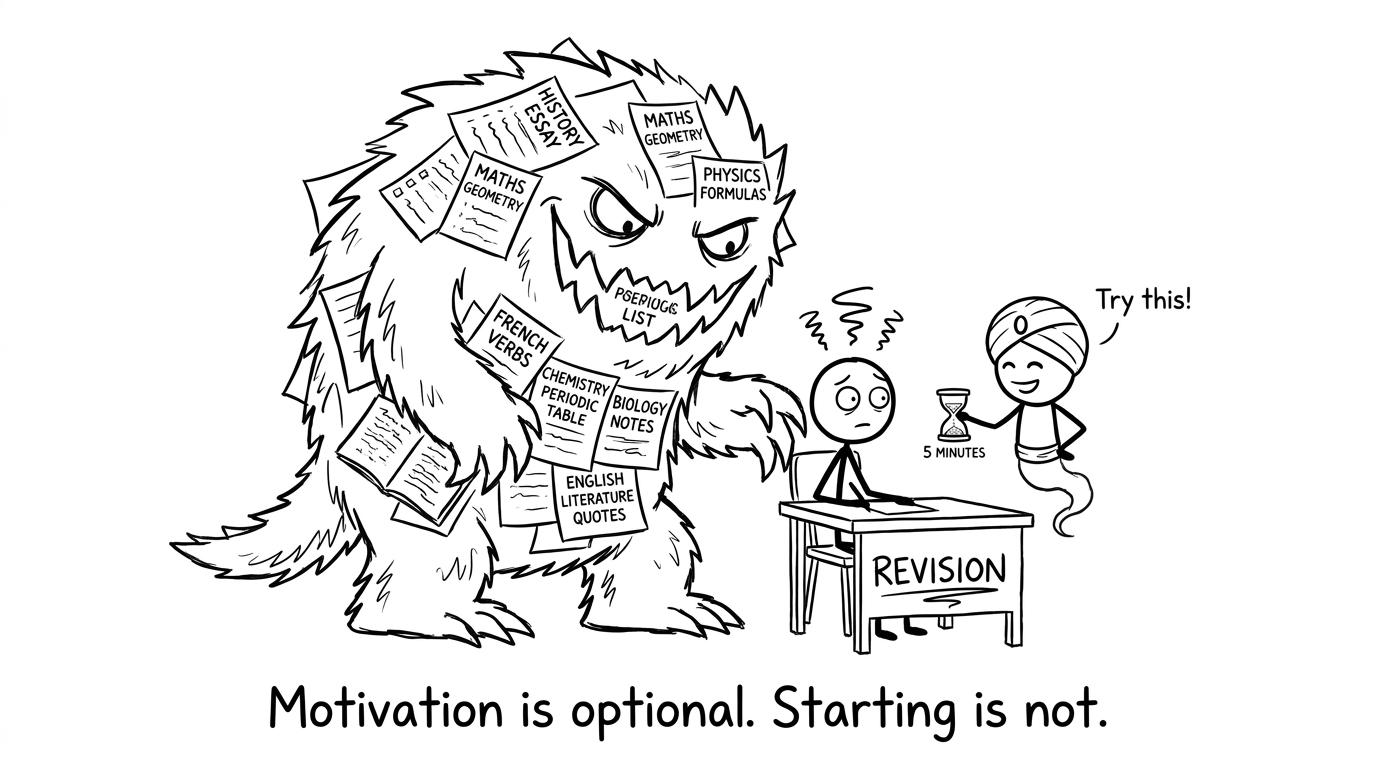 A tiny-start revision genie facing a to-do list monster
The low-motivation GCSE checklist (save this)
When motivation is missing, you need fewer choices and more defaults. Use this GCSE checklist:
- Choose a timer, not a target: start with 555 or 101010 minutes.
- Choose one topic only (not “algebra”).
- Do three questions, then stop or continue.
- Mark immediately using a mark scheme or video solution.
- Write one fix: “Next time I will…”
- End with a tiny win: one easier question to finish cleanly.
YesGenie makes this simple because you can pick a topic, do exam-style questions, then check solutions without hunting around: Resources on YesGenie.
Why GCSE motivation disappears (and why it’s not laziness)
Most GCSE students don’t lose motivation because they don’t care. They lose it because the work starts to represent something bigger: fear of a grade, fear of disappointment, fear that effort won’t pay off.
Maths adds a special twist. In English, you can still write something when you feel low. In maths, a blank page feels like proof you’re stuck. So your brain protects you by avoiding the page altogether.
The way out isn’t a pep talk. It’s a system that reduces the emotional cost of starting.
A useful rule:
- Make starting smaller than your excuses.
Not “revise for two hours”, but “open one YesGenie lesson and do one example”. Not “finish Paper 1”, but “answer Question 1 and mark it”.
If you want a quick home base for your GCSE journey, start here: GCSE subjects on YesGenie.
Build a GCSE maths routine that works even when you don’t
The 10-minute GCSE routine (the “minimum viable revision”)
This is your default for bad days. It’s deliberately small.
- Open one topic page and read the first method.
- Do one worked example (copy the steps).
- Do two exam questions.
- Mark and correct in a different colour.
A good place to practise when you want short, focused tasks is a single topic page like Simplifying algebra (GCSE).
The 30-minute GCSE routine (when you have a little more energy)
- 101010 minutes: one lesson + a couple of practice cards.
- 151515 minutes: exam-style questions or an exam booklet.
- 555 minutes: mark, then write one sentence about your main mistake.
This is where GCSE progress often accelerates: not through heroic sessions, but through repeatable ones.
The “train the race” routine: GCSE past papers
When motivation is low, relevance helps. Past papers feel relevant because they are literally the exam.
Use: Edexcel GCSE Maths Past Papers (and the equivalent for your board inside YesGenie).
Even if you only do the first few questions, you’re training the exact skills the exam will mark.
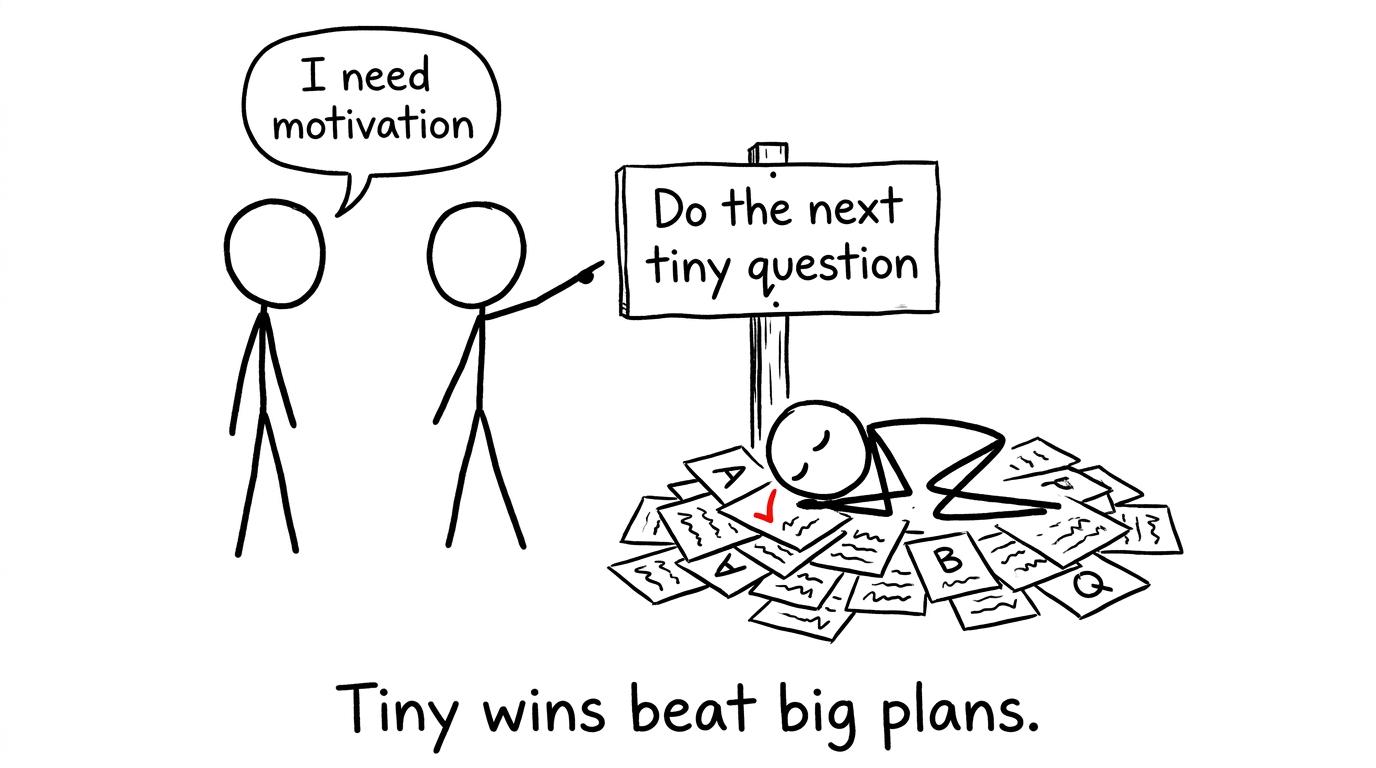 Stick figures choosing “the next tiny question” over motivation
Worked examples you can use as a warm-up (GCSE style)
These examples are designed for days when you need to start gently. Copy the steps, then try one similar question on YesGenie.
Worked example 1: Simplify an expression (GCSE algebra)
Simplify 3(2x−5)−2(x+4)3(2x-5)-2(x+4)3(2x−5)−2(x+4).
3(2x−5)−2(x+4)=(6x−15)−(2x+8)=6x−15−2x−8=4x−23\begin{aligned} 3(2x-5)-2(x+4) &= (6x-15) - (2x+8)\\ &= 6x-15-2x-8\\ &= 4x-23 \end{aligned}3(2x−5)−2(x+4)=(6x−15)−(2x+8)=6x−15−2x−8=4x−23If you want more practice in the same style, use a focused page like Simplifying algebra (GCSE).
Worked example 2: Reverse percentage (common GCSE higher tier skill)
A jacket is reduced by 20%20\%20% and now costs £484848. What was the original price?
After a 20%20\%20% reduction, you pay 80%80\%80% of the original price.
Let the original price be £xxx.
0.8x=480.8x = 480.8x=48 x=480.8=60 x = \frac{48}{0.8} = 60x=0.848=60So the original price was £606060.
(Quick check: 20%20\%20% of 606060 is 121212, and 60−12=4860-12=4860−12=48.)
Worked example 3: Probability from a table (GCSE foundation to higher)
A bag contains red, blue and green counters.
- P(red)=0.35P(\text{red})=0.35P(red)=0.35
- P(blue)=0.25P(\text{blue})=0.25P(blue)=0.25
Find P(green)P(\text{green})P(green).
Probabilities for all outcomes add to 111:
P(green)=1−(0.35+0.25)=1−0.60=0.40P(\text{green}) = 1 - (0.35+0.25) = 1 - 0.60 = 0.40P(green)=1−(0.35+0.25)=1−0.60=0.40For more structured practice (with clear explanations), see a full revision guide like Probability revision guide (GCSE).
How to use YesGenie when you feel stuck
Low motivation gets worse when revision has friction: too many tabs, unclear next steps, no feedback loop. YesGenie reduces that friction.
Try this GCSE flow:
- Pick one topic from a board checklist like Edexcel GCSE Maths revision guides.
- Use the lesson/revision guide to learn the method.
- Do a handful of exam-style questions.
- Mark using solutions or video solutions.
- Save one mistake as tomorrow’s first task.
When you’re ready to practise in exam conditions, build around papers and marking:
- Use Edexcel GCSE Maths Past Papers
- Or if you need something shorter, use the quick-test options on Resources on YesGenie
And if you’re switching boards or checking old-style topics, YesGenie also has board-specific collections like Edexcel GCSE old maths.
Common mistakes when revising for GCSE with no motivation
- Waiting to “feel ready”. In GCSE maths, readiness usually comes after 101010 minutes of doing.
- Making the plan too big. If your plan requires a perfect evening, it will fail on an ordinary one.
- Only re-reading notes. Notes can feel safe, but GCSE marks come from doing questions and fixing errors.
- Not marking properly. If you don’t use a mark scheme or solutions, you don’t get the feedback loop that creates motivation.
- Jumping topics too fast. Switching every 555 minutes keeps you entertained but not improving.
- Practising without reflection. One sentence like “I forgot to square the bracket” is often worth more than five more questions.
A quiet promise for your next GCSE session
You don’t need a personality transplant. You don’t need endless willpower. For GCSE maths, you need a plan that works on ordinary days: small starts, fast feedback, and repetition.
So make it simple. Open YesGenie. Pick one topic. Do three questions. Mark them. Write one fix. That’s revision.
When you’re ready to level up, use YesGenie’s revision lessons and topic guides, then move into exam practice with Edexcel GCSE Maths Past Papers (or your own board), plus mini tests and predicted papers from Resources on YesGenie. Keep the loop tight: practise, mark, improve.
Your GCSE grade won’t be built in a single motivated afternoon. It will be built in the moments you start anyway.










