GCSE Maths Numeracy Revision Book Reviews
GCSE maths numeracy revision book reviews can mislead. Check the exam board, tier, specification, practice, answers and real value before buying.
A revision guide can look reassuring before you open it. The cover promises complete coverage, exam success and clearer methods. Yet the useful question is not whether the book looks impressive. It is whether it matches the qualification you will actually sit and gives you enough opportunity to practise.
That is why GCSE maths numeracy revision book reviews are worth reading before buying, but star ratings alone are not enough. Check the exam board, specification, tier, publication date, question quality, answer support and balance between explanation and active practice. Most importantly, decide whether the book fills a genuine gap in your revision rather than duplicating resources you already have.
The quick pre-purchase checklist
Before spending anything, confirm:
- the exact name of your qualification
- your exam board and specification
- whether you need foundation or higher tier material
- whether the guide covers the current course
- whether its terminology matches your exam
- how many questions you must answer independently
- whether answers include methods rather than final answers alone
- whether calculator and non-calculator work are represented correctly
- whether contextual numeracy problems receive enough attention
- whether you can inspect sample pages
- what free resources could do the same job
You can first use the MathsGenie GCSE Maths revision hub to identify your board, explore topic lessons and see what support you already have.
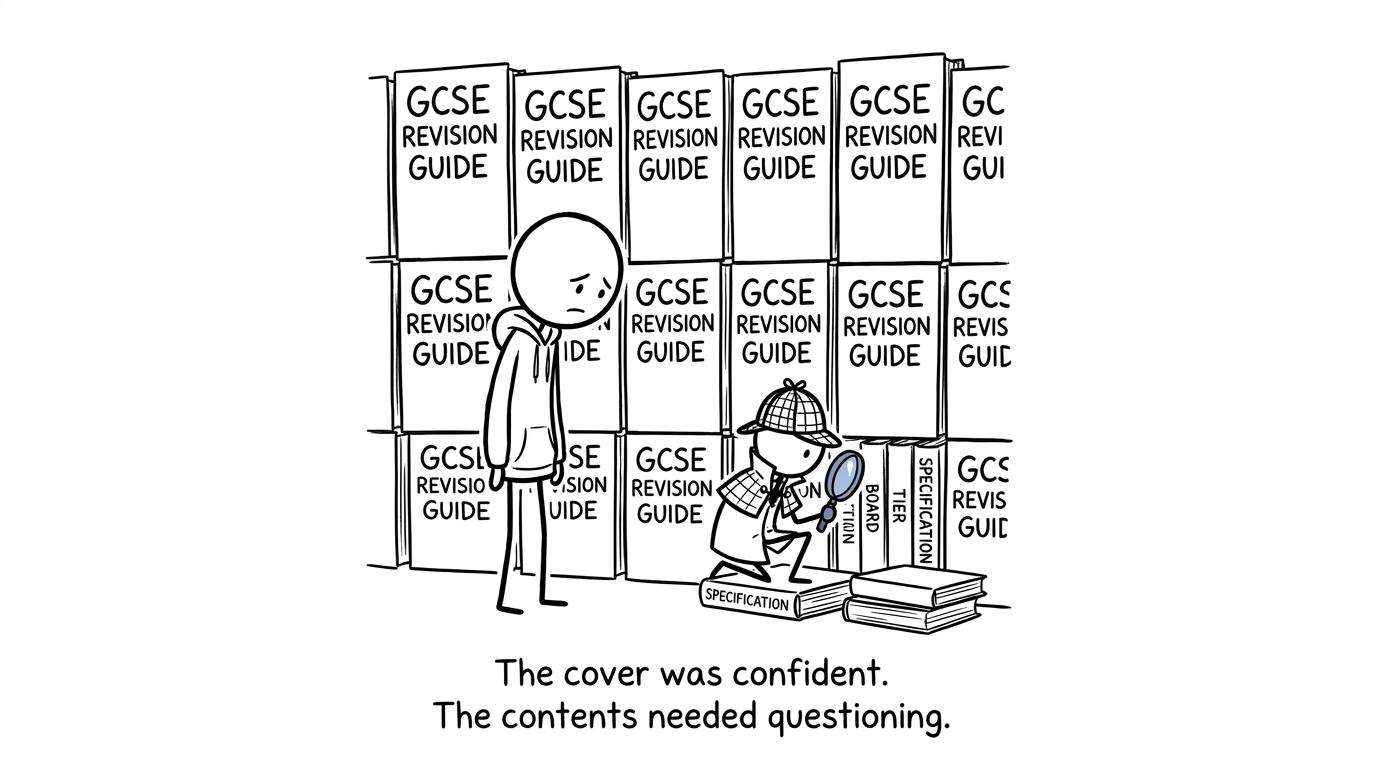 A student investigates a wall of revision guides rather than trusting their covers
Begin with the qualification, not the book cover
The word “numeracy” creates an important complication. Sometimes publishers use it informally for practical number skills, percentages, ratio, measures, money and data. In Wales, however, Mathematics and Numeracy can form part of the formal qualification title.
Students in England taking Edexcel, AQA, OCR or Eduqas GCSE Mathematics generally follow specifications graded from 999 to 111, with foundation and higher tiers. Although these boards share nationally prescribed subject content, their paper structures, wording and organisation are not identical. A general numeracy workbook may help with individual skills, but it should not be mistaken for a complete board-specific revision guide.
Wales is also moving between qualifications. The new WJEC GCSE Mathematics and Numeracy Double Award began teaching in September 2025, with its first award in November 2026. It combines mathematics and numeracy within one double-award qualification and has three units: financial mathematics and other applications of numeracy, non-calculator mathematics, and calculator mathematics. It uses foundation and higher tiers and reports grades on the Welsh qualification’s grading scale, not England’s 999-111 scale.
Legacy WJEC Mathematics and Mathematics / Numeracy qualifications remain relevant to some resit students during the transition. Consequently, an older book may be perfectly appropriate for one candidate and significantly outdated for another.
Your first question should therefore be: What is the exact qualification title and specification my school has entered me for? Ask your teacher if there is any uncertainty. Then compare the book’s copyright page, edition and stated specification with that answer.
For a broader map of content, use the GCSE Maths topics by exam board and tier alongside your official specification.
What useful GCSE maths numeracy revision book reviews reveal
A helpful review describes the inside of the book. An unhelpful one mainly describes the delivery, price or condition of the parcel.
Look for reviewers who answer specific questions:
- Does the guide identify the precise specification it supports?
- Are explanations brief but sufficient to begin a question?
- Does it include realistic multi-step and contextual problems?
- Are questions labelled accurately by tier or difficulty?
- Is there enough space to work, or is a separate notebook needed?
- Do answers explain methods and acceptable alternatives?
- Are units, estimation and interpretation treated seriously?
- Does the index make weak topics easy to find?
- Are errors or unclear answers reported consistently?
A single complaint can be a misunderstanding. The same detailed complaint repeated by several readers deserves attention. Conversely, hundreds of vague five-star ratings do not prove that the book matches your course.
Publication date matters, but “new” does not automatically mean “correct”. Check whether the publisher explicitly names the current specification. This is especially important for students in Wales during the qualification change.
Check whether the book teaches numeracy as decision-making
Numeracy is not simply arithmetic with a shopping-themed question wrapped around it. Strong numeracy material asks you to select relevant information, choose a method, manage units, interpret a result and decide whether the answer is reasonable.
A useful guide should cover the underlying skills, including fractions, decimals, percentages, ratio, proportion, measures, graphs, statistics and probability, while also placing them in unfamiliar contexts. It should ask you to think about assumptions and communicate conclusions, not merely repeat a demonstrated procedure.
Inspect sample pages for a healthy progression:
- a concise reminder of the method
- questions that establish fluency
- contextual questions requiring interpretation
- mixed problems where the method is not announced
- opportunities to review earlier skills
If every exercise appears directly beneath an almost identical model, the book may create familiarity without independence. In an examination, nobody labels a problem “use percentage change now”. You must recognise the structure yourself.
The best order for learning GCSE Maths topics can help you judge whether a guide builds sensibly from number fluency towards mixed exam practice.
Examine the questions and answer section
Revision becomes valuable when it makes your misunderstandings visible. A book containing long explanations but few questions is mostly a reference guide. That may be useful, but it cannot replace practice.
Count the questions on several sample topics. Check whether there are enough for a first attempt, correction and later retest. Variety matters too: ten near-identical calculations test something different from a short mixed set requiring you to choose among several methods.
Then turn to the answers. Final answers are adequate for checking simple recall, but they are less useful when you cannot see why your approach failed. Better support shows key stages, units, rounding expectations and reasoning. It should also help you recognise where method marks may be available.
A book does not necessarily need full solutions to every question if you have another dependable source of explanation. MathsGenie combines free revision lessons, practice questions, mark schemes and video solutions, allowing a printed guide to serve as one part of a wider system rather than carry the entire burden.
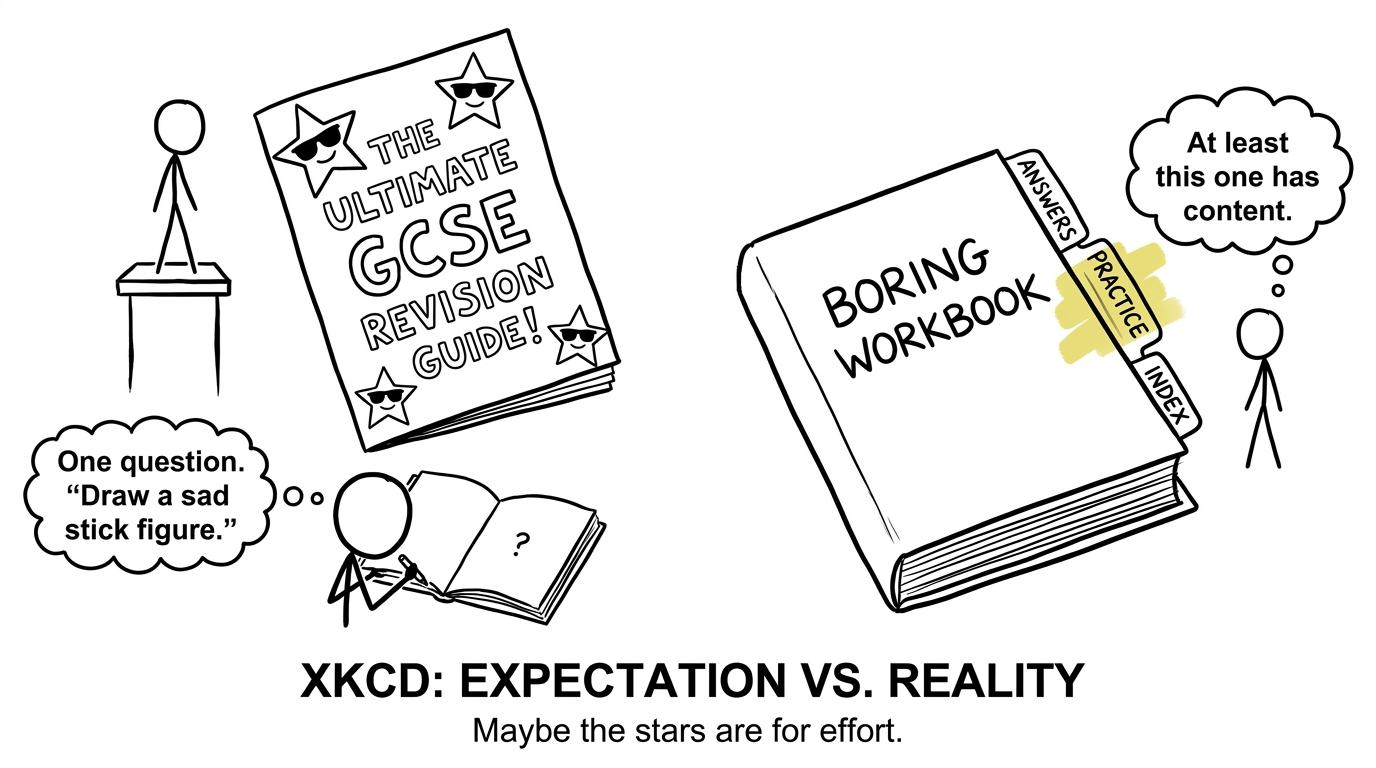 A glamorous star rating competes with a plain but useful practice book
Test the book before you buy it
Treat the purchase like a small investigation. Use a library copy, a friend’s copy, school stock or official sample pages where available. Choose one topic you genuinely find difficult and spend a short session with it.
After reading the explanation, close the book and attempt fresh questions without copying. Then ask:
- Could I identify the method independently?
- Did the explanation resolve my actual confusion?
- Could I diagnose mistakes from the answers?
- Was the page clear enough to use when tired?
- Did I do mathematics, or mainly read about it?
That last distinction matters. A page can feel clear because you recognise what you see. The exam asks whether you can retrieve and apply it without the page. Your test should therefore include closed-book practice.
The GCSE twenty-minute maths revision routine provides a simple structure for trying a resource without turning the decision into an evening-long project.
Decide whether the book adds value to your revision
“Worth buying” does not mean “good in isolation”. It means useful relative to what you already possess.
You may benefit from a book if you prefer paper, need a clear course checklist, want screen-free revision or work better with one organised reference. It may be poor value if it repeats your school textbook, covers the wrong board, offers little practice or will sit unopened beneath your desk.
Before buying, inventory your existing resources:
- class notes and school worksheets
- a textbook or revision guide supplied by school
- specification and topic checklist
- online revision lessons
- topic questions and mini tests
- past papers and mark schemes
- predicted papers for later exam preparation
A revision book is strongest as a map and quick reference. Topic questions build technique. Mixed tests develop recognition. Past papers teach timing and paper structure. Mark schemes show how credit is awarded. No single book performs every role equally well.
If organisation is the real problem, a GCSE Maths revision timetable may help more than another guide. If exam practice is missing, read when to start GCSE past papers and direct your time there instead.
Common mistakes when choosing a revision guide
Trusting the average star rating
Ratings combine opinions from students with different boards, tiers, goals and prior knowledge. Read detailed comments and inspect the book yourself.
Buying for the wrong specification
A respected guide can still be wrong for your course. Match the qualification title, board, tier and edition exactly, particularly if you are studying in Wales.
Assuming “complete revision” means complete preparation
Coverage is not competence. You still need independent questions, marking, corrections and timed papers.
Choosing a book that feels easiest
Clear explanations are valuable, but a guide should eventually remove prompts and make you choose methods. Exam questions are not designed to resemble the example immediately above them.
Ignoring the answer quality
Weak answers can leave you unable to diagnose a lost mark. Inspect the back of the book before admiring the front.
Buying several guides at once
More resources can create more decisions rather than more progress. Start with one clear system and add a book only when you can name the gap it fills.
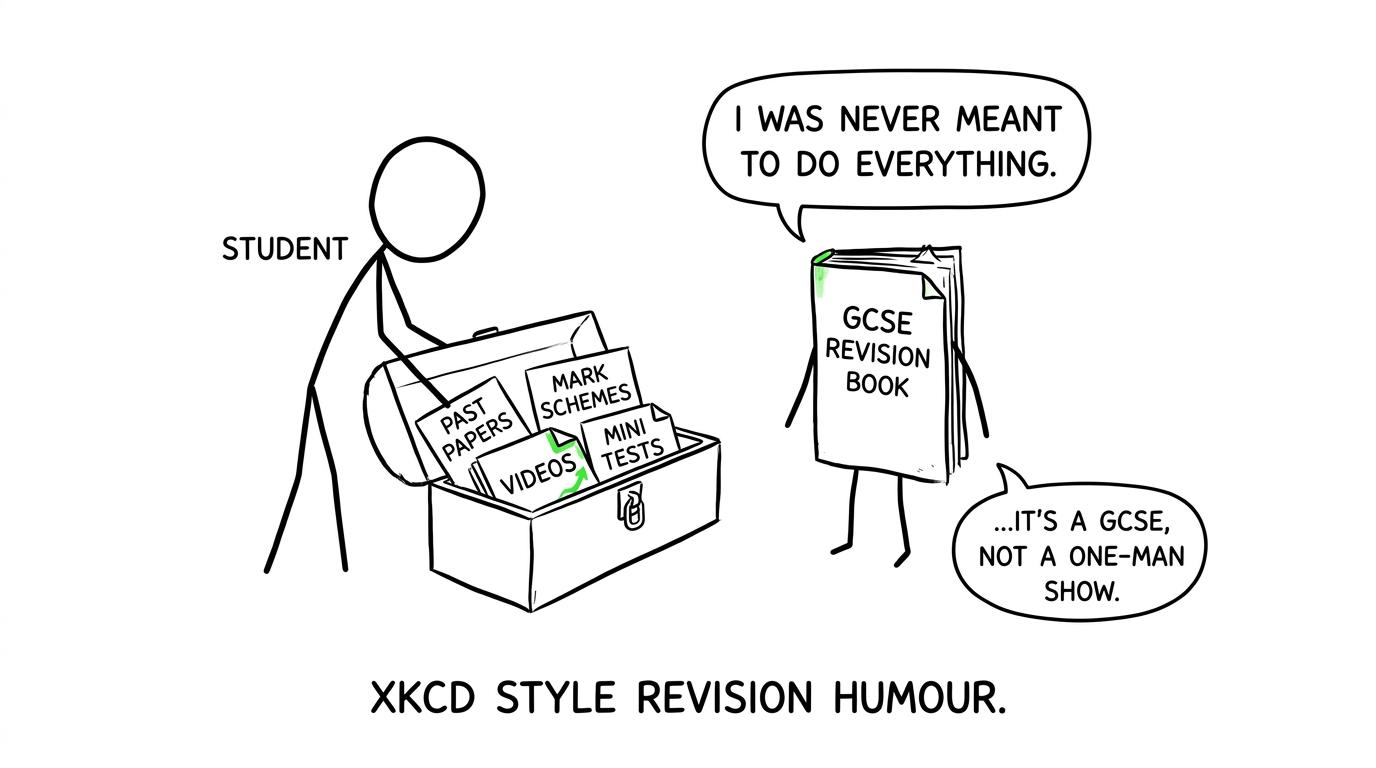 A revision book joins past papers and mini tests in a student’s toolkit
A better way to use the book after buying
Once you choose a guide, avoid reading it from beginning to end as if it were a novel. Begin with evidence from a mini test, mock or marked paper. Select one weak topic, retrieve what you already know, read only the explanation you need, and attempt questions without looking back.
Mark the work immediately. Record the precise error, then revisit the skill after a gap. Later, test it inside mixed questions or a past paper. This turns the book into a repair tool rather than a source of passive reassurance.
For a structured longer cycle, adapt the MathsGenie one-month GCSE revision plan. Use your book for concise topic review, then use MathsGenie practice questions, mini tests and video solutions to check whether the learning survives without prompts.
Review carefully, then start practising
So, is it worth reviewing a GCSE Maths Numeracy book before buying it? Yes. A few careful checks can prevent you from revising the wrong specification, choosing unsuitable questions or paying for material you already have. But reviews should begin the decision, not make it for you.
Confirm your qualification. Inspect sample pages. Test one difficult topic. Judge the practice and answers. Then ask whether the book has a clear job in your revision plan.
Whatever you choose, let practice do the heavy lifting. Start at the MathsGenie GCSE Maths revision hub for free revision lessons, topic questions, past papers, predicted papers, mini tests, mark schemes and video solutions. Use a revision guide when it helps, and use MathsGenie to turn what you read into marks.