GCSE ICT Cram Guide: 1-Week Plan for Late Starters
GCSE ICT cram guide: 1 week of focused revision, active recall, past-paper practice and exam technique, with a realistic plan for late starters.

There is a particular kind of panic that arrives when an exam is seven days away. The course suddenly looks enormous, every folder seems incomplete, and making a beautiful revision timetable feels easier than answering a question.
This GCSE ICT cram guide: 1 week plan gives you a more useful response. Check your exact qualification, diagnose the gaps, revise actively, practise exam questions and correct mistakes while there is still time. You cannot relearn an entire course perfectly in a week. You can, however, become considerably better prepared than you are today.
One important clarification comes first. GCSE ICT was discontinued in England, so many students using that name are actually taking GCSE Computer Science or a vocational digital qualification. WJEC GCSE ICT remains relevant to some learners in Wales during the transition to GCSE Digital Technology, while international students may take Cambridge IGCSE ICT. Specifications and assessment arrangements differ. Use the plan below only after checking the qualification title, exam board, specification and paper code supplied by your school.
Your one-week ICT revision checklist
Before beginning, collect:
- your current specification or school topic list;
- the correct past papers and mark schemes for your qualification;
- any practical files required for spreadsheet, database or document tasks;
- class notes, flashcards and teacher feedback;
- one sheet or document for an error log;
- the dates, times and requirements of each paper or component.
Then follow one rule throughout the week: questions first, notes second. Attempting to recall an answer shows what you actually know. Rereading notes can merely show that the page looks familiar.
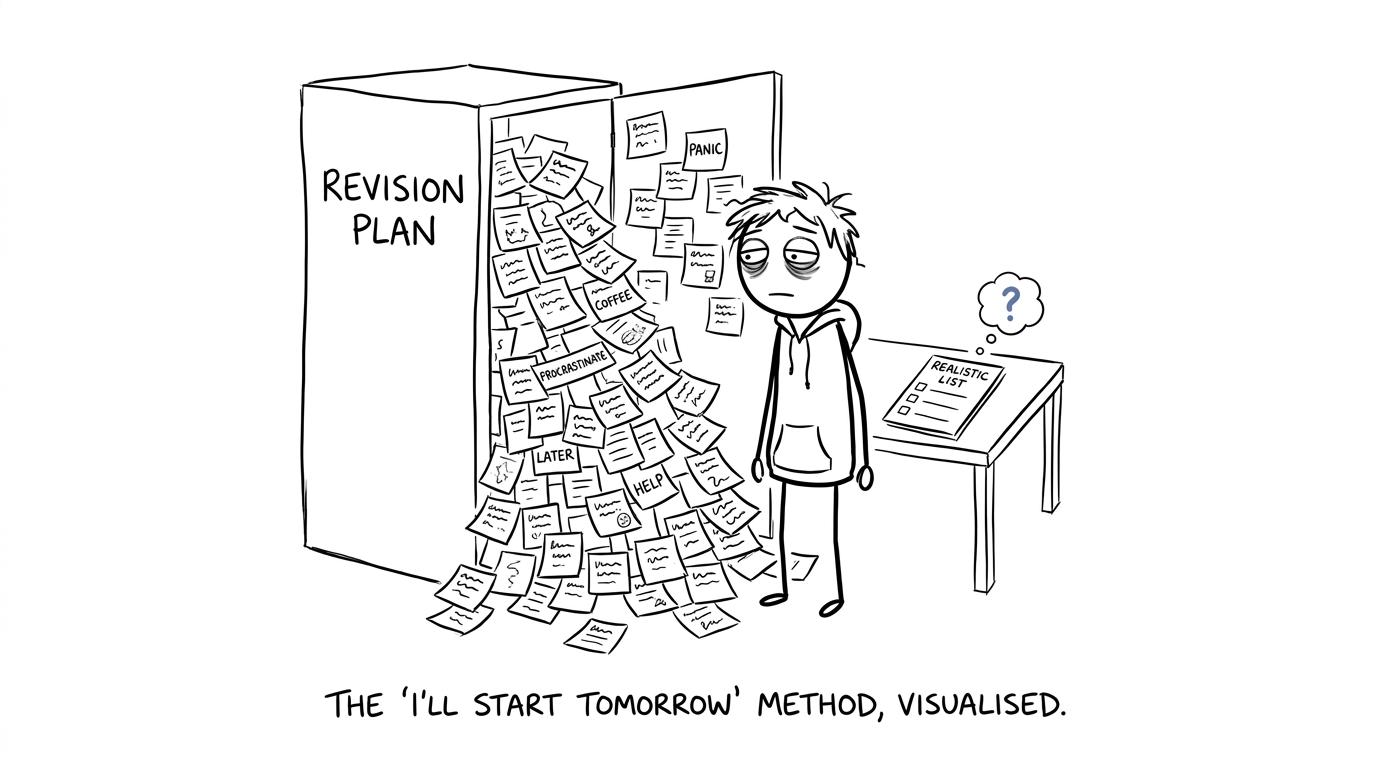 A late-starting student discovers that a small checklist is more useful than an avalanche of revision notes
How to structure each revision day
Aim for two or three focused sessions rather than an exhausting evening that destroys the following day. A practical session has four parts:
- Recall: write everything you remember about one topic without notes.
- Repair: check the specification, lesson material and concise notes.
- Apply: answer exam-style questions or complete a practical task.
- Review: mark the work and record the precise reason for each lost mark.
Keep breaks, meals and sleep in the plan. A late start is not corrected by becoming too tired to think. Put your phone beyond reach during each block and decide what you will attempt before the timer begins.
If maths is also approaching, protect a short daily slot for it. The GCSE maths revision hub brings together board-specific lessons, practice questions and papers. MathsGenie's twenty-minute maths revision routine is particularly useful when ICT has to take most of the evening.
Day one: identify the qualification and diagnose gaps
Do not begin by revising the first page of your textbook. Begin with the assessment you will actually sit.
Confirm whether your course is WJEC GCSE ICT, Cambridge IGCSE ICT, GCSE Computer Science or another digital qualification. Check which content belongs to each paper and whether practical work, programming, controlled assessment or extended responses are involved. AQA, OCR, Pearson Edexcel, WJEC and Cambridge qualifications are not interchangeable.
Next, attempt a past-paper section without notes. You are not trying to earn a reassuring mark. You are collecting evidence. Sort every weakness into one of four categories:
- missing knowledge;
- weak application to a scenario;
- unclear extended writing;
- practical or procedural weakness.
Choose no more than six priority areas. A short honest list is more useful than colouring every specification statement red. The same diagnostic principle works in maths, and MathsGenie's guide to finding your weakest GCSE topics explains how to turn lost marks into a focused repair list.
Day two: secure systems, hardware and data knowledge
Use your specification to select the relevant topics. These may include hardware components, input and output devices, storage, software, networks, cloud services, data representation or file management.
Start each topic with closed-book recall. Draw a labelled concept map or write short definitions, then compare it with your notes. Pay attention to differences between terms that sound similar. Students often know a vague benefit of cloud storage, for example, but cannot explain how it affects accessibility, collaboration, security or dependence on connectivity in a given scenario.
Finish with short-answer questions. For every response, ask:
- Did I use the correct technical term?
- Did I answer the context in the question?
- Did I explain the consequence rather than merely name a feature?
Day three: practise software, data handling and practical skills
This day depends heavily on your qualification. Relevant work might include spreadsheets, databases, document production, presentations, website authoring, image handling, file organisation or the systems life cycle.
Do not revise practical skills by watching someone else complete them. Open the software and perform the task. Practise selecting suitable data types, constructing spreadsheet formulae, sorting and filtering records, using validation, producing readable layouts and saving files with sensible names. Follow the conventions required by your course materials.
For theory questions, connect each tool to a purpose and audience. Choosing software is rarely about declaring one package “best”. It is about explaining why its features meet the needs in the scenario.
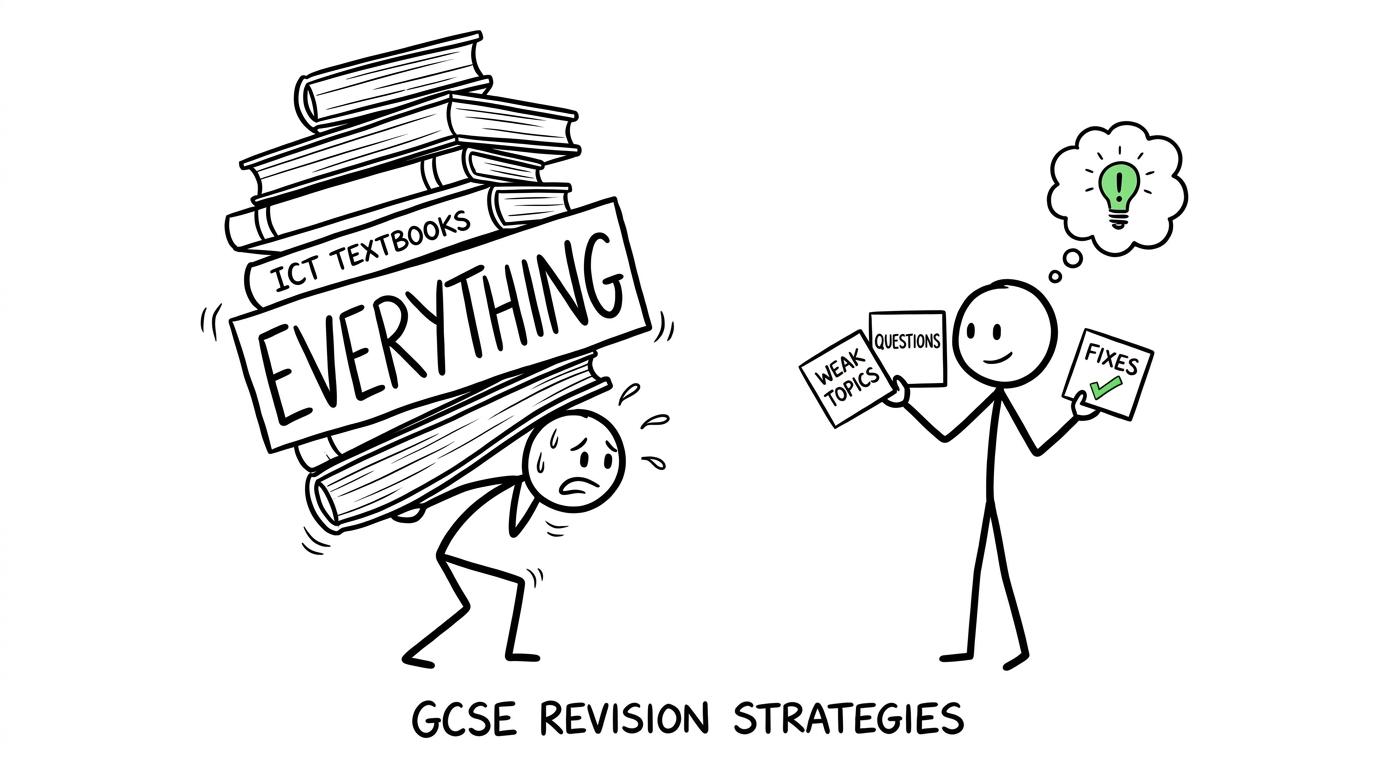 One student carries everything while another carries only the weak topics, questions and fixes
Day four: cover security, legislation and wider impacts
Security questions reward precise chains of reasoning. Revise threats, vulnerabilities and appropriate safeguards together. Depending on the specification, this may include malware, phishing, unauthorised access, weak passwords, social engineering, backups, encryption, access levels and physical security.
Avoid memorising isolated lists. Ask who is affected, what could happen, how the proposed control reduces the risk and what limitation remains.
Then review the legal, ethical, social and environmental topics named in your specification. Learn the legislation required by your course rather than relying on an old revision guide. Be ready to apply ideas such as privacy, intellectual property, accessibility, surveillance, unequal access and electronic waste to unfamiliar organisations or users.
End by planning several longer responses. You do not need to write every answer in full, but each plan should contain arguments, contextual evidence, consequences and a supported conclusion.
Day five: mix topics and improve written answers
By now, returning to earlier material matters more than opening another untouched chapter. Mix questions from days two, three and four. This forces you to decide which knowledge applies rather than relying on the heading above the page.
Study the command words used in your papers. A question asking you to identify something needs a different response from one asking you to explain, compare, evaluate or justify. Use the mark scheme to notice how credit is awarded, but do not memorise a phrase without understanding it.
Build a compact final-recall pack containing:
- essential definitions;
- commonly confused terms;
- security threat-and-control pairs;
- practical procedures you forget;
- structures for extended responses;
- mistakes taken directly from your error log.
This pack should be short enough to revisit tomorrow. Revision resources become less useful when making them consumes all the available practice time.
Day six: sit a timed paper or realistic component
Choose the closest available paper for your specification and complete it under realistic conditions. If your qualification contains practical papers, recreate the permitted software and file-handling conditions as closely as your school resources allow.
Do not pause to search for an answer. Mark uncertain questions and continue. The purpose is to practise retrieval, timing and decision-making together.
Mark the paper strictly. For each lost mark, record whether the cause was knowledge, interpretation, technical vocabulary, insufficient development, timing or a careless omission. Then repair the three largest mark leaks and answer fresh questions on them.
Use the same discipline for your other subjects. MathsGenie's Edexcel GCSE maths past papers include mark schemes and solutions, while the guide to using Edexcel past papers properly shows how to convert mistakes into targeted practice.
Day seven: consolidate without exhausting yourself
The final day is for retrieval and confidence, not an attempt to absorb an untouched textbook.
Reattempt questions from the error log without looking at yesterday's corrections. Review your compact recall pack, complete one short mixed set and check practical routines that are central to your paper. Stop heavy revision at a sensible time.
Prepare the equipment and documents your school has told you to bring. Confirm the location and start time. If the assessment is computer-based, follow your centre's instructions rather than making assumptions about permitted files or software.
Maths students can use the GCSE maths exam-week checklist to organise parallel papers calmly. If another maths exam is imminent, the one-week GCSE maths revision plan provides a separate subject-specific schedule.
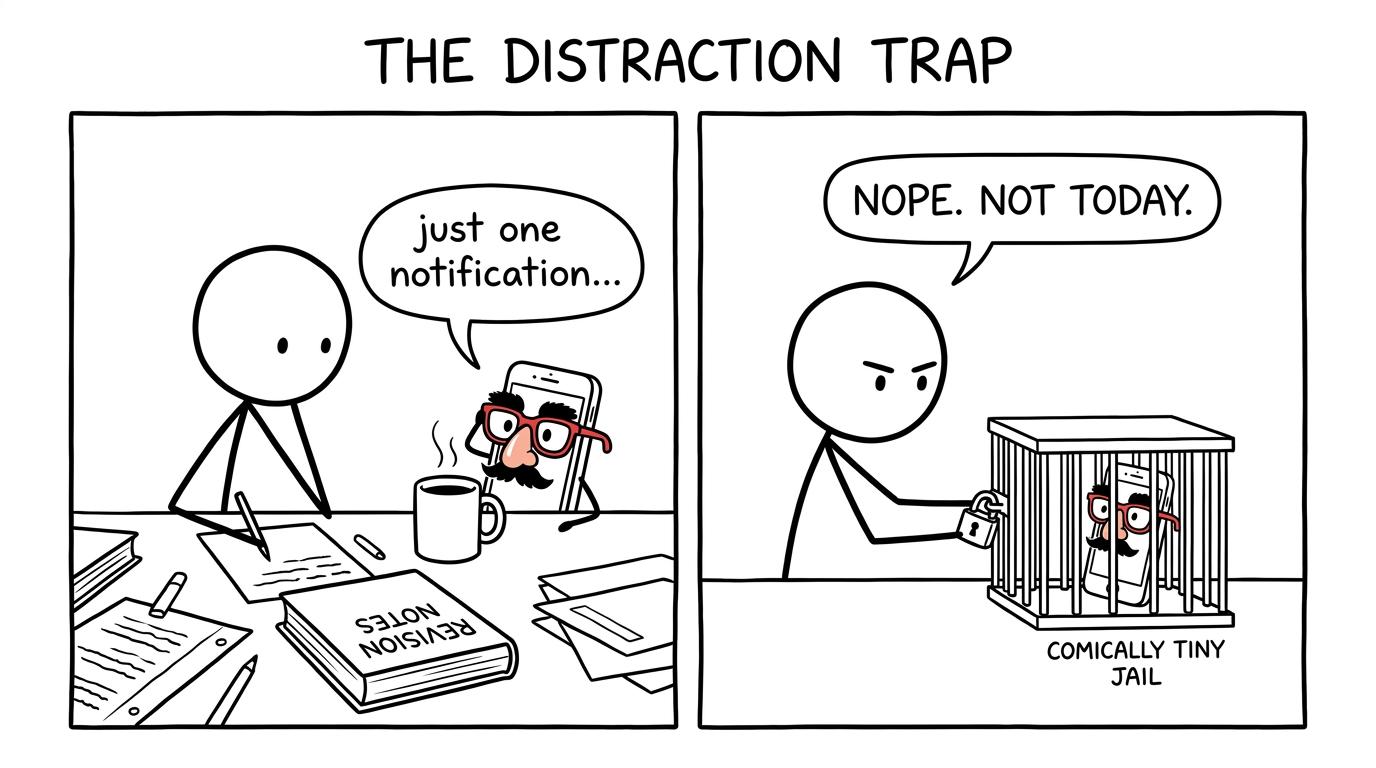 A revision student protects a quiet desk from a phone demanding just one notification
Common mistakes when cramming GCSE ICT
Revising the wrong qualification
Resources labelled ICT, Computer Science, Digital Technology and Digital Information Technology may cover different content and assessment styles. Match every resource to your exact specification and exam year.
Copying notes instead of retrieving knowledge
Neat notes can feel productive without exposing gaps. Close the book, answer first, then use the notes to correct what was missing.
Ignoring practical work
If your course assesses software skills, recognition is not enough. You need to perform the procedures accurately and manage files according to the instructions.
Giving generic advantages and disadvantages
An answer such as “it is faster” is often too vague. Explain what becomes faster, for whom, and why that matters in the stated situation.
Doing papers without reviewing them
A completed paper is only evidence. Improvement happens when you mark it, classify errors, repair the underlying topic and reattempt a similar question.
Sacrificing sleep for one more chapter
The final night is not the time for a revision marathon. Use MathsGenie's night-before GCSE plan to keep your wider exam preparation controlled and realistic.
Make the final week count
Seven days is not ideal, but it is enough time to make deliberate choices. Confirm the specification. Find the gaps. Retrieve knowledge. Practise the assessed skills. Mark honestly. Return to mistakes.
For ICT, use the official materials and resources supplied for your exact qualification. For the maths exams surrounding it, make MathsGenie your free revision base: learn through revision lessons, practise with topic questions and mini tests, then test yourself using past papers and predicted papers. Mark schemes and video solutions show where the marks are earned.
Open the MathsGenie GCSE revision hub, choose today's weakest maths topic, and protect one short session alongside this ICT plan. Starting late changes the schedule. It does not remove your ability to improve.