

GCSE History Discord Server: Is It Worth Joining?
GCSE history Discord server guide covering realistic revision benefits, safety risks, misinformation and how to use online communities without relying on them.

The appeal is easy to understand. You are revising alone, one interpretation question refuses to make sense, and somewhere online there appears to be a room full of students discussing exactly the same course. A GCSE history Discord server can be worth joining for quick explanations, shared motivation and conversations about exam technique. But it should be a supplement, not the foundation of your revision.
The central problem is trust. A busy server can feel authoritative without being accurate. Members may follow another exam board, study different options or confidently share advice that does not match your mark scheme. The best approach is to use the community for discussion while relying on your teacher, specification, textbooks, official assessment materials and completed exam questions for evidence.
The quick verdict
A subject Discord server may be useful if it helps you:
- discuss a specific topic or question;
- test your recall by explaining ideas to others;
- compare possible arguments rather than copy answers;
- find motivation during an otherwise solitary revision session;
- recognise gaps that you then check against reliable materials.
It is less useful when it becomes:
- a source of unverified facts and model answers;
- a substitute for writing complete timed responses;
- a stream of notifications that fragments your attention;
- a place where strangers request personal information or private contact;
- another revision resource you collect but rarely use purposefully.
The question is not simply whether the server is good. It is whether your behaviour inside it produces better revision outside it.
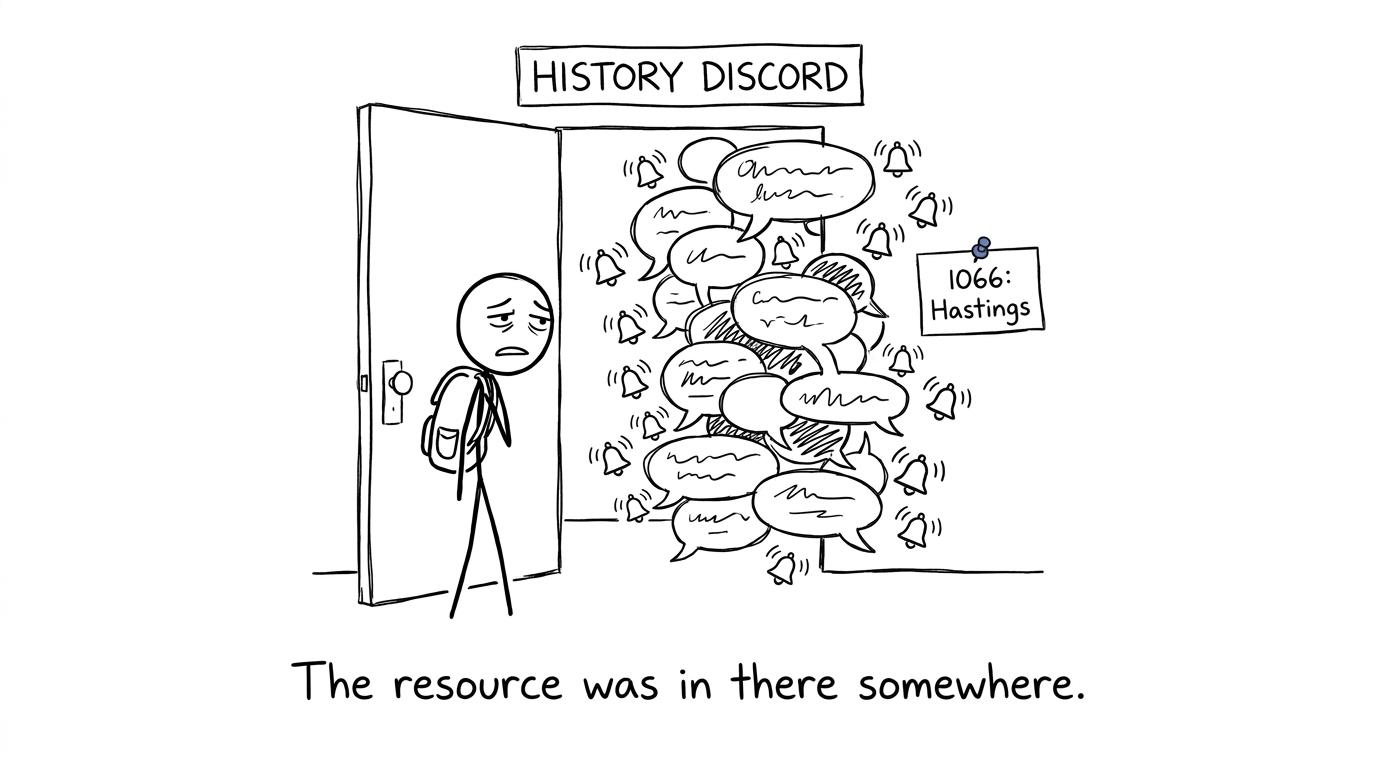 A student searching through a noisy History Discord for one useful resource
What a GCSE history Discord server can realistically offer
Online communities are strongest at connection and conversation. They are weaker at quality control. Understanding that difference makes it easier to use one sensibly.
Quick clarification when you feel stuck
A well-moderated server may provide another way of hearing an idea explained. If you cannot distinguish causation from consequence, or you are unsure why two interpretations differ, a focused discussion might reveal the missing connection.
That can help you restart. It cannot confirm that every reply is correct. Treat responses as suggestions to investigate, then check them against your course materials or ask your teacher.
Low-pressure recall
Explaining a historical development to somebody else forces you to select relevant knowledge and organise it clearly. That is more active than scrolling through notes. Short quizzes, flashcard channels and focused study sessions can also make retrieval feel less isolated.
However, recall alone is not the entire GCSE History course. Official subject requirements include historical knowledge, explanation and analysis, the use of sources, interpretations and substantiated conclusions. The precise balance and question format depend on the exam board and specification.
A server can prompt recall. Only deliberate written practice shows whether you can turn that knowledge into marks.
Exposure to different arguments
History is not improved by memorising one impressive paragraph. Strong responses select evidence, explain relationships and reach a judgement that answers the exact question. Seeing classmates propose different lines of argument can help you understand that more than one defensible conclusion may exist.
The useful question is not, “Which answer should I copy?” It is, “Which evidence makes this argument convincing?” That shift turns conversation into historical thinking.
Motivation and accountability
A quiet study room, scheduled revision session or check-in channel may help you begin. Beginning matters because revision plans often fail at the moment of transition between intending to work and actually opening the task.
Yet social accountability can become social distraction. If a planned ten-minute question becomes an hour of general chat, the server has stopped serving its purpose. Maths students facing the same problem can use MathsGenie’s 20-minute GCSE revision routine to build a clearer start-and-finish structure across the week.
Why your exact specification matters
“GCSE History” is not one identical course. AQA, Edexcel, OCR and Eduqas offer different structures and option combinations. Even two students taking the same exam board may study different depth, period or thematic options.
Before accepting advice, check:
- the contributor’s exam board;
- the exact specification and option;
- the paper or component being discussed;
- the question type and available marks;
- whether the resource is current and traceable;
- whether your teacher has taught a different response structure.
A detailed message about Norman England is irrelevant if your class studies Elizabethan England. More subtly, an essay plan may contain sound history but answer the wrong style of question for your paper.
This principle applies equally to maths. Resources should match your board and, where relevant, your foundation or higher tier entry. MathsGenie’s GCSE Maths revision hub lets students choose Edexcel, AQA, OCR, Eduqas, WJEC or CCEA materials rather than relying on generic advice.
The main risks of relying on Discord too much
Confident misinformation
A polished answer is not necessarily a correct answer. Dates can be wrong, quotations may be misattributed and simplified claims can lose essential context. Server roles, popularity and confident language are not substitutes for evidence.
Use a simple verification ladder:
- check your teacher’s guidance and class materials;
- check the official specification and board materials;
- compare the claim with a trusted textbook or source;
- test exam advice against an official mark scheme;
- leave the claim out if you still cannot verify it.
This matters especially for predicted questions. Students can discuss possible themes, but nobody in an ordinary community knows the secure contents of a future paper. Do not narrow your revision because somebody claims a topic is “guaranteed”.
Passive revision disguised as work
Reading debates, downloading notes and reacting to quiz answers can feel productive because history words remain on the screen. But recognition is easier than recall, and recall is easier than constructing a response under time pressure.
A useful session should leave evidence: a completed plan, a timed paragraph, a marked answer, corrected flashcards or a list of gaps. The same distinction sits behind MathsGenie’s guide to finding your weakest GCSE topics: improvement begins with evidence of what you cannot yet do reliably.
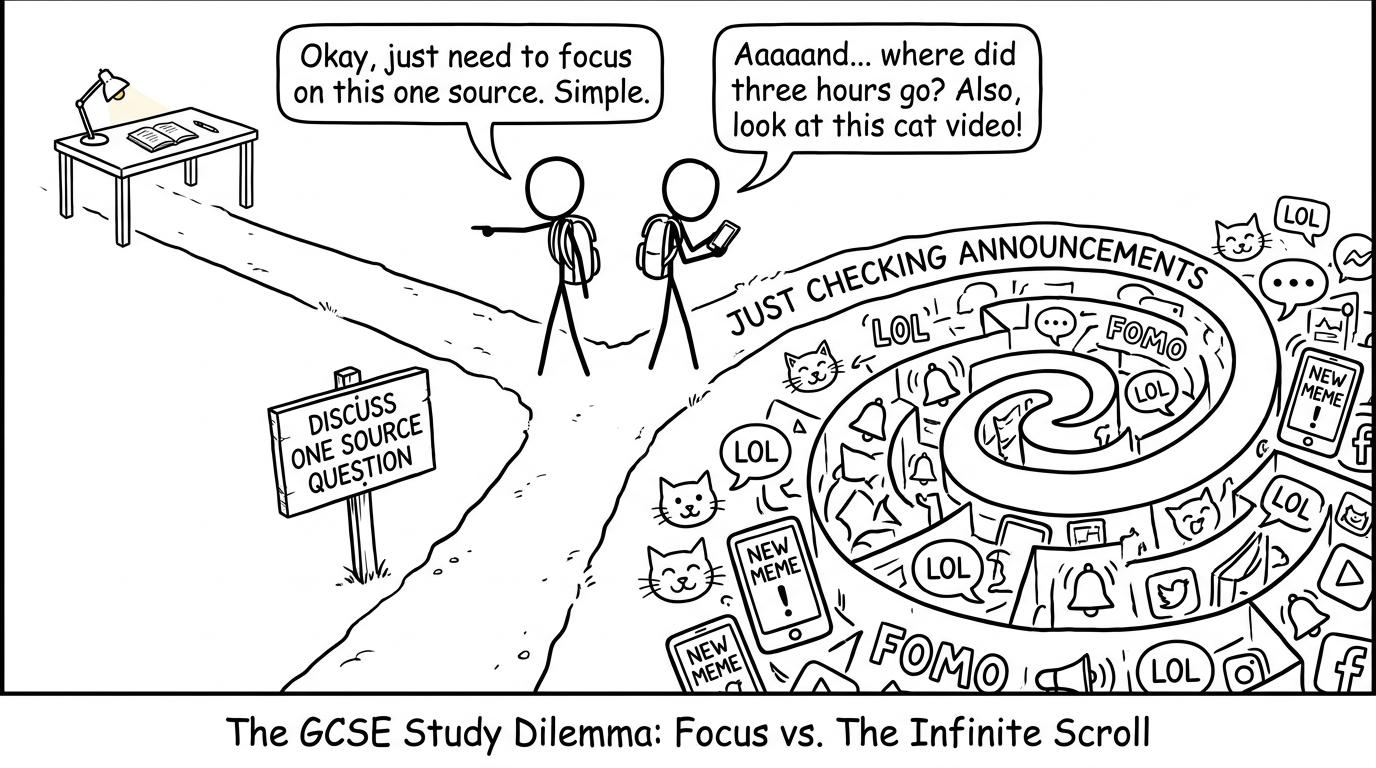 A focused source question competing with an endless maze of online notifications
Distraction and comparison
Discord combines revision with the mechanics of social media: alerts, status indicators, jokes, rapid replies and the feeling that a conversation may move on without you. That creates urgency even when nothing important is happening.
Comparison adds another cost. Somebody posting a large folder of notes does not prove that they understand it, and somebody completing more hours does not tell you whether those hours were effective. Measure your revision through completed tasks and corrected mistakes instead.
A realistic GCSE revision timetable can protect separate blocks for history, maths and other subjects. Discord should fit inside the plan, not continually interrupt it.
Privacy and unwanted contact
Discord requires users to meet its minimum age requirement, which is generally 131313. UK users also have default protections around sensitive content and age-restricted areas. These features reduce some risks, but no setting makes communication with strangers risk-free.
For safer use:
- use a non-identifying display name and profile image;
- do not share your school, location, timetable or contact details;
- restrict direct messages and friend requests from server members;
- keep sensitive-content filters enabled;
- avoid moving conversations to private calls or other platforms;
- block and report unwanted behaviour;
- tell a trusted adult if anything feels manipulative, threatening or uncomfortable;
- leave immediately if moderation is weak or content is inappropriate.
A genuine revision helper does not need personal photographs, your address, your school name or secrecy from adults.
How to test a server before trusting it
Do not judge a community by its member count. Spend a short trial period observing how it operates.
Look for visible moderation
A credible study server should have clear rules, active moderators, reporting routes and boundaries around harassment, inappropriate material and unsolicited direct messages. Moderators should correct misinformation rather than rewarding whoever replies fastest.
Inspect the revision channels
Useful organisation might separate exam boards, options, source questions, interpretations and general discussion. Resources should identify their origin. Be cautious when files have no author, date, specification or explanation.
Ask one specific question
Try a narrow, verifiable question related to your course. Good replies should acknowledge context, explain reasoning and welcome correction. A flood of contradictory certainty is a warning sign.
Measure the outcome
After several sessions, ask whether you have completed more high-quality revision. If you are merely checking messages, mute the server or leave. Digital communities are optional; your progress is not.
A healthier way to include Discord in revision
Use the server only at defined points in a closed revision loop:
- Choose: identify one precise topic or skill.
- Recall: write what you know without opening Discord.
- Practise: answer a relevant question.
- Check: use teacher feedback, reliable materials and the mark scheme.
- Discuss: ask the community about one unresolved issue.
- Correct: amend your answer in your own words.
- Leave: close Discord and record the next task.
This keeps discussion attached to action. It also prevents the community becoming your only source of feedback.
For maths, the equivalent process is particularly clear: attempt questions, mark them and repair the exact gap. MathsGenie explains this in how to use past papers properly and how to use mark schemes as a revision coach. The subject changes, but the underlying habit remains valuable: feedback should lead to another attempt.
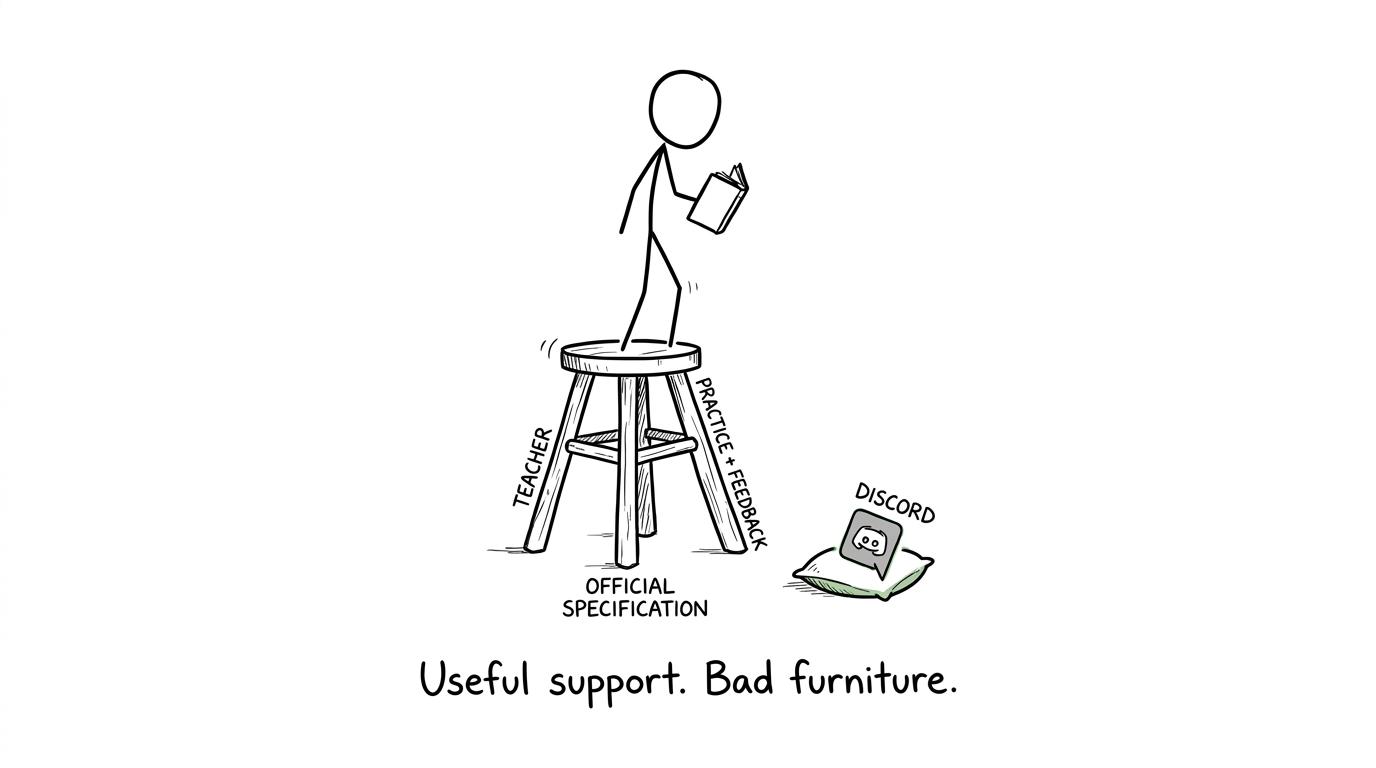 Discord shown as an optional cushion rather than the foundation of revision
Common mistakes when using subject communities
Joining too many servers
More communities mean repeated resources, competing advice and additional notifications. One well-run server is more manageable than several noisy ones.
Copying model answers
Copying creates familiarity, not independent performance. Analyse why an answer works, close it, then produce your own response to a fresh question.
Trusting resources without checking their origin
A colourful revision sheet may be outdated, incomplete or designed for another specification. Verify its board, option and source before using it.
Asking questions before attempting the task
Immediate help can remove the productive struggle that reveals what you actually understand. Attempt the question first, then ask about the precise step that stopped you.
Letting history discussion displace maths practice
GCSE revision is a portfolio of competing priorities. A fascinating historical debate can still be poor time management if tomorrow’s exam is maths. Use the MathsGenie GCSE topic guide by board and tier to keep your maths priorities visible alongside your other subjects.
Make the community optional, not essential
A GCSE history Discord server is worth joining when it provides focused discussion, sensible motivation and a way to test ideas. It is not worth depending on when it replaces verified content, timed writing, teacher feedback or safe online boundaries.
Think of the server as a study group held in a very large corridor. You may hear an explanation that unlocks a difficult idea. You may also hear rumours, distractions and advice intended for somebody else’s course. Enter with a question, verify what you learn and know when to leave.
Then return to the work that produces evidence. For maths, start with MathsGenie’s free Edexcel GCSE past papers and solutions or choose your board through the main revision hub. Combine revision lessons and practice questions with mini tests, past papers, predicted papers, mark schemes and video solutions. Online conversation can encourage you, but completed questions show you what to do next.










