GCSE Mark Schemes: Use Them Like a Revision Coach
GCSE mark schemes can boost grades fast. Learn how to read mark schemes, spot method marks, and turn feedback into a simple revision loop.

GCSE season has a particular kind of silence. You finish a question, you circle an answer, and a small part of you whispers: is that what they wanted, or just what I wanted it to be?
That’s why GCSE mark schemes matter more than most students realise. They’re not just the “answers”. They’re the examiner’s definition of credit. If you learn to read that definition, you stop revising in the dark. You start revising with a torch.
And if you’re here primarily for maths revision (this is YesGenie, after all), don’t worry; the skill transfers beautifully. Whether it’s GCSE English Literature or GCSE Maths, the mark scheme teaches you the same habit: write what earns marks, not what feels impressive.
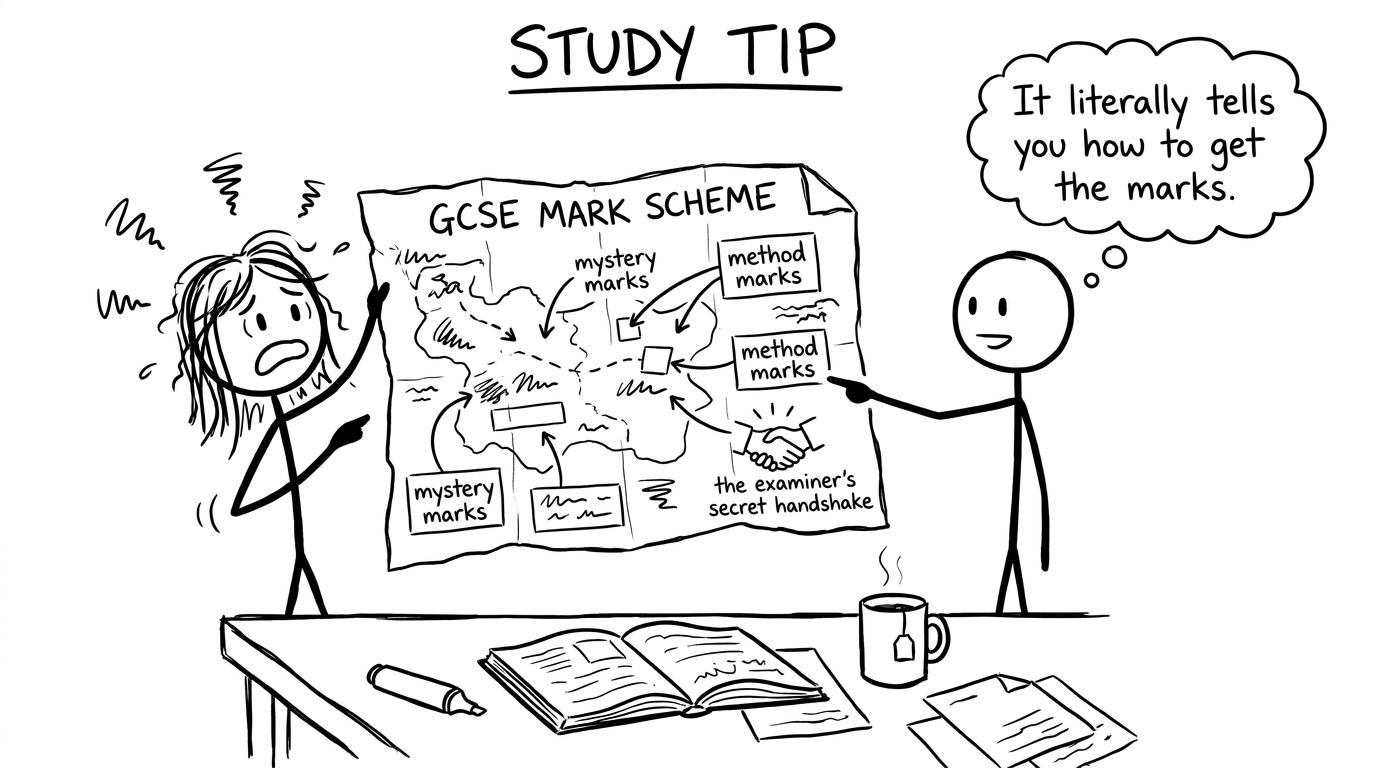 A student holding a mark scheme like a treasure map
The mark scheme mindset (and why it helps across GCSE subjects)
A mark scheme is a model of how marks are awarded under pressure. It shows you:
- what counts as a “method” (working) and what counts as “accuracy” (final result)
- what gets credit even if you don’t finish
- what gets zero even if it looks sensible
- what “show your working” really means in practice
In GCSE English Literature, that might mean seeing how quotations, inference, and writer’s methods are credited. In GCSE maths, it’s even clearer: method marks and follow-through marks are often written explicitly.
YesGenie is built around this idea: practise with questions, check the mark scheme, then fix the exact thing that lost you marks. You can do that using:
- GCSE Past papers
- Edexcel GCSE Maths Past Papers
- Edexcel GCSE Maths Predicted Papers
- Edexcel GCSE Maths Mini Tests
- Edexcel GCSE Maths Revision Guides
- OCR GCSE Maths
- Eduqas GCSE Maths Question Bank
- Resources hub
- Other Resources
A quick checklist for using GCSE mark schemes properly
Use this as your default routine whenever you do GCSE practice:
- Attempt the question under timed conditions.
- Mark with the mark scheme using a different colour.
- Identify which type of mark you dropped (method, accuracy, communication).
- Rewrite the solution in a “mark-winning” form.
- Do one more similar question immediately.
- Log the mistake as a short rule (one sentence).
That last part matters. Improvement in GCSE exams is often just reducing repeated mistakes.
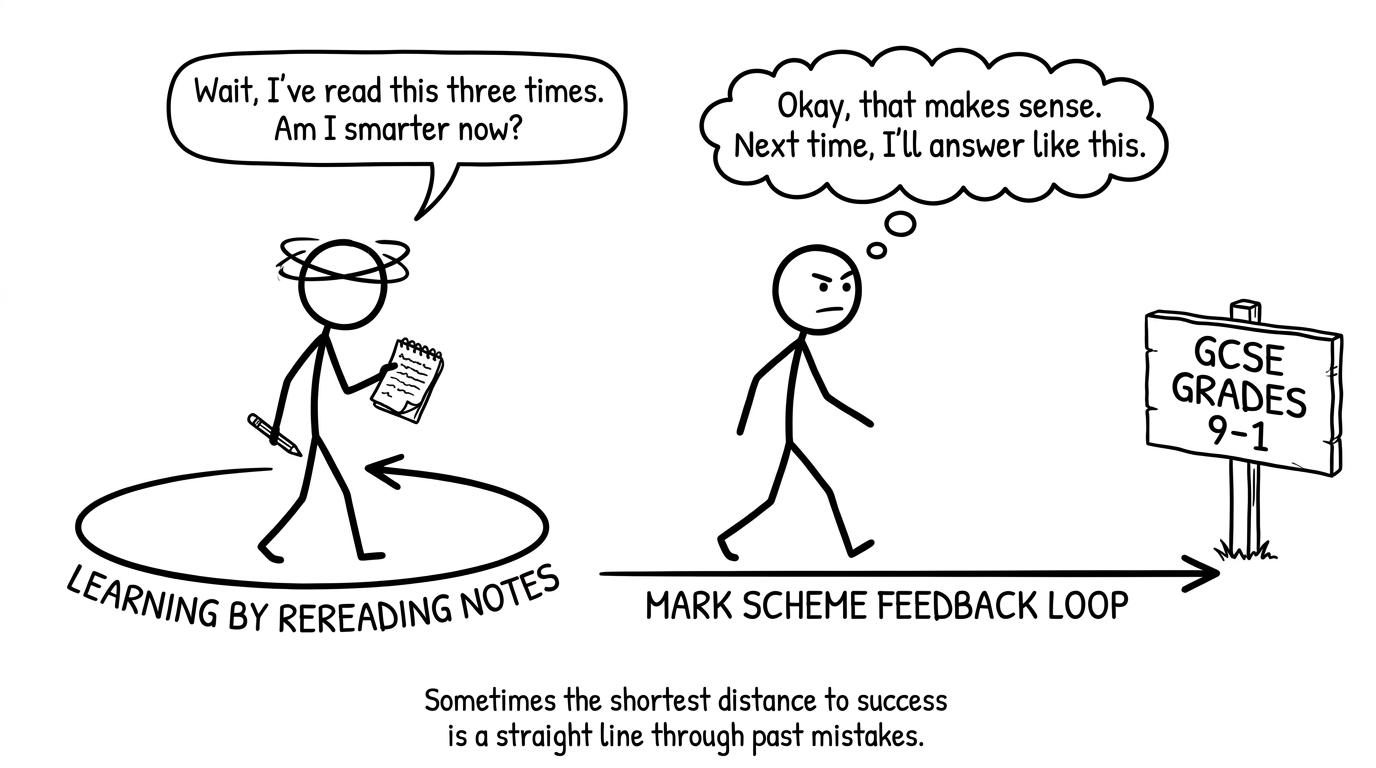 Two paths: rereading notes vs mark scheme feedback loop
How examiners award marks (what the codes are really saying)
Many GCSE mark schemes (especially in maths) use codes like:
- MMM marks: method marks for a valid approach
- AAA marks: accuracy marks after a correct method
- BBB marks: independent marks for a correct statement/result
- “ft”: follow-through marks (you can still get credit using your earlier wrong answer)
- “cao”: correct answer only
You’ll often see this in Edexcel, AQA, OCR, and Eduqas style schemes (wording varies, but the logic is similar). The important insight is this:
You are not just being marked on what you know, but on how reliably you show it.
That’s why a mark scheme is a training manual for reliability.
Worked example (maths): how method marks save you
Suppose a question is worth 333 marks:
Solve 3x−5=163x - 5 = 163x−5=16.
A mark scheme might effectively reward:
- M1M1M1: add 555 to both sides: 3x=213x = 213x=21
- M1M1M1: divide by 333: x=7x = 7x=7
- A1A1A1: correct solution
A full, mark-friendly solution:
3x−5=163x - 5 = 163x−5=16 3x=213x = 213x=21 x=7x = 7x=7Now imagine you make a slip: you write 3x=203x=203x=20 and then x=203x=\frac{20}{3}x=320. You might still get the first MMM mark for the correct rearrangement step if it’s visible. If you write only x=7x=7x=7 with no working and it’s wrong, you lose everything.
That’s the GCSE lesson: method marks are paid out only when your method is readable.
Worked example (English Literature): the same idea, different clothes
In GCSE English Literature, mark schemes reward things like:
- a clear, conceptual argument (a “method”)
- relevant evidence (quotations)
- analysis of language/structure/form
- context used appropriately (where required)
A typical top-band answer doesn’t just mention techniques. It links them to meaning and effect.
So when you use an English Literature mark scheme, don’t only check what the “model answer” said. Check what the criteria is asking for. If the scheme rewards “analysis of writer’s methods”, then naming a method without explaining its effect is like writing an answer in maths without showing working.
How to turn a GCSE mark scheme into a personal revision plan
Mark schemes give you a simple way to stop guessing what to revise.
Step one: classify the loss
When you drop marks in GCSE maths, it’s usually one of these:
- Recall issue: you didn’t know the method (topic gap)
- Process issue: you knew the method but executed it poorly
- Exam technique issue: you didn’t show the step that earns MMM marks
- Presentation issue: rounding, units, form, or incomplete statement
In GCSE English Literature, it’s similar:
- didn’t answer the question focus
- too much retelling, not enough analysis
- quotations used without explanation
- ideas not organised into an argument
Once you know the category, you know what to do next.
Step two: prescribe the fix (use YesGenie to make it fast)
If it’s a topic gap in maths, go straight to a targeted lesson and practise:
- Use topic lists in Edexcel GCSE Maths Revision Guides
- Then hit mixed practice using the Eduqas GCSE Maths Question Bank (question banks are brilliant for repetition)
If it’s exam technique, you need mark scheme exposure:
- Do a set of questions from Edexcel GCSE Maths Past Papers
- Mark carefully, then watch solutions where available (YesGenie’s video solutions are a calm way to see what “enough working” looks like)
If it’s timing and stamina, scale the test down:
- Use Edexcel GCSE Maths Mini Tests to practise the feedback loop without burning out
And when you’re close to exams, sharpen your aim:
- Use Edexcel GCSE Maths Predicted Papers to practise exam-style selection and pacing
How to annotate mark schemes without drowning in them
A mark scheme can feel like a wall of tiny decisions. Make it readable:
- Circle the first point where your solution diverges.
- Write a 5-word label: “expanded wrong”, “units missing”, “no justification”.
- Copy one perfect line from the scheme into your notes (one line only).
- Create a “next time” rule.
A good “next time” rule is specific and checkable.
For example:
- “When asked to solve, always end with x=…x=\dotsx=….”
- “When giving probability, write as a fraction.”
- “When asked for angle, include ∘^\circ∘.”
Yes, these are small. That’s the point. Big grade jumps at GCSE often come from tiny habits done consistently.
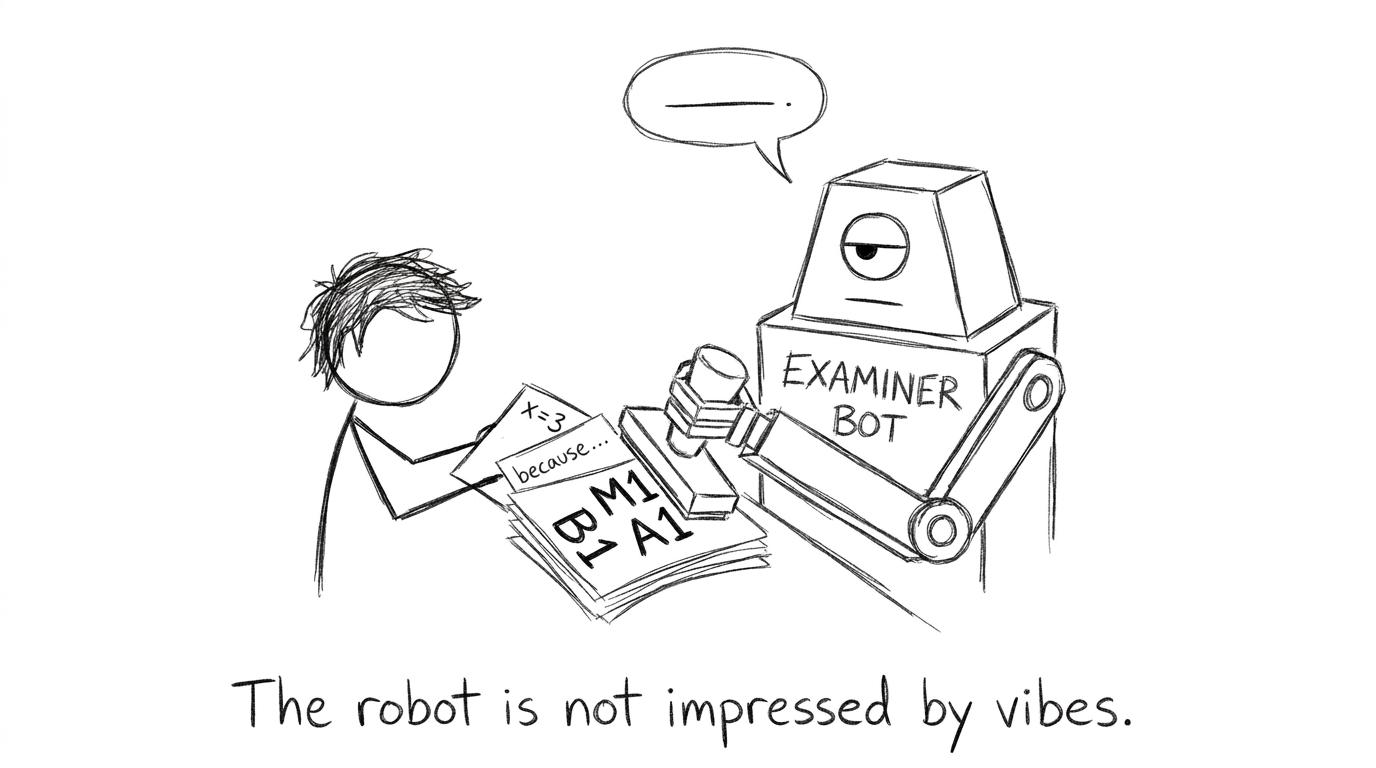 Examiner robot stamping M1 A1 B1
Worked example (maths): using the mark scheme to rescue marks
Here’s a classic situation where the mark scheme reveals what the examiner really wants.
Expand and simplify (x+3)(x−5)(x+3)(x-5)(x+3)(x−5).
A full solution:
(x+3)(x−5)=x(x−5)+3(x−5)(x+3)(x-5)=x(x-5)+3(x-5)(x+3)(x−5)=x(x−5)+3(x−5) =x2−5x+3x−15=x^2-5x+3x-15=x2−5x+3x−15 =x2−2x−15=x^2-2x-15=x2−2x−15Common student error: x2−15x^2-15x2−15 (forgetting the middle terms). The mark scheme would still often credit a correct expansion structure even if the final simplification is wrong. If you show the four-term line x2−5x+3x−15x^2-5x+3x-15x2−5x+3x−15 but simplify wrongly, you’ve created a place for method marks to land.
So the revision move is:
- practise expanding
- but also practise the last simplification step as its own micro-skill
On YesGenie, that’s exactly how you should use topic-by-topic practice and worked examples, then check the scheme.
Common mistakes when using GCSE mark schemes
- Only checking the final answer. This turns a mark scheme into a scoreboard, not a coach. You need the “why”.
- Assuming the scheme is a single perfect method. Many GCSE maths questions accept multiple methods. The scheme often shows alternatives or “oe” (or equivalent).
- Ignoring follow-through marks. If you made one early slip, you still need to keep going clearly to earn “ft” credit.
- Not writing what the scheme rewards. In maths that means clear steps, units, and rounding. In English it means analysis linked to the question, not a list of techniques.
- Fixing the wrong problem. If you lost marks for presentation (like missing units), don’t waste an hour relearning the whole topic. Fix the presentation habit.
Bringing it back to maths revision (because that’s where your marks move fastest)
Even though this post started with GCSE English Literature, the mark scheme habit is a secret weapon for GCSE maths.
Maths rewards what is visible: correct method, clear steps, accurate arithmetic, correct form. The fastest improvers aren’t necessarily the cleverest students, but they’re the ones who use mark schemes like a mirror, then fix one repeated mistake at a time.
So build a simple weekly loop:
- Learn the topic using Edexcel GCSE Maths Revision Guides
- Practise questions from the Eduqas GCSE Maths Question Bank or your board page like OCR GCSE Maths
- Test with GCSE Past papers or Edexcel GCSE Maths Mini Tests
- Mark honestly using the mark scheme
- Patch the gap, then repeat
That is what revision looks like when it’s calm, deliberate, and measurable.
Conclusion: let the GCSE mark scheme do the coaching
A mark scheme is not a judgement. It’s a map. It shows you how marks are actually awarded, and it turns vague effort into specific improvement.
If you want better GCSE grades, don’t just do more questions. Do questions, mark them properly, and let the mark scheme teach you how to communicate your thinking.
Make YesGenie your home base for that process: revision lessons, topic practice, past papers, predicted papers, mini tests, mark schemes, and video solutions, all designed to keep your feedback loop tight and your progress obvious. Start with GCSE Past papers, pick your exam board, and use the mark scheme like a revision coach rather than an answer sheet.