GCSE Arabic Year 10 Revision Head Start: Worth It?
GCSE Arabic year 10 revision head start: discover when early practice helps, how to balance it with maths, and how to avoid burnout before Year 11.
The difficult part of starting early is not finding time. It is knowing whether the time will matter. A student can spend months making beautiful notes and still reach Year 11 unable to recall the vocabulary, solve the equation or explain an answer under pressure.
So, does a GCSE Arabic Year 10 revision head start actually help? Yes, provided it means short, active and sustainable practice rather than beginning Year 11-style exam preparation a year early. The aim is to make Arabic easier to maintain while protecting enough time and energy for GCSE maths and your other subjects. Starting early should reduce future pressure, not extend it.
The short answer: start building, not cramming
A useful Year 10 approach has five parts:
- confirm your exact Arabic qualification and specification
- practise vocabulary and grammar through recall rather than rereading
- include listening, speaking, reading and writing where your course assesses them
- keep sessions short enough to repeat consistently
- preserve separate time for maths lessons, topic questions and feedback
There is no need to complete full Arabic papers every weekend. Nor should you abandon maths until Year 11. Early revision works best as maintenance: learn something, retrieve it later, receive feedback and revisit it after a gap.
That pattern is consistent with evidence reviewed by the Education Endowment Foundation. Spaced learning and low-stakes retrieval can support long-term recall, although the quality of the task and the feedback still matter. Simply starting sooner is not the advantage. Revisiting knowledge intelligently is.
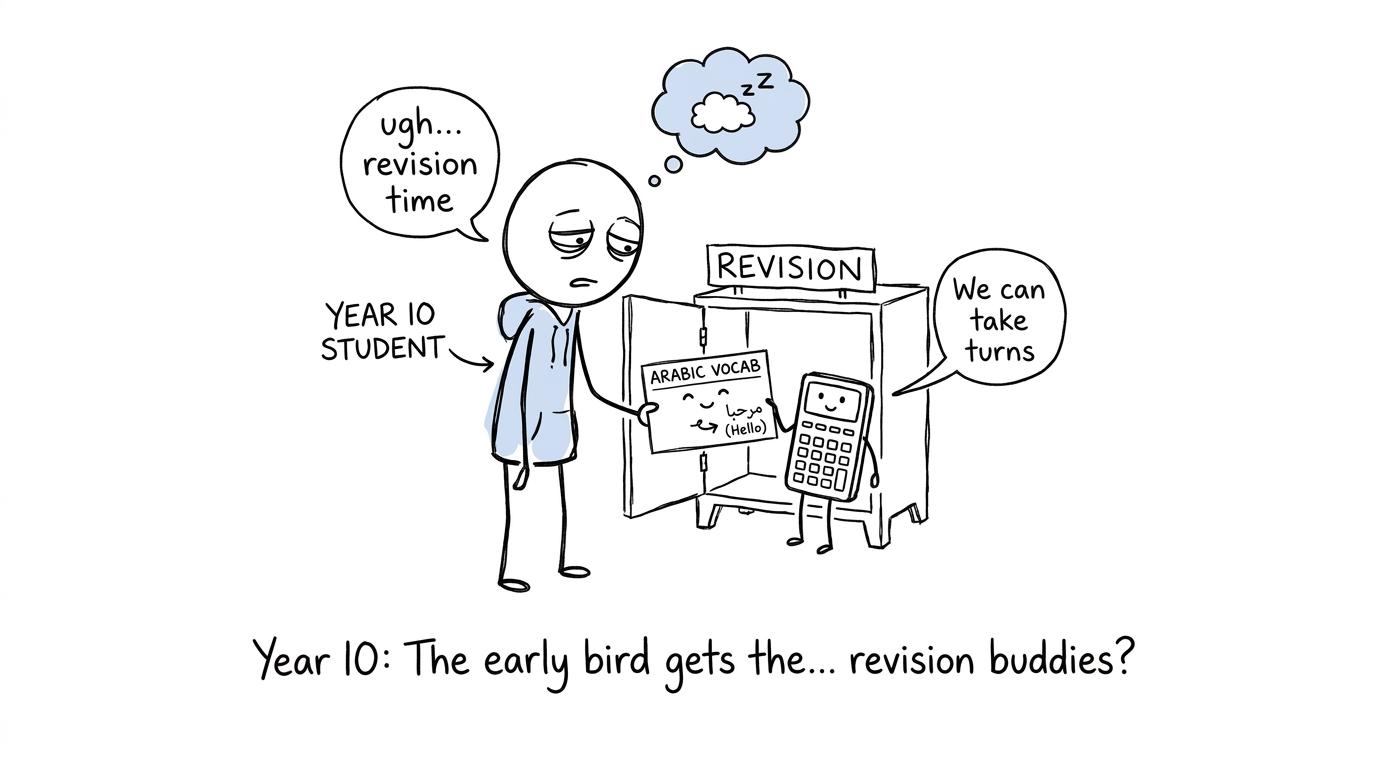 A student discovers that Arabic and maths revision can take turns
Why Year 10 can be the right time for Arabic revision
Language knowledge is cumulative. Vocabulary supports reading and listening; grammar supports writing and speaking; regular exposure makes unfamiliar material feel less unfamiliar. A modest routine in Year 10 gives these connections time to develop.
This differs from last-minute revision, where the student may recognise a word on a flashcard but cannot retrieve it in a sentence. Recognition feels reassuring. An exam asks for more.
The main benefits of beginning in Year 10 are practical:
- More retrieval opportunities: difficult words and structures can be recalled repeatedly after delays.
- Earlier diagnosis: you can discover whether reading, listening, speaking or writing is causing the problem.
- Lower weekly pressure: a small amount now can prevent an unmanageable backlog later.
- Better balance: maths and Arabic can both remain active rather than competing during the final months.
- Time to seek help: misunderstandings can be discussed with your teacher before they become habits.
However, early revision does not mean racing ahead of your class. If you teach yourself an unfamiliar grammatical structure incorrectly, repeated practice may strengthen the error. Use your specification, class materials and teacher feedback to decide what belongs in your routine.
Know which Arabic qualification you are taking
Before downloading papers, check the qualification name and code with your school. GCSE Arabic and International GCSE Arabic are not interchangeable labels.
For example, the current Pearson Edexcel GCSE Arabic specification, code 1AA0, assesses listening, speaking, reading and writing. Each skill contributes 25%25\%25% of the qualification, and students take foundation or higher tier consistently across the papers. Dictionaries are not permitted in the assessments. That makes secure recall and experience across all four skills important.
An International GCSE in Arabic may have a different structure, skills balance or set of papers. OxfordAQA, for instance, has introduced an International GCSE Arabic First Language qualification for first teaching from September 2026 and first examinations from May/June 2028. It is a distinct qualification, not a replacement paper that every UK GCSE student will sit.
The safe rule is simple: check the specification rather than revising from a resource merely because it says “GCSE Arabic”. The same principle applies in maths. Edexcel, AQA, OCR and Eduqas cover a shared mathematical core, but paper structures and presentation differ. MathsGenie therefore organises resources by exam board, including Edexcel GCSE Maths revision, the AQA GCSE Maths hub and board-specific paper collections.
A sustainable Year 10 routine
A head start should be small enough to survive busy school weeks. Begin with two Arabic sessions and two or three maths sessions, adjusting the plan around homework, assessments and teacher guidance.
| Session | Purpose | Sensible Year 10 activity |
|---|---|---|
| Arabic recall | Strengthen memory | Retrieve a small vocabulary set without notes, then correct it |
| Arabic application | Use the language | Short listening, reading, speaking or writing practice |
| Maths learning | Repair understanding | One focused lesson followed by topic questions |
| Maths retrieval | Check independence | A short mixed test without notes |
| Weekly review | Decide what comes next | Record errors and choose next week’s priorities |
Keep Arabic practice active
Flashcards can help, but only when you attempt the answer before turning the card over. Include translation in both directions, recall words inside useful phrases and say responses aloud where speaking is assessed. For listening, replaying an extract is less useful if every attempt remains passive. Give yourself a question to answer, check it, then identify what prevented understanding.
Writing practice should also receive feedback. Correct spelling, agreement and sentence structure rather than treating a completed paragraph as proof that the topic is secure.
Give maths its own protected routine
Maths is another cumulative subject. If algebra, fractions or ratio become uncertain in Year 10, later topics can become harder because the underlying methods are carrying too much strain.
Use the GCSE revision guides to review a method, then answer questions without copying the solution. Short Edexcel GCSE Maths mini tests can provide a manageable check without demanding a full paper.
The useful loop is the same in both subjects:
- attempt from memory
- check against reliable feedback
- name the precise error
- practise the weak skill
- return to it after a delay
This is where a revision planner becomes valuable. It should record when a topic will return, not merely when it was completed. A tick proves that you met the task once. Retrieval later shows whether you retained it.
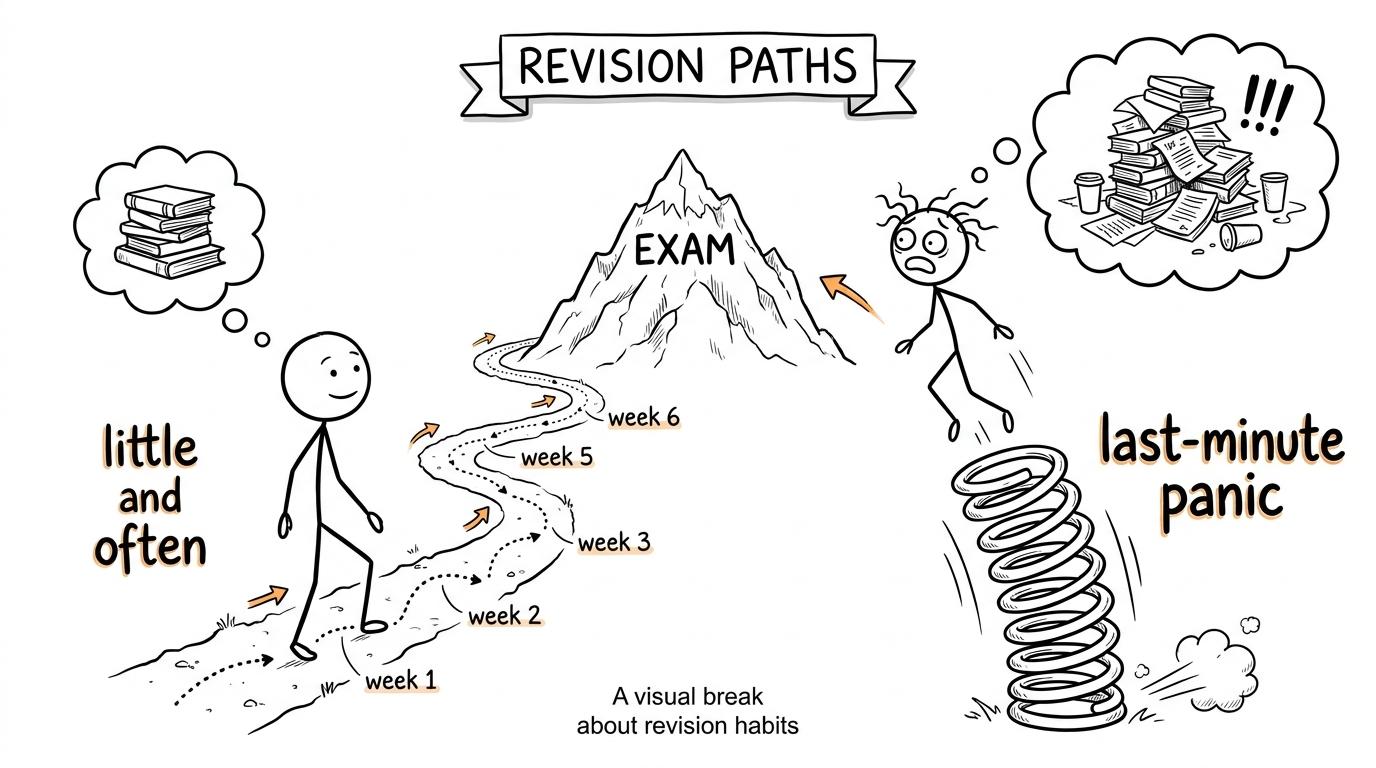 One student climbs through small weekly steps while another attempts a last-minute launch
When early revision turns into burnout
Burnout is more likely when “starting early” quietly becomes “being in exam season for two years”. Constant full papers, rigid daily targets and guilt about rest are not necessary in Year 10.
Watch for these warning signs:
- sessions keep growing because the plan never feels complete
- every missed day is treated as failure
- you repeatedly revise comfortable material to maintain a streak
- sleep, exercise or ordinary free time is being displaced
- Year 11 papers are attempted before enough course content has been taught
- revision creates plenty of notes but little usable feedback
If these appear, reduce the volume before abandoning the routine. A smaller plan repeated for months is usually more valuable than an ambitious plan that disappears after three weeks.
Year 10 should mainly build knowledge, habits and accuracy. Closer to the examination, the emphasis can move towards timing, complete papers and exam technique. For maths, the article on when to start GCSE past papers explains how to move gradually from mini tests to timed sections and then full papers.
How to decide whether your head start is working
Do not measure progress by hours alone. Measure what you can now do without support.
At the end of each month, ask:
- Can I retrieve older Arabic vocabulary without seeing the answer first?
- Can I use key structures in a new response rather than reciting one memorised paragraph?
- Have I practised every skill assessed by my specification?
- Can I complete previously weak maths questions independently?
- Does my error log show fewer repeated mistakes?
- Is the routine still compatible with rest and normal schoolwork?
For maths, a short diagnostic is often more revealing than another evening of rereading. MathsGenie’s guide to finding your weakest GCSE topics shows how to turn lost marks into specific revision priorities.
Full papers become more useful once enough material has been covered. When that point arrives, choose resources matching your board and tier, such as Edexcel GCSE Maths past papers, AQA GCSE Maths past papers or OCR GCSE Maths past papers. Mark schemes and video solutions matter because a score alone cannot explain the mistake.
Common mistakes with a Year 10 head start
Starting with full papers
A full paper can reveal gaps, but it is a poor daily teaching tool when much of the course is unfinished. Begin with taught content, focused recall and short exam-style tasks.
Revising only vocabulary for Arabic
Vocabulary matters, but the Edexcel GCSE assesses four skills. Knowing isolated words does not automatically produce accurate writing, fluent speaking or careful listening.
Treating familiar material as mastered
Rereading notes creates familiarity. Close the notes and retrieve the information. In maths, complete the question before watching the video solution. In Arabic, produce the word, sentence or response before checking it.
Using the wrong specification or tier
A paper from a different qualification may assess different skills. In maths, foundation and higher tier material also differ. Confirm the board, qualification code and tier with your teacher.
Letting Arabic replace maths revision
A head start should ease the future workload, not move the problem elsewhere. Give both subjects protected time. Nearer the maths exams, GCSE predicted papers can help rehearse unfamiliar combinations of topics, but they should follow secure topic practice rather than replace it.
Ignoring rest
Rest is not time stolen from revision. It is part of a routine you can continue. If your plan only works during a perfect week, it is not yet a reliable plan.
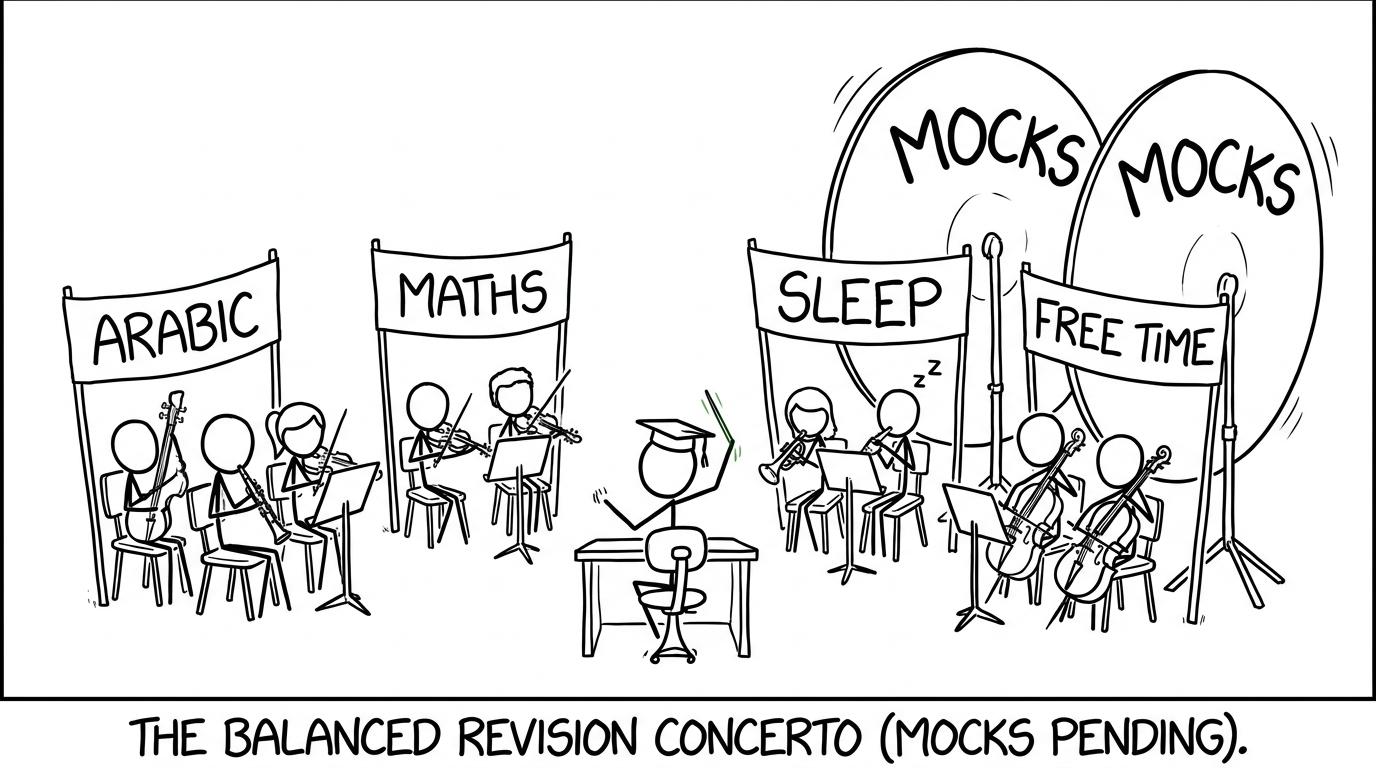 A student conducts a balanced orchestra of Arabic, maths, sleep and free time
Start early, but keep the finish line in perspective
A GCSE Arabic Year 10 revision head start genuinely pays off when it creates stronger recall, earlier feedback and a calmer Year 11. It does not pay off when it means endless papers, constant pressure or sacrificing the foundations of other subjects.
Begin with something repeatable: two short Arabic sessions, protected maths practice and one weekly review of your errors. Let the routine grow only when the evidence says it should.
MathsGenie can keep the maths side of that plan clear and free. Use revision lessons and practice questions to repair individual topics, mini tests to check recall, then progress to past papers, mark schemes, video solutions and predicted papers when you are ready. Build your plan around what you need to improve, not around how busy revision is supposed to look.