

GCSE Revision Timetable You’ll Actually Stick To
GCSE revision timetable that you’ll actually stick to: a simple plan for maths using YesGenie lessons, practice questions, past papers and mark schemes.

A GCSE revision timetable looks brilliant on Sunday night. Then Monday arrives: homework, tiredness, one unexpected thing, and suddenly the plan becomes a guilt museum.
If that’s you, you’re not lazy and you’re not “bad at revision”. You’ve just built a timetable that only works for a version of you who never gets distracted, never gets stressed, and never has a bad day. Real GCSE revision needs a timetable that bends without breaking, and a routine that makes starting feel easy.
This post shows you how to make a GCSE revision timetable you actually stick to, with a maths-first approach that works for foundation and higher tier, and still fits around other subjects.
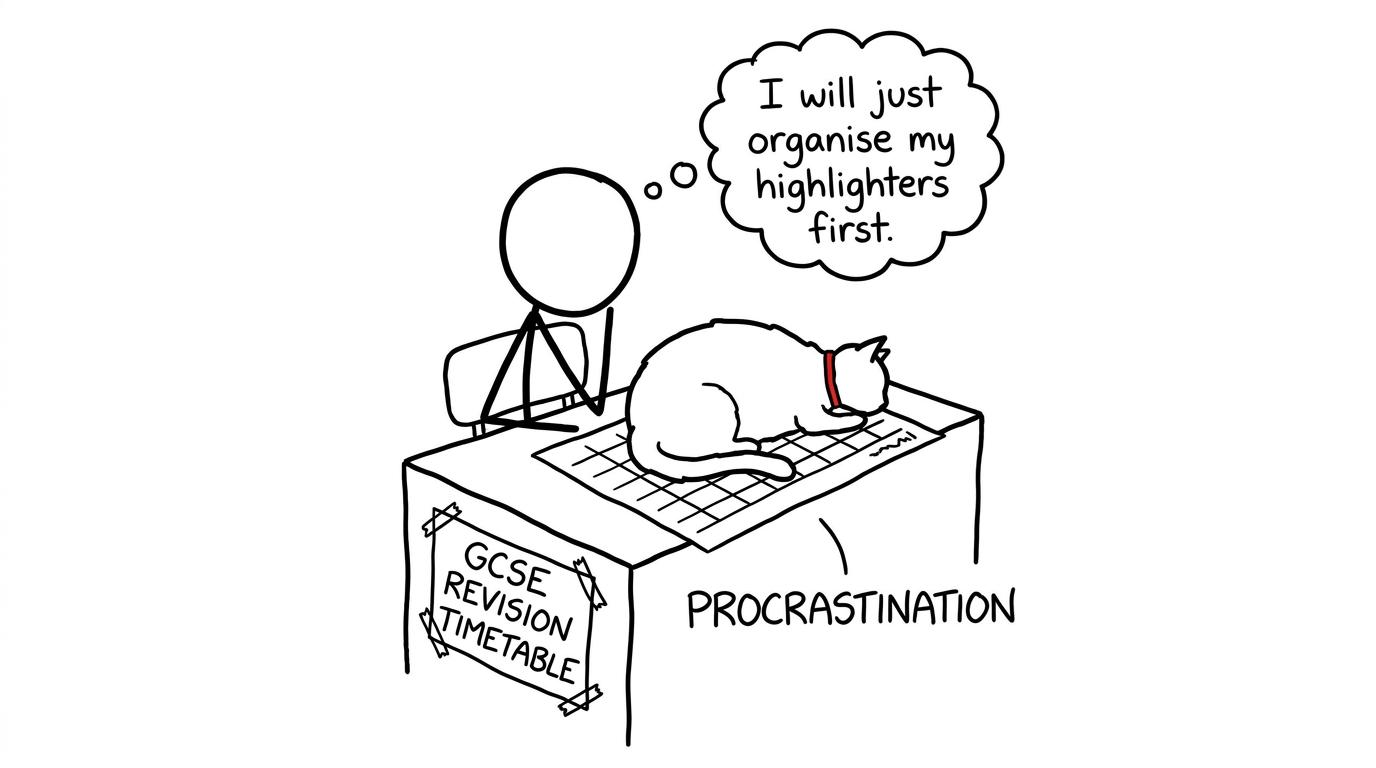 A cat called Procrastination blocks the timetable
The quick checklist for a GCSE revision timetable that sticks
Before we go deeper, here’s the checklist that separates “pretty plans” from usable ones:
- Keep sessions short enough that you’ll start (even on a low-motivation day).
- Plan what you’ll do, not just when you’ll do it.
- Build around your exam board (Edexcel, AQA, OCR, Eduqas/WJEC) and tier (foundation/higher).
- Use a weekly loop: learn a topic, practise exam questions, then check a mark scheme.
- Reserve one slot per week for full GCSE papers, timed.
- Include catch-up time so one missed session doesn’t wreck the whole timetable.
If you want everything in one place for maths, start at your board hub, such as Edexcel GCSE Maths, then pull from lessons, revision guides, practice, and exams.
Why most GCSE revision timetables fail (and what to copy instead)
A timetable fails for one of three reasons.
It asks for perfection
A plan that assumes you’ll revise two hours every night is usually a plan that collapses by Wednesday. GCSE weeks are noisy: after-school clubs, coursework, family stuff, tiredness. A good GCSE revision timetable expects this, and still works.
It measures time, not outcomes
Writing “Maths: 6-7pm” isn’t a task. It’s a container. Your brain needs something smaller and clearer: “Complete one YesGenie lesson, then do 8 exam questions, then mark.” That’s a finish line.
It ignores the maths skill ladder
In GCSE maths, the difference between a grade 4 and a grade 7 is often not “knowing more topics” but being able to execute methods under pressure, show working, and avoid predictable mistakes. That means your timetable must include practice questions, mark schemes, and timed papers, not just reading notes.
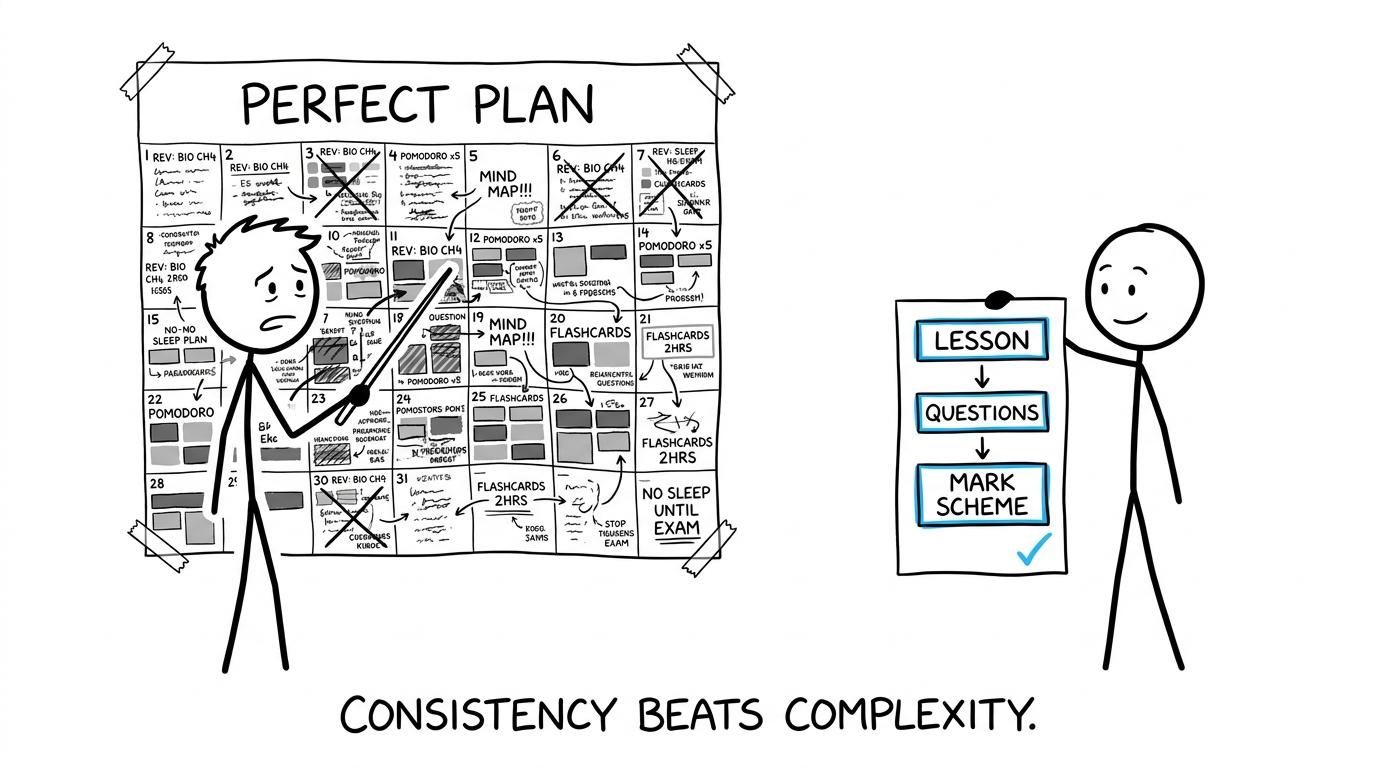 Consistency beats complexity
Build your GCSE revision timetable around three blocks (the YesGenie loop)
Here’s the simplest structure that works for most GCSE students revising maths:
Lesson block (learn or re-learn)
Use this when a topic feels rusty.
- Pick a topic from Edexcel GCSE Maths Revision Guides (or your board equivalent).
- Read the notes, watch the video, and write a short “method card” in your own words.
- Keep it tight: you are aiming for clarity, not a perfect set of notes.
You can also use Edexcel GCSE Maths Lessons for structured, bite-sized teaching.
Questions block (practise like the exam)
This is where grades move.
- Do topic-by-topic questions from the revision guide page, or build exam-style practice using your board section.
- Aim for a small set you can finish and mark in one sitting.
Mark scheme block (feedback, not judgement)
Marking is not a punishment. It’s a map.
- Use mark schemes and worked solutions to spot exactly where method marks are earned.
- Write one line: “Next time, I will…”
For paper practice, bookmark Edexcel GCSE Maths Past Papers and Edexcel GCSE Maths Predicted Papers. Predicted papers are especially useful close to exams because they focus your GCSE revision on likely areas, while still keeping the style exam-realistic.
A GCSE revision timetable you can actually follow (weekly template)
A realistic GCSE revision timetable doesn’t need to be huge. It needs to be repeatable.
The 5-session week (fits most students)
Use five sessions of 303030 to 454545 minutes.
- Session 1 (Maths): Lesson block + a few questions
- Session 2 (Maths): Questions block (same topic)
- Session 3 (Maths): New topic lesson block
- Session 4 (Maths): Mixed questions (two topics)
- Session 5 (Maths): Timed half paper or mini test + marking
Then repeat weekly. The magic is the loop: learn, practise, mark, repeat.
If you want extra resources to vary your practice without breaking the plan, use Resources on YesGenie to find mini tests, predicted papers, and other GCSE revision materials.
The two-tier tweak (foundation vs higher)
- Foundation tier: prioritise fluency and accuracy. Your timetable should revisit core topics more often (fractions, percentages, ratio, linear graphs, standard form).
- Higher tier: keep core fluency, but add weekly problem-solving and “linking topics” sessions (e.g. algebra + graphs, trigonometry + Pythagoras).
Either way, the GCSE revision timetable stays the same shape; only the topics change.
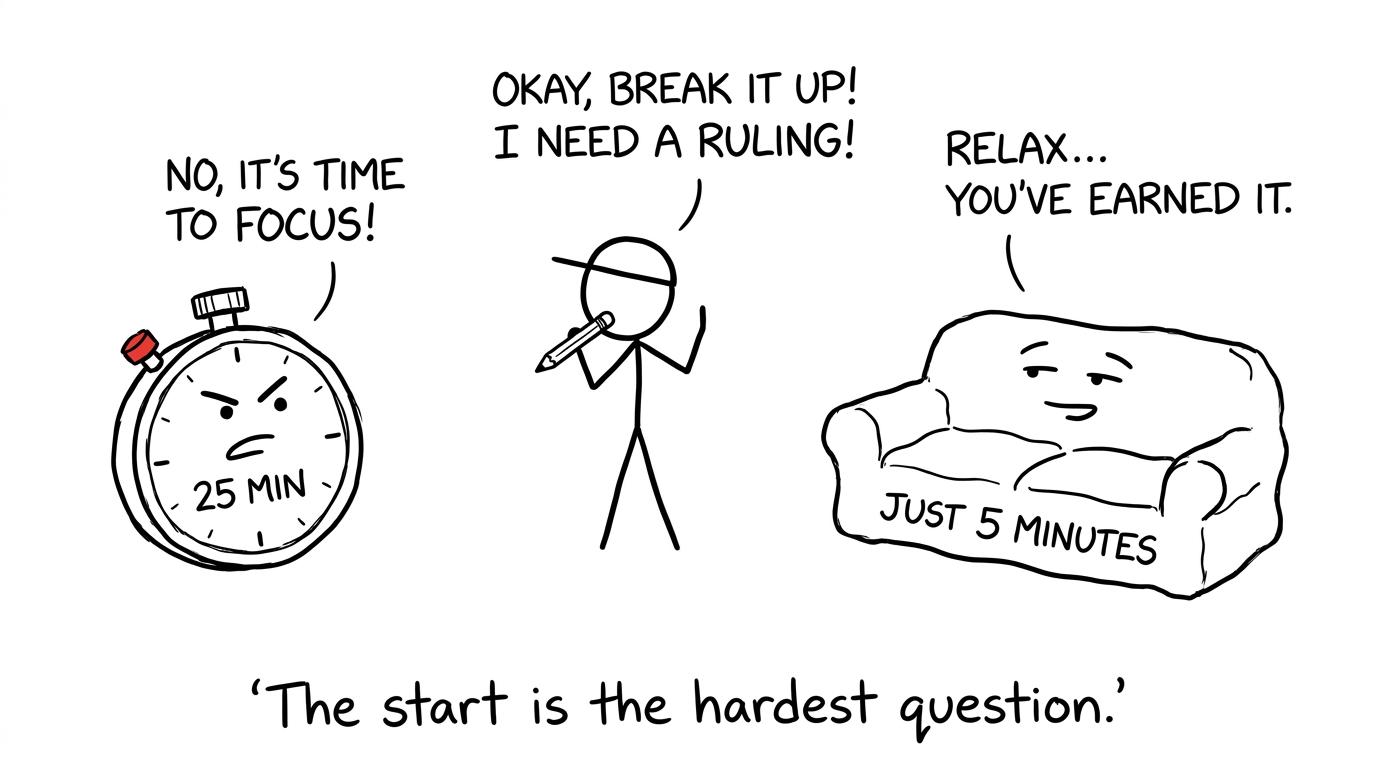 A stopwatch argues with a sofa
Worked example: plan your time using simple GCSE maths
A timetable sticks better when it’s honest about time. Let’s use a quick, GCSE-style calculation to make your plan realistic.
Example: How many maths sessions can you genuinely do?
Suppose you have 444 weeks until your next mock, and you can commit to 555 maths sessions per week.
Total sessions:
4×5=20 4 \times 5 = 20 4×5=20Now decide a split. A strong GCSE split is:
- 40%40\%40% lessons (re-learning)
- 50%50\%50% practice questions (exam style)
- 10%10\%10% timed papers (pressure practice)
Convert to sessions:
Lessons:
0.4×20=8 0.4 \times 20 = 8 0.4×20=8Practice questions:
0.5×20=10 0.5 \times 20 = 10 0.5×20=10Timed papers:
0.1×20=2 0.1 \times 20 = 2 0.1×20=2That’s already a complete GCSE revision timetable for maths: 888 lesson sessions, 101010 question sessions, and 222 timed-paper sessions before the mock.
The point isn’t the exact percentages. The point is that you’ve turned “revise more” into a plan you can finish.
Example: how to pick topics without guessing
Take 101010 practice sessions and spread them across your biggest mark-leaks.
If your last paper showed you dropped marks on:
- algebra (twice as often as other topics)
- probability
- ratio
You might allocate practice sessions in a 2:1:12:1:12:1:1 ratio.
Total ratio parts =2+1+1=4=2+1+1=4=2+1+1=4.
Algebra sessions:
24×10=5 \frac{2}{4} \times 10 = 5 42×10=5Probability sessions:
14×10=2.5≈2 or 3 \frac{1}{4} \times 10 = 2.5 \approx 2\text{ or }3 41×10=2.5≈2 or 3Ratio sessions:
14×10=2.5≈2 or 3 \frac{1}{4} \times 10 = 2.5 \approx 2\text{ or }3 41×10=2.5≈2 or 3Now your GCSE revision timetable is personalised, not random.
To target specific weak areas, choose revision guide pages such as Venn Diagrams (AQA GCSE Maths) or Coordinates (OCR GCSE Maths), then follow the same loop: learn, practise, mark.
How to make your GCSE revision timetable easier to start
Most students don’t fail to revise because they can’t do maths. They fail because they can’t start.
Use the “minimum viable session”
Write a smaller version of every task, so you can still keep the habit on bad days.
- Full session: “Lesson + 10 questions + mark.”
- Minimum session: “3 questions + mark.”
A GCSE revision timetable is a streak game. A small win today protects tomorrow.
Keep the first five minutes stupidly easy
Set up your desk. Open the right page. Do the first question only.
Once you’ve started, your brain stops negotiating.
Plan catch-up time on purpose
Put one catch-up slot in your timetable each week. If you miss a session, you don’t “fall behind”. You just move it.
This is the difference between a timetable that survives real life, and one that demands perfection.
Common mistakes students make with a GCSE revision timetable
- Planning marathon sessions and then avoiding them. Shorter sessions done consistently beat heroic plans.
- Only doing lessons and not doing exam questions. GCSE maths is performance under pressure, not just understanding.
- Not marking properly. If you don’t use a mark scheme, you don’t learn what the examiner rewards.
- Always revising what feels comfortable. Your timetable must deliberately revisit the topics you avoid.
- Ignoring mixed practice. GCSE papers mix topics, so your timetable needs at least one mixed session weekly.
- Treating missed sessions as failure. A good timetable has flex built in.
 The exam paper demands working
Closing: make your GCSE revision timetable boring in the best way
The timetable you stick to is rarely the most impressive one. It’s the one that forgives missed days, starts easily, and tells you exactly what to do next.
If you want a GCSE revision timetable that actually holds, build it around the YesGenie loop: learn a topic, practise exam questions, and mark using worked solutions. Then add timed practice with Edexcel GCSE Maths Past Papers and sharpen your focus with Edexcel GCSE Maths Predicted Papers. Use Edexcel GCSE Maths (or your board page) to keep everything organised: revision lessons, revision guides, practice questions, and mark schemes.
Your GCSE revision timetable doesn’t need to change your personality. It just needs to make the next session simple enough that you’ll do it, and repeat it until exam day.










