

GCSE German Paper 3: What to Actually Expect
GCSE German Paper 3 explained: compare timings, tiers and question types, then build a calm revision plan for reading and translation marks in 2026.
The unsettling thing about a reading exam is that the page can look difficult before you have answered anything. One unfamiliar compound noun appears, confidence falls, and suddenly every sentence seems harder.
But GCSE German Paper 3 is not a test of whether you understand every German word. For the main specifications used in England, it is the reading paper. It tests whether you can identify messages, details, opinions and time frames, infer meaning from context, and translate German into accurate English.
For students taking the reformed AQA or Pearson Edexcel qualifications from 2026, Paper 3 lasts 454545 minutes at foundation tier and 606060 minutes at higher tier. It is worth 25%25\%25% of the GCSE and carries 505050 marks. Eduqas uses a different structure and longer timings, so checking your board is the first task, not a minor administrative detail.
GCSE German Paper 3 at a glance
Before revising, confirm these five things:
- your exam board and specification code
- whether you are entered for foundation or higher tier
- the exact time allowed
- the language in which each answer must be written
- the length and mark value of the translation
The current arrangements are not identical across boards.
| Exam board and specification | Foundation tier | Higher tier | Main Paper 3 focus |
|---|---|---|---|
| AQA 866286628662, first assessed in 202620262026 | 454545 minutes, 505050 marks | 606060 minutes, 505050 marks | Reading comprehension in English or non-verbally, followed by German-to-English translation |
| Pearson Edexcel 1GN11GN11GN1, first assessed in 202620262026 | 454545 minutes including 555 minutes of reading time, 505050 marks | 606060 minutes including 555 minutes of reading time, 505050 marks | Reading and understanding, inference and German-to-English translation |
| Eduqas legacy specification | 606060 minutes, 606060 marks | 757575 minutes, 606060 marks | Responses in English and German, plus German-to-English translation |
AQA’s new Paper 3 gives 404040 marks to reading comprehension and 101010 marks to translation. The minimum translation length is 353535 words at foundation and 505050 words at higher. Pearson’s reformed qualification has the same overall duration, total marks and weighting, although you should use its own sample assessment materials when learning the precise layout.
OCR does not currently offer a mainstream GCSE German qualification. If you have seen OCR mentioned in a general revision guide, do not assume its advice describes your German paper. Your school or exam timetable should identify the board you are actually taking.
Specifications change. AQA’s older 866886688668 qualification and Pearson’s older 1GN01GN01GN0 papers remain useful for some reading practice, but their layouts should not be treated as exact models for the reformed exams first assessed in 202620262026.
What is actually different about Paper 3?
Listening asks you to process language at the speed of a recording. Writing asks you to generate language yourself. Paper 3 sits between them.
You control the pace, but the examiner controls the evidence. Your job is to find exactly what the text proves.
You are reading for evidence, not general familiarity
A passage may be about holidays, school, technology, relationships or the environment. Recognising the topic is only the beginning. Questions usually target a particular detail, reason, attitude or change.
That is why broad answers are dangerous. If the text says someone used to enjoy school but now finds lessons stressful, an answer such as “They talk about school” identifies the topic but misses the tested contrast.
Train yourself to separate:
- the overall message
- a specific factual detail
- a positive or negative opinion
- a reason or consequence
- what happened in the past, happens now or will happen later
- information that is stated directly from meaning that must be inferred
Unknown vocabulary is often part of the task
Current AQA assessment explicitly includes inferring plausible meanings of individual words in sentences. Pearson also expects students to deduce meaning from context.
This does not mean guessing randomly. Look at the surrounding sentence, familiar word stems, grammatical role and overall situation. A strange noun may be less important than the recognisable verb or adjective beside it.
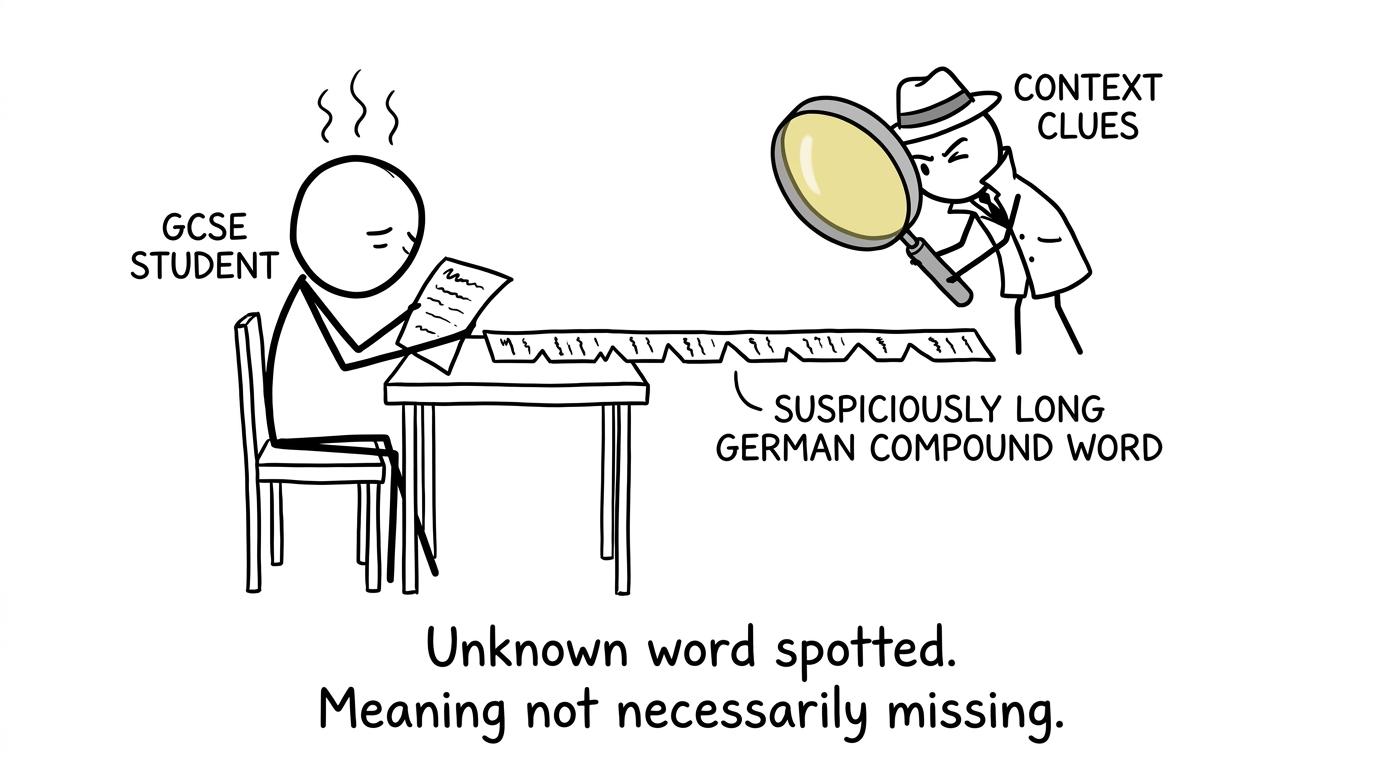 A detective investigates an unfamiliar German word using context clues
One unknown word should not be allowed to contaminate an entire paragraph. Mark it lightly, gather the information you can understand, and return only if the question genuinely depends on it.
Translation rewards complete meaning
The German-to-English translation is not creative writing. It rewards a faithful, natural English version of the full message.
Pay particular attention to:
- negatives such as nicht, nie, nichts and kein
- modal verbs
- separable verbs
- pronouns and possessives
- comparative language
- connectives that establish contrast or cause
- past, present and future time frames
A polished sentence that omits “not” can reverse the meaning. A slightly plain English sentence that preserves every idea is usually safer than an elegant paraphrase that loses detail.
The question types Paper 3 favours
Exact formats differ, but you should expect a mixture rather than one long comprehension exercise.
Common tasks include:
- multiple-choice or non-verbal selection
- matching people, statements or headings
- choosing true or false statements
- completing gaps, notes or tables
- short answers in English
- short answers in German on specifications that require them
- identifying details, reasons and opinions
- drawing an inference from context
- translating a passage into English
Eduqas explicitly lists multiple choice, matching, gap fills, correct or false statements, table completion, short answers and longer responses. AQA’s reformed specification simplifies the language of response by placing comprehension questions in English, answered in English or non-verbally.
Always read the instruction before the passage. The command may require one detail, two details or a letter from a list. This is the language-exam equivalent of a maths student solving correctly but answering the wrong part of the question.
A sensible timing strategy
There is no universal minute-by-minute plan because passages and mark allocations vary. A reliable principle is to let the marks govern your time.
At the beginning:
- scan the paper and locate the translation
- notice which questions carry several marks
- read each instruction carefully
- begin steadily rather than trying to translate the opening passage word by word
During the paper:
- underline names, dates, negatives and time indicators
- answer from the text, not from what seems likely in real life
- move on when one word is blocking progress
- leave enough space to return to uncertain answers
At the end:
- check that every required box or line has a response
- verify that English questions have English answers
- reread the translation for missing negatives and time frames
- make sure your English communicates the original meaning naturally
This resembles the discipline used in timed maths practice. The MathsGenie guide to starting GCSE past papers explains why timing should be trained gradually rather than attempted only in the final week.
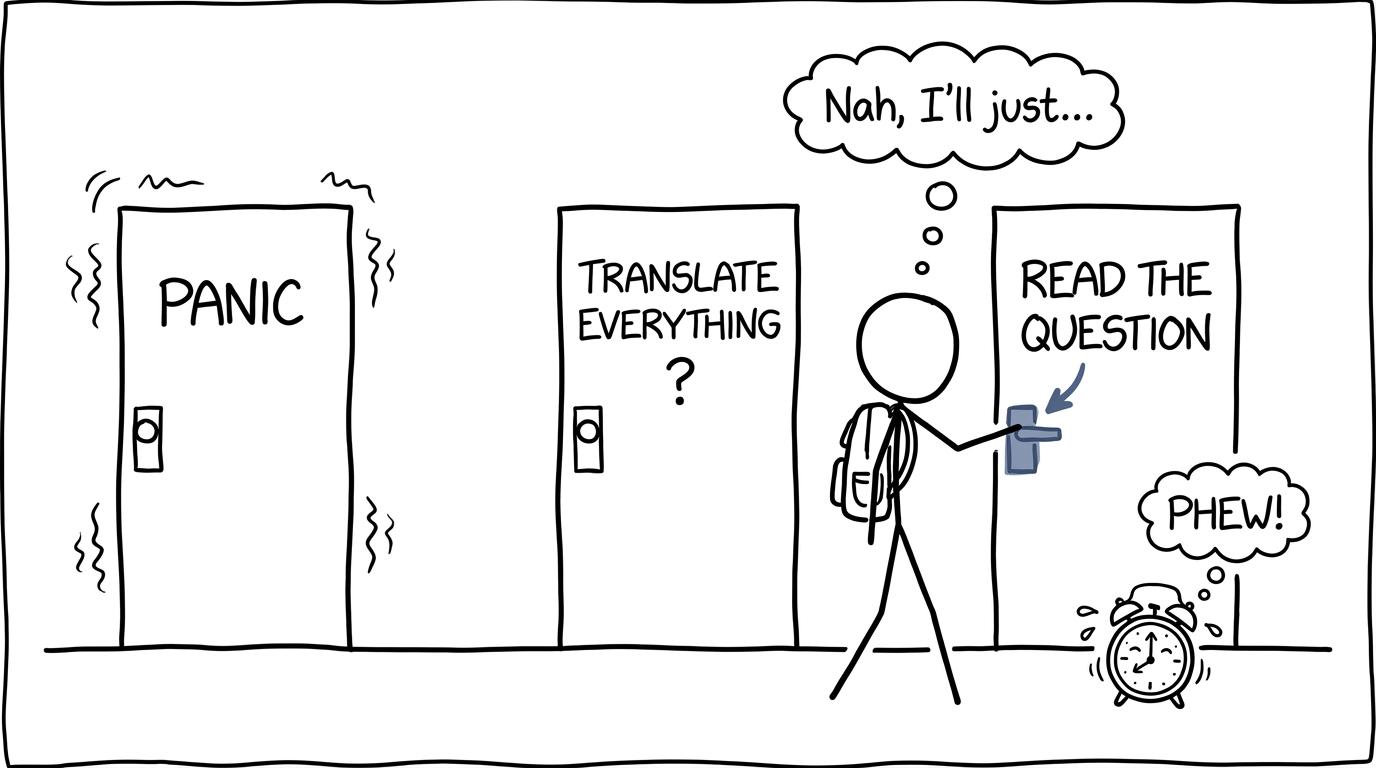 A student chooses to read the question instead of panicking
How to revise for the reading paper
Vocabulary lists matter, but rereading them is not enough. Paper 3 asks you to recognise language inside unfamiliar texts, under time pressure.
Use short retrieval sessions
Choose a small vocabulary group, cover the meanings and retrieve them from memory. Include verbs, adjectives and connectives as well as topic nouns. Return to the same material after a gap rather than treating one successful session as proof that it is secure.
The learning principle transfers directly across subjects. MathsGenie’s guide to stopping GCSE content from being forgotten shows how active recall, spaced practice and exam questions can form one revision cycle.
Practise extracting details
Use specification-matched sample papers and available past papers. After each text, classify any lost mark:
- vocabulary gap
- missed negative
- wrong time frame
- answer lacked enough detail
- instruction misunderstood
- unsupported inference
- correct idea written in the wrong language
A total mark tells you how the paper went. An error category tells you what to do tomorrow. The same diagnostic habit is described in MathsGenie’s guide to finding weak GCSE topics.
Mark strictly and repeat the skill
Use the official mark scheme for your specification. Do not award yourself a mark because your answer was “close to what I meant”. Compare the credited information with your actual words.
Then try another question testing the same skill. Improvement comes from closing the gap, not merely discovering it.
If German is competing with several subjects, place it inside a realistic schedule. The GCSE revision timetable guide offers a useful model for balancing retrieval, focused practice and timed work. The one-month GCSE revision plan can also help you organise the final run-in without turning every evening into a full-paper marathon.
Common mistakes in GCSE German Paper 3
Translating the whole passage before answering
This consumes time and can make simple retrieval questions feel larger than they are. Read the question first, locate the relevant section and extract the required evidence.
Ignoring small words
Words such as aber, obwohl, früher, noch, schon and leider can change the direction or time frame of a sentence. Small words often carry large amounts of meaning.
Copying German into an English answer
A copied phrase does not demonstrate understanding when the instruction requires English. Check the required response language every time.
Giving too much information
Extra material can introduce a contradiction. If the question asks for one reason, give one precise reason supported by the text.
Assuming every old paper matches the current format
Older papers remain valuable for comprehension practice, but the reformed AQA and Pearson specifications are first assessed in 202620262026. Prioritise current sample assessment materials for layout, timing and instructions.
Leaving the translation until there is almost no time
The translation carries a defined block of marks. Decide in advance when you will start it, then protect that time in practice papers.
Make Paper 3 feel familiar before exam day
A reading paper becomes manageable when you stop treating every unfamiliar word as a verdict on your ability. Confirm the correct specification, practise the question types you will actually face, mark your answers honestly and revisit the mistakes that repeat.
MathsGenie does not provide GCSE German papers, but it can keep the rest of your exam preparation structured. Use the free GCSE maths revision hub for board-specific revision lessons, practice questions, mini tests, past papers, predicted papers, mark schemes and video solutions. For busy days, the 20-minute GCSE revision routine provides a simple pattern you can apply across your revision timetable.
Paper 3 rewards a calm habit: read the instruction, find the evidence, preserve the meaning and move forward. Practise that habit often enough, and the page stops looking like a wall of German. It becomes a series of decisions you already know how to make.











