

GCSE Geography November Resit: Is It Available?
GCSE Geography November resit options explained, including current exam rules, possible exceptions and how to plan for a summer Geography resit.

A disappointing Geography result can make November feel like the obvious second chance. It arrives quickly, the knowledge is still fresh and GCSE maths resits already happen then. But the central fact is simple: a GCSE Geography November resit is not normally available in England. Under the current standard arrangements, the November GCSE series is for English Language and maths, with age restrictions. Students resitting Geography will usually need to enter the next summer exam series instead.
There can be narrow exceptions involving legacy qualifications, different UK jurisdictions or qualifications that are not standard GCSEs in England. That is why the safest next step is to check the exact qualification, exam board and specification with your exams officer rather than relying on a general online resit calendar.
The answer at a glance
- Standard GCSE Geography qualifications in England are normally examined in the summer series.
- November GCSE examinations are generally limited to English Language and maths for eligible students.
- AQA, Pearson Edexcel and OCR Geography resit candidates should usually expect to wait until the following summer.
- Eduqas candidates should confirm the series attached to their exact specification.
- Some legacy WJEC qualifications may have restricted additional resit opportunities for eligible post-16 candidates.
- A November assessment described as a Geography “resit” may actually be a school mock or an internal assessment.
- Private candidates need an approved centre willing to make the correct entry and meet any specification requirements.
The difference matters because revision is shaped by the date. A November exam calls for a short turnaround. A summer resit gives you longer, but only if that time is turned into a deliberate plan.
Why Geography is not normally in the November series
GCSE subjects do not all share the same resit timetable. In England, Ofqual’s current guidance states that November GCSE examinations are available for English Language and mathematics, and only for students who were aged 16 or over on 31 August of that year. Most other GCSE examinations take place in May and June.
Geography therefore follows the main summer cycle. This is true even when a student only narrowly missed the grade they wanted. The size of the gap does not create an extra examination sitting.
That can feel arbitrary. Yet an exam series is a large system involving secure papers, trained markers, centres, timetables and consistent national standards. The familiar November opportunity for maths does not imply that every GCSE subject can be entered at the same time.
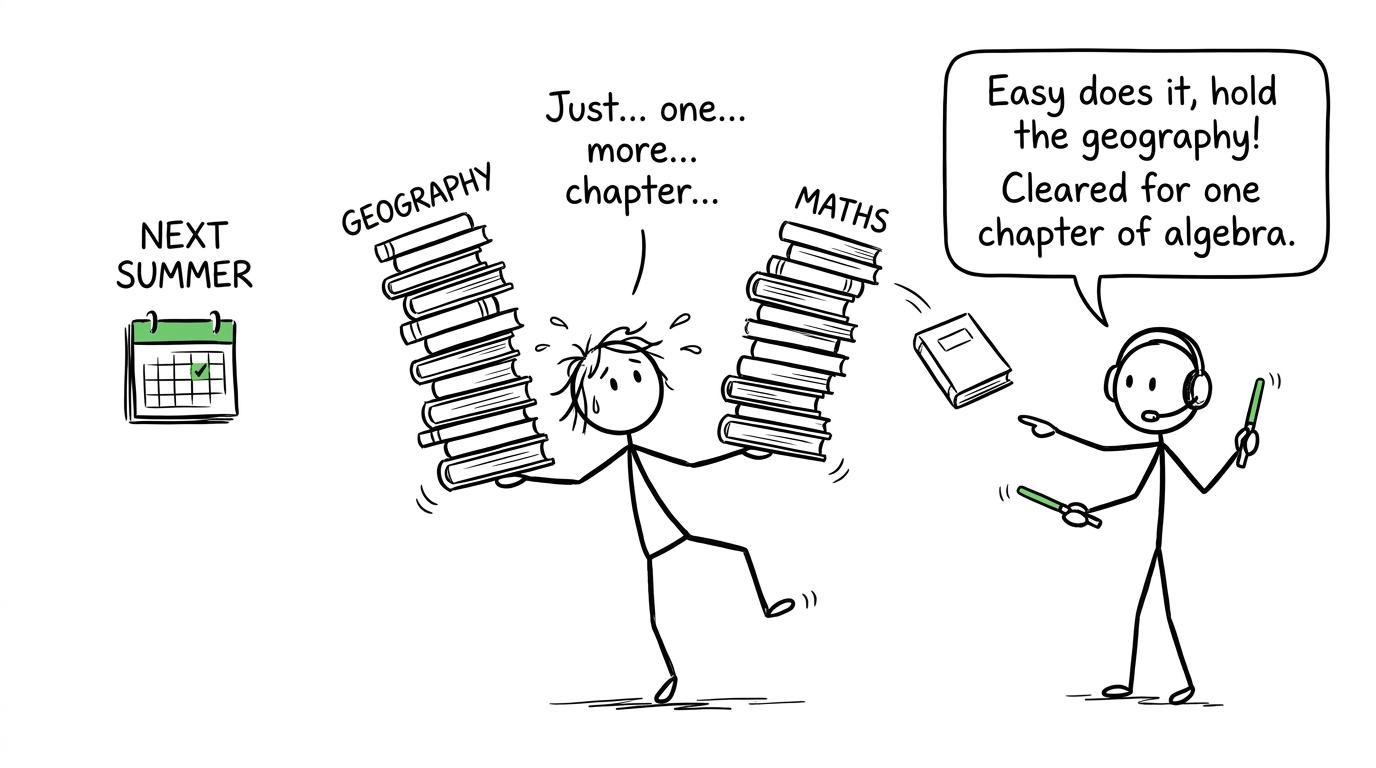 A student balancing Geography and maths revision while a planner calmly directs the workload
Does the answer change by exam board?
For the mainstream GCSE Geography specifications used in England, changing exam board does not usually produce a November route. The normal expectation remains a summer entry.
AQA, Edexcel and OCR
Students taking AQA, Pearson Edexcel or OCR GCSE Geography should ordinarily plan for the next available summer series. Before revising, confirm the specification code and make sure the centre intends to enter you for that same qualification.
This is important because Geography specifications differ in their content, case-study expectations, fieldwork requirements and paper structure. Revising “GCSE Geography” in general is not precise enough when the examination questions will follow one particular specification.
Eduqas and WJEC
Eduqas qualifications used in England should also be checked against the current timetable for the exact specification. Do not assume that the presence of another WJEC-branded Geography qualification creates a November entry for your course.
There is a limited complication in Wales: qualification reform has created additional resit arrangements for certain legacy WJEC qualifications. Official WJEC information indicates that some legacy Geography candidates may have a November 2026 opportunity, restricted to eligible post-16 candidates who previously cashed in the relevant qualification.
That is an exception, not a general GCSE Geography November resit. It is realistic only if your qualification code, previous entry and candidate status satisfy the published conditions. Your school, college or approved centre must verify this before you build a revision plan around it.
Who is a Geography resit realistic for?
Being allowed to resit and benefiting from a resit are different questions. A summer Geography resit can be sensible when the improved grade has a clear purpose.
It may be realistic if:
- a sixth form, college, apprenticeship or future course expects a particular grade;
- your result was materially below your usual performance;
- illness, disruption or poor exam technique affected the original sitting;
- you have enough time to prepare without weakening more important qualifications;
- an approved centre can enter you for the correct specification;
- you are prepared to revisit the complete assessed course rather than only your favourite topics.
A resit is less convincing when it is driven only by discomfort with the result. Geography is content-heavy, and the examination also rewards application, interpretation, fieldwork understanding and extended responses. Wanting a higher grade is understandable, but the likely benefit should justify the time, centre arrangements and any private-candidate fees.
For many post-16 students, maths and English Language deserve priority because continued participation may be required by their education programme and because these qualifications commonly affect progression. Geography is normally an optional improvement. If you are balancing both subjects, begin with the practical advice in the GCSE maths resit results-day plan.
What to do if someone has offered you a November resit
Do not reject the information immediately, but do not assume it means a standard GCSE examination either. Ask for the details in writing.
Confirm:
- the full qualification title;
- the exam board;
- the specification and entry codes;
- whether the assessment is an external GCSE examination or a school mock;
- the examination series and year;
- your eligibility as a new or resit candidate;
- which papers or components must be taken;
- the entry deadline and total centre fee.
A useful rule is that a date without a specification code is not yet an exam plan. November may refer to a mock examination, an international qualification, a legacy specification or an internal college deadline.
 A candidate checking the board, specification and series instead of trusting an internet rumour
Planning for the next summer series
Once summer is confirmed, the waiting period should become an advantage. The most effective plan is not constant revision from results day onwards. It is a sequence: diagnose, repair, practise and then rehearse.
Diagnose the original result
Start with any available teacher feedback, exam breakdown or recalled difficulties. Separate gaps in knowledge from problems with command words, timing, map interpretation, data response and extended writing.
Use the same principle in maths. A total mark tells you what happened; an error log tells you what to do next. The GCSE maths revision timetable guide explains how to turn weak areas into a sustainable weekly routine.
Rebuild weak content before attempting full papers
Revise from your exact Geography specification and cover the whole course. Avoid repeatedly reviewing only familiar case studies. Complete focused questions after each topic, then return to it later without notes.
For maths, MathsGenie’s free resources make the same learning cycle straightforward: use a revision lesson, answer practice questions, mark the work and retest the skill. The one-month GCSE maths revision plan is useful when you need a compact structure rather than an unrealistic daily marathon.
Introduce timed papers gradually
Full papers are most valuable after enough content has been rebuilt to make the result diagnostic. Start with individual sections, then progress to complete papers under the correct time limit.
Marking is not the final step. Record why each mark was lost and decide what action follows. Maths students can use the advice in when to start GCSE past papers to balance topic repair with timed practice.
Predicted papers can add fresh questions near an exam, but they should not replace official past papers or complete specification coverage. MathsGenie’s Edexcel GCSE maths predicted papers include mark schemes and worked solutions for structured exam preparation.
Balancing Geography with a November maths resit
Some students searching for a Geography November resit are actually facing two different calendars: maths in November and Geography the following summer. Treating both subjects as equally urgent can create unnecessary pressure.
Until the November maths papers, give maths the larger share of your exam-focused revision while keeping Geography alive through shorter, regular sessions. After the maths series, increase the depth of Geography work. This avoids abandoning Geography without distracting from the nearer examination.
Use mini tests and targeted questions before relying on complete maths papers. As the exam approaches, the GCSE maths night-before plan can help you protect sleep, check equipment and avoid frantic topic-hopping. For longer-term decisions, how many GCSE past papers to complete explains why careful review matters more than collecting paper totals.
Common mistakes when arranging a Geography resit
Assuming every GCSE can be resat in November
The November availability of maths and English Language is specific to those subjects. It is not a universal autumn resit window.
Confusing a mock with an external examination
Schools often hold mocks in November. A mock can be valuable preparation, but it does not produce a new GCSE result.
Revising before confirming the specification
Course content and paper structures vary between boards and specifications. Confirm the qualification first, especially if you have changed school or are entering privately.
Finding a centre too late
Not every school or private exam centre accepts external Geography candidates. Centres set their own administrative deadlines and charges, so contact them well before the awarding organisation’s final entry deadline.
Underestimating assessment requirements
Geography is not simply a collection of facts. Your centre should confirm which papers are required and how any fieldwork or administrative requirements apply to your entry.
Letting Geography damage a more urgent maths resit
If maths is scheduled for November, its shorter preparation window deserves attention. A clear planner protects both subjects better than switching between them according to anxiety.
Your next move
For most students in England, the answer is settled: there is no standard GCSE Geography November resit, so plan for the next summer series. The narrow exceptions are only realistic when an exams officer confirms that your exact qualification and candidate history qualify.
Make that confirmation first. Then build a revision timetable around the examination you will actually sit.
If maths is part of your resit year, use MathsGenie as your free revision base. Begin with revision lessons and practice questions, diagnose gaps with mini tests, and then build confidence through past papers, predicted papers, mark schemes and video solutions. The calendar may decide when the exam happens. Your revision process decides how well prepared you are when it arrives.











