GCSE French Exam Time of Day: Does It Matter?
GCSE French exam time of day explained: discover whether morning or afternoon exams affect performance and how to prepare effectively for either session.
You open your exam timetable and spot GCSE French in the afternoon. Your friend has already decided this is bad news: everyone is tired after lunch, concentration disappears and morning candidates supposedly have an advantage.
The short answer is reassuring. Your GCSE French exam time of day may influence how alert you feel, but there is no strong evidence that a morning or afternoon session will determine your grade. Some research suggests teenagers may perform slightly better later in the day, yet the findings are mixed and are not specific to GCSE French. Sleep, preparation, food, stress and familiarity with the paper are likely to matter more.
You usually cannot choose the session. What you can do is prepare your body and routine for the time printed on your school timetable.
The quick answer
Keep these points in mind:
- Morning and afternoon sessions are both normal parts of the GCSE timetable.
- JCQ's published starting times are 9.009.009.00 am for morning examinations and 1.301.301.30 pm for afternoon examinations, although schools can start within permitted windows.
- Different French components may be held in different sessions.
- Speaking assessments are normally arranged by your school within an assessment window.
- Research suggests time of day can affect alertness, but it does not prove that afternoon GCSE French papers are easier or harder.
- You should check your personal timetable rather than relying on a friend's timetable or an online summary.
- The best response is to practise under conditions resembling your actual session.
That final point matters. A timetable is not a prediction of your performance. It is simply a condition you can prepare for.
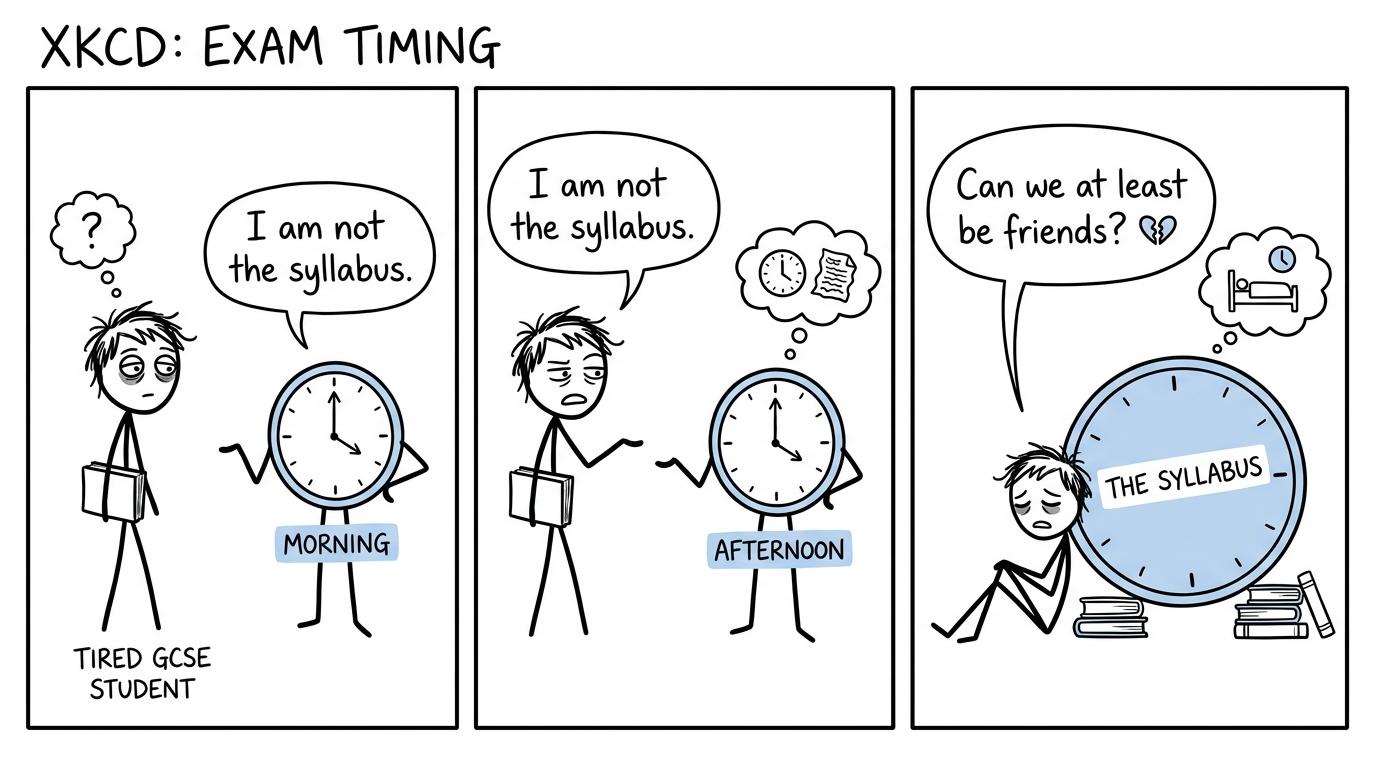 Two clocks discover that neither of them is the syllabus
How GCSE French exam sessions are decided
GCSE examination dates and sessions are set nationally by awarding organisations working within JCQ timetable arrangements. Your school enters you for the relevant specification and gives you a personal timetable showing the date, session, location and candidate details.
JCQ's standard published start is 9.009.009.00 am for a morning examination and 1.301.301.30 pm for an afternoon examination. In the UK, centres may ordinarily begin up to 303030 minutes before or after the published time while following JCQ security rules. That means the precise start at your school may differ slightly from the headline time.
French is not one single written examination. Depending on the exam board and specification, assessment covers listening, speaking, reading and writing. Some components may share a date or session, while others occur on separate days. AQA, Pearson Edexcel and Eduqas do not necessarily use identical structures or timetables.
Always treat your school's final timetable as the practical authority. Specifications and timetables can change between examination series, so a date copied from a previous year is not reliable.
Does morning versus afternoon affect performance?
Possibly, but not in a simple or predictable way.
Adolescent body clocks commonly shift later during the teenage years. This can make very early starts feel difficult, particularly after insufficient sleep. Research involving secondary-school and university students has sometimes found weaker performance among later chronotypes in morning assessments. Other studies have reported stronger average results around late morning or early afternoon.
However, there are important limits:
- much of the research is not based on GCSE candidates;
- studies examine different subjects, ages and assessment formats;
- individual sleep patterns vary;
- an average difference does not predict one student's result;
- evidence specifically comparing morning and afternoon GCSE French papers is lacking.
One large UK university study found that students performed best on average in an early-afternoon examination slot. Yet university examinations are not GCSE French papers, and the result should not be treated as proof that every teenager will perform better after lunch.
The sensible conclusion is that time of day can affect readiness at the margins. It is not destiny. A well-prepared student in a morning session is not automatically disadvantaged, just as an afternoon session does not guarantee sharper thinking.
What each session may feel like
A morning French examination
A morning paper can feel clean and direct. There is less time to wait, fewer conversations to overhear and less opportunity for anxiety to grow. If you normally wake early and eat breakfast, you may feel naturally ready.
The difficulty appears when a student stays up late revising, wakes in a rush and arrives mentally foggy. This is not really a morning-exam problem. It is a sleep and routine problem.
For a morning session:
- return to your normal school-night sleep schedule several days beforehand;
- prepare your equipment and candidate details the night before;
- eat a familiar breakfast if you normally do;
- arrive at the time requested by your school;
- use only a brief vocabulary warm-up rather than frantic last-minute learning.
The GCSE maths night-before plan is written for maths, but its central lesson transfers well: organise the evening, complete a small amount of focused revision and stop at a sensible time.
An afternoon French examination
An afternoon paper gives you more time, but more time is not always more useful. The temptation is to revise continuously from breakfast until the exam. By the time the paper begins, attention has already been spent.
Another risk is the post-lunch dip. A very heavy or unfamiliar meal may leave you uncomfortable, while skipping food can make concentration harder. Choose a normal lunch that you already know suits you and follow your school's arrangements for candidates waiting on site.
For an afternoon session:
- keep the morning structured but light;
- complete one short recall activity, then take a proper break;
- eat and drink normally rather than experimenting with energy drinks;
- avoid discussing predicted questions immediately before entering;
- follow any supervision instructions if you have another examination that day.
 A student realises the enormous pre-exam lunch may be the real opponent
Prepare for the session you actually have
The best way to reduce uncertainty is rehearsal. If your written French paper is in the morning, complete some timed practice in the morning. If it is in the afternoon, occasionally practise after lunch.
You are not trying to discover a perfect biological minute. You are teaching your brain that focused work at this time is familiar.
A useful rehearsal should include:
- the correct paper length and permitted equipment;
- a quiet desk without a phone;
- no pausing during listening practice;
- realistic reading and writing time limits;
- marking against the exam board's mark scheme afterwards.
Do not move every revision session to the examination time. Your weekly timetable still needs to accommodate school, travel, meals and other GCSE subjects. One or two realistic rehearsals can reveal practical issues without distorting your entire revision plan.
Maths students can apply the same principle with free GCSE maths revision resources. Choose your board and tier, then use timed practice to learn how your concentration changes across the day.
Protect your maths revision around the French paper
The real cost of worrying about GCSE French timing may be what it does to the rest of your timetable. A student can spend an entire morning thinking about an afternoon French paper, then abandon maths revision because the day feels "used up".
A better approach is to make the day smaller.
Before an afternoon French exam, you might complete a short maths retrieval task, but avoid a demanding full paper. After a morning French exam, take a break before deciding whether a light maths session is sensible. If you have another examination the next day, prioritise that subject rather than replaying French answers.
The one-week GCSE maths revision plan shows how to divide revision into manageable tasks. If you are unsure where to begin, use a mini test or paper section to find your weakest GCSE topics instead of revising everything equally.
Your exam board and tier also matter. The GCSE maths topics by board and tier guide helps distinguish Foundation and Higher content across Edexcel, AQA, OCR and Eduqas. That is more productive than letting one French session consume the whole day's attention.
Common mistakes when planning for exam time
Assuming afternoon automatically means worse
Feeling sleepy once after lunch does not prove that every afternoon examination will go badly. Your sleep, meal, hydration, anxiety and preparation all interact with the session.
Changing sleep at the last minute
Going to bed unusually early before a morning exam may leave you staring at the ceiling. Keeping a stable routine over several days is more sensible than trying to force one perfect night.
Using the extra morning for cramming
An afternoon start can create the illusion of unlimited revision time. Long, anxious cramming often increases fatigue without creating secure knowledge.
Trusting an unofficial timetable
Dates differ by exam board, specification and year. Check the timetable issued by your school, including arrival instructions and any access arrangements.
Sitting full papers without reviewing them
Practice only becomes useful when you identify why marks were lost. MathsGenie's guide to starting GCSE past papers explains how timed work should develop gradually and be followed by careful marking.
Neglecting other subjects
French matters, but so does the maths paper approaching next. Use the best order for learning GCSE maths topics to choose a focused next task rather than opening a random chapter.
 The boring organised plan calmly defeats exam-day chaos
Focus on the variables you can control
You cannot normally move a nationally timetabled French paper from morning to afternoon. You can control when you sleep, what you eat, how early you arrive and whether you have rehearsed the format.
That is the deeper answer to the question. The GCSE French exam time of day may slightly change how the paper feels, but preparation determines whether that feeling becomes a problem. Build a familiar routine, check your official timetable and save your energy for the questions in front of you.
Then keep the rest of your revision moving. Visit the MathsGenie GCSE revision hub for free revision lessons, practice questions, past papers, predicted papers, mini tests, mark schemes and video solutions. Choose one useful task, complete it carefully and let evidence, not the clock, decide what you revise next.