GCSE Food and Nutrition Exam Dates 2026
GCSE food and nutrition exam dates 2026, paper durations, exam-board details and a practical checklist covering everything to arrange before test day.
An exam date can look like a small piece of information. Yet once it enters your calendar, everything around it changes: revision sessions gain a deadline, other subjects compete for space, and the night before becomes real.
The key GCSE food and nutrition exam dates 2026 answer is straightforward. The AQA, OCR and Eduqas written examinations were scheduled for Thursday 11 June 2026 in the afternoon. The duration depended on the exam board: AQA and Eduqas allowed 1 hour 45 minutes, while OCR allowed 1 hour 30 minutes.
Your personalised school timetable remains the final instruction for your start time, room, seat and approved access arrangements.
Exam date overview
| Exam board | Specification or component | Date | Session | Duration |
|---|---|---|---|---|
| AQA | 8585/W Paper 1: Food preparation and nutrition | Thursday 11 June 2026 | Afternoon | 1 hour 45 minutes |
| OCR | J309/01 Food preparation and nutrition | Thursday 11 June 2026 | Afternoon | 1 hour 30 minutes |
| Eduqas | C560UA0-1 written or C560UB0-1 on-screen Component 1 | Thursday 11 June 2026 | Afternoon | 1 hour 45 minutes |
These details come from the final summer 2026 timetables published by the relevant awarding organisations. If your qualification has a different title, particularly in Wales or Northern Ireland, do not assume that this table applies. Check the board and component code printed on your school timetable.
A useful first checklist is:
- confirm your exam board and paper code;
- copy the date, school arrival time and room into your calendar;
- distinguish the written examination from non-exam assessment;
- tell your exams officer immediately about any apparent clash;
- remain available for the official contingency sessions;
- prepare permitted equipment before the final evening;
- organise your food revision alongside your remaining GCSE maths papers.
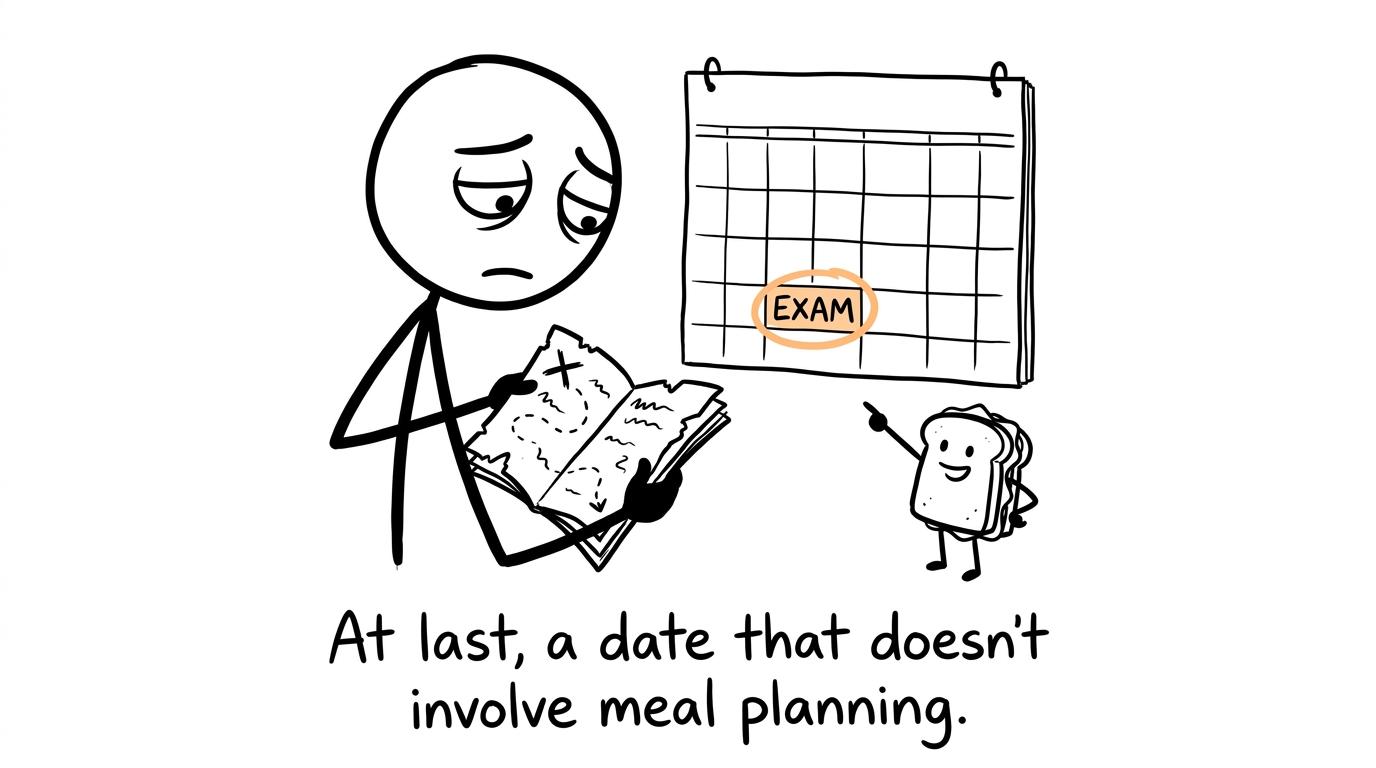 A student discovers the exam date on a revision-planner treasure map
Why your exam board matters
Food Preparation and Nutrition is not identical across every specification. Even when boards place the written paper in the same session, the duration, paper code and assessment language can differ.
For AQA, the written paper was code 8585/W and lasted 1 hour 45 minutes. AQA also listed a separate non-exam assessment component. Its submission deadline was an administrative deadline for centres, so a student's internal school deadline could be earlier.
OCR's J309/01 written paper lasted 1 hour 30 minutes. Eduqas scheduled written and on-screen versions of Component 1 in the same afternoon session, each lasting 1 hour 45 minutes.
That is why searching for a subject name is only the beginning. The reliable sequence is:
- read your candidate timetable;
- identify the awarding organisation;
- match the component code;
- confirm whether the paper is written or on-screen;
- follow your school's arrival instructions.
Do not use a friend's timetable unless they take exactly the same specification. Exam boards can share a date without sharing every detail.
The written exam and the practical assessment are different
Students sometimes hear “food exam” and picture only the practical task. The qualification also includes a timetabled written component, while practical and investigative work is handled through non-exam assessment.
The written paper is the part fixed nationally on the summer timetable. Schools arrange non-exam assessment work and internal deadlines within the board's rules. Your teacher should tell you when practical sessions, investigations and final submissions take place.
This distinction matters because missing an internal deadline and missing a nationally timetabled examination are different problems. Keep both in your planner, but label them clearly. A simple heading such as “NEA deadline” prevents it being confused with “written paper”.
The same principle helps with maths revision. A topic lesson, a timed paper and the real examination serve different purposes. MathsGenie's GCSE maths revision hub brings revision lessons, practice questions, mini tests, papers and solutions together so each task has a clear place.
What the morning usually looks like
Because the Food Preparation and Nutrition paper was in an afternoon session, the morning was not an invitation to revise everything at once. It was time to protect concentration.
Schools organise exam days differently. Some expect students in normal lessons; others provide supervised revision or set a specific arrival time. Follow your school's written instructions rather than relying on the awarding body's published session time alone.
A calm morning usually means:
- getting up at your normal school-day time;
- eating something familiar;
- checking your candidate timetable once;
- completing only brief, low-pressure recall;
- avoiding intense discussion about possible questions;
- arriving at the time required by your school.
The awarding organisations' published afternoon starting time is 1:30 pm. Under JCQ rules, centres may begin an afternoon examination between 1:00 pm and 2:00 pm without seeking prior permission. This flexibility is one reason your school timetable is more important than a generic online calendar.
If you are late, contact the school immediately and report to the exams officer when you arrive. Do not decide for yourself that the paper has become impossible to sit. The centre must apply the regulations and tell you what happens next.
What to take into the exam room
The safest exam kit is simple:
- at least two black ink pens;
- permitted drawing or writing equipment requested by your school;
- a clear pencil case;
- a clear, label-free water bottle if your centre allows one;
- any approved equipment or access-arrangement materials organised by the centre.
JCQ guidance states that watches, mobile phones, revision notes and smart devices must not be taken into the exam room. That includes earbuds, smart glasses and tablets. Possessing an unauthorised item can create a malpractice issue even if you did not intend to use it.
Once you enter, formal examination conditions apply. Stay silent, listen to the invigilator and do not open the question paper until instructed. Check that you have the correct paper and raise your hand if anything is missing, unclear in the printing, or inconsistent with your approved arrangements.
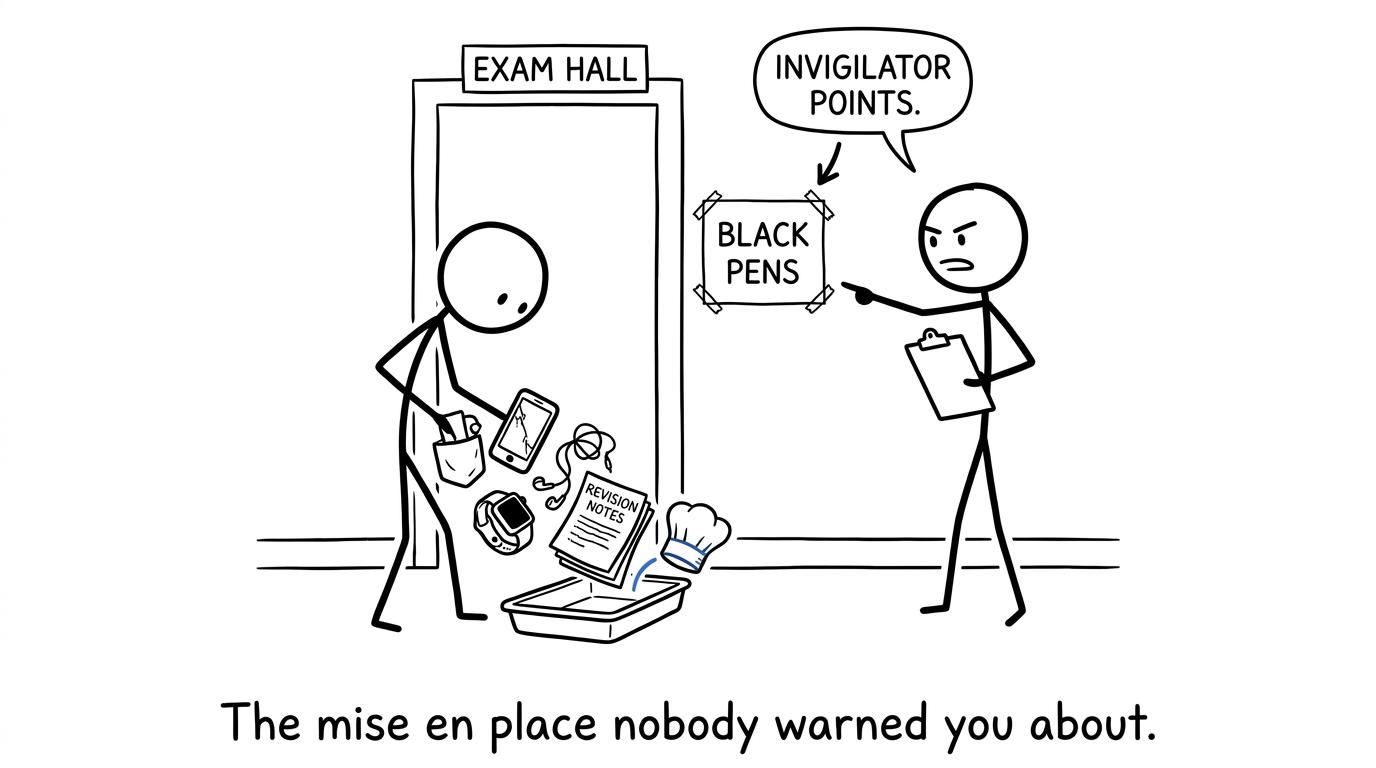 A student removes every forbidden object before entering the exam hall
Plan around your maths examinations too
For a student preparing for maths, the useful question is not only “When is food?” It is “What does this date do to the rest of my week?”
An afternoon paper uses more energy than its duration suggests. It affects travel, meals, sleep and the revision available for the following day. Avoid building a plan that assumes you will return home and immediately complete a full maths paper.
Instead, map every examination first. Then place demanding revision in the open spaces, leaving lighter recall for crowded days. The GCSE maths revision timetable guide explains how to build a weekly structure around topic work, timed practice and error review. If the final month feels compressed, use the one-month GCSE maths revision plan to turn the calendar into manageable sessions.
Past papers work best when they are scheduled early enough to reveal weaknesses. MathsGenie's guide to when to start GCSE past papers helps you decide when to move from individual topics to timed papers. The aim is not to collect completed papers. It is to recover marks by reviewing them.
Near the exams, predicted papers can sharpen your preparation, but they should never replace specification-wide revision. The guide to GCSE predicted topics explains how to use predictions without gambling on a narrow list.
The night before the written paper
The last evening should reduce uncertainty rather than create more of it. Check the paper details, pack your equipment and stop revision at a sensible time.
A practical final check is:
- candidate timetable photographed or placed in your bag;
- school arrival time confirmed;
- route and transport checked;
- black pens packed;
- phone and watch storage decided in advance;
- alarm set;
- emergency school contact saved;
- breakfast and lunch planned.
If you also have maths revision to complete, choose a short task such as correcting previous mistakes or reviewing a mini test. Beginning an unfamiliar full paper late at night rarely gives you useful feedback before sleep. The GCSE maths night-before plan offers a calmer structure for your maths papers.
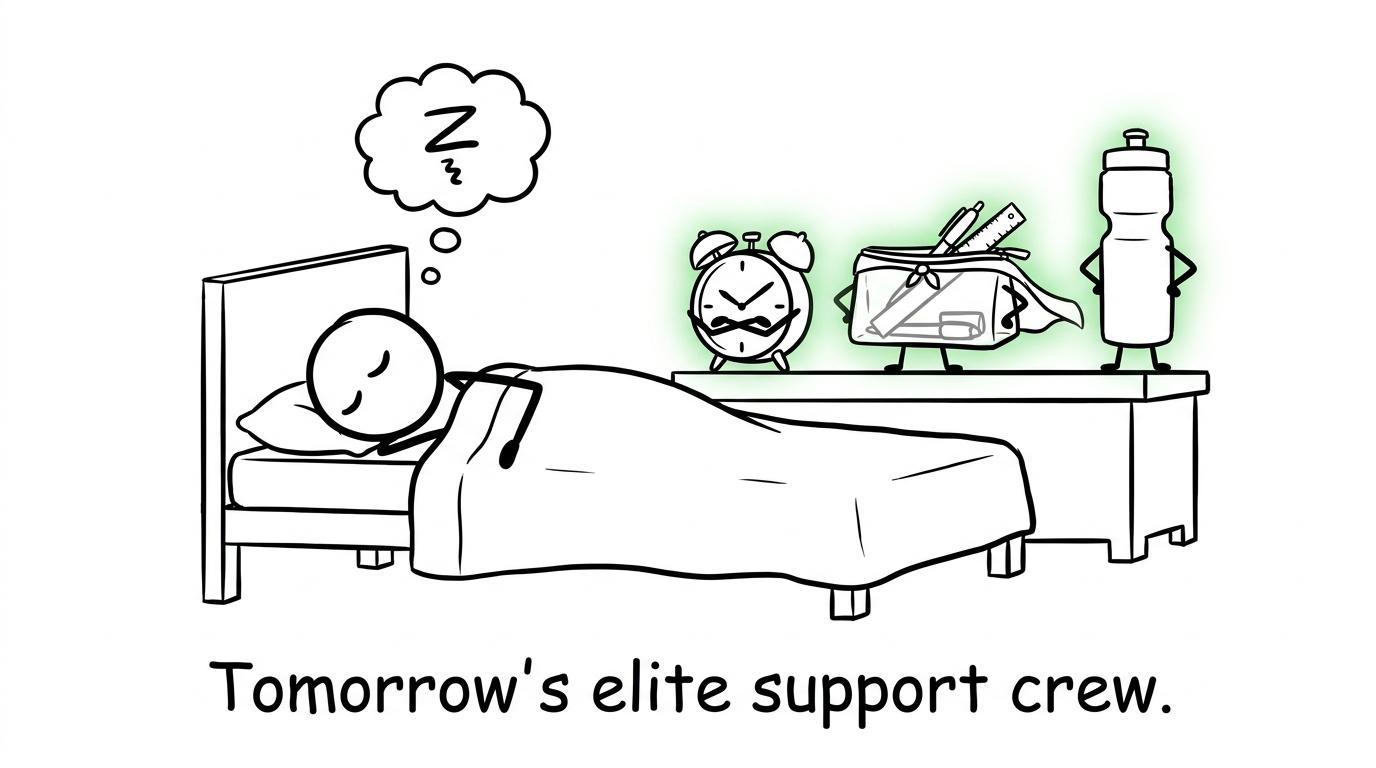 An alarm clock and exam kit form a student's heroic support team
Contingency sessions and timetable clashes
The awarding organisations designated the morning and afternoon of Wednesday 24 June 2026 as contingency sessions. Candidates were required to remain available up to and including that date in case significant national or local disruption caused examinations to be moved.
Do not book travel that makes you unavailable before the contingency period ends. It is unlikely to be used for an individual everyday problem; it exists for wider disruption and is invoked by the awarding organisations.
If two of your papers appear in the same session, tell your exams officer rather than attempting to solve the clash yourself. Centres use formal supervision and timetable-clash rules. Your personalised timetable may therefore show arrangements that differ from the headline board time.
Common mistakes to avoid
Looking only at the subject name
“Food” is not enough information. Match the full qualification, exam board and component code.
Treating 1:30 pm as your arrival time
It is the published session start, not permission to reach school then. Your centre may use a different start within the permitted window and will usually require earlier arrival.
Confusing NEA with the written examination
Practical and investigative work follows school arrangements. The written paper follows the national timetable. Record both separately.
Taking a watch or phone into the room
All watches and unauthorised smart devices are prohibited under the published candidate guidance. Follow your school's storage procedure before entering.
Revising only predicted content
Predictions are practice tools, not advance knowledge of the paper. Cover the full specification and use predictions only after broader revision.
Filling every gap with a full maths paper
More papers do not automatically mean more progress. Review matters. The guide to how many GCSE past papers to complete shows why a carefully marked paper is more valuable than several rushed attempts.
Turn the date into a plan
A date becomes useful when it changes what you do next. Confirm your board, copy the school-specific details, keep the contingency session free and prepare your equipment before the final evening. Then arrange your remaining subjects around the energy that the exam will require.
For maths, make MathsGenie your free revision base. Start with revision lessons and practice questions, test recall with mini tests, then build exam confidence through past papers, predicted papers, mark schemes and video solutions. If you take Pearson Edexcel maths, the guide to revising GCSE Maths Edexcel efficiently gives you a clear revision loop.
The calendar tells you when to arrive. Good preparation makes sure you know what to do until then.