Tracking Revision Progress GCSE Arabic: Does It Help?
Tracking revision progress GCSE Arabic can reveal weak skills, but logging alone will not improve recall. Learn how to turn every entry into useful practice.
A spreadsheet can become a strange source of comfort. Rows turn green, totals rise and revision begins to look organised. Yet the exam will never ask how carefully you coloured a cell.
So, does tracking revision progress GCSE Arabic preparation genuinely help? Yes, if the tracker exposes weak skills and tells you what to practise next. No. if recording revision replaces retrieval, speaking, listening, reading or writing.
That distinction matters for maths students too. Whether you are revising Arabic vocabulary or quadratic equations, progress comes from attempting demanding tasks, checking the result and acting on mistakes. The spreadsheet is only the map. You still have to walk.
The short answer: tracking helps when it changes your next action
A useful GCSE Arabic tracker should help you:
- separate listening, speaking, reading and writing;
- record performance, not merely time spent;
- identify weak themes, vocabulary and grammar;
- schedule another attempt after a gap;
- capture feedback from mark schemes or teachers;
- choose the next revision task quickly.
A spreadsheet is not essential. A notebook, calendar or app can perform the same role. The important feature is a short cycle:
Plan, practise, check, reflect, repeat.
Research into self-regulated learning supports teaching students to plan, monitor and evaluate their learning. Evidence for retrieval practice also favours actively recalling material over simply encountering it again. Neither finding proves that spreadsheets themselves raise GCSE grades. The benefit comes from the behaviour the tracker prompts.
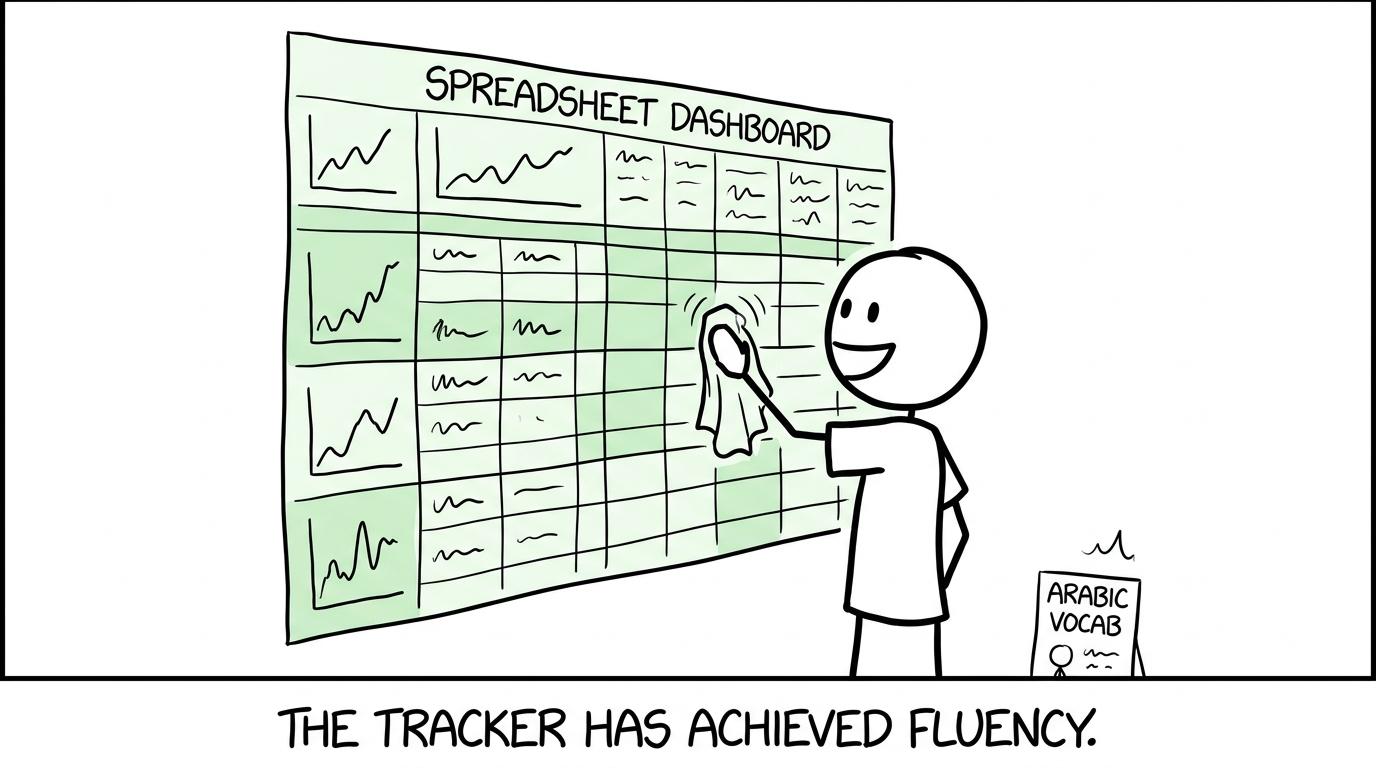 A student perfects a spreadsheet while an Arabic flashcard waits for attention
What GCSE Arabic progress actually looks like
For the current Pearson Edexcel GCSE Arabic specification, students are assessed through listening, speaking, reading and writing papers. Each skill contributes equally to the qualification, and students take either foundation or higher tier across the papers. Always confirm your own specification and tier with your school because course arrangements can change.
A single label such as “Arabic: green” hides too much. A student may read confidently but struggle to understand speech at exam speed. Another may know plenty of vocabulary but lose accuracy when writing extended answers.
Track the four skills separately, then divide them into useful components:
| Area | Evidence worth recording |
|---|---|
| Listening | Score, unfamiliar words, distractors and passages needing replay |
| Speaking | Fluency, pronunciation, response length and teacher feedback |
| Reading | Score, translation accuracy and misunderstood vocabulary |
| Writing | Task coverage, grammatical accuracy, range of language and corrections |
| Vocabulary | Successful recall, not cards viewed |
| Grammar | Accurate use in sentences and exam tasks |
This principle transfers directly to maths revision. “Algebra revised” tells you very little. A better record distinguishes solving equations, rearranging formulae, factorising and algebraic fractions. The MathsGenie GCSE maths revision hub already divides revision into board-specific resources and manageable skills, making those distinctions easier.
What to put in a simple revision spreadsheet
The best tracker is usually smaller than the one you first imagine. Include only fields that influence a decision:
- date;
- skill or topic;
- task completed;
- result;
- mistake or difficulty;
- next action;
- date for another attempt.
For a marked task, calculate accuracy using:
Accuracy=marks earnedmarks available×100%\text{Accuracy}=\frac{\text{marks earned}}{\text{marks available}}\times 100\%Accuracy=marks availablemarks earned×100%A percentage is more informative than “done”, but it still needs context. A high score completed with notes is not equivalent to the same score under timed, closed-book conditions. Add a brief conditions column so you do not compare unlike tasks.
You could also use a confidence rating from 000 to 333:
| Rating | Meaning |
|---|---|
| 000 | I cannot begin without help |
| 111 | I can complete parts with prompts |
| 222 | I can usually complete it independently |
| 333 | I can complete it accurately under exam conditions |
Confidence is subjective, so pair it with evidence. If you feel confident but repeatedly lose marks, trust the marked task. A feeling can guide attention; a result should guide the plan.
Maths students can use precisely the same columns after practice questions or papers. The guide to finding your weakest Edexcel GCSE maths topics explains how errors can be converted into topic labels and targeted repair work.
Track outputs rather than revision time
Time is easy to measure and easy to misunderstand. Sixty minutes may contain focused recall, or it may contain ten minutes of work and fifty minutes of rearranging colours.
Hours can help you notice whether Arabic or maths is being neglected, but they do not measure learning. Give greater weight to outputs such as:
- words recalled without looking;
- listening questions answered correctly;
- speaking responses recorded and reviewed;
- writing tasks corrected;
- maths questions attempted independently;
- lost marks explained and retested.
The same lesson applies to apps. Streaks and notifications may encourage consistency, but tapping “complete” proves only that something was logged. An app is useful when it reduces friction. If it takes longer to maintain than a basic spreadsheet, simplify it.
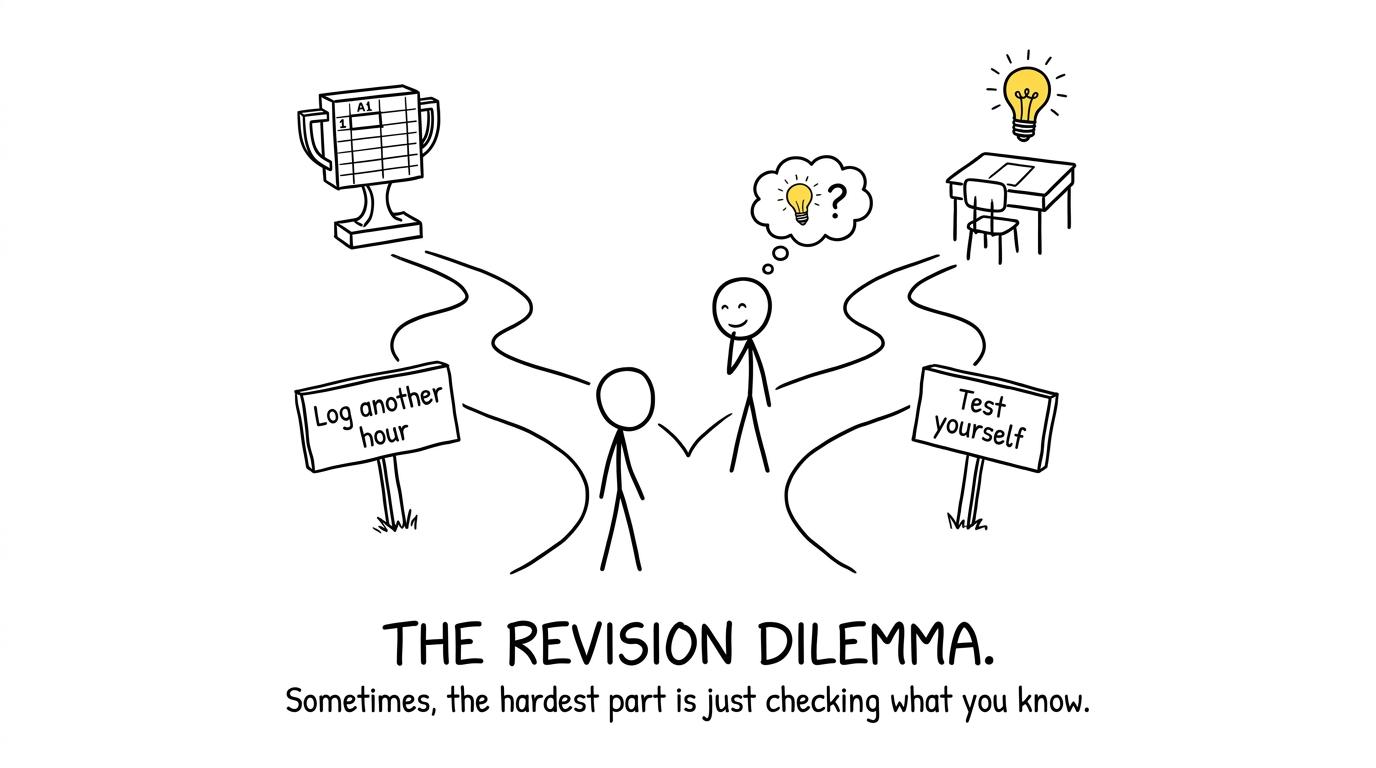 Students choose between logging another hour and testing themselves
Build retrieval and spacing into the tracker
A tracker becomes valuable when it remembers what your enthusiasm forgets.
After practising a vocabulary set, grammar structure or maths topic, schedule another attempt on a later day. Do not simply reread the original material. Try to retrieve the answer first, then check it and correct errors.
Your “next review” column should therefore lead to a specific task:
- recall the vocabulary without prompts;
- answer fresh listening questions;
- record a new speaking response;
- rewrite corrected sentences from memory;
- complete another set of maths questions;
- reattempt questions that previously lost marks.
This is more useful than automatically colouring a topic green after one successful session. Learning is better demonstrated by successful performance after a delay.
For maths, short assessments make this cycle manageable. Edexcel GCSE maths mini tests provide focused timed practice, while the GCSE maths revision timetable guide shows how to combine topic work, marking and paper practice across a week.
Use an error log, not just a completion log
Completed tasks describe the past. Errors can shape the future.
After each task, record one precise reason for lost marks. For GCSE Arabic, that might be an unfamiliar word, a missed negative, inaccurate verb agreement, weak pronunciation or failure to address part of a writing prompt. For maths, it might be a missing method, an arithmetic slip, premature rounding or misreading the question.
Avoid entries such as “careless” or “need more practice”. They are too vague to produce an action. Instead, write a correction you can follow.
Past papers become especially valuable here because they expose several weaknesses under realistic conditions. Maths students can use Edexcel GCSE maths past papers, the AQA GCSE maths revision collection or the OCR GCSE maths revision collection, depending on their exam board.
Marking is not the final step. As the guide to using Edexcel GCSE maths past papers properly explains, mistakes should become targeted practice followed by another attempt.
A weekly review that takes minutes, not hours
Once a week, filter or scan your tracker and answer five questions:
- Which skill has received the least practice?
- Which errors have appeared more than once?
- Which result improved after a delayed retest?
- Which topic feels confident but lacks evidence?
- What are the next three priority tasks?
Three priorities are usually enough. A list of twenty weaknesses creates anxiety without direction.
For Arabic, balance matters because the qualification assesses four different language skills. For maths, your balance should reflect your board, tier and actual mark losses. Foundation and higher students may need different content, but both benefit from honest diagnosis followed by focused practice.
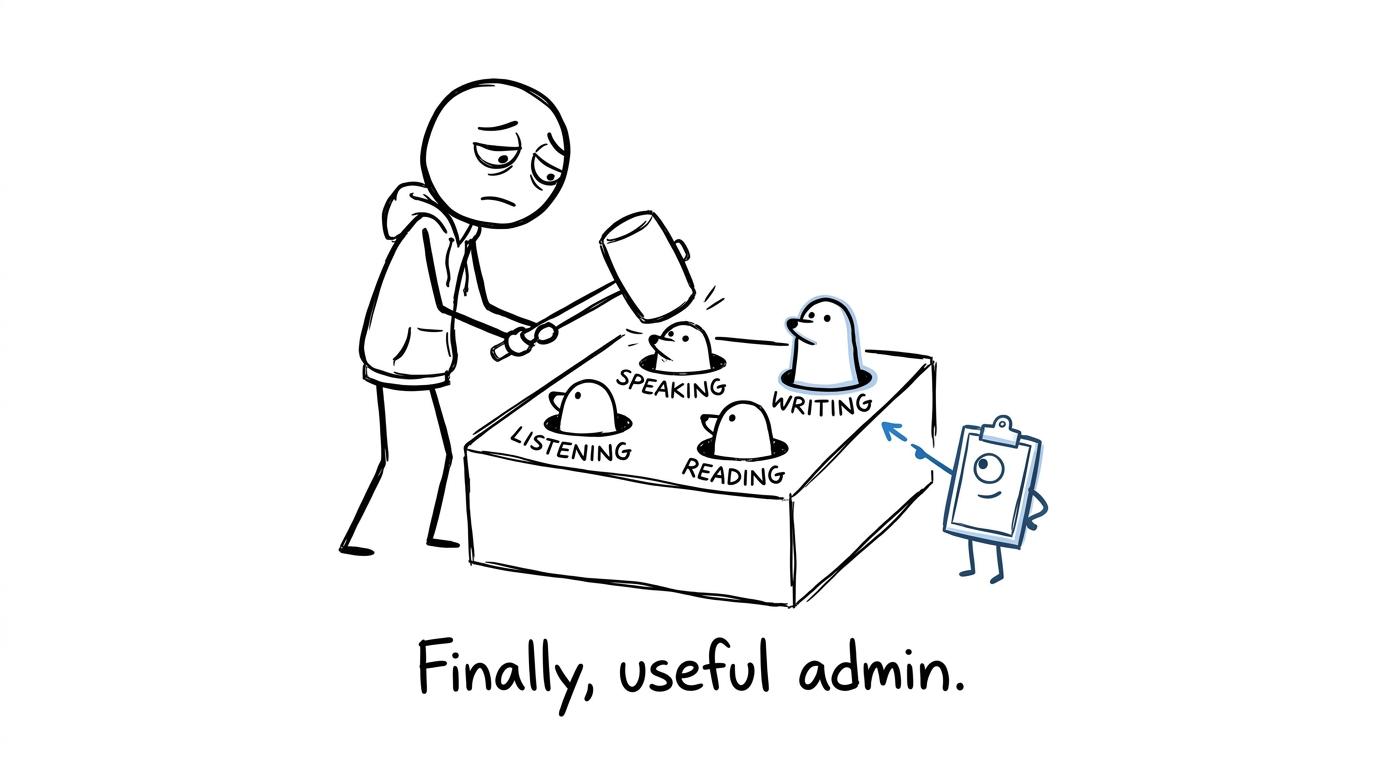 A revision clipboard calmly identifies the weakest skill
Common mistakes when tracking revision progress
Making the tracker more complicated than the revision
Charts, formulas and colour rules can feel productive because they create visible order. Limit setup time. If a field never changes your next task, remove it.
Recording exposure as mastery
Watching a video, reading notes or opening an app is not evidence that you can retrieve or apply the material. Record an independent attempt and its result.
Turning every cell green too quickly
One correct attempt may reflect short-term familiarity. Retest after a gap before treating the skill as secure.
Tracking time but ignoring mistakes
Hours show effort, not necessarily progress. Record scores, error patterns and corrections alongside time, or leave time out entirely.
Comparing scores from different conditions
A supported task and a timed paper measure different things. Label whether notes, prompts, pauses or repeated audio were used.
Revising only the weakest area
Weaknesses deserve attention, but abandoning stronger skills allows them to fade. Use most sessions for priority gaps while retaining short maintenance practice elsewhere.
The verdict: a spreadsheet should create better revision
Tracking revision progress for GCSE Arabic can help, but not because spreadsheets possess any special learning power. A tracker works when it makes weaknesses visible, schedules retrieval, captures feedback and removes the daily question of what to do next.
The same rule holds for GCSE maths. Do not measure how organised revision looks. Measure what you can now do independently that you could not do before.
Start with one simple row after your next task: what you attempted, what happened, what went wrong and when you will try again. Then let MathsGenie supply the practice behind the record. Use its free revision lessons, practice questions, mini tests, past papers, predicted papers, mark schemes and video solutions to turn a neat plan into stronger exam performance.