GCSE English Literature Time Pressure Mistakes
GCSE English Literature time pressure mistakes can cost easy marks. Learn how to plan, stay focused, use quotations wisely and finish every response.
The clock rarely causes the first mistake. More often, it magnifies a small one: spending too long recalling a quotation, writing an elaborate introduction or answering the theme you revised rather than the question on the page.
The most damaging GCSE English Literature time pressure mistakes are avoidable. Read the exact question, allocate time according to the available marks, make a brief plan, use short textual references and move on when your planned time ends. These habits protect the final response, where accessible marks are often lost simply because a student arrives with only minutes remaining.
English Literature is untiered, but paper structures vary across AQA, Edexcel, OCR and Eduqas. Use the timings and instructions for your own specification rather than adopting a generic schedule from somebody studying a different board.
A quick time-pressure checklist
Before practising another essay, make sure you can do the following:
- identify your exam board, paper structure and required texts;
- recognise the command words and precise focus of a question;
- create a useful plan in a few minutes;
- select short quotations or precise textual references;
- connect every paragraph to a clear overall argument;
- move on at a predetermined time;
- attempt every required question;
- leave a small checking window where your paper structure allows it.
These are not tricks. They are routines. The point of practising them is to make sensible decisions feel automatic when the room becomes quiet and the clock becomes unusually noticeable.
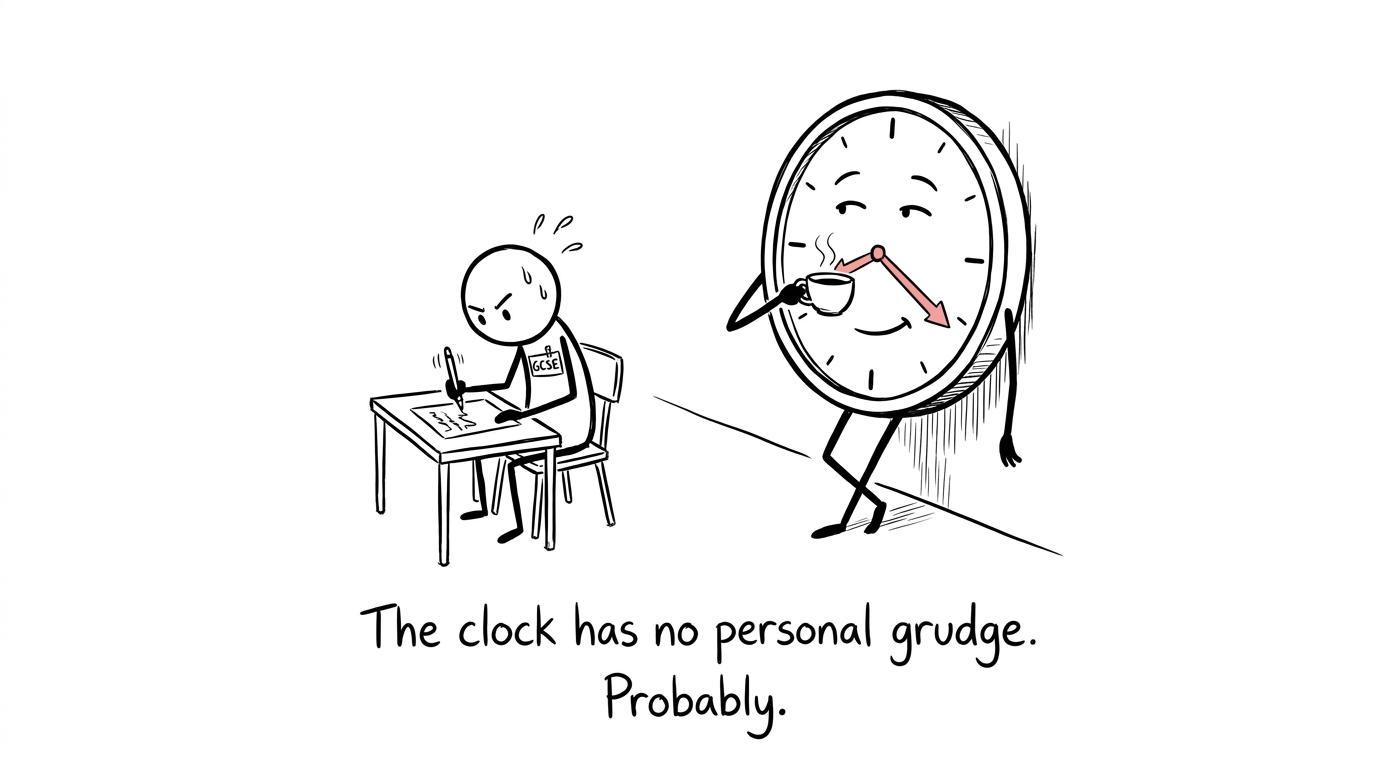 A student races an untroubled exam clock
Know the paper you will actually sit
A timing plan only works when it matches the paper. At the time of writing, AQA English Literature Paper 1 lasts 1 hour 45 minutes and Paper 2 lasts 2 hours 15 minutes. Pearson Edexcel uses the same overall durations for its two components, although its question structure differs. OCR has two closed-text papers of two hours each, while Eduqas uses components of two hours and two hours 30 minutes.
These qualifications are closed-book or closed-text assessments, so preparation matters. However, closed book does not mean that every sentence must contain a perfectly memorised quotation. Official assessment objectives reward understanding, response, textual support, analysis of writers' methods and, where assessed, context and writing accuracy.
Check your current specification, recent papers and your teacher's guidance. Then write down the time at which you will leave each section. Do this at the start of the exam rather than repeatedly calculating it while anxious.
A simple planning principle is:
working time per mark=available working minutesmarks on the paper\text{working time per mark} = \frac{\text{available working minutes}}{\text{marks on the paper}}working time per mark=marks on the paperavailable working minutesThis is a starting point, not a universal instruction. Reading an unseen poem, annotating an extract and planning a comparison all require time that raw mark allocation does not fully describe. Follow any recommended section timings printed by your exam board and practise the schedule before the real examination.
Maths students already understand the value of realistic timed practice. The same discipline used with GCSE maths past papers can strengthen Literature performance: reproduce the conditions, finish the task and review what happened afterwards.
The common mistakes that lose easy marks
Answering a familiar question instead of the actual one
Under pressure, the brain reaches for familiar material. A question about how a character changes can quietly become the essay you prepared about that character's importance. The knowledge may be accurate, but relevance has been lost.
Underline the character, theme, viewpoint or relationship and any qualifying words such as "how", "significant" or "at this point". Before each paragraph, ask: does this point answer those words?
A focused argument supported by selective knowledge is more valuable than a large amount of loosely related material.
Spending too long on the introduction
An introduction should establish your interpretation and direction. It does not need to summarise the plot, list every technique or offer a grand statement about society.
Write a concise answer to the question. Then begin the analysis. A long introduction can feel productive because the page is filling, but it may consume the time needed for developed evidence later.
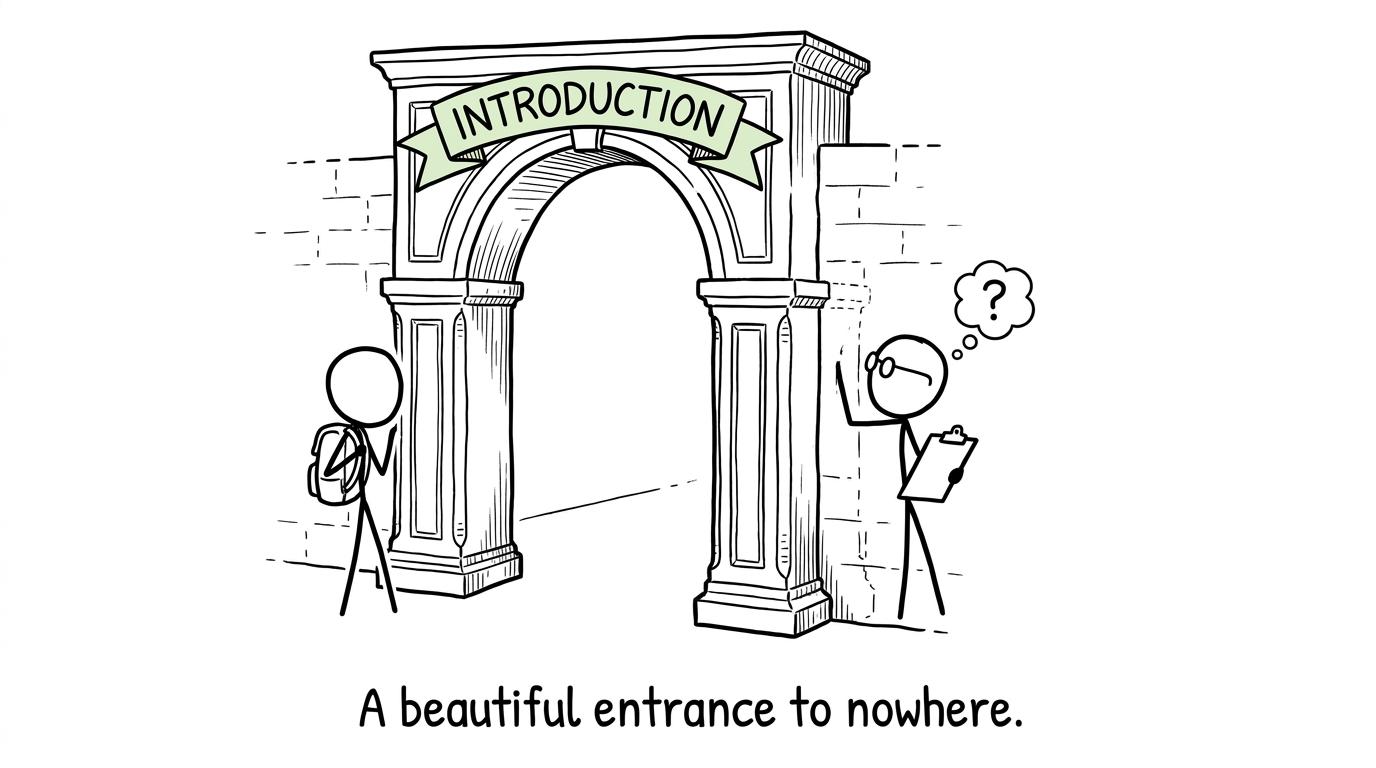 An impressive introduction leads to no essay
Freezing because the perfect quotation will not come
A forgotten word should not be allowed to stop an entire essay. AQA examiner guidance has explicitly noted that students can refer to moments in a text or paraphrase what characters say when exact wording cannot be recalled. Other boards similarly reward relevant textual knowledge according to their mark schemes.
If you remember a short, accurate phrase, use it. If you do not, identify the scene, action or change precisely. Never invent wording and present it inside quotation marks.
Revise adaptable evidence rather than carrying a mental warehouse of isolated lines. A small collection of well-understood references can support arguments about character, theme, setting and development.
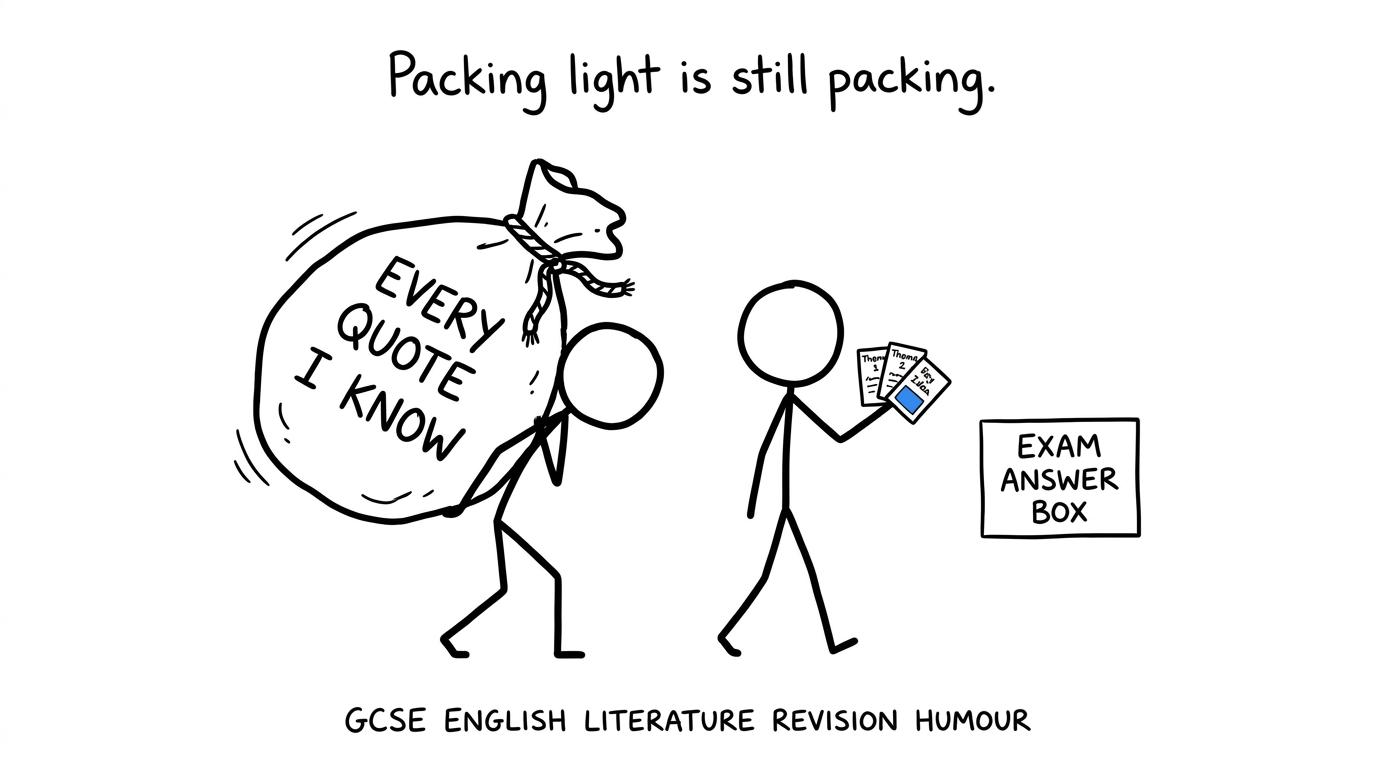 One student brings every quotation while another packs lightly
Retelling the plot instead of analysing it
Plot knowledge is necessary, but narration alone does not explain how a writer creates meaning. Underline the parts of a paragraph that interpret a choice made by the writer. If most of the paragraph merely reports what happens next, analysis is too thin.
After a reference, explore a purposeful detail: a word, image, contrast, structural shift, stage direction, narrative choice or pattern across the text. Then connect that detail back to your argument.
Technique spotting without discussing meaning
Naming a metaphor or adjective is not automatically analysis. Official examiner advice repeatedly warns against terminology that distracts from engagement with the text.
Start with meaning. What is the writer suggesting? How does the selected detail shape the reader's or audience's understanding? Use a literary term only when it makes that explanation more precise. "The word" is better than an impressive but incorrect label.
Adding context as a detached fact
Context is not assessed in every question, and its placement differs between boards. When it is relevant, it should illuminate the text rather than interrupt the essay.
Avoid bolted-on historical facts that could be pasted into almost any answer. Connect contextual understanding to the writer's idea, the audience's response or the values being examined. Check the assessment objectives for your particular component before deciding how much time to give it.
Making one response far longer than the others
The first essay often feels safest because it covers a familiar text. That comfort can become expensive. Extra pages on one answer do not compensate for an unattempted question elsewhere.
Use visible move-on times. When one arrives, finish the current sentence, leave space if necessary and continue. You can return later. Attempting every required task gives the examiner something to reward across the paper.
This habit resembles the first-pass strategy used in maths: secure accessible marks, avoid being trapped by one section and return if time remains. MathsGenie's guide to using Edexcel GCSE maths past papers properly explains how timed attempts can reveal whether lost marks come from knowledge, execution or exam technique.
Treating comparison as an afterthought
In comparative poetry, two separate mini-essays followed by a hurried final sentence rarely create a sustained comparison. Decide on a meaningful connection before writing: perhaps the writers present similar emotions but use different speakers, structures or endings.
Compare ideas and methods as the response develops. Do not force superficial links based only on line counts, punctuation totals or the fact that both texts contain imagery.
Skipping the final check
Accuracy of vocabulary, sentence structure, spelling and punctuation forms AO4, although the questions carrying these marks vary by board. A rushed final paragraph may also contain missing words or unclear references that weaken the argument itself.
If your schedule includes checking time, prioritise errors that affect meaning: incomplete sentences, missing paragraph breaks, incorrect character names, unclear pronouns and absent punctuation. Do not rewrite an entire answer for cosmetic reasons.
Build a timing system before exam day
Time management improves through rehearsal, not intention. Once a week, complete one Literature section under your board's conditions. Record three things afterwards:
- where you were when the move-on time arrived;
- which decision consumed more time than expected;
- what rule you will use in the next attempt.
Your correction should be specific. "Write faster" is not a strategy. "Limit the plan to a thesis and three paragraph ideas" is. So is "move on even if the final paragraph is shorter than planned".
Fit these sessions into a sustainable whole-subject plan. The GCSE revision timetable guide shows how to define the task rather than simply writing a subject name in a calendar. On a busy day, the structure in MathsGenie's 20-minute revision routine can also be adapted: recall evidence, plan one question and review the plan against the mark scheme.
Practise the decision, not only the essay
Full essays build stamina, but shorter drills can target the moments where pressure causes mistakes. Practise choosing a poem quickly, writing a one-sentence thesis, selecting three references or identifying the precise focus of several questions.
Then use a full timed paper periodically. Mark it with the relevant official mark scheme and classify each weakness:
- knowledge: the text or evidence was not secure;
- interpretation: the argument did not answer the question;
- analysis: references were explained too generally;
- timing: a section received too much or too little time;
- accuracy: rushed writing obscured meaning.
MathsGenie uses the same learn, practise, mark, fix and retest cycle across its free GCSE maths revision hub. If you are balancing English with foundation or higher tier maths, a realistic GCSE maths revision timetable can help prevent one subject from absorbing every evening.
A calmer final approach
The goal is not to feel no pressure. It is to retain a small set of reliable behaviours while pressure is present: read precisely, plan briefly, support ideas selectively, analyse meaning and obey move-on times.
In the final days, avoid replacing practice with frantic note-making. Use the same principle as the MathsGenie night-before exam plan: choose a small, useful task, correct a few recurring mistakes, prepare what you need and stop at a sensible time.
Then keep building confidence across your GCSEs. Open MathsGenie's free revision lessons and practice questions, test yourself with mini tests, and progress to past papers and predicted papers. Use the mark schemes and video solutions to find exactly where marks are leaking. The clock becomes less threatening when your next decision has already been practised.