GCSE English Literature Memory vs Understanding
GCSE English literature memory vs understanding: discover what exams reward and how to revise quotations, analysis, context and recall effectively.
A blank exam page can make English Literature feel like a memory contest. You remember the plot, half a quotation and perhaps something about Victorian society, but the exact words refuse to arrive. It is natural to wonder whether everyone with a better memory has already won.
The short answer to GCSE English literature memory vs understanding is this: understanding earns most of the marks, while memory gives you the material needed to demonstrate it. You need secure knowledge of characters, themes, events, context and carefully chosen quotations. But recalling them is only the beginning. Examiners reward the argument you build, the writer's methods you analyse and the interpretation you support.
That distinction should shape how you revise. Do not try to store the entire text. Build a compact bank of useful evidence, understand why each detail matters and practise applying it to unfamiliar questions.
The short revision checklist
A balanced approach looks like this:
- Know the plot, characters, themes and turning points securely.
- Memorise short, flexible quotations rather than long passages.
- Connect each quotation to several ideas or questions.
- Understand language, form and structure rather than merely naming techniques.
- Use context to illuminate the text, not replace analysis.
- Practise retrieving knowledge without notes.
- Write timed responses and review them against the assessment objectives.
- Check your own exam board's current specification and question format.
This is similar to successful maths revision. Knowing a formula is useful, but the exam rewards recognising when and how to apply it. The same principle runs through the free GCSE Maths Revision Hub: knowledge matters most when it can be used.
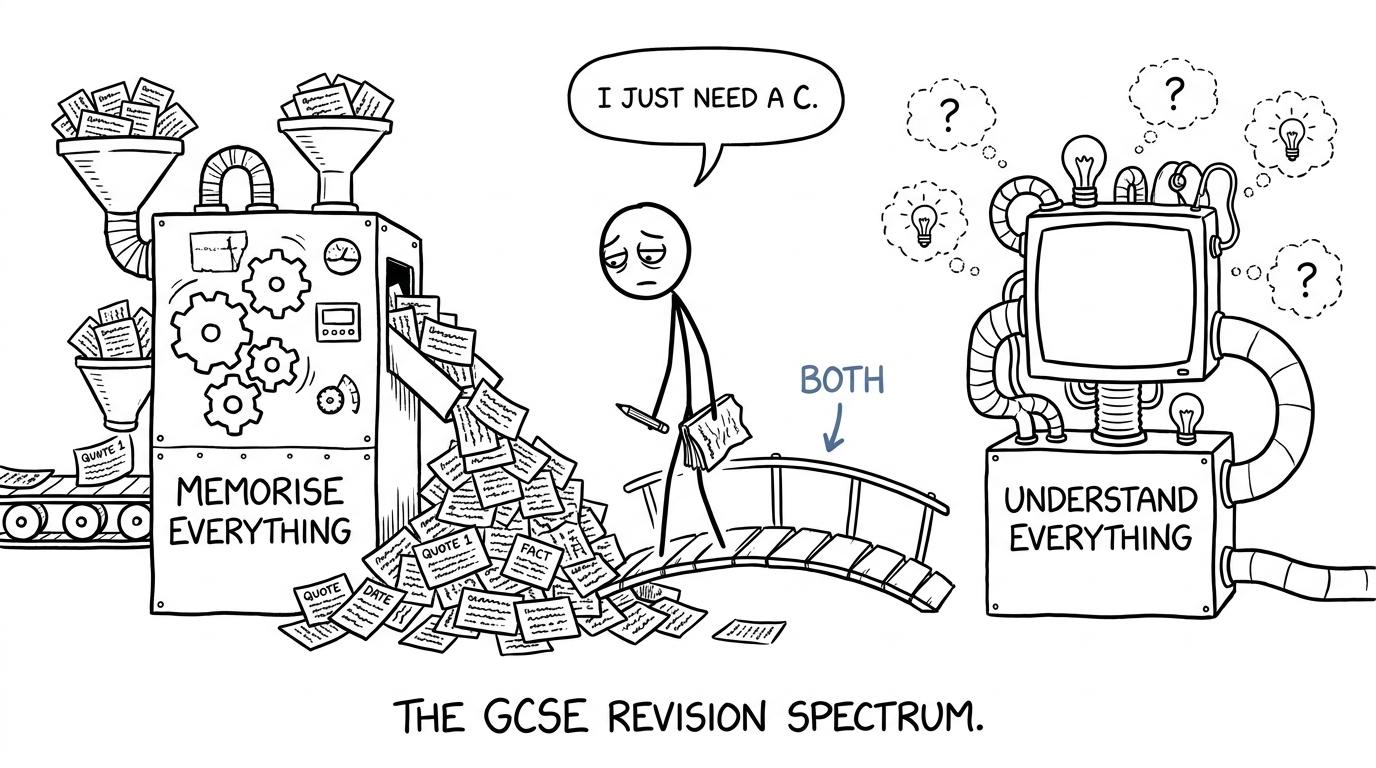 A student choosing the sensible bridge between memorising everything and understanding everything
What GCSE English Literature actually rewards
Across GCSE English Literature specifications, the assessment objectives emphasise reading, interpretation and analysis. The national subject criteria allocate approximately:
- AO1: 353535 40%40\%40% for understanding, responding and supporting interpretations with textual references.
- AO2: 404040 45%45\%45% for analysing how language, form and structure create meanings and effects.
- AO3: 151515 20%20\%20% for understanding texts in relation to their contexts.
- AO4: 5%5\%5% for accurate and effective writing.
The precise distribution across questions varies, so consult the specification and materials for Edexcel, AQA, OCR or Eduqas. However, the overall message is consistent: there is no assessment objective called “remember as many quotations as possible”.
Memory contributes most directly to AO1 because you need textual knowledge and supporting references. Yet AO1 also demands an informed response. AO2 requires analysis. AO3 requires meaningful contextual understanding. Even accurate recall cannot perform those jobs by itself.
Most mainstream GCSE English Literature examinations are closed-book or closed-text, although extracts or poems may be printed for particular questions. Arrangements differ between boards and sections. This creates a genuine memory requirement, but it does not turn the qualification into a recital test.
Why understanding has the greater ceiling
Imagine remembering ten quotations about a character but being unable to explain what changes, why the writer presents the character that way or how the language shapes the reader's judgement. You possess evidence, but not yet an argument.
Now imagine remembering only a few short references while understanding the character's development, contradictions and connection to the text's central themes. Your evidence bank is smaller, but each item can do more work.
The strongest answers combine both qualities. They make a clear claim, select relevant evidence and explore how that evidence supports an interpretation. Understanding creates the direction; memory supplies the detail.
What you genuinely need to remember
Trying to memorise every page is both unrealistic and strategically weak. The aim is selective, connected knowledge.
The shape of the whole text
Know the main sequence of events, but go beyond a simple plot summary. Identify:
- major turning points;
- changes in relationships or power;
- recurring conflicts and images;
- contrasts between beginnings and endings;
- moments that reveal a character's values;
- structural choices that influence the audience or reader.
This whole-text map helps you respond when a question approaches familiar material from an unfamiliar angle.
Short, versatile quotations
There is no universal official number of quotations required for a particular grade. A productive quotation bank is therefore measured by coverage and usefulness, not size.
Choose brief phrases that can support several themes or character arguments. Learn them accurately, but also attach meaning to them. For every quotation, know:
- who says or narrates it;
- where it appears;
- what is happening around it;
- which themes it connects to;
- which language or structural choices deserve attention;
- how it might support more than one interpretation.
A short phrase understood deeply is usually more useful than a long speech recalled shakily. AO1 permits textual references, including quotations, so a precise reference to an event can also support an interpretation where appropriate. Direct quotations remain valuable, especially for close language analysis, but they are not the only evidence available.
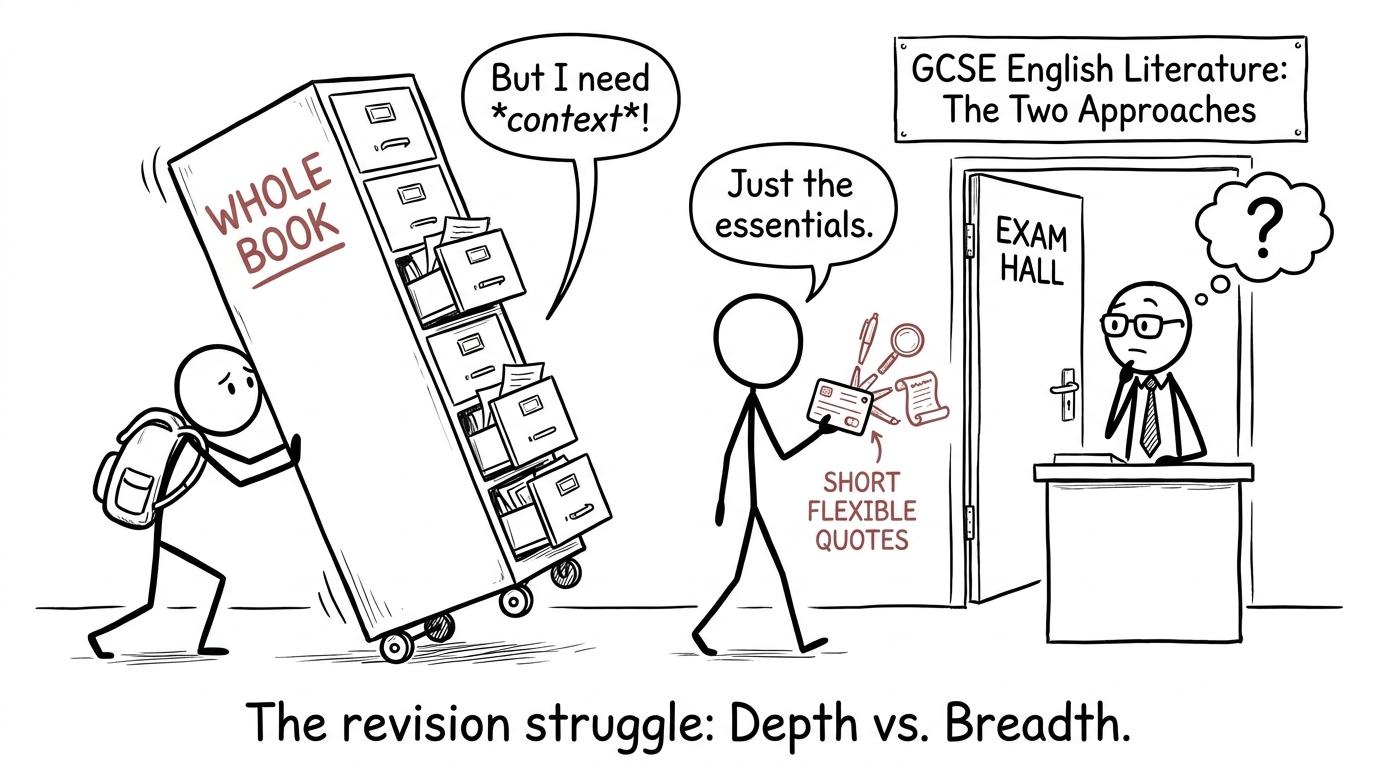 One student struggles with a whole-book filing cabinet while another carries flexible short quotations
Context with a purpose
Remember contextual information that changes how you understand the writing. A date or historical fact is not automatically analysis.
Useful contextual knowledge might help you explain a writer's audience, genre, social concern or literary tradition. It should sharpen the interpretation already being made. If a contextual point could be pasted into almost any essay without changing its meaning, it is probably too general.
How to revise memory and understanding together
The most efficient revision does not place memorisation and analysis in separate boxes. It trains them as one process.
Build theme-and-character networks
Instead of organising notes only by chapter or act, group evidence around characters, themes, relationships and writer's intentions. Then add links between groups.
A quotation about power might also reveal fear, conflict, gender expectations or a character's development. Those links make recall more flexible because the evidence is no longer attached to one predicted question.
Use active recall before rereading
Close the book and retrieve what you know. Write down quotations for a theme, sketch the development of a character or explain the significance of a turning point. Only then check the text.
Rereading can feel fluent because the words are familiar. Retrieval reveals whether the knowledge is actually available without prompts. Maths students can see the same principle in MathsGenie's guide to turning revision notes into active recall.
Use a simple cycle:
- retrieve from memory;
- check against the text or notes;
- correct inaccuracies;
- explain the significance;
- revisit the material on another day;
- apply it to a different question.
Practise unfamiliar questions
Understanding becomes visible when you can adapt. If you revise only one prepared essay on ambition, responsibility or conflict, you may struggle when the exam asks about change, relationships or consequences.
Practise planning several questions rather than writing every response in full. Give yourself a short time limit, create a thesis, choose evidence and map the progression of the argument. Then write selected timed essays to develop fluency and stamina.
The paper-review cycle used in MathsGenie's guide to using past papers properly transfers neatly: attempt, mark, identify the weakness, repair it and retest. In English Literature, the weakness might be vague analysis, limited whole-text coverage or evidence that does not support the claim.
Use mark schemes diagnostically
A mark scheme is not a script to memorise. It tells you what kinds of performance are rewarded. Look for language concerning critical style, informed response, relevant references, analysis, context and conceptualised thinking.
After a response, label each paragraph:
- claim: does it answer the precise question?
- evidence: is the reference relevant and accurate?
- analysis: does it explain how the writer creates meaning?
- development: does the interpretation become more thoughtful?
- context: does it deepen the argument?
Maths students already use this feedback process when learning how to use GCSE mark schemes as a revision coach. The subject changes, but the habit remains valuable: study why marks were earned or lost, not only the total.
A practical weekly revision pattern
A manageable week could include:
- one quotation-retrieval session;
- one character or theme map completed without notes;
- two short plans for unfamiliar questions;
- one analytical paragraph focused on language, form or structure;
- one timed essay or substantial section;
- one review using the mark scheme and teacher feedback.
Return to the same material after a gap. The purpose is not to repeat the identical task, but to retrieve and apply the knowledge in a new way.
If English Literature is competing with maths and several other subjects, use a realistic timetable rather than relying on last-minute intensity. The GCSE one-month revision plan and GCSE revision timetable guide show how to combine short retrieval sessions, focused practice and longer exam tasks without letting one subject consume the week.
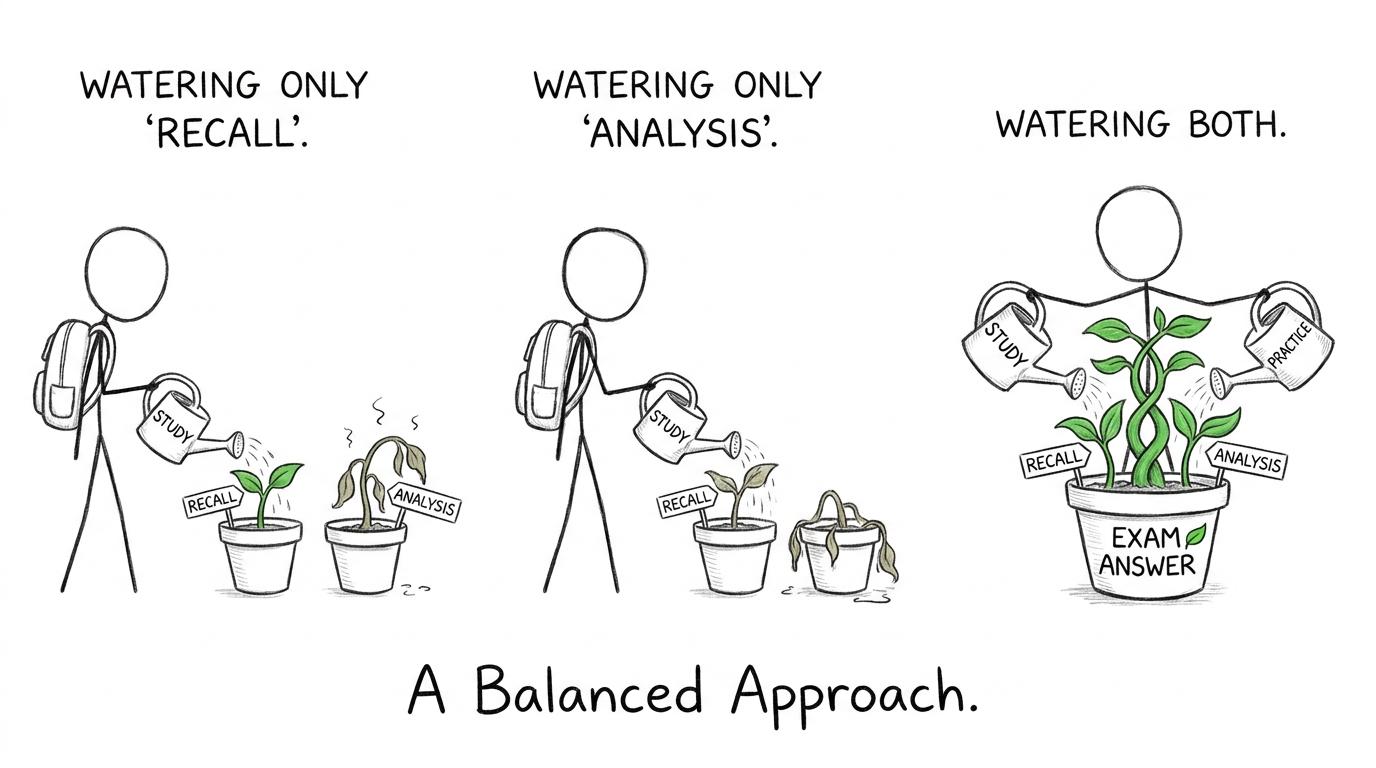 A student waters both recall and analysis plants to grow a strong exam answer
Common mistakes in memory-based Literature revision
Memorising quotations without interpretations
A quotation is evidence, not a complete point. Attach each quotation to possible themes, methods and interpretations so that recall leads somewhere useful.
Learning long passages
Long quotations consume revision time and are easier to distort under pressure. Prefer short, accurate fragments with strong analytical potential.
Memorising model essays
A polished essay may not answer the question you receive. Learn the ingredients and reasoning rather than a fixed sequence of paragraphs.
Retelling the plot
Plot knowledge is necessary, but narration rarely provides enough analysis. Use events to support a claim about character, theme, structure or the writer's purpose.
Listing techniques
Identifying a metaphor, contrast or stage direction is only the start. Explain what it suggests, how it shapes meaning and why it matters to the argument.
Bolting on context
A detached history paragraph can interrupt the essay. Integrate context where it helps explain a choice, interpretation or audience response.
Revising only comfortable material
Familiar themes create an illusion of readiness. Diagnose weak areas and target them, just as you would through MathsGenie's method for finding your weakest GCSE topics.
Memory opens the door; understanding earns the marks
GCSE English Literature is not purely a memory test, nor can memory be ignored. Closed-text assessment means you need secure knowledge. But the assessment objectives make the hierarchy clear: knowledge must become interpretation, analysis and a supported argument.
Learn fewer things more usefully. Retrieve them regularly. Connect quotations to several ideas. Practise responding to questions you have not predicted. Then use feedback to improve the quality of your explanation.
That balance also matters when you return to maths. A remembered method has little value if you cannot recognise where it applies. Use MathsGenie's free GCSE maths revision resources to move from revision lessons and practice questions to mini tests, past papers, predicted papers, mark schemes and video solutions. Build understanding first, train recall through practice and make both available when the exam paper opens.