

GCSE English Language: Revise Every Day or Rest?
GCSE English language: revise every day or rest? Use spacing, active practice and planned recovery to retain more while keeping maths revision on track.
The difficult part of revision is not always starting. Sometimes it is stopping without feeling guilty. You close the English paper, notice the untouched maths questions beside it, and wonder whether a day off will cost you marks.
If you have searched “gcse english language revise every day or rest”, the short answer is this: you do not need a full English Language session every day. For most students, several focused sessions spread across the week, with planned rest days, will be more sustainable than daily intensive revision. Short daily contact can help, but only when it remains purposeful and does not replace sleep, recovery or other subjects.
The goal is not to create the longest revision streak. It is to remember useful knowledge, improve exam skills and arrive at each paper able to think clearly.
The quick answer: daily contact, not daily intensity
A balanced English Language revision week should usually include:
- several short, active sessions rather than one large weekly block;
- gaps between sessions so that you must recall what you learnt;
- timed reading and writing practice;
- feedback from mark schemes or your teacher;
- at least one day without English Language revision;
- protected time for maths and your other GCSE subjects;
- proper sleep and regular breaks.
You might briefly recall an assessment objective, plan a paragraph or identify a writer’s method on a busy day. That is very different from completing a timed paper every evening.
Your schedule should also reflect your needs. A student who struggles with transactional writing may need more English practice than one already producing secure responses. Equally, if algebra is currently costing you more marks, your timetable should leave room for targeted work through the free MathsGenie GCSE and A Level revision resources.
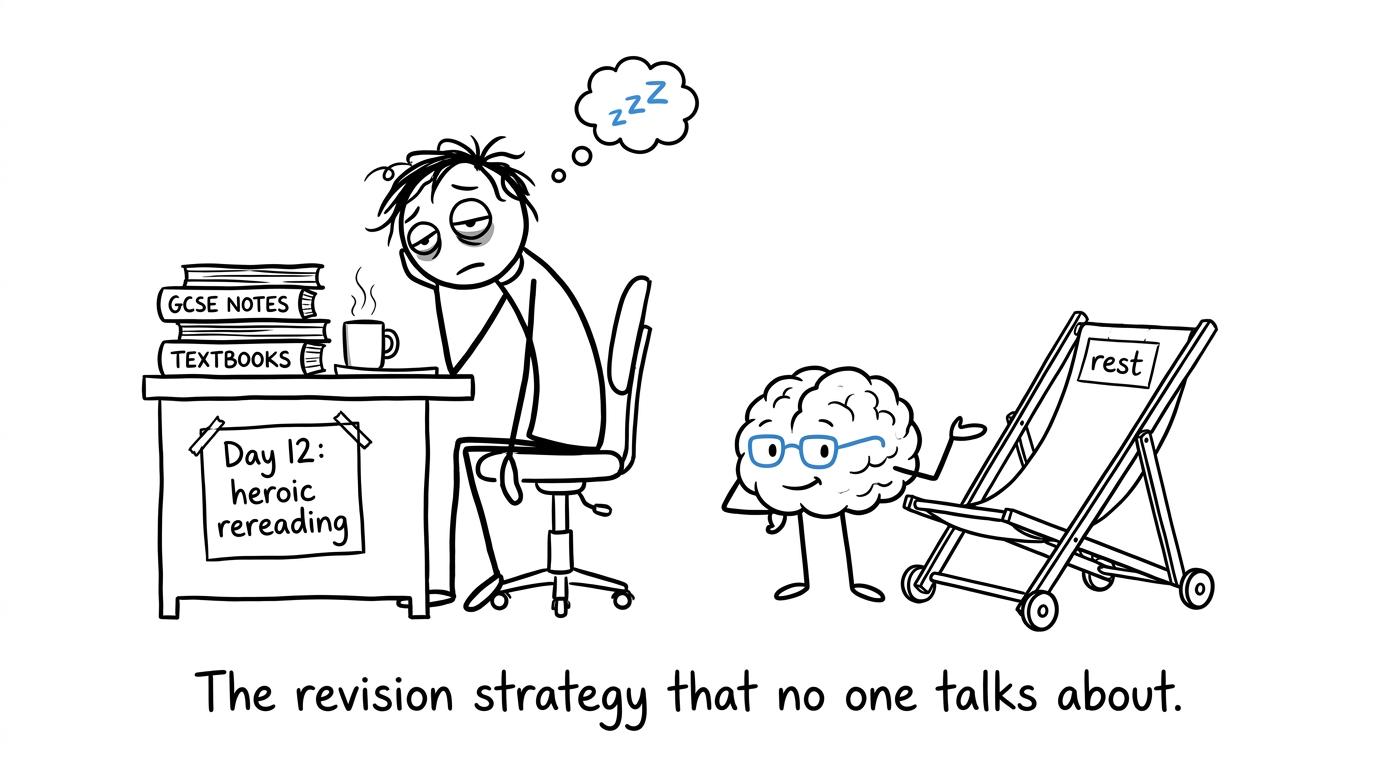 A tired student's brain quietly brings a deckchair into an excessive revision session
Why revising every day is not automatically better
It is easy to measure commitment in days. Learning is harder to see.
A calendar full of ticks can feel reassuring, yet the quality of each session matters more than whether you opened a book. Daily rereading may create familiarity without developing the ability to analyse an unseen text, adapt your writing or work within the examination time.
GCSE English Language is primarily a skills-based qualification. Across AQA, Edexcel, OCR and Eduqas specifications, students are assessed on abilities such as:
- identifying explicit and implicit information;
- analysing language and structure;
- comparing ideas or perspectives where required;
- evaluating texts;
- writing for a particular purpose, audience and form;
- using vocabulary, sentences, spelling and punctuation accurately.
The precise paper structure, question wording and timings vary by exam board, so always use your current specification and school guidance. However, these skills improve through repeated attempts, feedback and correction, not through simply spending time near a revision guide.
The same principle applies in maths. Watching a solution can make a method look obvious, but independent practice reveals whether you can actually use it. MathsGenie’s guide to English Language revision without wasting time follows a useful cycle: attempt, mark and improve.
How spacing helps retention
Spacing means distributing learning across separate sessions instead of compressing the same work into one long period. Research in cognitive science generally supports revisiting material over time, although no single timetable is ideal for every student or every type of task.
The gap matters because some forgetting occurs. When you later retrieve the idea, the effort involved can strengthen access to it. In English Language, useful knowledge for retrieval might include:
- the purpose of each question;
- the relevant assessment objective;
- structural and language methods;
- paragraph frameworks;
- checks for technical accuracy;
- personal targets identified from previous responses.
English revision cannot be reduced to memorisation. You must also apply those ideas to unfamiliar material. A useful spaced sequence might therefore move from recalling a question’s demands, to planning a response, to writing under time pressure, and finally to correcting it after feedback.
Rest days help create the gaps that spacing requires. They also give you room for other subjects. Rest is not a trick that makes learning happen without effort; it is part of a schedule that makes effort repeatable.
Retrieval needs feedback to become useful
Retrieval practice means bringing information to mind without immediately looking at your notes. Evidence supports it as a way to strengthen retention, but retrieval is only helpful when mistakes are identified and corrected.
For English Language, active retrieval could include:
- writing down the requirements of a question from memory;
- recalling several ways a writer may shape a reader’s response;
- planning a comparison without using a prepared template;
- listing your recurring punctuation errors before checking your log;
- explaining what a particular assessment objective rewards.
Then check. A confidently remembered mistake is still a mistake.
For longer responses, compare your work with the relevant mark scheme and seek teacher feedback where possible. Ask which feature would move the response forward: closer textual analysis, a clearer line of argument, better organisation, more precise vocabulary or greater technical accuracy.
This approach is particularly important for resit students. The GCSE English Language resit revision plan explains how diagnostic practice can turn broad concern into specific actions while maths revision continues alongside English.
What should happen on a rest day?
A rest day from English Language does not have to mean doing nothing all day. It means deliberately removing that subject from the schedule so attention and energy can go elsewhere.
Depending on your wider timetable, you could:
- complete a short maths topic session;
- exercise or spend time outside;
- see friends or relax with family;
- prepare materials for the following week;
- finish schoolwork without adding extra revision;
- take a complete break from academic work.
Government exam-pressure guidance recommends manageable targets, structured revision, regular breaks and attention to sleep and wellbeing. Sleep should not be treated as spare time available for revision. It supports memory and concentration, while persistent tiredness makes careful reading, accurate writing and mathematical problem-solving harder.
A rest day is especially sensible when you are repeatedly rereading the same sentence, rushing easy tasks, becoming unusually irritable or sacrificing sleep to maintain a streak. Continuing may add minutes without adding useful learning.
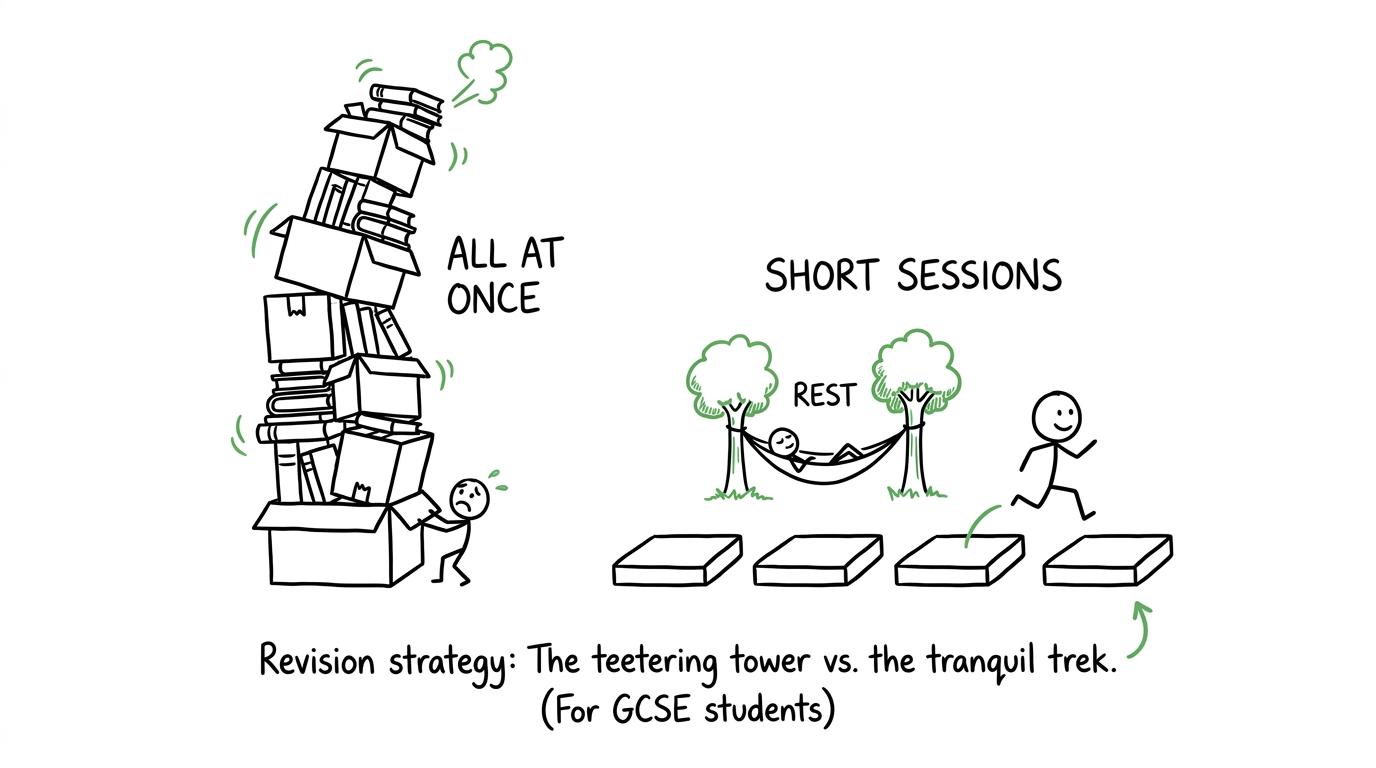 A sustainable revision plan crosses stepping stones while an all-at-once plan wobbles nearby
A sustainable weekly pattern for English and maths
Instead of asking whether you must revise English every day, decide what successful practice needs to contain across a week.
A sensible pattern could include:
- two focused English sessions: practise one reading question and one writing task;
- one longer English session: complete a timed section, mark it and improve part of the response;
- one or two brief recall moments: review question purposes, assessment objectives or personal error targets;
- several maths sessions: combine topic practice with mixed questions;
- one genuine recovery period: no additional revision beyond essential schoolwork.
This is a framework, not a prescription. Adjust it around examination dates, teacher feedback and the subjects requiring the most attention. Near an English paper, you may temporarily increase timed practice. Near a maths paper, English may reduce to a short maintenance task.
A timetable also needs catch-up space. If every evening is full, one missed session causes the entire plan to collapse. The GCSE revision timetable you can actually follow shows how specific tasks and catch-up time make a plan more realistic. You can also use the MathsGenie GCSE maths revision timetable to balance topic practice, marking and timed papers.
Match the task to your available energy
Not every session needs the same intensity. A useful plan has different gears.
Low-energy revision
Choose a contained task that still requires thought:
- recall the purpose of one question;
- review your error log;
- plan one response;
- improve several sentences for clarity;
- annotate a short extract with a specific focus.
Medium-energy revision
Complete one examination question under a realistic time limit, then use the mark scheme and your previous targets to review it.
High-energy revision
Attempt a complete section or paper under timed conditions. Full papers are demanding and should be followed by proper review, not placed on consecutive evenings simply because the exam is close.
Maths should be planned in the same way. Short topic sessions can maintain momentum, while full papers require more concentration and recovery. The guide to when you should start GCSE past papers explains how to progress from diagnostic sections towards complete timed papers.
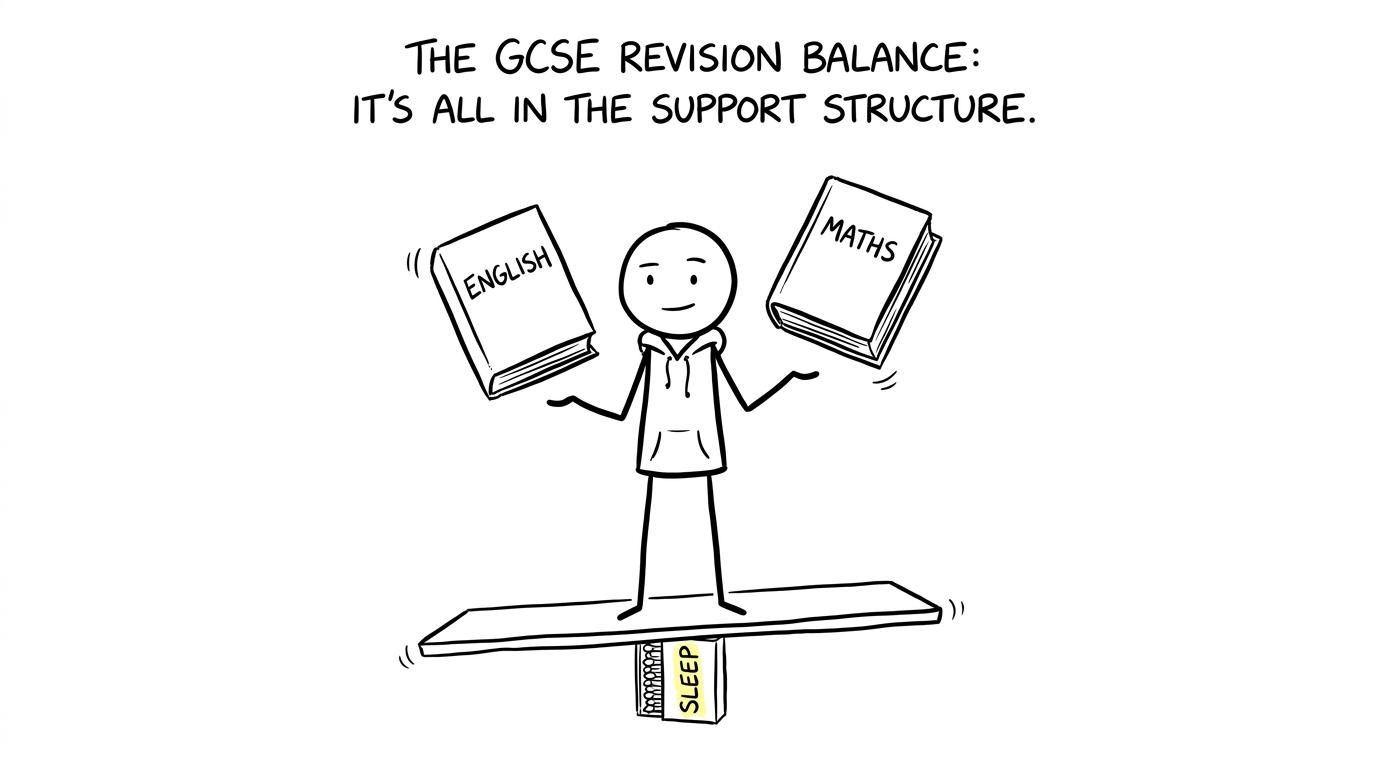 English and maths are juggled above a tiny sleep book supporting the whole stage
Common mistakes when planning revision and rest
Treating rest as a reward you must earn
Rest is a normal part of a sustainable timetable, not evidence that you lack ambition. If you only stop when exhausted, the break has arrived too late.
Revising English passively every day
Daily highlighting or rereading may feel productive because it is comfortable. Replace some of that time with independent planning, timed responses and correction.
Completing papers without reviewing them
A paper produces useful information, but improvement comes from acting on it. Identify why marks were lost and choose the next task accordingly.
Giving every subject equal time
Equal is not always sensible. Allocate time according to examination proximity, current performance and the size of each weakness. Reassess this weekly.
Sacrificing maths to catch up with English
English can expand to fill every available evening because written tasks have no obvious finishing point. Define the task before starting. Then protect maths sessions using a manageable resource such as the GCSE one-month maths revision plan.
Replacing sleep with late revision
A final exhausted response is unlikely to be your best work. Set a stopping time, prepare for the next day and return with more attention.
Build a rhythm you can trust
The best answer to gcse english language revise every day or rest is not a rigid rule. It is a rhythm: practise, retrieve, check, rest and return. Daily English contact can be useful when it is brief and focused, but intensive daily sessions are neither necessary nor automatically effective.
Plan English around active exam skills. Leave gaps between sessions. Protect sleep. Keep maths moving through revision lessons and targeted questions, then test your progress with past papers.
MathsGenie gives you a clear place to do that. Start with free revision lessons and practice questions, use mark schemes and video solutions to repair mistakes, and build towards mini tests, Edexcel GCSE maths predicted papers and full past-paper practice. A calm plan does not ask you to work every minute. It makes each useful minute easier to repeat.











