GCSE English Language Revision Without Wasting Time
GCSE English Language revision without wasting time: a simple plan, mark-scheme methods, and past-paper routines that still protect your maths grades.
The real reason GCSE English revision feels like a time sink
GCSE English Language revision has a special way of stealing an evening and giving nothing back. You sit down with good intentions, read a model answer, highlight a page, maybe rewrite a paragraph, and when you close the book you still can’t quite explain what changed. Meanwhile maths is sitting there like a quiet bill you’ll have to pay later.
The fix isn’t more effort. It’s choosing revision that creates measurable output: a plan, a method, a marked response, a corrected mistake. If you’re a GCSE or A Level maths student, you already understand this mindset. In maths, a question is either correct or it isn’t, and the fastest progress comes from finding exactly where it breaks.
English can work the same way, if you let the mark scheme drive, and you practise in short, sharp loops.
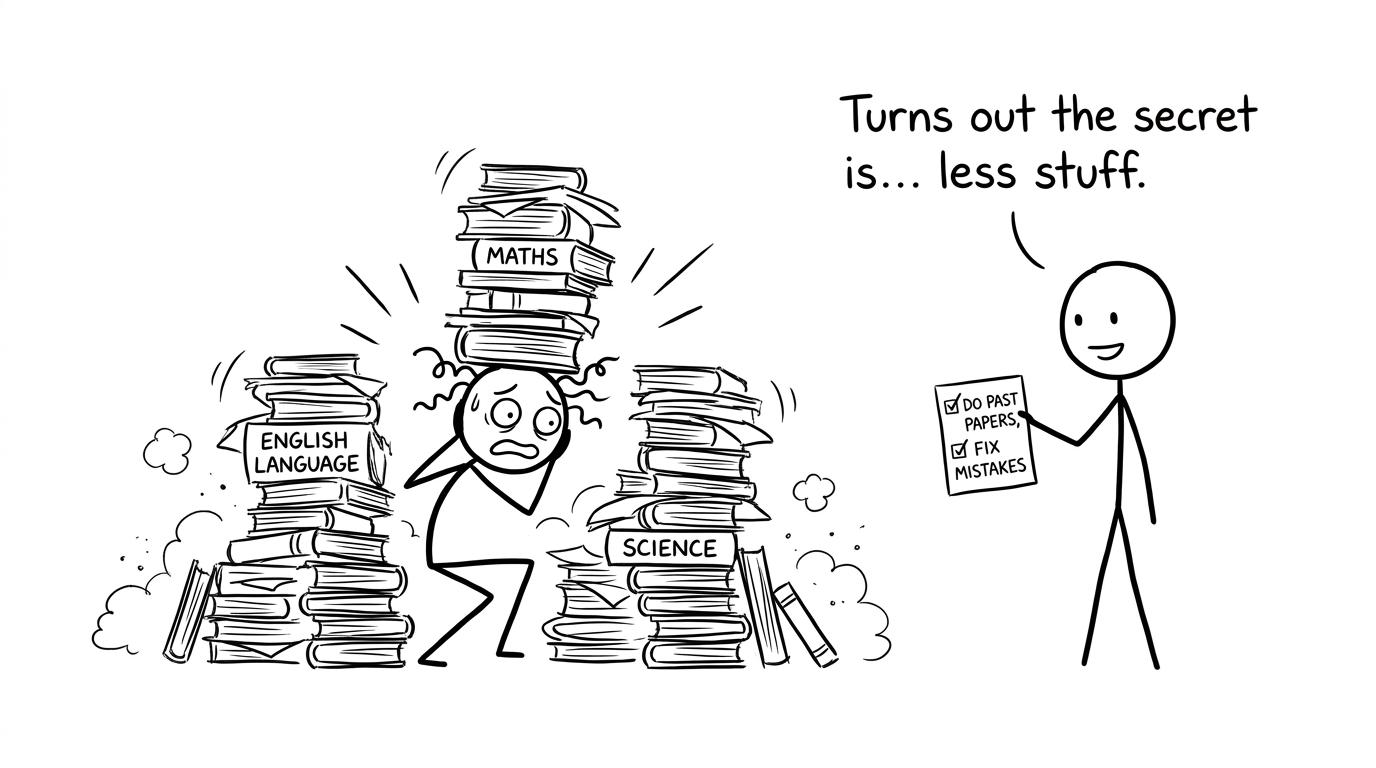 A stressed student and a tiny checklist
A quick checklist for GCSE English Language revision that actually works
Use this as your “no-waste” filter. If your revision session doesn’t include at least one of these, it’s probably drifting.
- Know your paper structure (AQA, Edexcel, OCR, Eduqas): timings, question types, assessment objectives.
- Practise with real papers and mark schemes, not just notes.
- Build two reusable paragraph frames: one for language analysis, one for evaluation/comparison.
- Collect a small bank of methods (metaphor, semantic field, sentence length, contrast, imagery, narrative perspective) and practise spotting them quickly.
- Do micro-writing: 888-minute openings, 121212-minute analysis, 151515-minute Q5 planning.
- Track mistakes like you would in maths: a short error log and one action next time.
When you need resources, YesGenie already organises English Language by exam board with papers and support tools. Start here: AQA GCSE English Language Revision.
Treat English like maths: marks come from a method
If you revise GCSE maths, you know the feeling of getting a method wrong, fixing it once, then suddenly picking up those marks repeatedly. English has the same “repeatable marks”; they just hide inside words like AO1 and AO2.
Most GCSE English Language questions reward three things:
- A clear point that answers the question.
- Evidence (a short quote, embedded smoothly).
- Analysis of method and effect (what the writer does and why it matters).
That is a method. And methods can be practised.
Worked example: a fast AO2 paragraph you can reuse
Imagine a question like: How does the writer present the setting as threatening?
Use a simple frame: Point, Quote, Method, Effect, Zoom.
- Point: The writer makes the setting feel dangerous and unpredictable.
- Quote: The road is described as “a throat of darkness”.
- Method: This is a metaphor.
- Effect: A “throat” suggests something that can swallow you, so the setting feels like an active threat rather than a neutral place.
- Zoom: The noun “darkness” implies the character cannot see or plan, creating fear through uncertainty.
Now here’s the revision trick: don’t just write one good paragraph and stop. Write two versions, one longer, one shorter. In the exam, time is the real boundary.
You can even borrow a maths habit: set a timer. If you give yourself 101010 minutes and produce one paragraph, you’re training speed and quality together.
The highest-ROI routine: past paper, mark scheme, rewrite
The most time-efficient GCSE English Language revision is the same shape as effective maths revision:
- Attempt a question under timed conditions.
- Mark it using the mark scheme.
- Rewrite one paragraph to target the missing marks.
This is where students waste time: they do Step 1, skip Step 2, and never do Step 3. But Step 3 is where your brain actually changes.
YesGenie makes this easy because it groups papers and provides structured practice paths. For maths, you might already use: Edexcel GCSE Maths Past Papers and Edexcel GCSE Maths Mini Tests. Take the same approach into English: use the English board pages and past papers to keep practice realistic, not random.
If you’re on OCR for English, you can pull papers from: OCR GCSE English Language Past Papers.
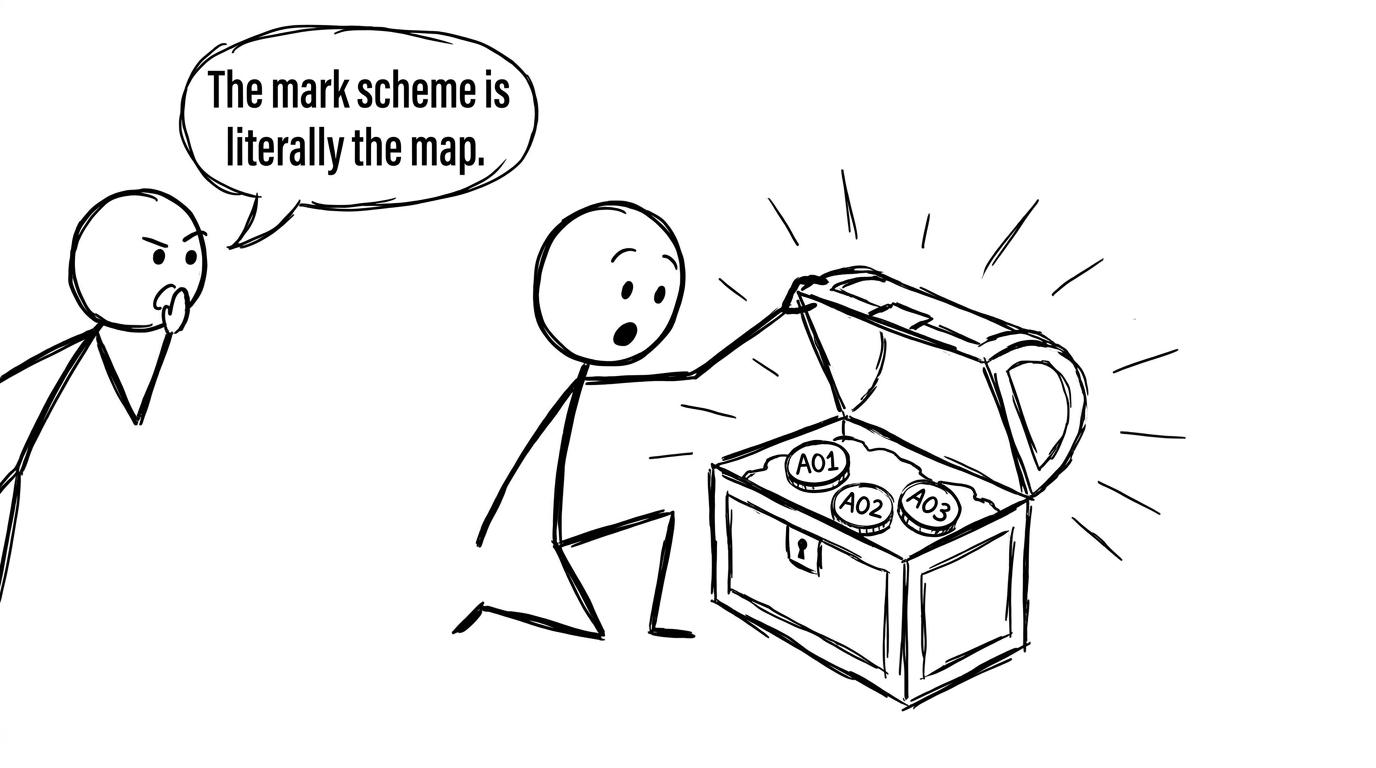 A mark scheme as a treasure chest
How to use the mark scheme without overthinking it
Mark schemes look intimidating because they’re written for examiners, not students. But they’re basically a checklist of what “better” means.
Do this:
- Highlight the difference between bands, not the whole page.
- Translate one band into a student instruction, e.g. “perceptive analysis” becomes: analyse a specific word choice and link to the question.
- Steal the vocabulary you actually need: clear, developed, convincing, judicious, critical.
For GCSE maths, the equivalent is understanding what earns method marks. For English, it’s understanding what earns analysis marks.
Stop writing too much: plan like a mathematician
In GCSE English Language, especially writing tasks, students lose time by starting too soon and steering by panic. Planning is not “extra”. Planning is the cheapest way to improve structure and control.
Worked example: a 555-minute plan for Question 5
Use a simple three-layer plan:
- Purpose: what emotion do you want to create (tension, wonder, anger)?
- Shape: beginning, turn, ending.
- Tools: 333 techniques you will deliberately use.
Example plan:
- Purpose: build tension.
- Shape: calm opening, unsettling detail, sudden shift.
- Tools: short sentence, sensory imagery, contrast.
Then write with control. One good short sentence placed well can outscore a long paragraph that goes nowhere.
 Highlighting vs real revision
A time-smart weekly plan that protects your maths grades
If you’re revising GCSE maths and maybe A Level maths too, you can’t let English expand until it fills the week. Use small, repeatable sessions.
Here’s a realistic structure:
- Two sessions per week (25-35 minutes): one reading question, one writing task.
- One session per week (45 minutes): a timed section of a past paper.
- Daily (5 minutes): method spotting: pick a paragraph and identify 333 techniques quickly.
That’s it. The goal is consistency, not heroics.
If you already build your maths revision from short, targeted practice, keep that habit with YesGenie’s maths resources too: the GCSE Past Papers Hub and the wider Resources page make it easier to stay organised.
How to choose what to practise (by exam board)
GCSE English Language is similar across exam boards, but the paper structure and timing differ. Your revision should mirror your exact specification.
- AQA: often rewards precise language analysis and clear evaluative judgements; timing discipline is crucial.
- Edexcel: question styles and texts can vary; focus on meeting the specific command word each time.
- OCR: make sure you’re used to the exact paper format and what each question is asking.
- Eduqas: practise structured responses and concise evaluation.
YesGenie organises subjects by qualification and exam board, so you can keep your revision aligned. If you’re juggling subjects, the Sitemap is a quick way to jump straight to your board’s page.
Common mistakes that waste time in GCSE English Language
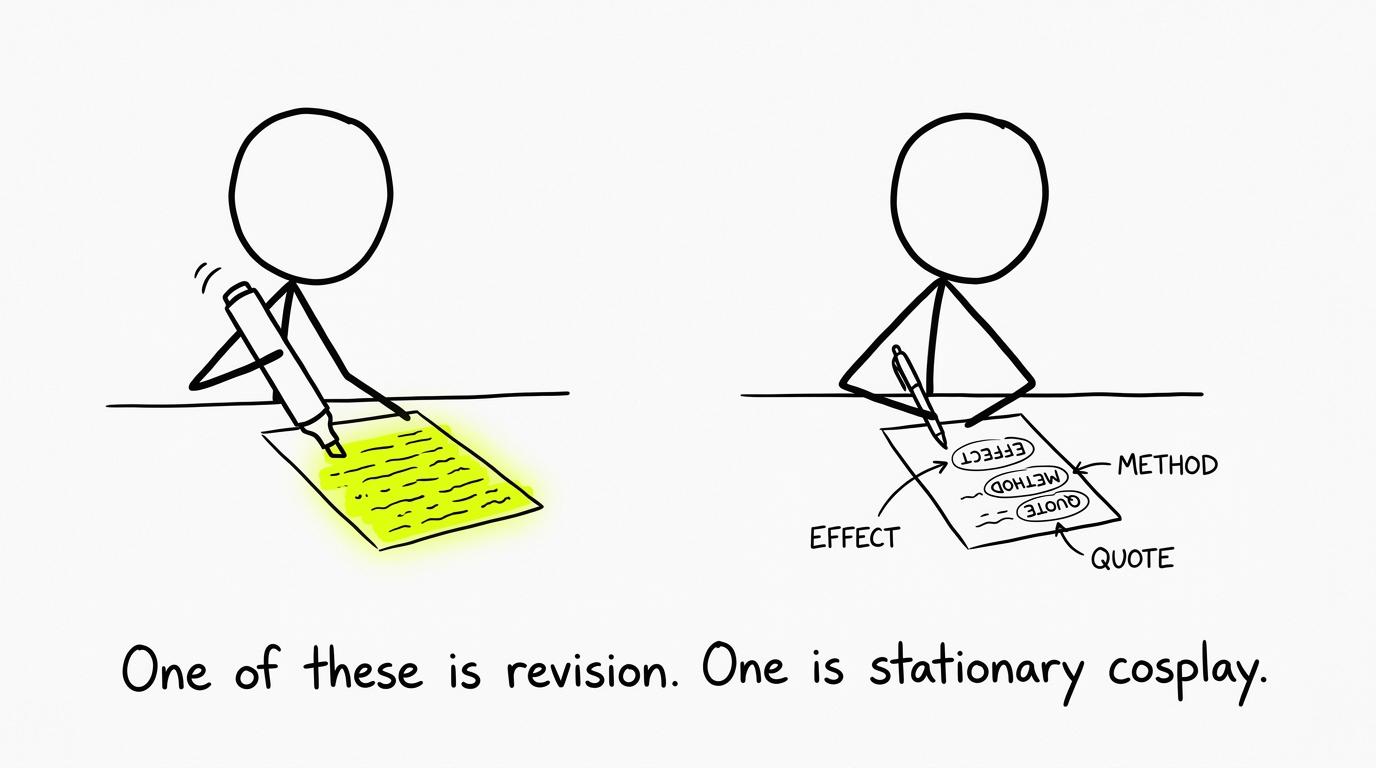
- Highlighting instead of practising. Highlighting feels productive because it’s tidy, but it doesn’t create exam performance.
- Writing long introductions. Examiners reward analysis and clarity, not warm-ups.
- Quoting too much. One short quote with sharp analysis beats a whole line copied out.
- Technique-spotting without effect. Naming “metaphor” isn’t analysis; explaining why it matters is.
- Ignoring the question wording. If it says “How does the writer present…”, you must focus on presentation methods, not plot summary.
- Skipping the mark scheme. You cannot reliably improve without seeing what the next band requires.
Bring it together: a no-waste GCSE revision mindset
The best GCSE English Language revision isn’t the most dramatic. It’s the most repeatable. You attempt, you check, you rewrite. You build small methods and run them until they’re yours.
And because you’re a maths student, you already have the advantage: you respect practice, you understand feedback, and you know that marks usually come from doing the basics well under time pressure.
If you want revision that stays organised across subjects, use YesGenie as your home base: revision lessons when you need clarity, practice questions when you need repetition, and past papers when you need exam confidence. Start with your board’s English page (for example AQA GCSE English Language Revision) and keep your maths sharp alongside it with Edexcel GCSE Maths Past Papers, Edexcel GCSE Maths Mini Tests, and the GCSE Past Papers Hub.
Do the work that changes you. Skip the work that only decorates your notebook. That’s how you revise for GCSE without wasting time.