

GCSE English Language and Literature Cram Guide 1 Week
GCSE English Language and Literature cram guide: a focused 1-week plan for texts, quotations, timed answers and calmer last-minute exam revision.
There is a particular kind of panic that arrives when the exam is close and your notes still look untouched. English Literature seems to contain too many characters, themes and quotations. English Language feels harder to revise because the extracts will be unseen.
If you searched for a gcse english language and literature cram guide 1 week, the useful answer is simple: spend seven days practising the tasks that earn marks, not trying to relearn two entire courses. Each day should combine active recall, one timed response and careful marking. You cannot cover everything, but you can become much better at retrieving evidence, analysing writers’ choices and controlling your time.
This plan is also designed for students balancing English with GCSE maths. It keeps English focused so that it does not swallow the revision time you need for other exams.
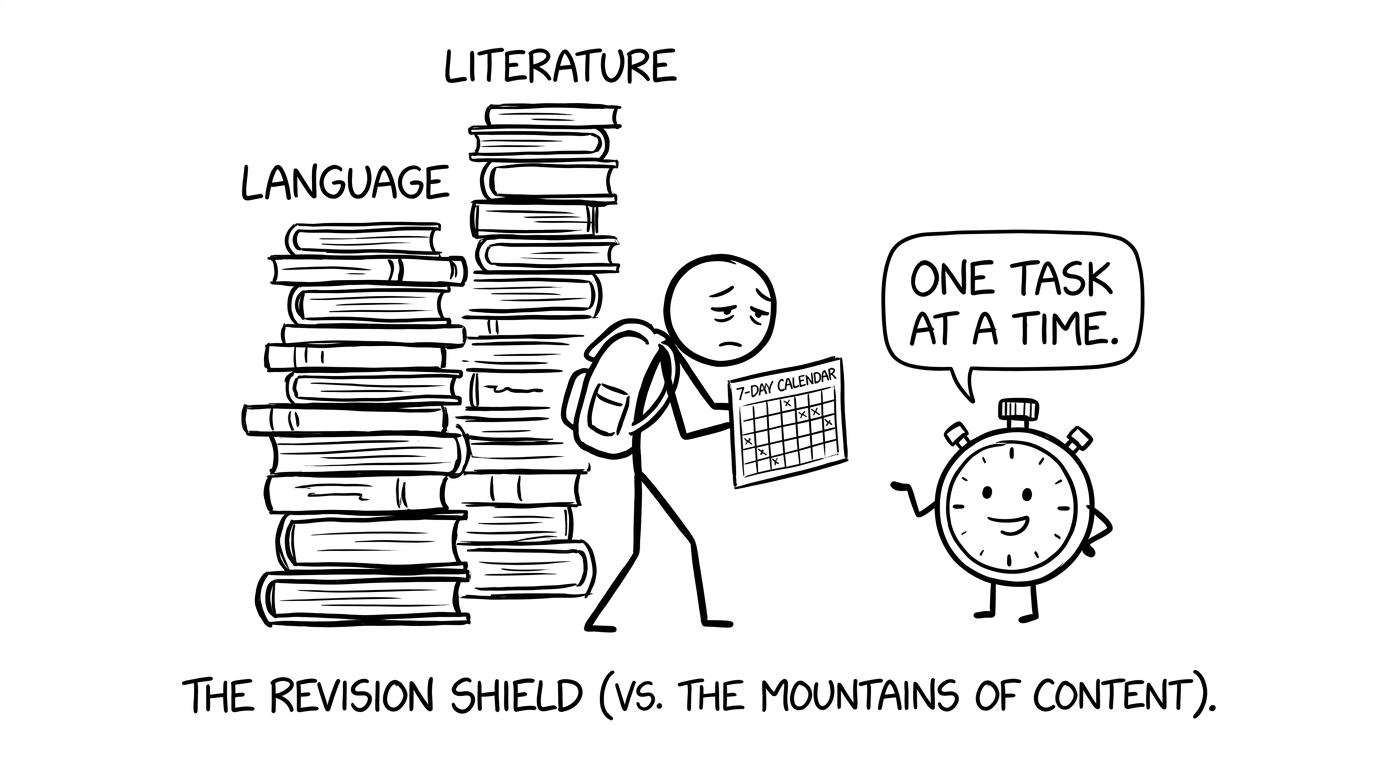 A student facing two giant English revision piles with a seven-day calendar
Your one-week cram checklist
Before beginning, collect:
- your correct exam-board specification and paper structure
- the names of every Literature text and poetry cluster you have studied
- past or specimen questions from your exam board
- mark schemes and any teacher-marked responses
- a blank quotation-and-theme sheet for each set text
- a timer and one notebook for mistakes
Check whether you take AQA, Edexcel, OCR or Eduqas rather than assuming every English paper follows the same format. The assessment objectives are nationally defined, but question styles, timings, text choices and paper structures vary.
English Language is not divided into foundation and higher tiers. English Literature is also untiered. That makes it especially important to revise the exact questions used by your board rather than borrowing a technique designed for another specification.
Use two focused English blocks each day, ideally around fifty minutes each, with a proper break between them. If you also have maths examinations approaching, reserve a separate block using the MathsGenie GCSE maths revision hub. A late start is not a reason to let one subject consume the entire week.
What matters most in GCSE English
A cram plan works only when it follows the marks.
In English Language, the core reading objectives assess your ability to retrieve and interpret information, analyse language and structure, compare perspectives and evaluate texts. The writing objectives reward clear communication, organisation, an appropriate tone and accurate spelling, punctuation and grammar.
For example, under the current AQA specification, the two written Language papers are equally weighted. Each combines reading with an extended writing task. AQA gives writing 50%50\%50% of the qualification overall, with technical accuracy forming a significant part of those marks. Other boards organise their papers differently, so copy the timing and question sequence from your own specification.
In Literature, the priorities are equally clear:
- answer the precise question
- develop an informed interpretation
- support ideas with textual references or quotations
- analyse language, form and structure
- connect relevant context to the writer’s ideas
- write accurately and coherently
For AQA, Literature is closed book and includes Shakespeare, a nineteenth-century novel, a modern text, anthology poetry and unseen poetry. Its first paper is weighted at 40%40\%40% and its second at 60%60\%60%. Do not assume those details apply to every board, but do take the larger lesson: plot knowledge alone is not enough. Examiners reward a reasoned argument about how and why a writer constructs meaning.
Day one: diagnose before revising
Do not begin by decorating notes. Begin with evidence.
Choose one English Language reading section and one Literature essay question from your own exam board. Complete short plans or timed responses without notes. Then compare your work with the mark scheme and any examiner guidance supplied by your school or board.
Create a one-page marks-leak list with three columns:
| Area | What went wrong | Action this week |
|---|---|---|
| Language reading | Explained the quotation but not the writer’s method | Practise two analysis paragraphs |
| Literature | Remembered events but lacked precise evidence | Learn flexible quotations by theme |
| Timing | Spent too long on an early question | Follow a written time budget |
Keep the list specific. “Bad at English” cannot guide tomorrow’s revision. “I identify metaphors but do not explain their effect on meaning” can.
This is the same diagnostic habit used in effective maths revision. The guide to finding your weakest GCSE topics explains why mistakes become more useful once they are classified rather than merely counted.
Day two: rebuild your Literature text maps
Give each set text one sheet. Write the title in the centre, then add:
- four or five major themes
- the central characters and how they change
- significant relationships or conflicts
- key moments from the beginning, middle and end
- relevant contextual ideas
- a small bank of short, flexible quotations
Aim for quotations that can support several themes. Short evidence is easier to retrieve and leaves more room for analysis. You may also use accurate references to events where appropriate, but precise textual knowledge gives your argument authority.
Test yourself with the page covered. Say the quotation, identify where it appears and explain which themes it could support. Then write it from memory. Repeated retrieval is more useful this week than repeatedly reading a finished poster.
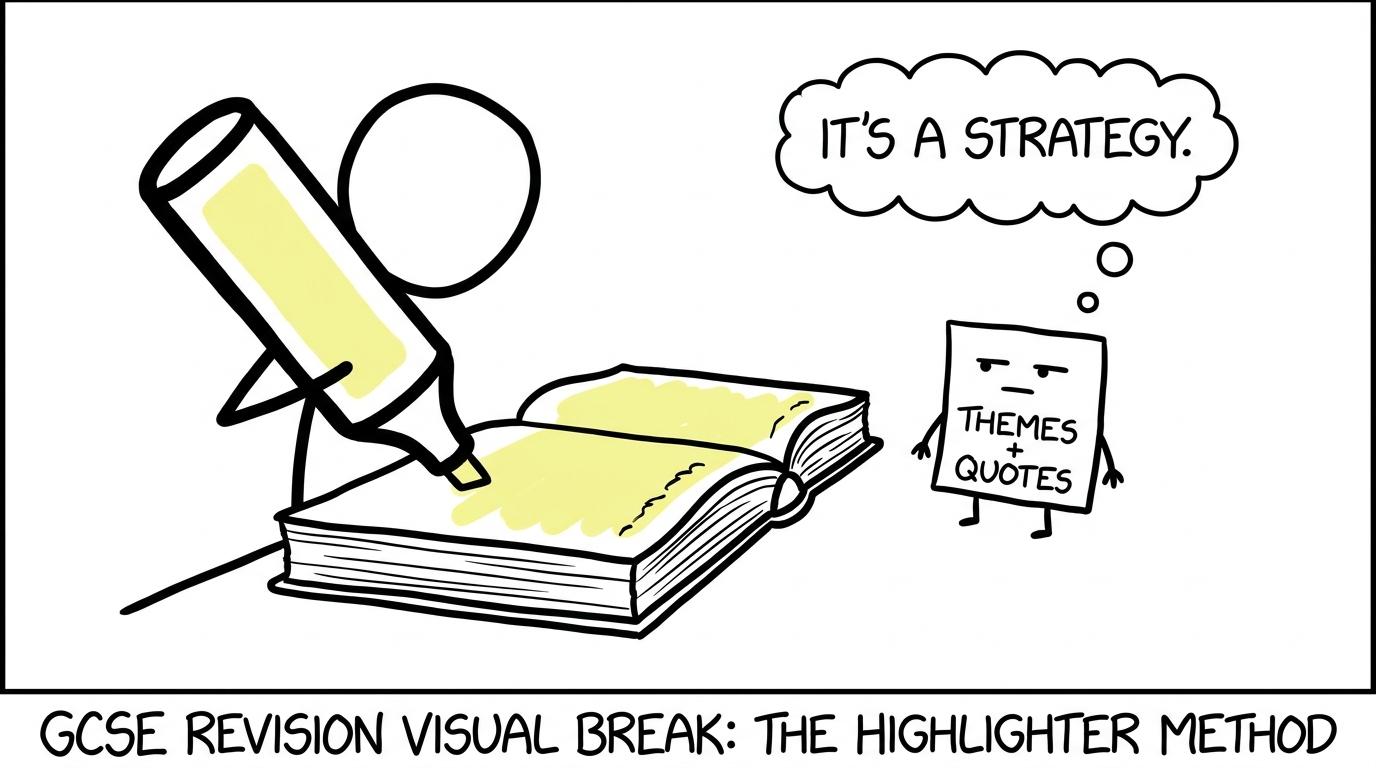 A giant highlighter meets a much more sensible themes and quotations note
Day three: train English Language reading skills
English Language revision should focus on repeatable reading decisions, because the texts themselves will be unseen.
Use one extract and practise this sequence:
- read the question before hunting for evidence
- underline its focus, location and command word
- select only evidence relevant to that focus
- identify a meaningful choice in language or structure
- explain what it suggests and how it shapes the reader’s understanding
- return explicitly to the question
For comparison tasks, organise paragraphs around a clear similarity or difference between the writers’ ideas or perspectives. Compare throughout the paragraph rather than writing about one source for a page and attaching the second at the end.
For evaluation, make a judgement and defend it with evidence. Listing techniques is not evaluation. Your answer needs to consider how convincingly the text creates the effect named in the question.
Complete one timed reading section, mark it promptly and add no more than three actions to your marks-leak list.
Day four: practise writing for purpose and audience
Today, prepare for the extended Language writing task. Check the forms used by your board, which may include narrative, description, articles, letters or speeches.
Build a compact planning routine:
- identify form, purpose and audience
- decide your central idea or viewpoint
- plan a clear opening and ending
- arrange paragraphs in a deliberate sequence
- reserve time to check technical accuracy
For persuasive or transactional writing, control is more valuable than a pile of rhetorical devices. Make a clear case, anticipate another perspective and choose vocabulary appropriate to the audience.
For creative writing, use a manageable idea. A controlled narrative with a deliberate viewpoint, atmosphere and structure is safer than an enormous plot that cannot be completed. Write one timed response, then proofread separately for sentence boundaries, apostrophes, spelling and paragraphing.
Day five: turn Literature knowledge into arguments
Select one question for each major set text. Do not write every essay in full. Instead, create fast plans containing:
- a direct answer to the question
- three connected lines of argument
- supporting evidence for each point
- language, form or structural choices to analyse
- relevant context woven into the interpretation
- a final judgement about the writer’s purpose
Then write one complete timed essay on your weakest text.
Avoid treating context as a detached history paragraph. Connect it to meaning: explain how an audience, literary tradition or social idea helps illuminate the writer’s choices. Context should strengthen the argument rather than interrupt it.
Finish with an unseen poem. Read for voice, situation, tone and shifts before searching for devices. A technique matters because of what it contributes to the poem, not because you have spotted its name.
Day six: complete a realistic paper rehearsal
Choose the paper you are sitting first and work under its correct conditions. Use the official time limit, put your phone away and follow the real question order unless you already have a tested alternative.
Afterwards, do not stop at a total mark. Record:
- questions where you misunderstood the task
- paragraphs lacking evidence
- analysis that became vague
- sections where timing failed
- recurring spelling or punctuation errors
The lesson transfers directly to maths: completing a paper is only the test; improvement happens during the repair. Use the MathsGenie guide to using past papers properly when planning your remaining maths practice, or try GCSE predicted papers for further timed preparation.
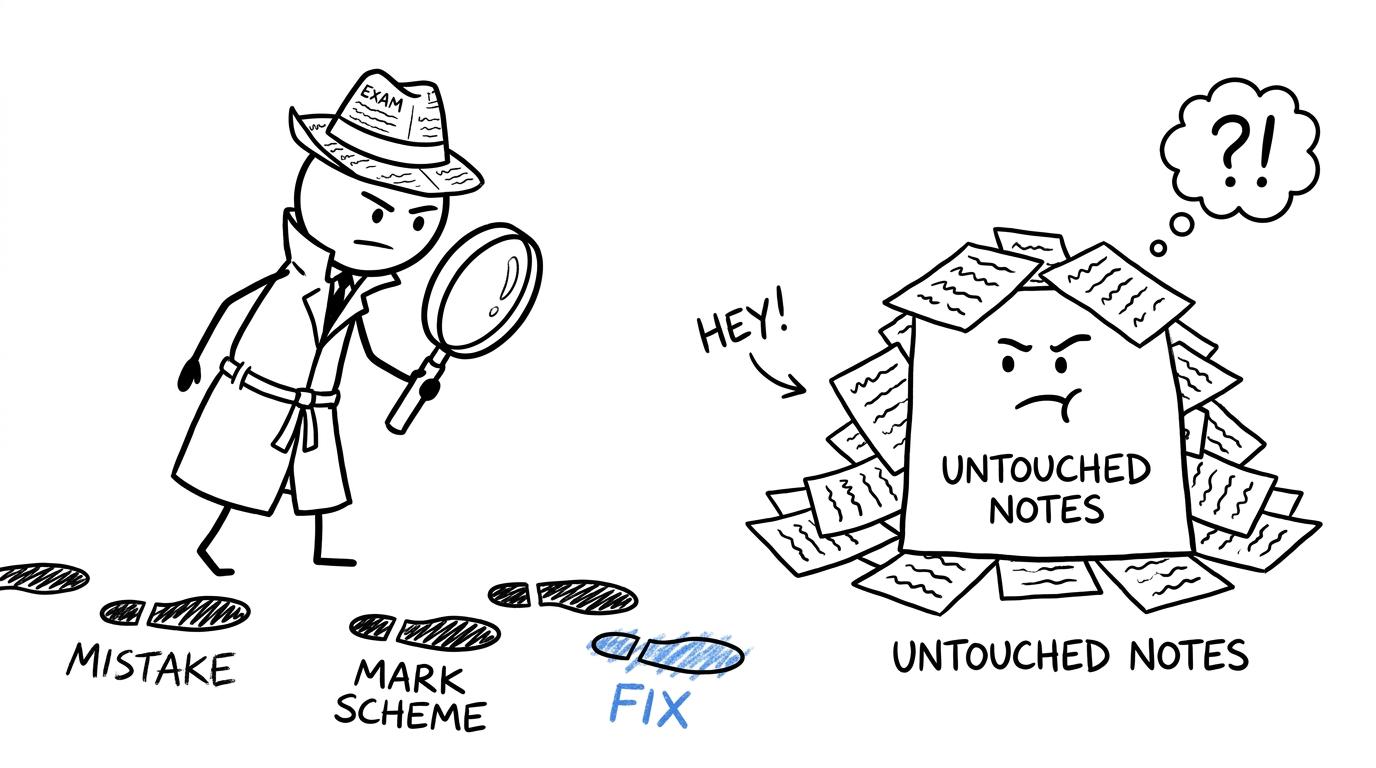 An exam-paper detective following mistake, mark scheme and fix clues
Day seven: retrieve, repair and stop
The final day is not for another mountain of notes. Use it to make the week retrievable.
Without looking, write down your Literature themes, flexible quotations and central arguments. Check them, correct them and repeat only what you missed. Review your Language question checklist and plan one writing task, but avoid exhausting yourself with several complete papers.
Read your marks-leak list. For every problem, write one instruction you can follow in the exam, such as:
- answer the wording of the question in every paragraph
- analyse the significant word, not merely the device
- compare both sources within the same argument
- leave time to check sentence boundaries
Then protect your sleep and prepare your equipment. If maths is also imminent, keep that final session short and structured. The GCSE maths night-before plan and twenty-minute maths revision routine can help you maintain accuracy without starting an unhelpful late-night marathon.
Common mistakes in a one-week English cram
Trying to memorise complete essays
A memorised response may not fit the question. Learn flexible evidence, interpretations and argument structures instead. Examiners reward engagement with the task in front of you.
Revising plot instead of analysis
Knowing what happens is necessary, but marks come from using that knowledge to answer a question about a writer’s presentation of an idea, character or relationship.
Collecting too many quotations
A huge quotation bank creates the feeling of work without guaranteeing retrieval. Prioritise a smaller set that covers several themes, then practise applying it to different questions.
Ignoring the exam board
AQA timings and question labels should not automatically be applied to Edexcel, OCR or Eduqas. Use the specification and materials for the qualification you will actually sit.
Completing papers without repairing mistakes
A paper exposes weaknesses; it does not automatically correct them. Mark, classify, repair and retest. MathsGenie’s one-week GCSE maths revision plan uses the same disciplined loop for students balancing both subjects.
Sacrificing every other subject
English may feel urgent, but your timetable still needs proportion. Allocate fixed English blocks, then stop. Use a wider GCSE maths revision timetable to protect the revision needed for foundation or higher tier maths papers.
One week can still change how you perform
Seven days will not make the course feel infinite. That is the point. A useful cram plan narrows your attention to what you can still control: understanding the questions, retrieving flexible evidence, building clear arguments, writing under time and learning from mistakes.
Start today with one diagnostic task. Tomorrow’s work should be chosen by what that task reveals, not by what looks easiest.
For the maths side of your exam week, make MathsGenie your free revision base. Use the revision lessons and practice questions to repair weak topics, mini tests to check recall, and past papers, predicted papers, mark schemes and video solutions to develop exam confidence. English needs a focused week. Your wider GCSE preparation needs the same calm cycle: practise, check, fix and return stronger.











