

GCSE Economics Exam Conditions Practice at Home
GCSE economics exam conditions practice: set up a realistic timed session at home, use the right paper and equipment, then learn from every lost mark.
The strangest thing about a mock paper at home is how easily it stops being a mock. The phone buzzes. Someone opens the door. A difficult question becomes a convenient moment for a snack.
Effective GCSE economics exam conditions practice removes those escape routes. Choose an official paper for your specification, sit for the full published time, use only permitted equipment and avoid notes, pauses or help. Then mark the paper carefully and turn every lost mark into a specific revision task.
The purpose is not to recreate an examination hall perfectly. It is to rehearse the decisions you will need to make when the clock is real: when to move on, how much to write and how to recover after a difficult question.
Your realistic practice checklist
Before beginning, check that you have:
- the correct GCSE Economics paper for your exam board and component
- the official time limit written beside an actual finishing time
- the question paper, answer booklet and relevant inserts
- black pens, pencils, an eraser, ruler and permitted calculator
- a clear desk in a quiet, well-lit room
- a visible clock showing the actual time
- no notes, textbooks, phone, watch, earbuds or internet access
- any access arrangements you are formally entitled to use
- the mark scheme hidden until the session has finished
- uninterrupted time afterwards, or later that day, for marking and review
Do not rely on a remembered paper format. Read the front cover and check your current specification because paper lengths and instructions differ between qualifications.
Choose the exact paper you are preparing to sit
In England, the principal current GCSE Economics specifications are offered by AQA and OCR. Pearson Edexcel offers an International GCSE in Economics, which is a different qualification. Eduqas does not currently offer the equivalent GCSE Economics specification, so never select a paper merely because the board name looks familiar.
For AQA GCSE Economics, there are two papers: How Markets Work and How the Economy Works. Each carries 808080 marks, lasts 111 hour 454545 minutes and contributes 50%50\%50% of the qualification.
OCR GCSE Economics also has two equally weighted 808080-mark papers. Each lasts 111 hour 303030 minutes. Its papers include multiple-choice questions, case-study material and short, medium and extended responses.
That difference matters. Borrowing the timing or structure from another board makes the result less useful. Your first job is therefore to confirm:
- your awarding organisation
- your qualification and specification code
- the correct component
- the published duration
- the materials and calculator rules printed on the paper
If you are interpreting previous results, remember that grade boundaries change between examination series. MathsGenie's guide to GCSE Economics grade boundaries explains why an old raw mark should not be treated as a permanent grade boundary.
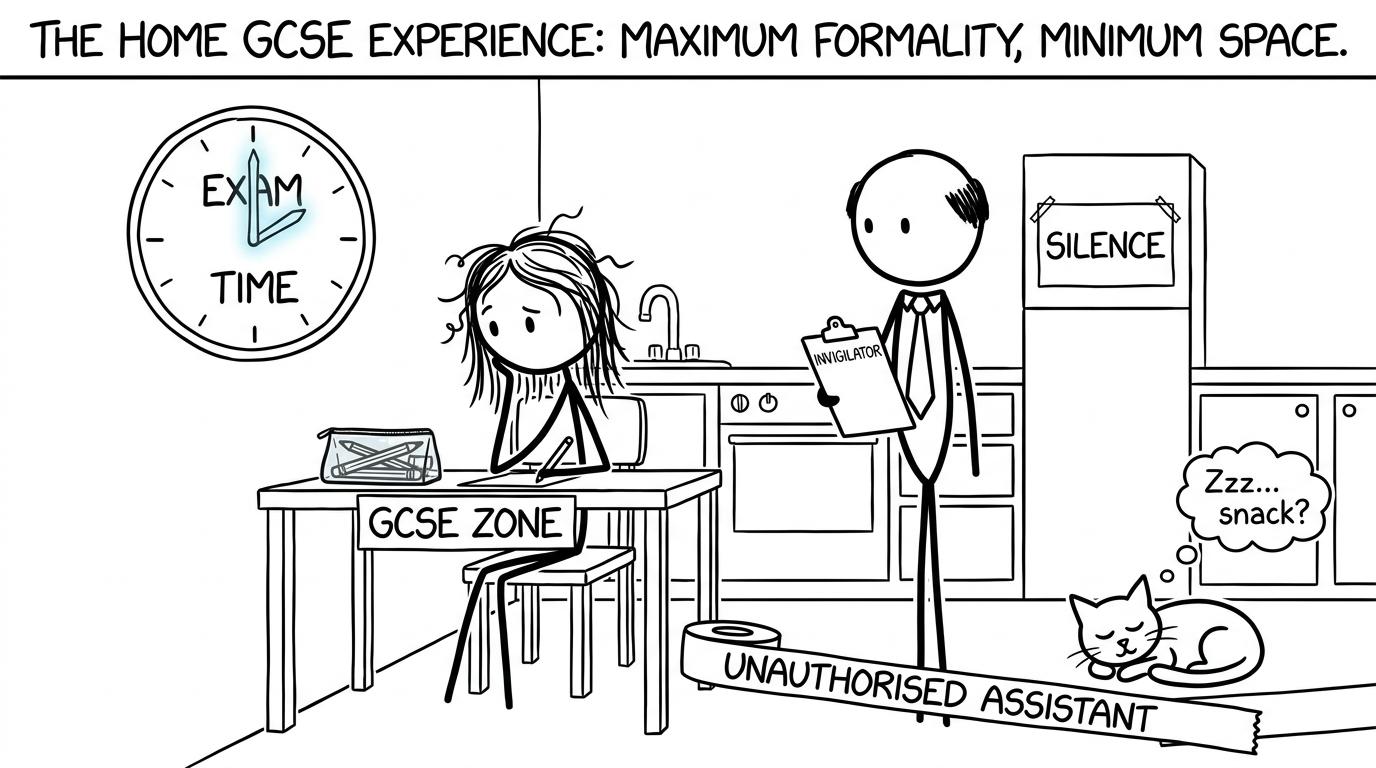 A student creates a comically serious examination hall at a kitchen table
Turn an ordinary room into an exam room
A realistic environment is deliberately uneventful. Clear away revision posters, formula cards, economics notes and open browser tabs. Sit at a desk rather than on a bed or sofa. Tell everyone at home when you will finish and ask not to be interrupted unless necessary.
Current JCQ instructions for formal examinations require suitable lighting, heating, ventilation and noise conditions. They also require a reliable clock showing the actual time; countdown and count-up clocks are not used as examination-room clocks. At home, imitate this by writing your actual starting and finishing times on a sheet in front of you.
Put your phone in another room. Switching it face down is not enough: part of the rehearsal is learning that checking it is not an available choice. Remove watches and earbuds too. Use a transparent pencil case if you have one and write in black ink, following the instructions on the paper.
A parent or carer can act as a simple invigilator by giving you the paper, recording the start and finish, and refusing to explain questions. They do not need to pace around the room looking suspicious. Their useful role is simply to protect the conditions.
Rehearse your approved access arrangements
If your school has confirmed an access arrangement, such as extra time, supervised rest breaks or use of a word processor, practise with that arrangement in the form your exams officer has approved. Ask the school if you are uncertain about how it will operate.
Do not add informal extra time because a paper felt difficult. Equally, do not remove an approved arrangement in an attempt to make practice seem tougher. Realism means rehearsing the conditions you will actually receive.
Start and finish like the real examination
Place the paper face down until the starting time. Read the front-cover instructions first, fill in any candidate details you are using for practice and begin only when the clock reaches the recorded start.
During the session:
- do not pause the clock for drinks, distractions or difficult questions
- do not search for definitions or current economic examples
- keep rough work within the paper or on designated paper
- leave space and move on when a question is consuming too much time
- return to incomplete answers before the end
- stop writing at the stated finishing time
The last point is uncomfortable, which is precisely why it matters. Continuing for another ten minutes may produce a nicer mark, but it gives you false evidence about your current performance.
Build up to full papers if your concentration is not ready. Mini tests and shorter timed sections can develop the habit first. The staged approach in when to start GCSE past papers is written for maths revision, but its progression from short diagnostic work to full timed papers transfers well to Economics.
Manage time through marks and command words
Time management is not about giving every question equal attention. A definition worth a small number of marks should not receive the same space as an extended evaluation.
Read three things before answering:
- the command word
- the number of marks
- the context or data provided
Words such as state, define and identify usually call for concise knowledge. Explain requires developed reasoning. Analyse asks you to explore relationships or effects, while evaluate, assess or justify requires a supported judgement appropriate to the specification and question.
GCSE Economics assessment is built around knowledge and understanding, application, and analysis and evaluation. Context therefore matters. A memorised paragraph that never uses the business, market, country or data in the question may show knowledge without securing all the available application marks.
Use regular clock checks at sensible points rather than after every sentence. If you become stuck, leave a clear marker, move forward and return later. The goal is to protect accessible marks across the whole paper.
Include the quantitative side of Economics
Economics is not a purely written subject. The OCR specification states that at least 10%10\%10% of marks assess quantitative skills, and calculations and data interpretation also form part of AQA assessment.
You may need confidence with percentages, percentage change, averages, ratios, interpreting tables and reading or constructing economic diagrams. Always show working when a calculation is required, check units and consider whether the result is economically plausible.
Students preparing for maths examinations have an advantage here if they connect the subjects. MathsGenie's free GCSE Maths revision hub contains revision lessons, exam questions and practice papers across AQA, Edexcel, OCR and Eduqas. Use it to repair an underlying numerical skill exposed by an Economics paper rather than repeatedly guessing at similar calculations.
Mark the paper without negotiating with yourself
Take a short break before marking so that you can read your work more objectively. Use the official mark scheme for that exact paper and apply it strictly. Do not award a mark because you “basically meant” something that is absent from the answer.
For longer responses, pay attention to the levels-based descriptors. A response can contain accurate economics yet remain limited because it lacks application, developed analysis, balance or a supported conclusion.
Record each lost mark under one of these causes:
- missing or inaccurate knowledge
- weak application to the context
- an incomplete chain of analysis
- unsupported evaluation or judgement
- quantitative error
- misreading the command word
- poor time management
This diagnosis is more valuable than the total alone. The method in finding your weakest GCSE topics shows how to convert lost marks into focused next actions rather than a vague promise to “revise more”.
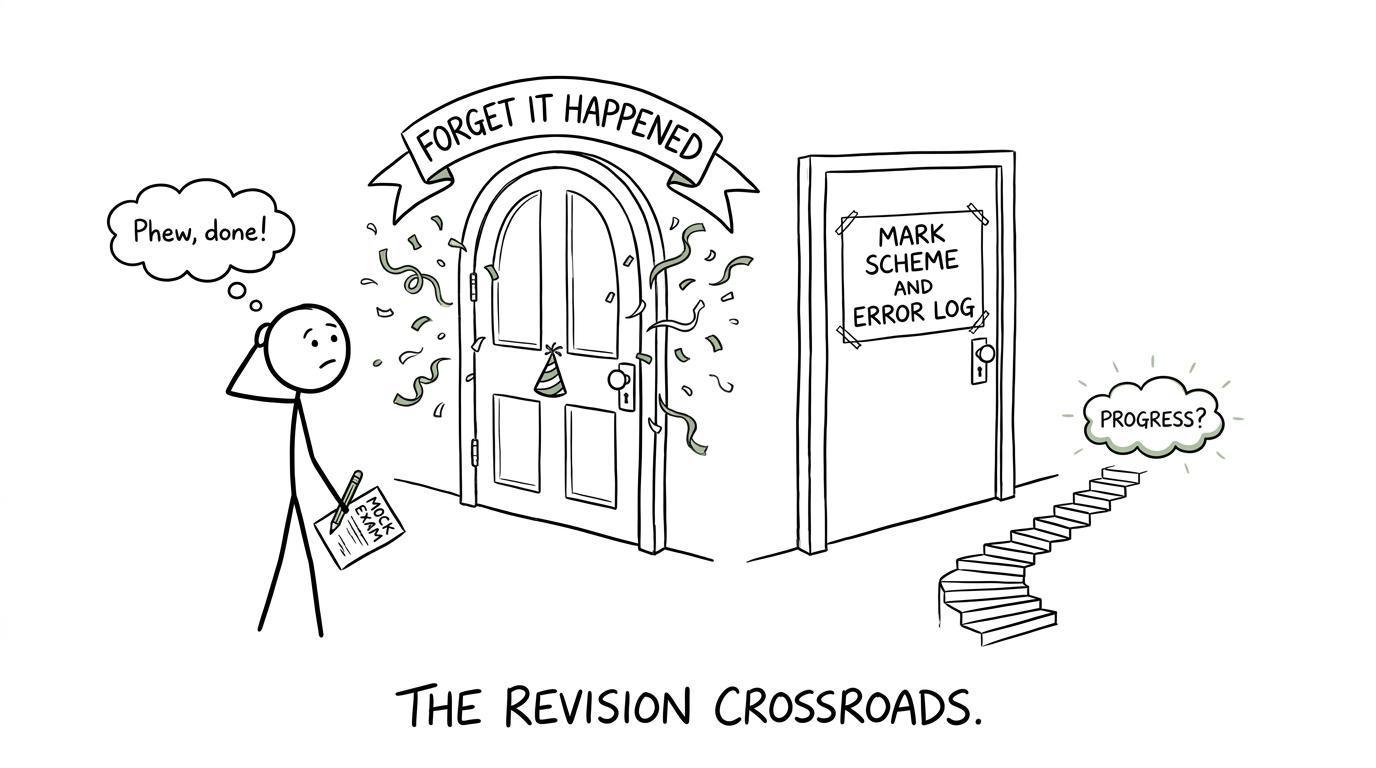 A student chooses between forgetting a mock and reviewing the mark scheme
Build a repeatable practice cycle
One realistic paper can reveal a problem. Repeated cycles change it.
After marking, select the two or three weaknesses that cost the most marks. Relearn the relevant content, practise a small set of targeted questions and attempt a fresh question without notes. Later, sit another full paper under the same conditions.
Avoid using every recent paper too early. Keep some unseen material for genuine testing. Predicted papers can provide additional unfamiliar practice, but they should never replace broad specification coverage. MathsGenie's discussion of predicted topics and sensible revision explains why predictions are best treated as practice rather than promises.
A revision planner should include both performance and repair:
- short content revision during the week
- targeted practice questions after each lesson
- a timed section or mini test
- a full paper at planned intervals
- mark-scheme review and reattempts
If you need a wider structure, adapt the habits in the one-month GCSE revision plan. The subjects differ, but the rhythm of retrieval, timed practice, diagnosis and correction remains useful.
Common mistakes during home exam practice
Making the conditions unrealistically comfortable
Music, snacks, messages and hints reduce the diagnostic value of the session. Comfort is not the same as calm. Build calm by becoming familiar with silence and uncertainty.
Using the wrong paper or duration
AQA, OCR and International GCSE Economics are not interchangeable. Confirm the qualification, component and front-cover instructions every time.
Pausing when a question becomes difficult
The difficult minute is part of the assessment. Practise deciding whether to persist, leave space or move on while the clock continues.
Looking at the mark scheme too soon
Once you have seen a mark scheme, the paper is no longer unseen. Finish the entire session before checking any answer.
Recording only the final mark
A score tells you where you are. It does not tell you what to do next. For a stronger review process, adapt the error-log routine in using GCSE past papers properly.
Repeating papers without repairing weaknesses
More papers do not automatically mean better preparation. A short targeted session between mocks often matters more than immediately attempting another full paper.
Make the real exam feel familiar
The best home mock is not the one with the highest mark. It is the one that tells the truth.
Choose the correct GCSE Economics paper, protect the full time, remove outside help and stop when the clock says stop. Then use the mark scheme to identify whether knowledge, application, analysis, evaluation, quantitative skill or timing cost you marks.
For the numerical skills that Economics demands, make MathsGenie your free revision base. Start with GCSE Maths revision lessons and practice, use mini tests to strengthen weak areas, and build exam stamina through past papers, predicted papers, mark schemes and video solutions. Repeat the cycle until formal exam conditions no longer feel unusual, only familiar.











