GCSE Economics Grade Boundaries 2026 Explained
GCSE economics grade boundaries explained for 2026 results day, with a clear mark example, exam-board checks and advice if your grade feels wrong.
Results day has a strange kind of suspense. The examinations are over, yet one unanswered question remains: what did your marks become? GCSE economics grade boundaries provide that conversion. They are the minimum total marks needed for each grade, from 999 to 111, and the official 2026 boundaries will be published on GCSE results day, Thursday 20 August 2026.
Until then, nobody can confirm the economics grade boundaries 2026. Previous boundaries can offer context, but they are not predictions. Each year’s boundaries are set after the papers have been taken and marked.
GCSE economics results day checklist
Before trying to interpret your result, check these details:
- Confirm your exam board and specification code.
- Find your overall qualification grade.
- Ask whether your results information includes marks for each paper.
- Use only the official boundary document for the 2026 exam series.
- Compare your total qualification mark, not an isolated paper mark, with the overall boundary.
- Speak to your school promptly if you are close to a boundary and have concerns.
MathsGenie’s GCSE Economics revision hub lets you select your exam board and explore specification-matched resources.
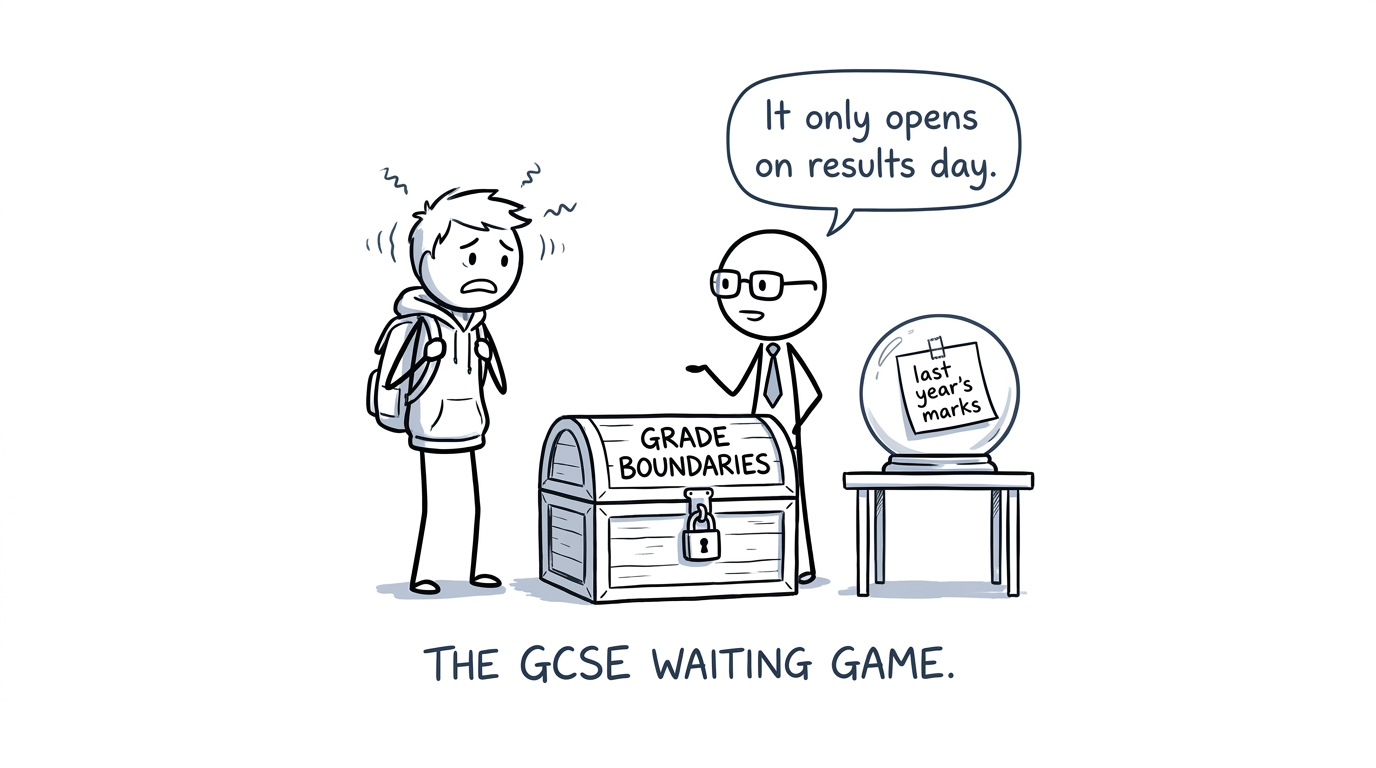 A student discovers that the grade-boundary crystal ball is useless
How GCSE Economics grade boundaries work
A grade boundary is the lowest mark that receives a particular grade. Suppose, purely hypothetically, that the grade 777 boundary were 115115115 marks. A total of 115115115 would receive grade 777, while 114114114 would fall into the grade immediately below, assuming no later change to the result.
Boundaries are not fixed percentages such as 70%70\%70% for every grade every year. Awarding bodies review the difficulty of the papers and evidence about student performance before setting them. If one series is more demanding than another, its boundaries may be lower. If it is more accessible, they may be higher. The aim is to keep the meaning of a grade reasonably consistent over time.
This is also why calculating a percentage and applying a classroom rule can mislead you. The useful comparison is:
your total markagainstthe official overall boundary\text{your total mark} \quad \text{against} \quad \text{the official overall boundary}your total markagainstthe official overall boundaryGCSE Economics is not divided into foundation and higher tiers. Students following the same specification take the same assessment, unlike tiered GCSE Maths qualifications.
Which marks count for Economics?
For AQA GCSE Economics 813681368136, students take two papers: How Markets Work and How the Economy Works. Each is worth 808080 marks and contributes 50%50\%50% of the qualification, producing a total of 160160160 marks. You can check the course structure and resources on the AQA GCSE Economics revision page.
OCR GCSE Economics J205 also has two 808080-mark papers, each contributing 50%50\%50%, for a total of 160160160 marks. MathsGenie provides OCR GCSE Economics papers and revision resources for this specification.
The key point is that your final grade comes from your combined qualification mark. Paper-level or component boundaries may be published as useful guides, but they do not create separate official grades that are then averaged. One stronger paper can compensate for a weaker one.
A worked boundary example
The following uses verified AQA June 2025 figures to demonstrate the method. It does not predict the 2026 boundaries.
For AQA Economics in June 2025, the maximum mark was 160160160 and the grade 777 boundary was 118118118. Imagine a student received:
- Paper 1: 575757 marks
- Paper 2: 626262 marks
Their total would be:
57+62=11957+62=11957+62=119Because:
119≥118119\geq118119≥118the total met the published grade 777 boundary by one mark. The percentage was:
119160×100=74.375%\frac{119}{160}\times100=74.375\%160119×100=74.375%However, it was the raw total of 119119119, rather than a universal percentage rule, that determined the grade.
This example also shows why paper marks should be combined before drawing conclusions. For experience of how marks are awarded, use the AQA GCSE Economics past papers and mark schemes.
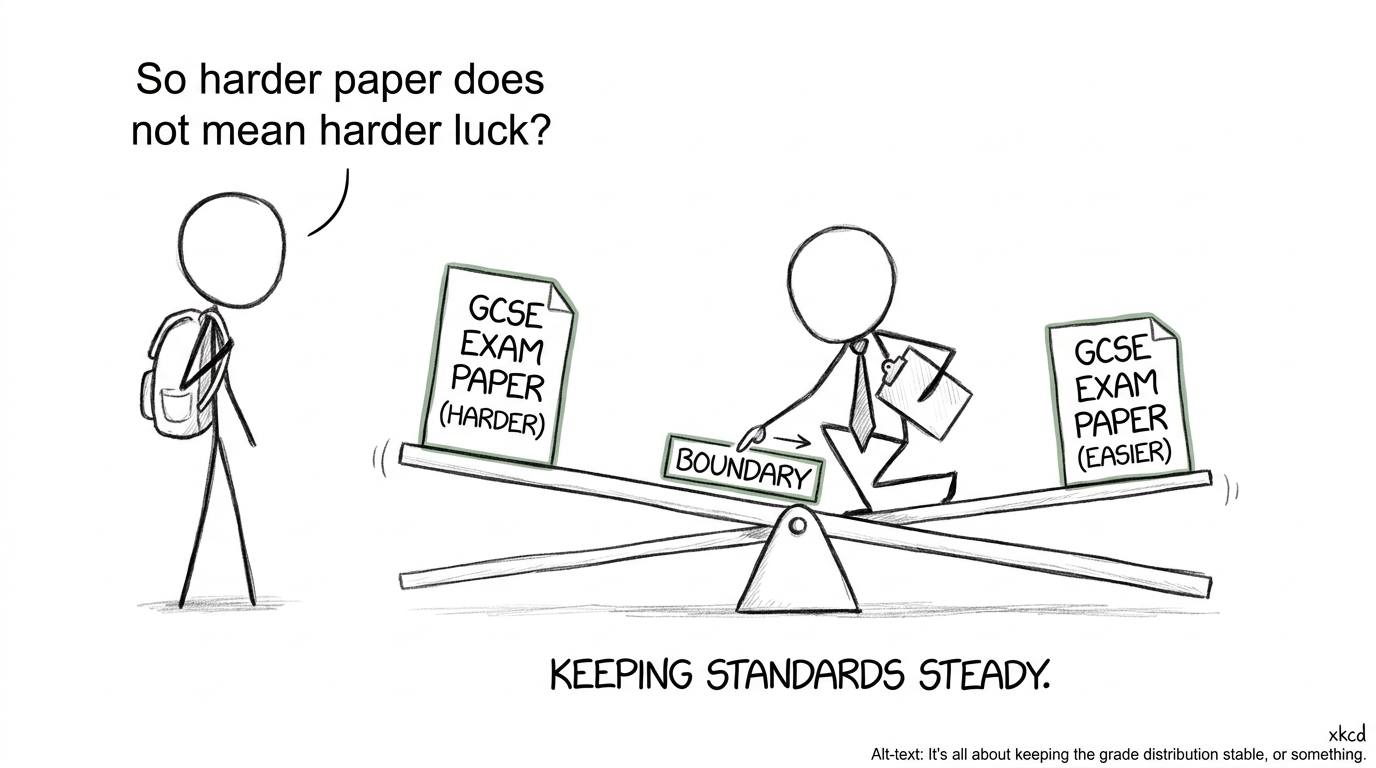 An examiner balances papers while keeping standards steady
Why 2026 boundaries cannot be predicted exactly
Past boundaries describe past papers. They cannot tell you precisely where a 2026 boundary will sit because the questions, cohort performance and available evidence differ.
A predicted boundary can be useful for setting a broad mock target, but it should always be labelled as an estimate. Moving last year’s boundary up or down because an examination “felt hard” is unreliable. The same paper often feels very different to different students.
The official GCSE economics grade boundaries for 2026 should be available from awarding bodies at 8.00 am on 20 August, when results can be released to candidates. Check the specification code carefully: an AQA boundary cannot be applied to OCR, and an International GCSE boundary cannot be applied to a standard GCSE.
What to do if you are close to a boundary
First, pause. Being one mark below a boundary does not automatically mean that the marking was incorrect.
Ask your teacher or examinations officer to help you check the overall mark, component marks and official boundary. Your school may be able to obtain your script and consider whether a clerical re-check or review of marking is appropriate. A review is not simply a request for an extra mark: the outcome can remain unchanged, rise or fall.
For the June 2026 series, the JCQ deadline for awarding bodies to receive most GCSE review-of-results requests is 24 September 2026, although schools commonly set earlier internal deadlines. Contact your school quickly rather than waiting.
Common mistakes when reading grade boundaries
Treating old boundaries as guaranteed targets
A past boundary is historical evidence, not a promise about 2026. Use it to understand a previous paper, not to declare your result before publication.
Looking at one paper in isolation
Your qualification grade is normally based on the combined total. Add the component marks using the assessment structure for your board.
Using the wrong exam board
AQA and OCR papers have different questions and independently published boundaries. Confirm the logo and specification code before comparing marks.
Assuming every grade has a fixed percentage
There is no permanent rule saying a particular percentage always earns grade 777, 888 or 999. Boundaries can change between series.
Confusing notional and official boundaries
A component boundary may show how performance on one paper roughly compares with a grade standard. The overall qualification boundary is the figure that determines the final grade.
Your next step with MathsGenie
A boundary explains the result, but your marked work explains how it happened. If you are continuing with Economics, start with MathsGenie’s OCR Economics revision guides or the AQA hub, then use past papers and mark schemes to identify where marks were gained or lost. The Economics calculations guide is particularly useful for percentages, averages, costs, revenue and quantitative data.
If your next goal is GCSE Maths, build the same calm feedback loop through MathsGenie GCSE Maths revision: learn with revision lessons, practise with topic questions and mini tests, then test yourself using past papers, video solutions and GCSE predicted papers.
On results day, check the right board, combine the right marks and use the official boundary. One number on a slip matters, but understanding it is what gives you a sensible next move.