GCSE Computer Science Exam Time of Day: Does It Matter?
GCSE computer science exam time of day can affect alertness, but preparation matters more. Learn how to handle morning and afternoon papers calmly.
The same Computer Science paper can feel very different at 9.009.009.00 am and 1.301.301.30 pm. In the morning, your brain may seem to be loading more slowly than an old computer. In the afternoon, lunch and a long wait can leave you restless or tired.
So, does the GCSE computer science exam time of day actually affect performance? Potentially, but not in a simple way. Research involving adolescents suggests that alertness and cognitive performance can vary with time of day, sleep and whether someone naturally functions better earlier or later. However, there is no reliable rule that every student performs better in the afternoon. Your sleep, routine, preparation and response to the paper are likely to matter more than the clock alone.
The practical answer is reassuring: you cannot choose the official session, but you can train for it.
The quick answer and exam-day checklist
Use this checklist once your school gives you its official timetable:
- Confirm whether each paper is in the morning or afternoon.
- Follow your school’s arrival time rather than guessing from an online timetable.
- Practise at least one timed paper during the same part of the day.
- Keep your sleep and waking times consistent in the final week.
- Eat familiar food and drink enough water.
- Avoid a frantic revision marathon immediately before the paper.
- Prepare for any other exam scheduled on the same day.
- Build a calm starting routine that works in either session.
JCQ’s standard published starting times for UK examinations are 9.009.009.00 am for morning sessions and 1.301.301.30 pm for afternoon sessions. Centres are normally allowed limited flexibility within the session, so the time printed on your school’s personal timetable is the instruction that matters.
For example, the final summer 202620262026 timetables placed both Computer Science papers in afternoon sessions for AQA, OCR and Pearson Edexcel. That does not guarantee the same arrangement in another exam series. Check your current exam-board timetable, then confirm it with your school.
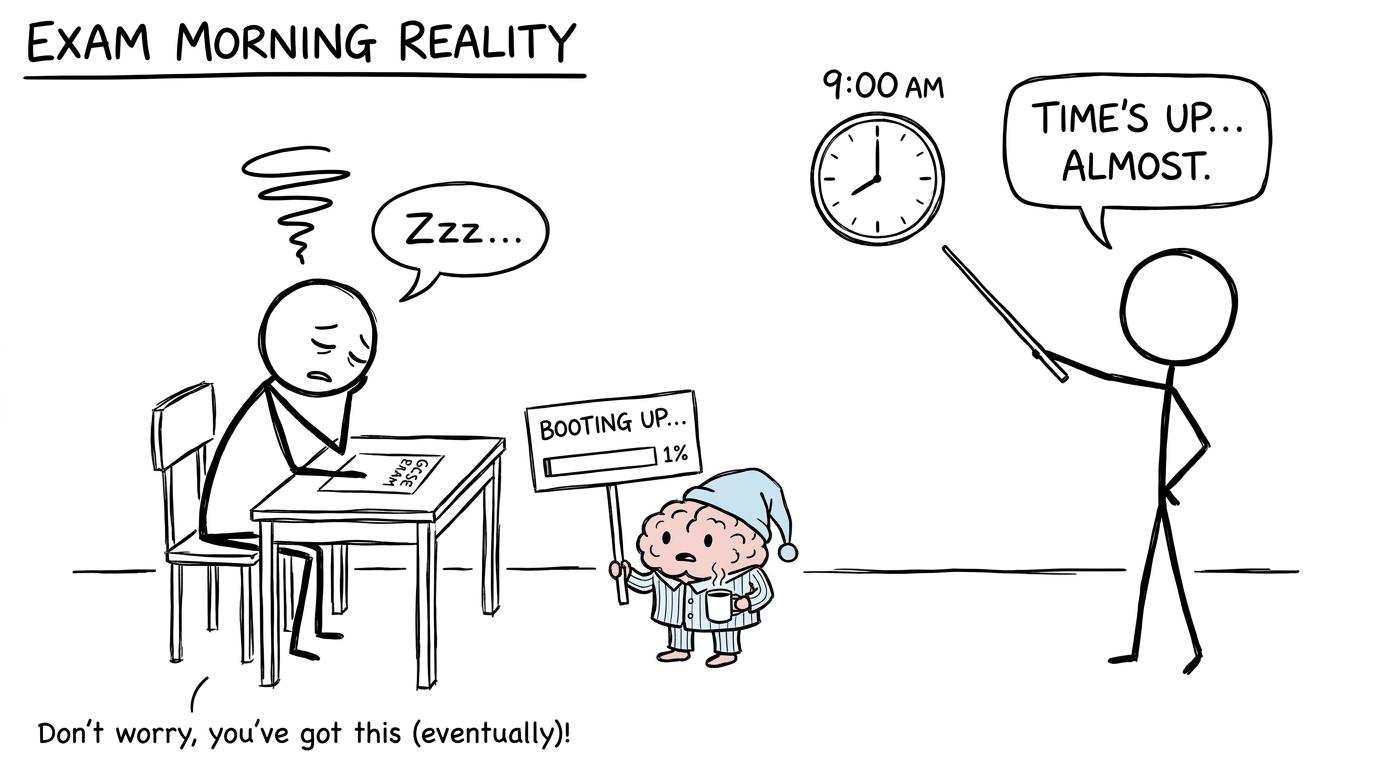 A sleepy GCSE student's brain booting up for a morning exam
What research says about morning and afternoon performance
There is credible evidence that time of day can influence how well people perform cognitive tasks. The important word is can.
Studies of secondary-school pupils have found interactions between exam timing and chronotype, a person’s tendency to feel more alert earlier or later in the day. Some research suggests that later chronotypes may be disadvantaged in early-morning assessments, while differences between early and late chronotypes can become smaller in the afternoon.
Other research has found that performance may peak around the middle of the day or early afternoon. Yet findings vary with the task, age group, sleep, season and setting. A result from a classroom intelligence test or a university examination cannot automatically predict a GCSE Computer Science mark.
That leaves three sensible conclusions:
- Time of day may create a small advantage or disadvantage. It can affect alertness, attention and the speed at which you settle.
- Individual responses differ. A morning-focused student may feel sharp early, while another may need longer to become fully alert.
- Timing is only one variable. Subject knowledge, programming practice, sleep and exam technique remain central.
Think of the session as a condition to prepare for, not a verdict on your result.
Why Computer Science may feel sensitive to timing
Computer Science demands several kinds of thinking in one paper. Depending on your exam board and specification, you may need to recall precise terminology, trace code, interpret algorithms, apply Boolean logic, explain computer systems or construct an extended response.
These tasks can expose different forms of tiredness. When you are not fully alert, you may read a loop condition incorrectly or overlook a command word. After lunch, the difficulty may be sustained concentration rather than waking up.
Paper structures also differ. OCR GCSE Computer Science has written components covering computer systems and computational thinking, algorithms and programming. Pearson Edexcel includes a written principles paper and an onscreen programming assessment. AQA’s current specification separates computational thinking and programming skills from computing concepts. Always prepare for the format named on your own specification.
The clock does not change what you know. It may change how smoothly you retrieve and apply it. That is why timed practice matters.
How to prepare for a morning Computer Science exam
A morning paper rewards preparation done before exam day. Trying to repair a late night with an early alarm usually creates two problems instead of solving one.
Shift your routine gradually
If you normally wake late at weekends, move towards your exam-day waking time over several days. The goal is not an extreme new routine. It is to make the morning feel normal.
Get your clothes, equipment and travel plan ready the night before. Maths students can follow the same principle using the GCSE maths night-before plan: reduce decisions, complete a small amount of focused work and stop at a sensible time.
Wake your thinking up gently
Use a short warm-up after breakfast. Review a compact list of definitions, trace a familiar piece of pseudocode mentally or recall the stages of a standard process. Do not attempt a difficult unseen paper just before leaving.
The purpose is activation, not assessment. You want to enter the exam feeling that Computer Science is familiar, not feeling judged by a question completed half-awake.
Practise in the morning
Complete at least one timed Computer Science paper at approximately the time of the real session. This tells you whether you need a longer morning routine and whether your concentration improves after the first few questions.
The same idea strengthens maths preparation. MathsGenie explains how to use GCSE past papers properly, including timing, marking and repairing errors rather than merely collecting scores.
How to prepare for an afternoon Computer Science exam
An afternoon paper removes the rush of an early start, but it creates a different challenge: waiting without exhausting yourself.
Protect the morning
Do a brief review, then stop. Spending four anxious hours switching between notes, videos and messages is unlikely to produce four hours of useful learning.
A focused routine works better. The 20-minute GCSE revision routine offers a useful structure: recall, active questions, immediate checking and one clear correction. You can adapt that rhythm to Computer Science terminology or code tracing.
Keep lunch ordinary
Choose food you know sits comfortably. Avoid treating exam day as the moment to experiment with an oversized meal, an unfamiliar supplement or far more caffeine than usual. Drink normally, but follow your centre’s rules about bottles in the exam room.
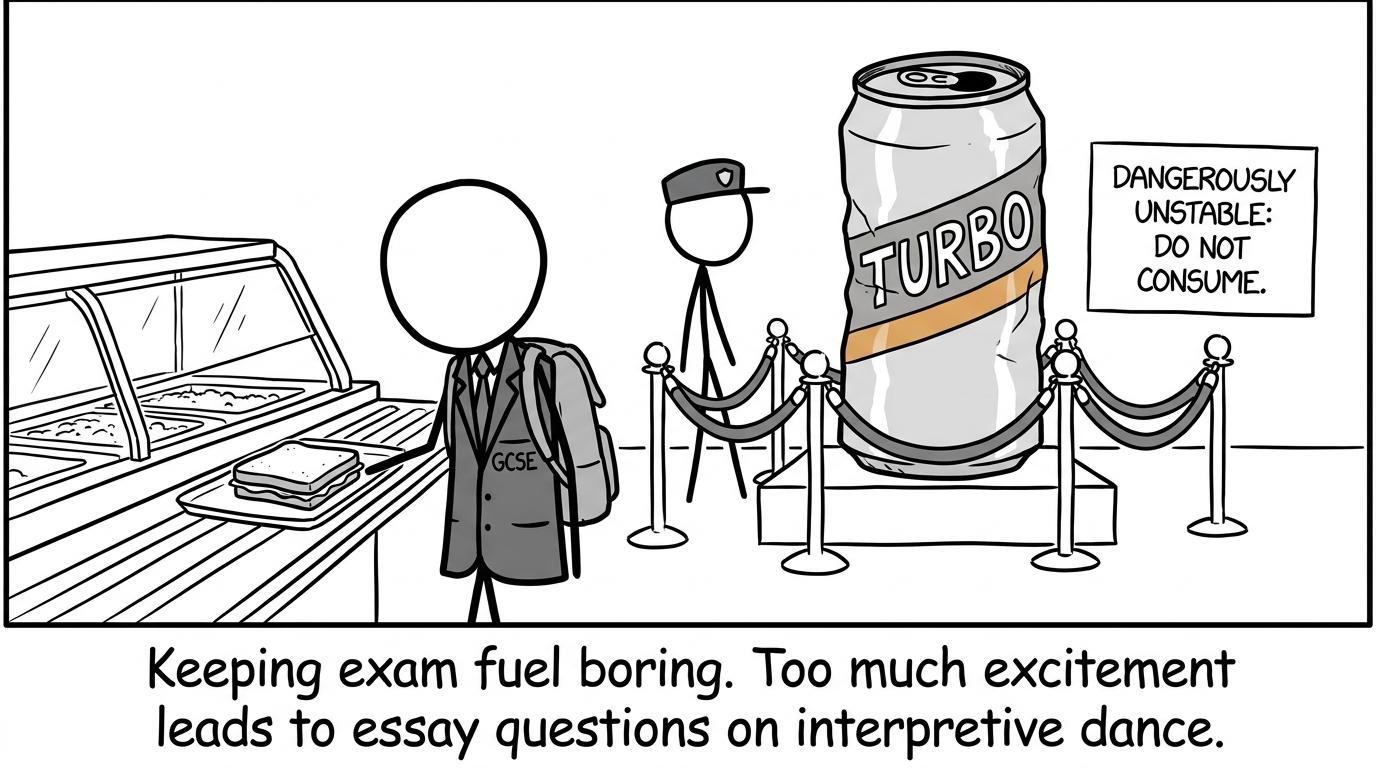 A normal sandwich cautiously avoids a turbo energy drink before an exam
Manage the waiting period
Know where you need to be and when. If your school keeps candidates under supervision because of a timetable clash or adjusted start, follow staff instructions carefully. Access to phones, the internet and other people may be restricted to protect the security of the examination.
Do not interpret pre-exam tiredness as proof that you will perform badly. Alertness can change once the paper begins and your attention has a clear target.
Match some practice to the real session
The best preparation is not to move all revision into the exam’s time slot. Learning benefits from a sustainable routine. Instead, use a small amount of session-specific rehearsal.
A sensible plan is:
- complete one full paper at the expected session time;
- rehearse your meal, travel and warm-up routine;
- notice when concentration drops;
- mark the paper later and classify each error;
- adjust the routine, then test it again.
Record whether a lost mark came from missing knowledge, misreading, weak application or time pressure. MathsGenie’s guide to finding your weakest GCSE topics shows how to turn mistakes into a targeted revision list.
This is more useful than deciding, after one poor morning practice, that you are simply “bad at morning exams”. One result contains too much noise to justify that conclusion.
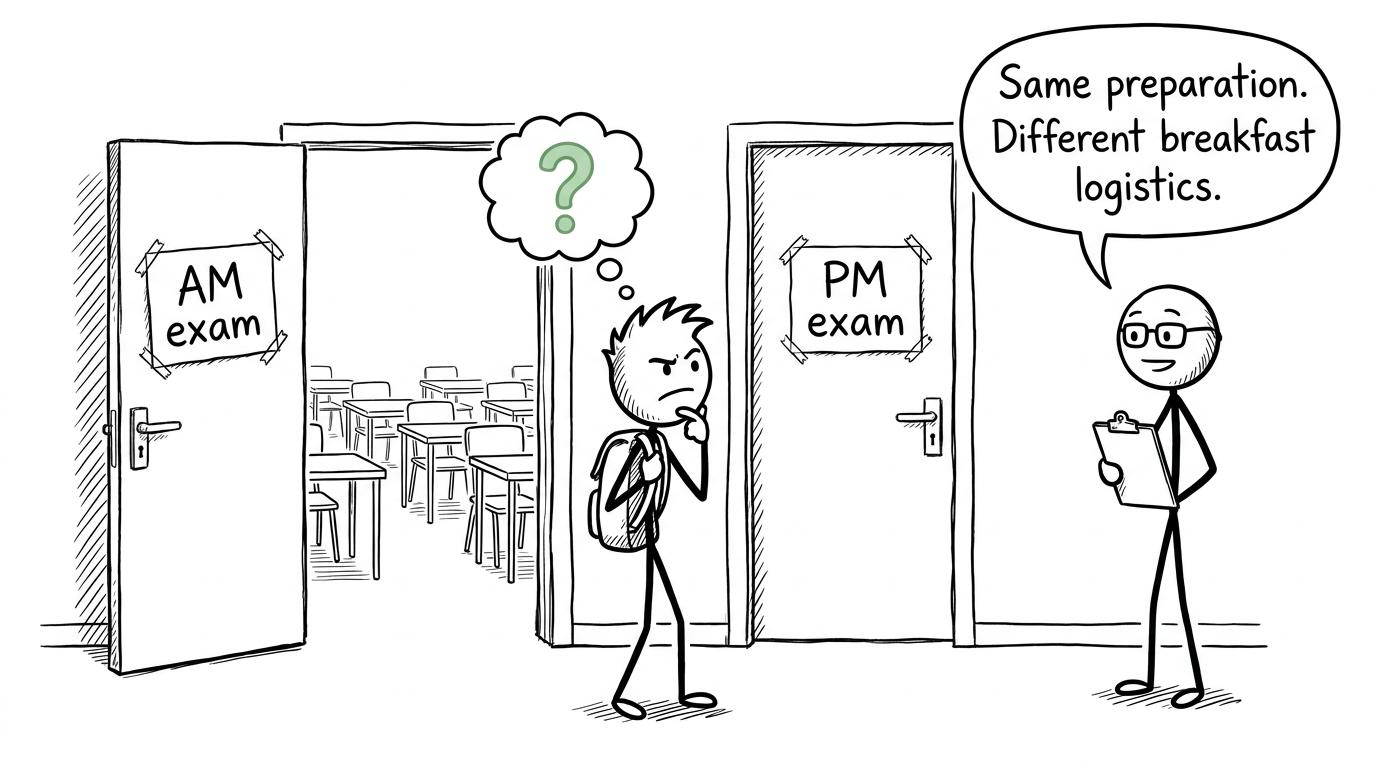 Morning and afternoon exam doors leading to the same exam hall
Plan around Computer Science and maths together
The real difficulty may not be the Computer Science session itself. It may be the surrounding timetable.
Look at the whole week. If Computer Science is followed by a GCSE maths paper the next morning, your evening should not become an emergency maths marathon. Build the work earlier with a realistic GCSE maths revision timetable.
Use the free GCSE Maths revision hub to choose your exam board, revision lessons and practice questions. If you take Edexcel, the Edexcel GCSE Maths past papers include mark schemes and worked solutions where available.
A one-month GCSE maths revision plan can also help you distribute topic work, mini tests and timed papers before the exam sequence becomes crowded. The revision planner should reduce last-minute decisions, not fill every available hour.
Common mistakes when worrying about exam time
Assuming afternoon automatically means easier
Some students may feel more alert later, but an afternoon paper is not inherently easier. Waiting, a heavy lunch or an earlier examination can all affect concentration.
Staying up late because the exam is after lunch
An afternoon start is not permission to shift your entire routine overnight. Sleep loss can undermine the alertness you hoped to gain.
Cramming until the doors open
Last-minute review may refresh a definition, but frantic exposure to unfamiliar material can increase confusion. Use a short, pre-selected list and finish in time to settle.
Testing a new routine on the real day
Do not discover on exam morning that a huge breakfast makes you uncomfortable, or that an energy drink makes it difficult to sit calmly. Rehearse ordinary routines during timed practice.
Using the wrong timetable
Exam-board timetables can change between series, and your centre may use an allowed start-time adjustment. Treat your personalised school timetable as the final instruction and ask the exams officer if anything is unclear.
Blaming the clock for every practice error
A wrong answer may come from tiredness, but it may also reveal a genuine knowledge gap. Mark carefully. Fix the content rather than explaining every lost mark through time of day.
The session matters less when the routine is familiar
Morning versus afternoon can influence how alert you feel, particularly if the session conflicts with your usual sleep pattern. But the evidence does not support a universal claim that one session guarantees better GCSE Computer Science performance.
Prepare for the time you have been given. Confirm the timetable, protect your sleep, rehearse the session and keep food and caffeine familiar. Most importantly, make sure the knowledge underneath the routine is secure.
For the maths papers surrounding your Computer Science exam, make MathsGenie your revision base. Use the free revision lessons and practice questions to repair weak topics, mini tests to check recall, and past papers, predicted papers, mark schemes and video solutions to build exam-ready accuracy. Start with the GCSE Maths revision hub, add each paper to your revision planner and make exam time feel like a routine you have already practised.