GCSE Computer Science Coursework Time Management
GCSE computer science coursework time management made practical: balance programming tasks with maths and exam-only subjects using a realistic weekly plan.

A programming task can consume an evening without looking as though it has moved at all. One bug becomes three; the documentation remains blank; meanwhile, your maths paper is still waiting. Good GCSE computer science coursework time management solves this by giving practical work protected blocks while keeping exam revision active through short, regular sessions.
There is an important detail to check first. Students often call any extended programming assignment “coursework”, but current assessment arrangements vary by exam board and specification. Practical programming remains a required part of GCSE Computer Science, yet it may be assessed through written or on-screen examinations rather than as coursework contributing directly to your grade. Ask your teacher whether your task is assessed, compulsory practical experience, an internal deadline or preparation for an examination. That answer should shape how much time it receives.
The short checklist
Use this process before building a detailed timetable:
- Confirm exactly what the programming task is and when it is due.
- Turn the task into small actions such as design, code, test and document.
- Protect two or three focused programming blocks each week.
- Keep maths alive with shorter, more frequent revision sessions.
- Schedule exam-only subjects according to evidence from tests and past papers.
- Leave spare time before the deadline for debugging and submission problems.
- Review the plan weekly rather than rebuilding it every evening.
The aim is not to give every subject equal time. It is to give each subject the time it currently needs.
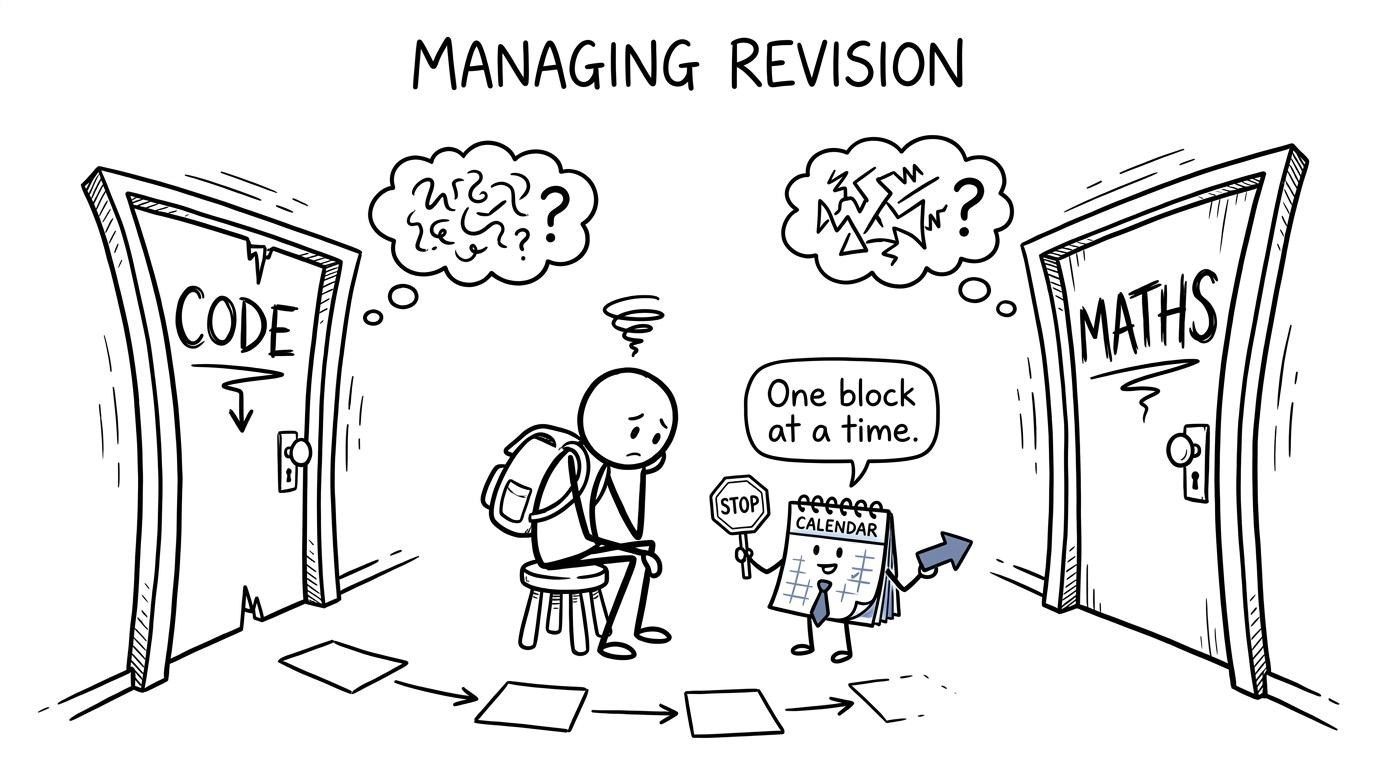 A student balancing code and maths with help from a sensible calendar
First, understand what “coursework” means for your course
GCSE Computer Science specifications require students to develop practical programming skills, including designing, writing, testing and refining programs. However, the way those skills are assessed is not identical across AQA, OCR, Pearson Edexcel and Eduqas.
For example, OCR’s current GCSE includes two externally assessed written components and requires students to receive practical programming opportunities during the course. AQA’s specification for students taking examinations in summer 2026 also uses two written papers. Pearson Edexcel includes an on-screen programming examination, while assessment arrangements and specification versions must still be checked carefully with your school.
This distinction matters. An unweighted class programming project still deserves serious effort because it develops examinable knowledge, but it should not automatically replace weeks of maths, English and science revision. Equally, you should not ignore a practical task merely because it is not a traditional marked non-exam assessment. Designing algorithms, tracing code, selecting test data and refining programs all support the skills examined later.
Write down four facts:
- your exam board and specification;
- whether the task contributes directly to the qualification grade;
- the school deadline and any supervised working conditions;
- what evidence or files your teacher expects.
Rules can differ between cohorts and specifications, so your teacher’s instructions should take priority over general advice online.
Build a time budget before making a timetable
A timetable answers, “What will I do on Tuesday?” A time budget answers the more useful first question: “What deserves my available hours?”
Let your available independent revision time for the week be TTT. Divide it into:
T=C+M+O+B T = C + M + O + B T=C+M+O+BHere, CCC is Computer Science practical work, MMM is maths revision, OOO is your other subjects and BBB is buffer time. The buffer is deliberate. Programming tasks contain uncertainty, and school weeks acquire unexpected homework, appointments and tired evenings.
Do not allocate time by counting subjects and dividing equally. Instead, consider:
- deadline proximity;
- marks currently being lost;
- the amount of unfinished work;
- upcoming assessments;
- whether the task needs school equipment or teacher supervision.
Your maths allocation should be based on evidence. The MathsGenie GCSE maths revision hub brings together board-specific lessons, questions and papers. A short diagnostic can show whether algebra needs immediate attention or whether your time is better spent on geometry, probability or another weak area. The guide to finding your weakest GCSE topics explains how to turn lost marks into priorities.
Use fixed blocks for programming
Programming benefits from continuity. Constantly opening the project for ten minutes creates repeated setup costs: remembering the design, locating the bug and rebuilding your train of thought.
Use longer, protected blocks for practical work, with a precise stopping point. Suitable outcomes include:
- finish the input validation;
- create normal, boundary and erroneous test data;
- test the login procedure;
- annotate one completed module;
- update the refinement log or required documentation.
“Work on coursework” is not an outcome. It is a category, and categories are easy to postpone.
Use shorter sessions to keep maths moving
Maths often responds well to regular retrieval and immediate feedback. On a programming-heavy day, a shorter maths session can still protect progress:
- recall a method;
- complete a focused set of questions;
- mark it straight away;
- record the reason for each lost mark;
- plan a later retest.
If you are unsure which order to follow, use the guide to learning GCSE maths topics. Students following different boards or tiers can also check the GCSE maths topics by exam board and tier.
Break the programming task into visible stages
Coursework feels endless when “finished” is the only milestone. Replace one large deadline with a sequence of smaller states:
Clarify the requirements
List the required inputs, processes, outputs and success criteria. Note any rules about permitted resources, collaboration, artificial intelligence tools, internet access and teacher assistance. Do not assume that tools allowed during ordinary homework are permitted for a supervised task.
Design before coding
Decide on variables, data structures, validation, subroutines and the broad program flow. A brief design can prevent repeated rewrites later. It also gives you a useful re-entry point when returning to the project after revising another subject.
Implement in modules
Build one coherent part at a time. Test it before adding another. This makes bugs easier to locate and turns progress into something visible.
Test deliberately
Do not rely only on values you expect to work. Use normal, boundary and erroneous data where appropriate, then record the expected and actual outcomes. Fixing a defect is part of development, not evidence that you have failed.
Document as you go
If your task requires evidence, screenshots, comments or a refinement record, update them while decisions are fresh. Reconstructing several weeks of reasoning on the final evening is slow and unreliable.
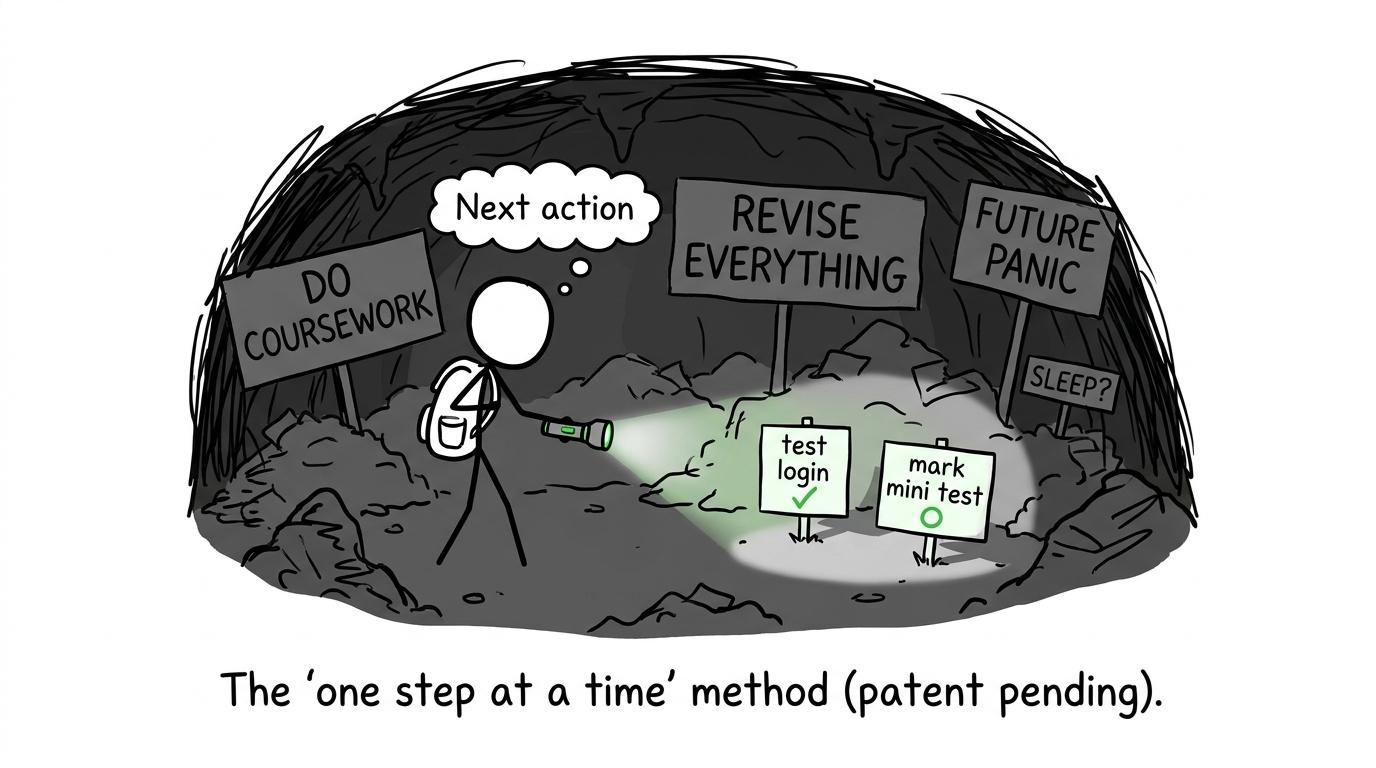 A student uses a next-action torch to escape a cave of vague tasks
Protect exam-only subjects without revising everything daily
The danger is not that Computer Science receives time. The danger is that its visible deadline takes every available hour while quieter subjects disappear.
Use a rolling rhythm. Programming may receive two substantial blocks in a week, while maths appears more frequently in smaller sessions. Other exam-only subjects can rotate according to upcoming assessments and weak areas. You do not need to touch every subject every day, but no important subject should vanish for weeks.
A useful weekly structure contains:
- fixed commitments, including lessons and supervised practical sessions;
- priority blocks for the nearest deadline;
- recurring maths practice;
- rotating blocks for other exam subjects;
- one catch-up block that is not assigned in advance;
- a short weekly review.
If examinations are approaching, move maths gradually from isolated topic practice towards timed mixed work. The article on when to start GCSE past papers explains how to progress from mini tests and sections to complete papers. If you study Edexcel, using GCSE maths past papers properly will help you turn marking into targeted follow-up rather than just a score.
Make each session easier to start
A good plan reduces decisions. Before stopping, write the next physical action: “Run the boundary tests” is better than “Continue coding”; “Complete one algebra mini test” is better than “Revise maths”.
Prepare the correct files, booklet or calculator before the session. Put your phone out of reach and use one task window where possible. Decide in advance what “done” means. When the block ends, save and back up work according to your school’s rules, then leave a short note explaining what comes next.
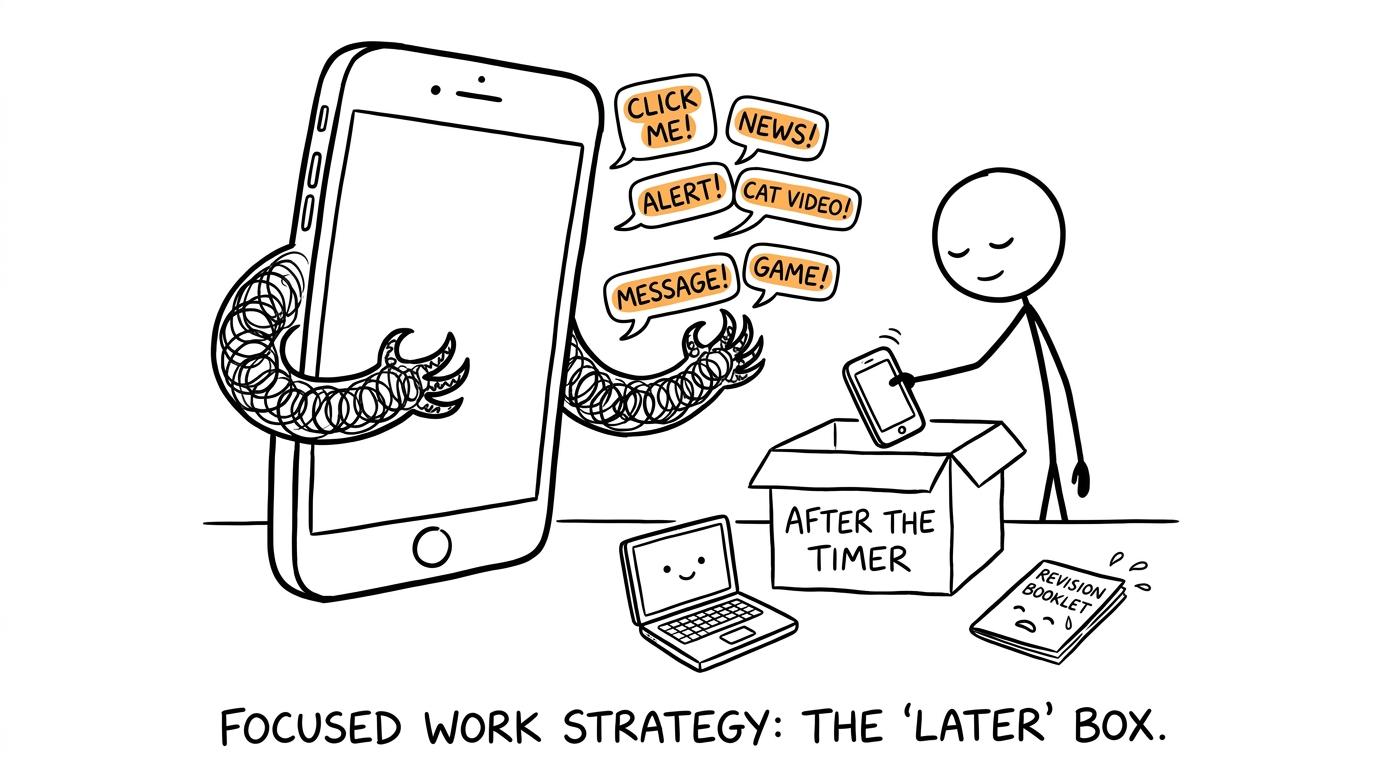 A notification monster is disappointed when a student puts the phone away
Common time-management mistakes
Giving the project every spare evening
A deadline can feel more urgent than an examination months away. Cap the project’s weekly time unless your teacher confirms that an immediate deadline genuinely requires more. Preserve a minimum amount of maths and other retrieval practice.
Planning with vague labels
“Computer Science” and “maths” do not tell you what to begin. Name a programming feature or a maths topic, resource and stopping point.
Leaving testing and documentation until the end
Code that appears complete may still fail on boundary or erroneous inputs. Reserve time for testing, refinement and any required evidence before the submission date.
Doing full papers when a focused task would be better
A full paper is useful, but it is not automatically the best use of a crowded evening. A mini test or targeted question set may reveal and repair a weakness faster. A structured one-month GCSE maths revision plan can help you choose the right scale of task.
Measuring time instead of output
Two hours at a desk does not guarantee two hours of progress. Record what was completed, what remains and the next action. This makes the following session much easier to start.
Treating predicted papers as predictions of exact questions
Predicted papers offer fresh exam-style practice, not certainty about the real examination. Use them alongside official past papers, topic questions and mark schemes. The purpose is to expose weaknesses and improve timing.
Finish the task without sacrificing your maths grade
Strong GCSE computer science coursework time management is not about squeezing more activity into every evening. It is about separating urgent practical work from ongoing exam preparation, then giving both a reliable place in the week.
Confirm what your course actually requires. Break the programming task into concrete outcomes. Keep maths frequent and evidence-led, even when individual sessions are short. As the exams approach, use the MathsGenie guide to efficient Edexcel revision or select your board through the main GCSE hub.
Start now by choosing one next action for your programming task and one weak maths topic. Then let MathsGenie support the maths side with free revision lessons, practice questions, mini tests, past papers, predicted papers, mark schemes and video solutions. A balanced week is rarely dramatic. It simply keeps both deadlines and exam marks moving in the right direction.