GCSE Combined Science Homework Grade Impact Explained
GCSE combined science homework grade impact explained: discover what affects final marks, which tasks help most and when maths revision should take priority.
A homework deadline can feel strangely powerful. It sits on the screen in red, while the GCSE exam that determines your result is still months away. Naturally, you wonder which deserves your attention.
The short answer to the GCSE combined science homework grade impact question is this: ordinary homework does not directly contribute marks to your final GCSE Combined Science result. Your certificate grade is determined by your performance in the formal assessments set by your exam board. However, well-designed homework can improve the knowledge and skills that earn those exam marks.
So homework can matter considerably but indirectly. The real issue is not whether you completed a worksheet. It is whether the task changed what you can remember, explain or calculate without help.
The answer at a glance
Use this checklist when deciding how much attention a science homework task deserves:
- Homework is not normally submitted to the exam board and does not become part of your final Combined Science mark.
- Your final result comes from formal assessment, usually external written papers for GCSE Combined Science qualifications in England.
- Combined Science is a double award, producing two equal or adjacent grades such as 6-66\text{-}66-6 or 6-56\text{-}56-5.
- Effective homework can improve exam performance by strengthening recall, application, scientific vocabulary and mathematical fluency.
- Task quality matters more than simply spending longer on the work.
- Feedback matters because an uncorrected mistake can become a repeated exam mistake.
- Your predicted or working-at grade is different from your final grade and may be informed by homework under your school's own policy.
- Maths revision may sometimes offer the greater return, especially when calculations, graphs or formulae are causing lost marks across both subjects.
Does science homework count towards your final grade?
For the standard GCSE Combined Science qualifications offered by exam boards such as AQA, Pearson Edexcel and OCR, routine school homework does not carry exam-board marks. OCR, for example, describes its Combined Science qualification as fully externally assessed. Other specifications similarly determine the award through formal examinations rather than weekly homework scores.
This distinction matters because students often confuse three different things:
- a homework mark recorded by a teacher;
- a school working-at or predicted grade;
- the final GCSE grade awarded after formal assessment.
A teacher may use homework alongside tests, mock exams and classroom performance when judging your current progress. Schools decide how they calculate internal reports and predicted grades, so you should ask your teacher if you are unsure. That internal judgement does not mean the homework score is added to your final exam total.
Combined Science itself is worth two GCSEs. In England, it uses a 171717-point paired scale running from 9-99\text{-}99-9 to 1-11\text{-}11-1. The two grades are always equal or adjacent. Your result reflects performance across biology, chemistry and physics papers rather than producing three separate subject grades.
That means one missed worksheet cannot mechanically remove a grade. Equally, completing every worksheet cannot guarantee one.
Why homework can still move your Combined Science grade
The absence of direct homework marks does not make homework irrelevant. There is a difference between something being counted and something being useful.
The Education Endowment Foundation's current evidence summary reports a positive average effect for homework, particularly at secondary level. Its estimate is around five additional months of progress, but the evidence security is rated low and there is substantial variation between tasks and settings. This is not evidence that every student gains five months, nor can it responsibly be translated into a guaranteed GCSE grade increase.
The more useful findings are about conditions. Homework connected to classroom learning tends to work better. Tasks with a clear purpose are preferable to vague activity, and studies involving feedback have generally shown stronger effects. The EEF also warns that impact may diminish as the amount of time increases.
In other words, an hour spent copying a textbook is not automatically more valuable than twenty focused minutes retrieving facts, answering questions and correcting mistakes.
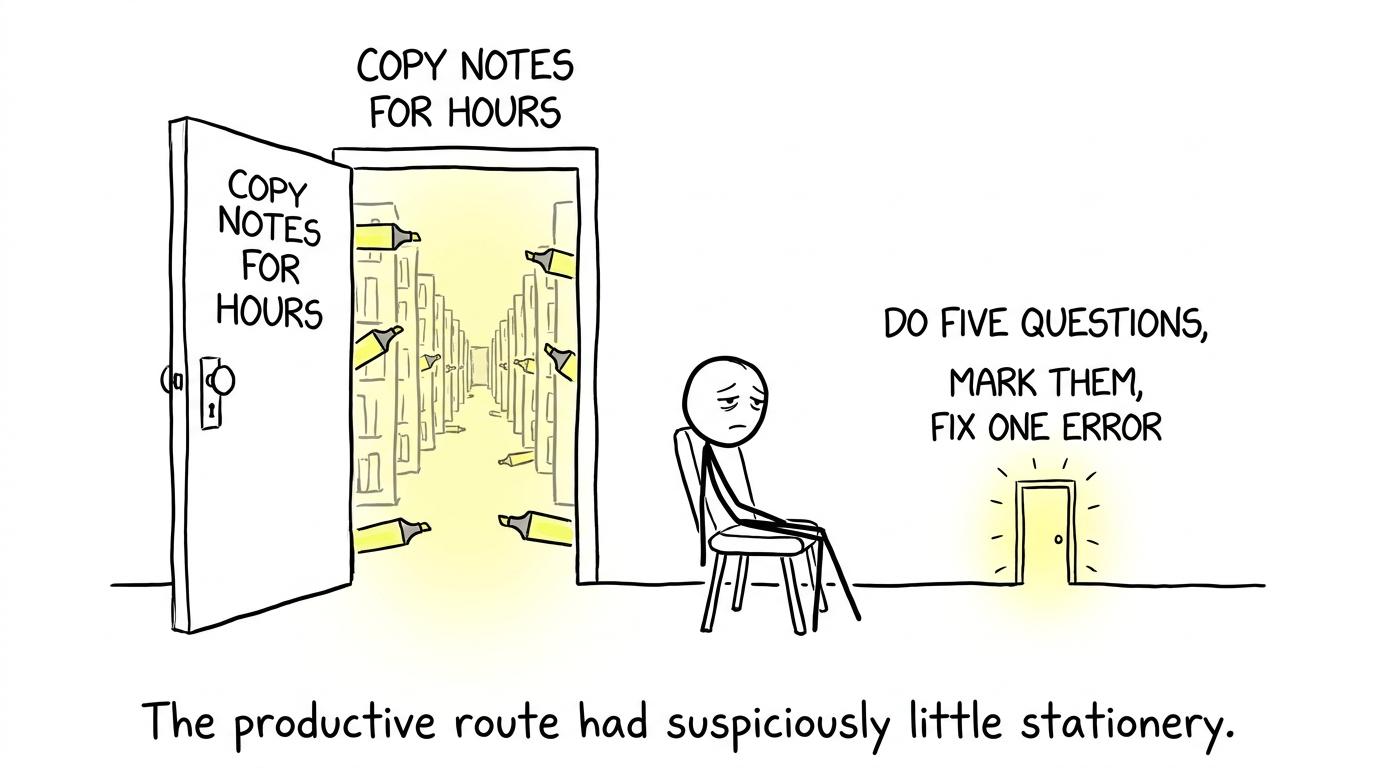 A student discovers that the productive homework route contains suspiciously few highlighters
What effective Combined Science homework looks like
Good homework produces evidence of learning. By the end, you should know what became stronger and what still needs attention.
It makes you retrieve knowledge
Reading notes can create familiarity without reliable recall. A stronger task asks you to close the book and recover ideas from memory: key definitions, processes, equations, required practical methods or the sequence of an explanation.
Retrieval is uncomfortable because it reveals gaps. That discomfort is useful. An exam also asks you to produce knowledge without first rereading the page.
It includes exam-style application
Knowing a fact and recognising when to use it are different skills. Combined Science papers test recall, application, analysis and evaluation. Questions may place familiar knowledge inside an unfamiliar experiment or context.
A valuable homework task therefore includes questions that require decisions, not just copied sentences. Marking those questions matters as much as attempting them. The same principle underpins MathsGenie's guide to using GCSE past papers properly: assess, mark, repair and retest.
It strengthens the maths inside science
Combined Science contains substantial mathematical demand. Depending on the topic, you may need to rearrange formulae, calculate percentages, interpret graphs, use ratios, convert units or work in standard form.
These skills are unusually valuable because one improvement can support both science and maths. If formula rearrangement repeatedly costs science marks, use the free GCSE Maths revision hub to rebuild the underlying method. If several weaknesses are competing for your time, the process in finding your weakest GCSE topics helps you prioritise evidence rather than instinct.
It ends with correction
Completion is not the same as improvement. After marking, label each error:
- knowledge: a fact or definition was missing;
- application: you knew the content but could not use it;
- mathematics: the calculation, units or graph work failed;
- question reading: you answered something different;
- communication: the explanation lacked precise scientific detail.
Then correct the answer and revisit the skill on another day. MathsGenie's plan for stopping forgotten content explains how spaced retrieval, immediate marking and short revisits can be combined into a repeatable routine.
When is your time better spent elsewhere?
Homework should not automatically consume every available revision minute. Time is limited, particularly when maths, English and several option subjects all have deadlines.
The sensible question is: what use of the next half-hour is most likely to prevent future lost marks?
Complete a set task when it targets relevant content, provides useful practice or will lead to feedback. If it is taking far longer than intended, you do not understand the instructions or you are repeatedly stuck, ask your teacher rather than disguising the problem with copied answers.
During independent revision, prioritise according to evidence:
- upcoming assessments and genuine deadlines;
- topics producing repeated lost marks;
- prerequisite skills blocking several topics;
- tasks that can be marked and corrected;
- appropriate rest when tiredness has made the work unproductive.
For students preparing for maths exams, science homework should not silently replace all maths practice. A short routine can protect both subjects. The 20-minute GCSE maths revision routine offers a manageable structure for busy evenings, while the GCSE maths revision timetable helps distribute practice across a longer period.
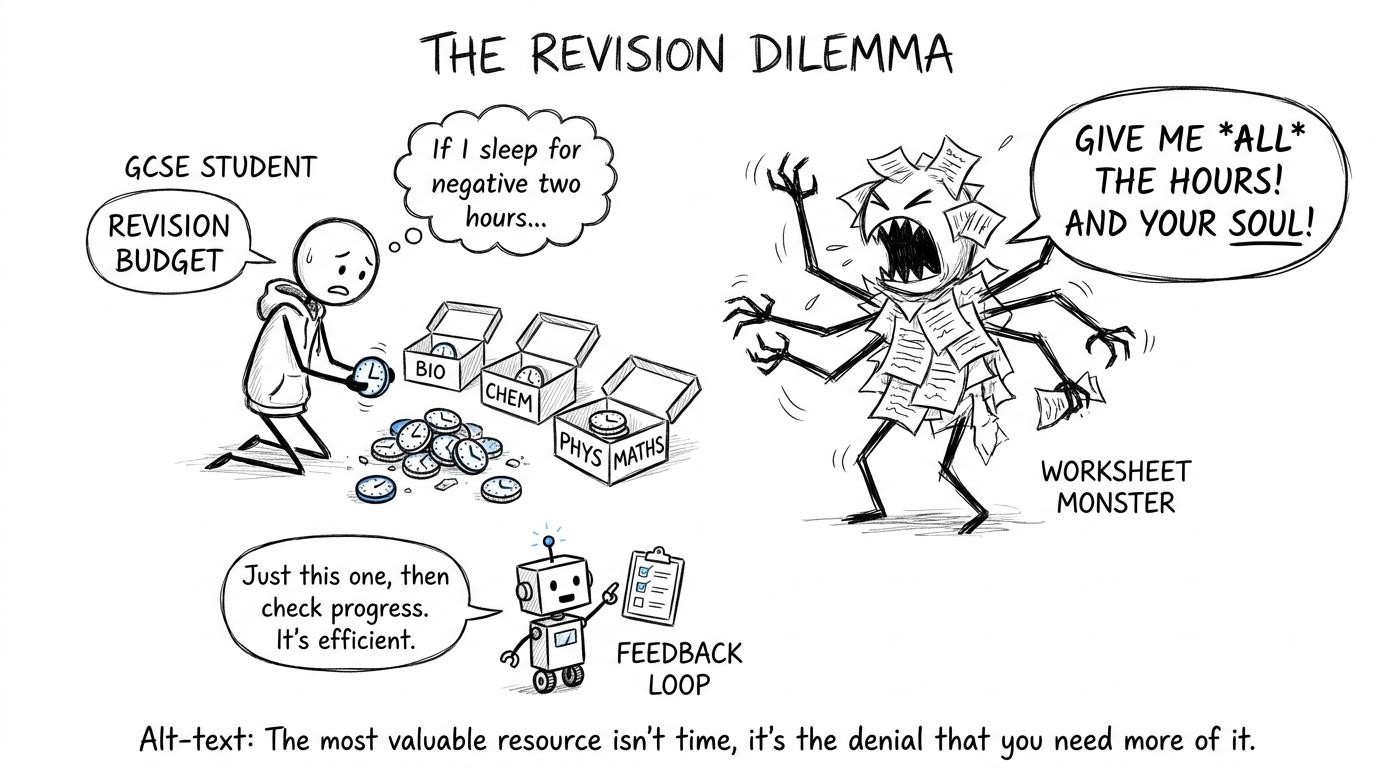 A revision budget is divided between science and maths while a worksheet monster asks for everything
A better homework-to-grade routine
Instead of measuring effort by pages or minutes, use a simple learning loop:
- Define the purpose. Identify the exact topic or skill being practised.
- Attempt from memory first. Use notes only after discovering what you cannot recall.
- Answer relevant questions. Write complete responses rather than mentally agreeing with a solution.
- Mark promptly. Use teacher feedback, a mark scheme or a reliable solution.
- Record one precise correction. Avoid vague notes such as "revise chemistry".
- Retest later. Use a different question to check whether the improvement lasted.
This approach also protects your maths grade. You can use Edexcel GCSE Maths past papers under timed conditions, identify a weak skill and return to targeted practice. If exams are close, a one-week GCSE maths revision plan can help you balance diagnosis, topic repair and paper practice without allowing one subject to absorb the entire week.
Common mistakes when judging homework's value
Assuming every completed task improves your grade
A completed sheet may show compliance rather than learning. If you used notes for every answer and never checked your mistakes, the exam benefit may be small.
Treating the EEF average as a personal guarantee
Research averages describe groups under varied conditions. They do not prove that a particular homework task will raise your result by a fixed number of grades.
Copying because the final answer is due
Copying can preserve a homework record while hiding the exact gap your teacher needs to see. An honest attempt with clearly identified difficulties is more useful for learning.
Ignoring feedback
Reading a mark and closing the book wastes the most informative part of the task. Corrections turn feedback into a future exam action.
Abandoning maths whenever science feels urgent
Science calculations often expose weaknesses that will also matter in GCSE Maths. Maintain regular maths practice, even if the session is short. MathsGenie's GCSE Maths revision resources bring together revision lessons, topic questions, past papers and board-specific materials for foundation and higher tier.
The grade comes from what homework leaves behind
Homework does not usually enter the calculation of your final GCSE Combined Science grade. What can enter the exam room is the knowledge, fluency and judgement built while doing it.
That is the useful test. If a task helps you retrieve content, apply it independently, receive feedback and fix a weakness, it deserves space in your revision plan. If it has become hours of passive copying, speak to your teacher and change how you approach it. More time is not always more progress.
Protect your maths preparation too. Start with MathsGenie's free revision lessons and practice questions, diagnose weaknesses with mini tests, then build towards past papers and predicted papers. Mark each attempt with the mark scheme, use video solutions where a method is unclear and let every mistake choose the next task. That is how homework stops being a deadline and starts becoming preparation.