GCSE Citizenship Studies: Revise Daily or Rest?
GCSE Citizenship Studies revise every day or rest? Learn how spacing, active recall, sleep and planned breaks can improve retention without burnout.
The revision timetable looks sensible until every subject asks for a place on it. Maths needs practice. Citizenship Studies contains detailed concepts, institutions and arguments. Then there are lessons, homework and sleep.
If your search history says “gcse citizenship studies revise every day or rest”, the short answer is this: revisit Citizenship Studies regularly, but do not force yourself to revise it intensively every day. Short retrieval sessions on several days, separated by sleep and genuine breaks, are usually more useful for long-term retention than daily cramming. A complete rest day can also make a demanding GCSE timetable more sustainable.
The important distinction is between frequency and intensity. A five-minute recall check is not the same as an hour of exhausted rereading. You can keep knowledge active without turning every day into a full revision day.
The short revision checklist
A balanced approach should include:
- Citizenship Studies on roughly 333 or 444 days each week during normal revision
- gaps between sessions so that you have to retrieve ideas again
- active recall before checking notes
- regular practice with source questions and extended responses
- at least one lighter evening or complete rest period each week
- enough sleep rather than late-night cramming
- separate time for maths practice, including questions and timed papers
- adjustments as examinations approach, based on weaknesses rather than panic
This is not a universal prescription. Your timetable should reflect your examination date, current knowledge, other subjects and wellbeing. The principle is more reliable than any fixed number: return to material after a gap, test yourself and protect your capacity to concentrate.
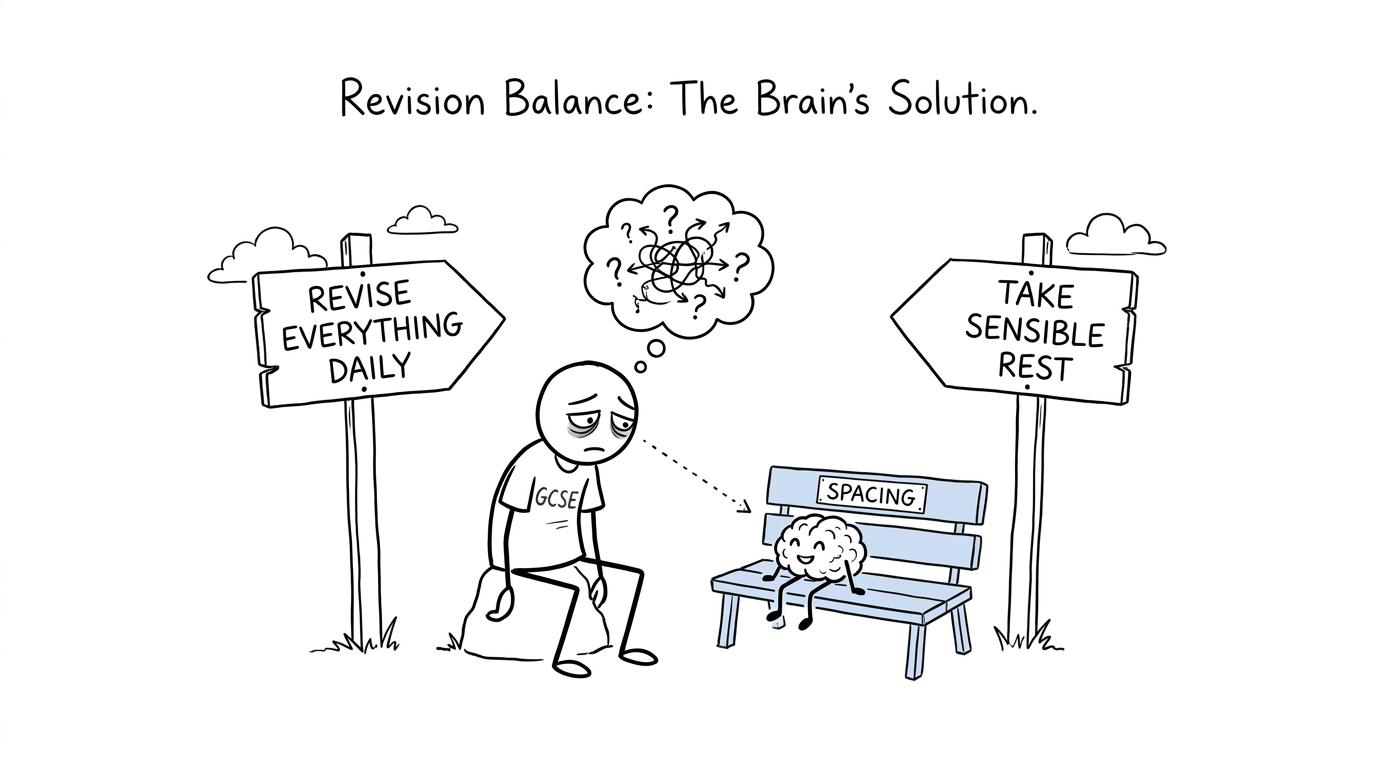 A student choosing between relentless revision and sensible spacing
Why revising every day is not automatically better
Daily revision feels reassuring because activity is visible. You open the book, highlight a page and feel that the subject has been dealt with. But memory does not measure how long notes remain open.
Research on learning consistently supports spacing: revisiting knowledge across separated sessions tends to produce stronger long-term retention than concentrating the same practice into one block. The gap matters because some forgetting occurs. When you later reconstruct an idea from memory, the retrieval requires effort, and that effort strengthens access to it.
This makes a schedule such as Monday, Wednesday and Saturday potentially more effective than repeating the same notes for three consecutive hours on Sunday. It also explains why a rest day does not erase progress. The gap can become part of the learning process, provided you return and retrieve the material later.
Maths benefits from the same broad principle. A method can look obvious while you are watching it, yet feel unfamiliar two days later. That is why the MathsGenie guide to stopping forgotten GCSE maths content combines spaced practice with active recall and exam-style questions.
What effective Citizenship Studies revision looks like
Citizenship Studies requires more than remembering isolated definitions. Specifications assess knowledge and understanding, application to contexts, and the ability to analyse evidence, compare viewpoints and reach substantiated judgements.
For example, AQA organises its qualification around areas including life in modern Britain, rights and responsibilities, politics and participation, and active citizenship. OCR uses its own component structure and includes rights, law, democracy, government, the wider world and citizenship action. Always use the current specification for your board because organisation and assessment formats differ.
That mixture of knowledge and argument calls for several kinds of revision.
Retrieve precise knowledge
Close your notes and write everything you can remember about one narrow area, such as the role of Parliament, the legal system, electoral processes or the work of pressure groups. Then check what is accurate, missing or confused.
Questions and flashcards should prompt recall, not recognition. Seeing a definition and thinking “I know that” is weaker evidence than producing it unaided.
Connect ideas to contexts
Citizenship questions can require you to apply knowledge rather than recite it. After recalling a concept, ask how it relates to a source, campaign, institution or unfamiliar scenario.
Keep examples current where your teacher or specification requires them, but avoid collecting facts without understanding their relevance. A smaller set of well-understood examples is more useful than a large list you cannot connect to an argument.
Practise reasoned judgements
Extended answers need a clear chain of reasoning. Practise planning both sides of an issue, selecting evidence and reaching a conclusion that follows from the discussion. Use your board’s mark schemes to check whether you are analysing and evaluating rather than merely describing.
This resembles good mathematical revision in one important way: reading a model response is not the same as producing one. MathsGenie’s advice on using GCSE past papers properly follows a useful loop: attempt, mark, diagnose, repair and retest. The same logic can guide written Citizenship Studies practice.
Should you take a complete rest day?
Usually, yes, especially when you are balancing several GCSE subjects.
A rest day is not a reward for finishing every possible task. That task will never be finished. It is part of a timetable designed to remain workable for weeks rather than collapse after a few intense days.
Rest can mean a full day without formal revision. During a particularly busy period, it might instead mean an evening off or a deliberately light day containing only a brief recall check. What matters is that your plan includes time when attention is not constantly being demanded.
Sleep deserves particular protection. Evidence from learning research indicates that sleep supports memory consolidation, while spacing learning across days gives you repeated opportunities to retrieve knowledge after sleep. Sacrificing sleep to reread familiar notes is therefore a poor bargain, particularly when tiredness also reduces concentration the following day.
Rest days also create useful information. If a topic is difficult to recall after a break, the break has not caused failure; it has revealed what needs another retrieval session.
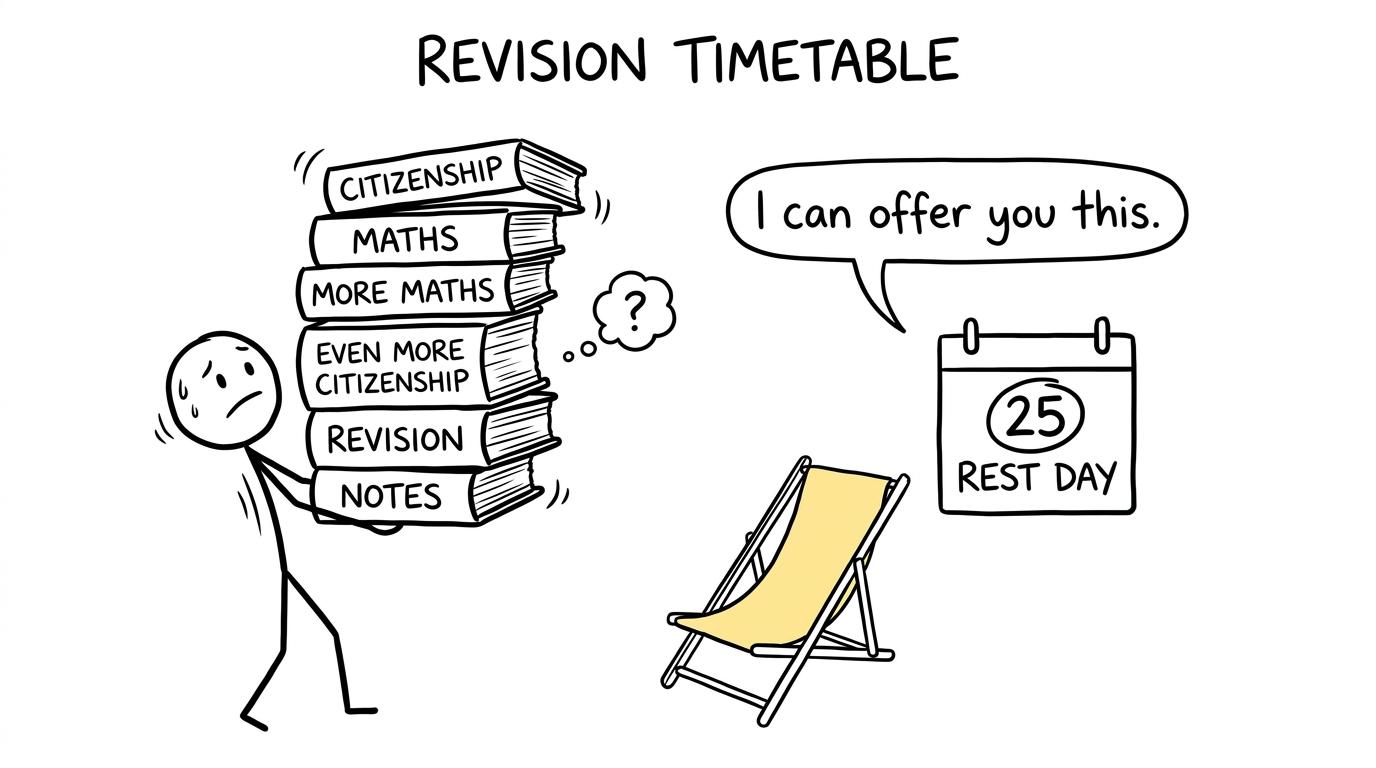 A revision timetable offering an overloaded student a rest day
A practical weekly pattern for Citizenship and maths
Instead of asking whether every day must contain Citizenship Studies, assign each session a purpose.
| Day | Citizenship Studies focus | Maths focus |
|---|---|---|
| Monday | Short retrieval of one previous topic | Targeted practice on one weak skill |
| Tuesday | Rest from Citizenship Studies | Revision lesson and practice questions |
| Wednesday | Source analysis or response planning | Light recall or corrections |
| Thursday | Rest from Citizenship Studies | Timed mini test |
| Friday | Recall plus one exam-style response | Rest or a short error review |
| Saturday | Longer mixed session and marking | Past-paper section and marking |
| Sunday | Complete rest or flexible catch-up | Complete rest or flexible catch-up |
This is a framework, not a rule. If your Citizenship Studies examination is close, you might add a brief retrieval session. If you have a maths paper first, maths should receive more time. The GCSE maths revision timetable guide can help you arrange topic learning, practice and paper work without filling every available hour.
On a busy school day, a compact routine is often easier to repeat than an ambitious one. MathsGenie’s 20-minute GCSE maths revision routine shows how a short session can include recall, exam questions and marking. Citizenship Studies can use a similar structure: retrieve, apply, check and record the next weakness.
Change the schedule as the examination approaches
A good timetable is not static. Early in revision, prioritise coverage and spaced recall. Later, increase mixed questions, timed responses and complete papers.
Several weeks before the examination, revisit each specification area and identify gaps. Closer to the paper, spend more time producing answers under realistic conditions. In the final days, concentrate on weak areas, command words and mistakes already found. Do not attempt to relearn the entire course on the final evening.
Use evidence to decide what receives time. This is especially important in maths, where doing comfortable questions can disguise a persistent weakness. The MathsGenie weakest-topics diagnostic explains how tests and lost marks can turn a vague revision plan into a specific repair list.
For a very short preparation window, the one-week GCSE maths revision plan offers a structured approach to diagnosis, focused practice and exam preparation. Even then, sleep and breaks remain part of the plan.
Common revision mistakes
Treating attendance as learning
Sitting with notes for an hour does not prove that knowledge can be recalled. Begin by testing yourself, then use notes to correct the result.
Revising Citizenship Studies every day in the same way
Repeated rereading becomes familiar but does not cover the full range of examination skills. Rotate recall, source interpretation, planning, timed writing and marking.
Taking unplanned rather than planned rest
Rest accompanied by guilt is rarely restful. Put breaks into the timetable in advance so that they are recognised as part of the strategy.
Ignoring the specification and exam board
Do not assume that every revision list matches your course. Check the current AQA or OCR specification used by your school, along with its papers and mark schemes.
Giving every subject equal time
Equal time sounds fair, but revision should respond to examination dates, confidence and lost marks. A weak maths topic may need more practice this week; a Citizenship Studies paper may become the priority next week.
Filling a missed day with double revision
A missed session does not create a debt that must be repaid immediately. Move the most important task, shorten another session or use a catch-up slot. Consistency survives through flexibility, not punishment.
Build a timetable you can still follow next week
So, should you revise GCSE Citizenship Studies every day or rest? Use regular, spaced sessions, but keep genuine rest in the week. Daily contact can be useful when it is brief and purposeful, particularly near the examination, but intensive daily revision is neither necessary nor automatically effective.
The best timetable is not the one that looks busiest. It is the one that repeatedly asks your memory to work, shows you what is missing and leaves enough energy to return tomorrow.
For the maths side of your GCSE preparation, make MathsGenie’s free GCSE revision guides your next stop. Use revision lessons and practice questions to repair individual topics, then add mini tests, past papers, predicted papers, mark schemes and video solutions. Plan the work, test what has stayed, and allow yourself to rest before beginning the cycle again.