GCSE Chinese vs Japanese: What Employers Notice
GCSE Chinese vs Japanese employers compare: discover what recruiters and colleges value, when each language helps, and how to choose your best GCSE option.
A subject choice can feel as though it is secretly deciding your entire future. Chinese sounds commercially significant. Japanese sounds distinctive. Both can appear impressive, but you may wonder whether one creates a genuine advantage.
The question behind searches for GCSE Chinese vs Japanese employers is simpler than it first appears: most employers and colleges do not automatically prefer one of these GCSEs to the other. They are more likely to notice your grade, your wider academic profile and whether you can explain how you used the language. For many applications, GCSE English and maths remain more important entry requirements.
Choose the language you are most likely to enjoy, sustain and achieve well in. A strong result supported by real interest is generally more useful than a supposedly strategic subject that becomes difficult to maintain.
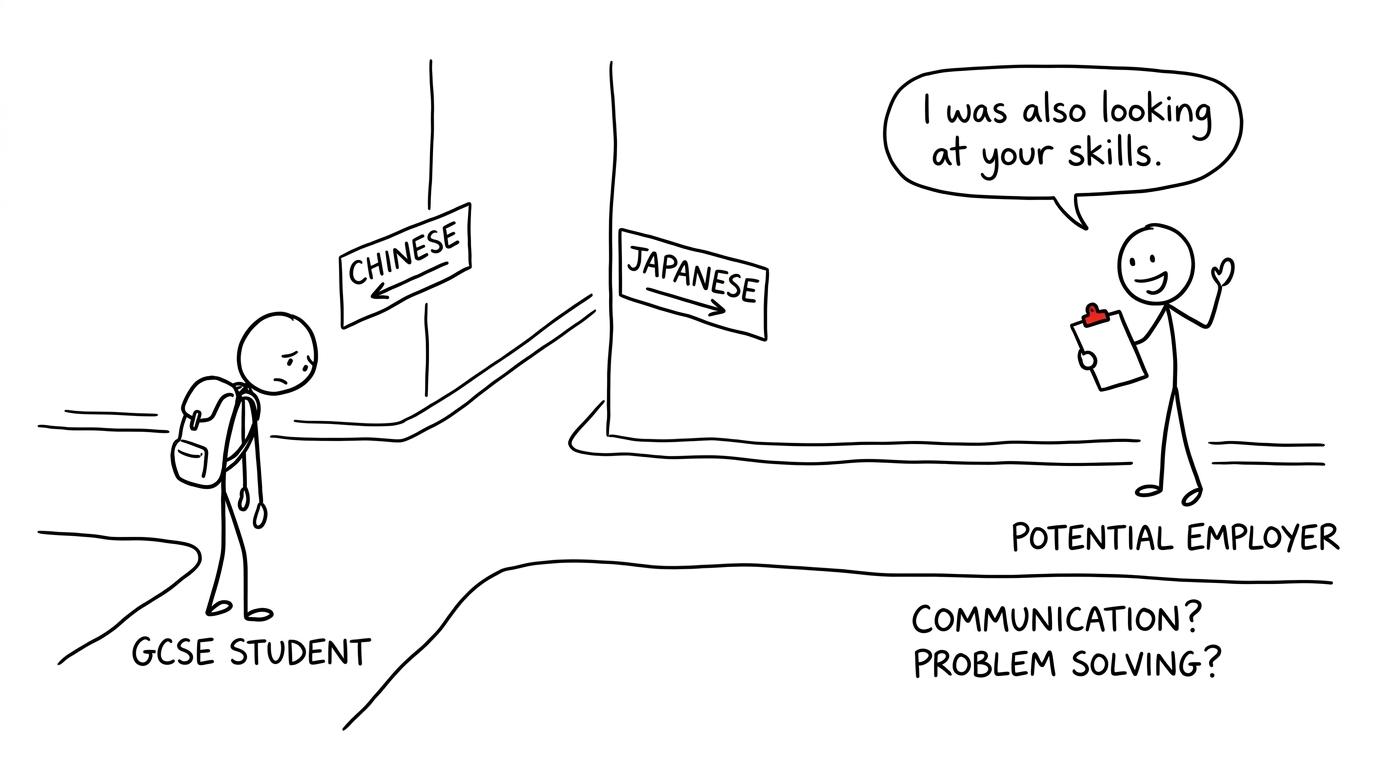 A student choosing between Chinese and Japanese while an employer considers wider skills
The quick answer for students
Before choosing between GCSE Chinese and GCSE Japanese, consider this checklist:
- Likely grade: Which course gives you the best chance of demonstrating strong listening, speaking, reading and writing?
- Genuine interest: Which language would you still want to practise when revision becomes repetitive?
- Teaching and support: Does your school have an experienced teacher, suitable resources and a stable class?
- Future direction: Are you interested in a particular country, university course, industry or A Level pathway?
- Qualification details: Which exam board and specification does your school offer, and are you eligible to take it?
- Overall workload: Can you study the language without weakening essential subjects such as English and maths?
There is no universal league table in which Chinese always beats Japanese, or Japanese always looks more impressive. Context matters.
What employers actually notice
An employer reviewing an application does not usually inspect each GCSE as an isolated badge. The complete pattern matters more.
A language GCSE can suggest that you have developed communication skills, persistence and an ability to work with unfamiliar structures. However, possessing the qualification does not prove fluency, and employers understand that GCSE is an early stage of language learning. You should describe your level accurately rather than presenting a GCSE as professional working proficiency.
For a typical school-leaver role or apprenticeship, an employer may focus first on:
- whether you meet stated English and maths requirements;
- your overall grades and consistency;
- evidence of reliability, teamwork and communication;
- relevant work experience, projects or responsibilities;
- your reason for applying;
- any skills directly connected to the role.
Chinese or Japanese may attract interest because either is less commonly presented than some European languages. Yet being noticed is not the same as being selected. The qualification becomes valuable when it supports a coherent application.
For example, Japanese may be especially relevant to an applicant with sustained interest in Japanese studies, translation or a company working with Japan. Chinese may be relevant to an applicant interested in Chinese studies, international business or organisations working with Chinese-speaking markets. Neither connection guarantees an advantage, and the relevance depends on the particular role.
Do colleges care more about Chinese or Japanese?
Usually, colleges and sixth forms care more about whether you meet their published entry requirements.
If you want to continue a language at A Level, the institution may require a particular GCSE grade in that language. Requirements differ, so check the current course page and ask the admissions team. A college offering Japanese cannot treat GCSE Chinese as automatically equivalent preparation, and the reverse is also true.
For unrelated courses, colleges commonly look at your overall GCSE profile and specified subjects. Maths, sciences and economics pathways may require particular maths or science grades. Humanities courses may place more emphasis on English or essay-based subjects. A language is part of the academic picture, but rarely overrides a missing compulsory requirement.
UCAS guidance also advises students to work backwards from any course they may want to study and check its actual requirements. When you eventually complete a university application, your GCSE qualifications form part of the information supplied. That means your language result can be seen, but it will be considered alongside everything else.
The sensible rule is straightforward: never choose Chinese or Japanese because you imagine every college will prefer it. Choose it because it suits your strengths and keeps an appropriate future route open.
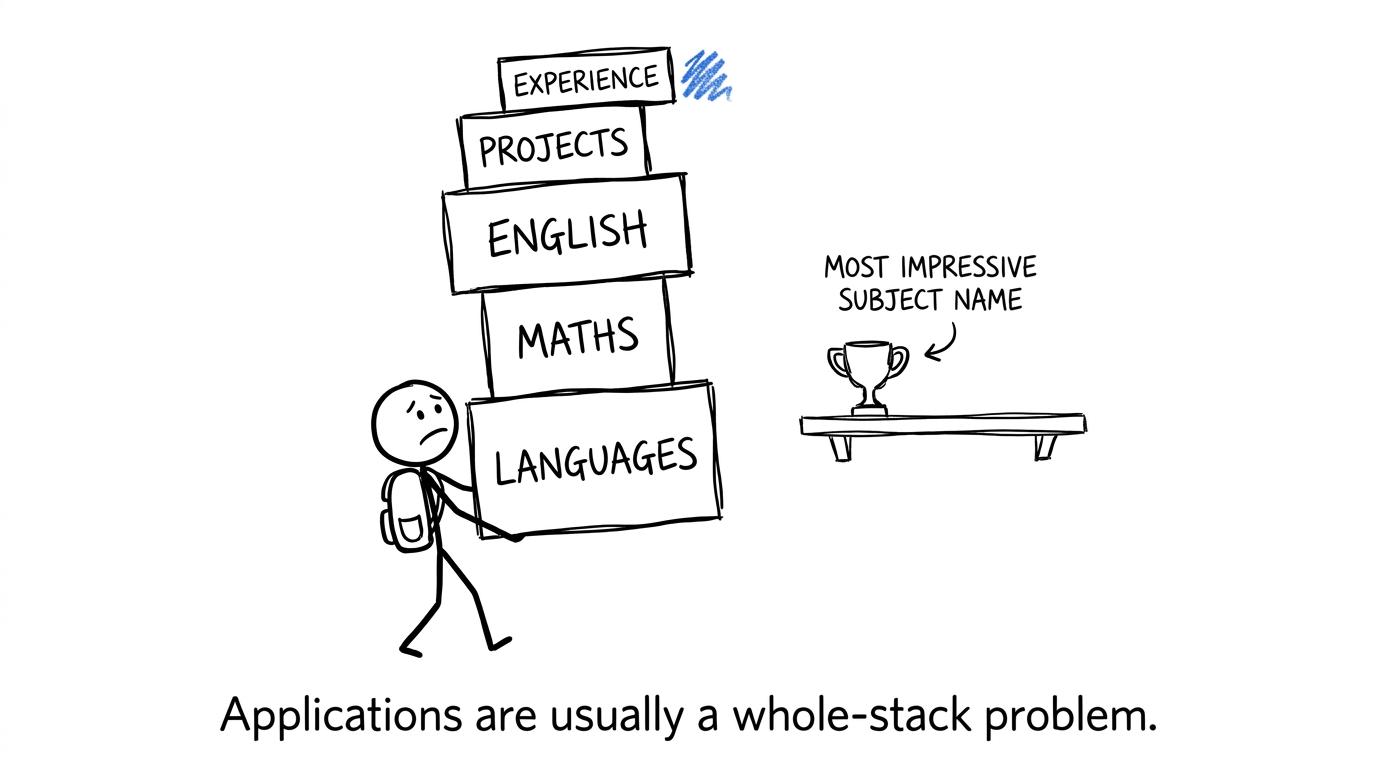 A student carrying the complete stack of skills that makes an application
When Chinese or Japanese can make a difference
A language qualification becomes more noticeable when it is connected to evidence.
When the role has a genuine language connection
If an organisation deals with customers, offices or suppliers in a relevant region, your GCSE may start a useful conversation. The employer may still need a much higher standard for language-dependent work, but the qualification can show the beginning of a longer commitment.
When you continue beyond GCSE
Progressing to A Level, university study or recognised advanced language learning gives the GCSE a clearer place in your story. It shows development rather than a subject abandoned immediately after Year 111111.
You do not have to continue formally for the GCSE to matter. Maintaining reading, conversation or cultural knowledge can also show genuine interest, provided you describe what you can actually do.
When you can explain the skills developed
Avoid vague claims such as “Chinese taught me determination”. Explain the process instead: regular vocabulary retrieval, responding under speaking-exam pressure, listening for detail or correcting written work after feedback.
That evidence is more credible because it describes behaviour. The same principle applies to maths. Completing a qualification is useful; showing how you approach difficult problems makes it meaningful.
How Chinese and Japanese differ as GCSE choices
Neither language is objectively the correct option for every student. They involve different linguistic demands, and the course available to you depends on your school, centre and exam-board specification.
Chinese courses commonly focus on Mandarin and require students to develop control of tones, listening, characters and sentence patterns. Japanese involves its own sound system, grammar and writing systems, including hiragana, katakana and kanji. These descriptions do not tell you which language will be easier for you.
Prior knowledge matters. So do teacher quality, lesson time, opportunities to speak and the amount of independent practice you can manage. A subject that looks impressive on an options sheet can feel very different during weekly vocabulary tests and speaking preparation.
Before enrolling, ask:
- Which qualification and current specification will I take?
- What prior knowledge does the course expect?
- How are speaking, listening, reading and writing assessed?
- What support is available outside lessons?
- Can I see sample assessment materials?
- Is the course suitable for complete beginners?
Do not assume that every exam board offers the same language options or assessment structure. Confirm the current arrangements with your school and examination centre.
Protecting your maths and core GCSE results
It is possible to become so focused on choosing an unusual subject that you overlook the qualifications appearing in far more entry requirements. English and maths frequently operate as gateways for college courses, apprenticeships and employment.
That does not mean abandoning an ambitious language. It means managing the complete workload.
Begin by using the GCSE maths revision hub to identify your board, tier and weak topics. MathsGenie provides free revision lessons, exam questions, worksheets and papers for boards including Edexcel, AQA, OCR and Eduqas.
If language practice is taking a large share of your evenings, create a repeatable maths minimum. The 20-minute GCSE maths revision routine is designed for busy school days when a full session is unrealistic.
You can then use the weak-topic diagnostic method rather than revising chapters you already know. That keeps revision efficient and leaves space for speaking preparation, character practice or vocabulary retrieval.
A better way to make the decision
The strongest choice usually sits where three things overlap: interest, aptitude and opportunity.
Interest keeps you practising after the novelty disappears. Aptitude helps you recognise the course in which your current strengths are useful. Opportunity includes the quality of teaching, available resources and realistic progression routes.
Speak to both language teachers if possible. Look at authentic course materials. Ask what students actually do each week, rather than relying on the subject's reputation. Then consider how the option fits beside your other GCSEs.
Your revision plan matters too. MathsGenie's guide to the best order for learning GCSE maths topics can help you secure foundational skills before moving to demanding higher-tier content. Nearer the exams, use the one-month GCSE maths revision plan to balance topic repair with timed practice.
The goal is not to assemble the most exotic-looking subject list. It is to build a set of results and experiences that you can sustain and explain.
 Two revision strategies compete while a cat judges subject prestige
Common mistakes when choosing a language GCSE
Choosing entirely for perceived prestige
There is no reliable evidence that employers generally rank GCSE Chinese above GCSE Japanese, or vice versa. Prestige is a fragile reason to carry a subject through two years of lessons and assessments.
Ignoring the likely grade
A challenging choice can be worthwhile, but difficulty alone does not make a qualification more valuable. Consider your starting point, available support and willingness to practise consistently.
Treating GCSE as proof of fluency
State your qualification and present ability honestly. If a role genuinely needs a language, the employer may assess your skills rather than relying only on the certificate.
Forgetting course-specific requirements
Do not rely on general advice when a particular sixth form, college, apprenticeship or university course publishes precise conditions. Requirements can change, so check them directly before applying.
Letting one option damage core revision
A language should broaden your education, not leave preventable gaps elsewhere. Use past papers properly by sitting, marking, repairing and retesting rather than completing paper after paper without review. Predicted papers can support final preparation, but the guide to GCSE predicted topics explains why they should not replace full specification coverage.
Choose the subject you can turn into evidence
Employers and colleges do not share one secret preference between GCSE Chinese and GCSE Japanese. Most will notice the wider application first: your grades, required qualifications, communication, experience and reasons for applying. Either language can add distinction when it is relevant and supported by genuine achievement.
Choose the course you are prepared to practise steadily. Check the specification and progression requirements. Protect your English and maths grades. Later, describe what the experience taught you without exaggerating your fluency.
Then give your maths revision the same steady attention. Start with MathsGenie's free GCSE revision lessons, move into practice questions and mini tests, and test your progress through past papers, predicted papers, mark schemes and video solutions. A thoughtful subject choice may open a door, but dependable preparation is what helps you walk through it.