GCSE Chinese Listening Exam Prep That Works
GCSE Chinese listening exam prep that builds real comprehension: train sound recognition, predict answers, review errors and use past papers with purpose.
The frustrating part of a Chinese listening paper is rarely complete silence. You recognise a place, a time or an opinion. Then one quick phrase changes the meaning, the recording moves on and confidence disappears with it.
Effective GCSE Chinese listening exam prep is not simply doing more listening. It means training separate skills: recognising familiar words at natural speed, noticing tones and negatives, predicting the information a question needs, and learning from each missed mark. The most useful routine is short and deliberate: listen, answer, check the transcript, diagnose the error and listen again.
That is the same active revision principle that works in maths. A completed paper measures performance; careful correction improves it.
Your listening preparation checklist
Use this as the foundation of each week:
- Confirm whether you take AQA or Pearson Edexcel and whether you are entered for foundation or higher tier.
- Learn vocabulary as sound as well as written characters and English meanings.
- Practise recognising time, tense, opinion, negatives, quantities and changes of plan.
- Read questions before listening and predict the type of detail required.
- Use the first playing for meaning and the second for confirmation.
- Review every mistake using the audio, transcript and mark scheme.
- Keep an error log based on causes, not merely scores.
- Repeat difficult extracts after a delay until the improvement is reliable.
The central idea is simple: do not ask only, “What was the answer?” Ask, “Why did the recording prevent me from finding it?”
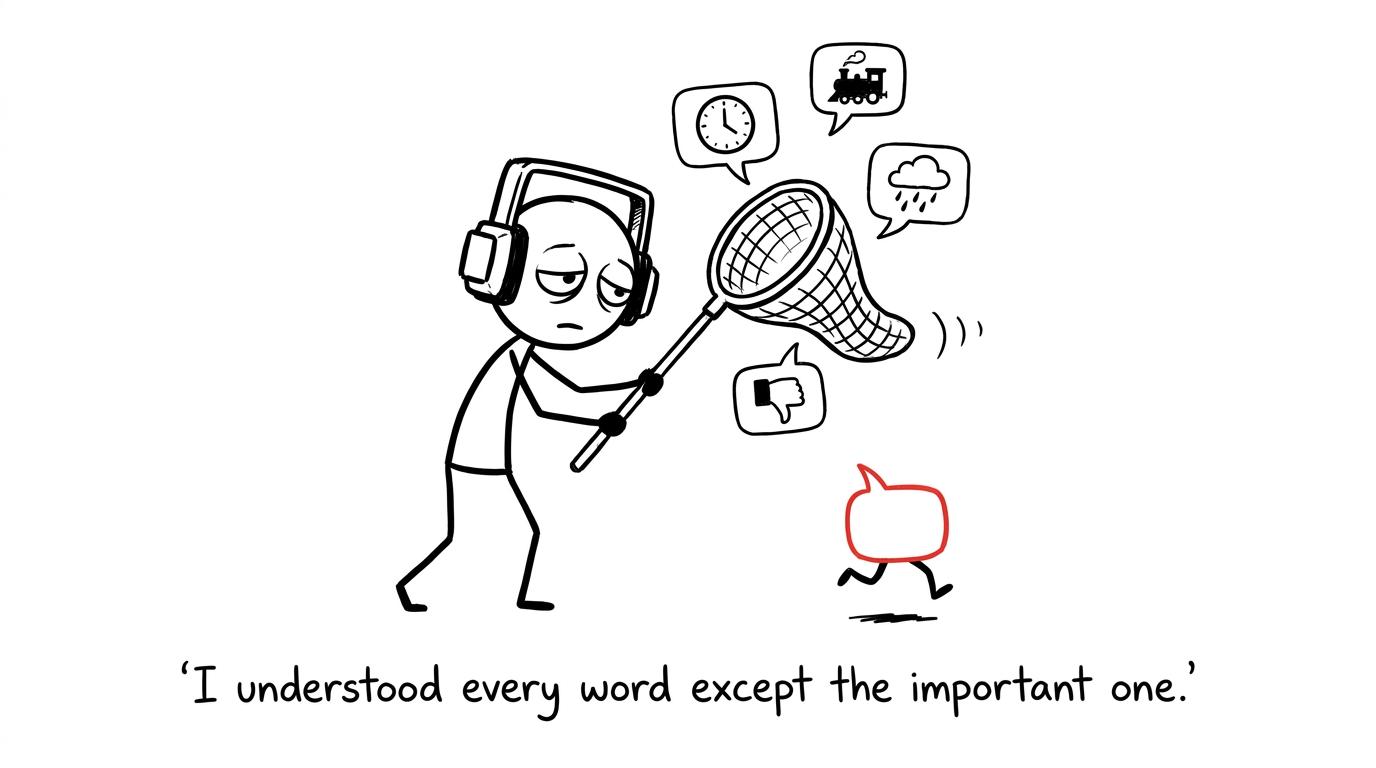 A student watches the important word escape from a listening exercise
Know what your Chinese listening paper demands
GCSE Chinese listening assesses your ability to understand and respond to spoken language. You need to identify overall meaning, specific details, opinions and relationships between past, present and future events. Longer passages can also require you to infer meaning rather than wait for an exact phrase from the question.
For the current AQA GCSE Chinese (Spoken Mandarin) specification, listening contributes 25%25\%25% of the qualification. The foundation paper lasts 353535 minutes and carries 404040 marks; the higher paper lasts 454545 minutes and carries 505050 marks. Both timings include five minutes of reading time. Questions are in English and responses are given in English or non-verbally. AQA states that each item is heard twice.
For the current Pearson Edexcel GCSE Chinese specification, listening also contributes 25%25\%25%. Both tiers carry 505050 marks: foundation lasts 353535 minutes and higher lasts 454545 minutes, including five minutes of reading time. Questions and instructions are in English, and written responses in Chinese are not required. Edexcel Chinese can involve spoken Mandarin or spoken Cantonese, so confirm your school’s entry and practise with the correct recordings.
Do not assume that arrangements for another language or exam board apply to you. Check your specification, tier and teacher’s guidance before building a revision plan.
Train your ears, not just your vocabulary list
A word can look familiar on a flashcard and still feel unfamiliar in speech. Spoken language arrives without spaces. Sounds influence one another, speakers maintain a natural rhythm, and the detail you need may appear inside a longer sentence.
Build each vocabulary item in several directions:
- hear the word and recall its meaning;
- see the English meaning and say the Chinese aloud;
- hear it inside a sentence rather than in isolation;
- recognise it when spoken by different voices;
- connect it to common opposites, topic words and opinions.
Tone awareness matters, but listening preparation should not become a hunt for isolated syllables. Context also carries information. If the question concerns transport, the surrounding words may help distinguish an uncertain sound. Your goal is to combine sound, context and question clues quickly.
Numbers, dates and times deserve dedicated practice. So do short words that alter meaning: negatives, comparisons, intensifiers and words showing that a plan changed. These are small in length but large in consequence.
Read the question like a prediction tool
The reading period is part of the assessment, not waiting time. Use it to turn every question into a listening target.
Before the recording begins:
- underline the subject of the question;
- identify whether you need a person, place, reason, time, opinion or activity;
- notice the number of marks and answer spaces;
- mark contrasts between multiple-choice options;
- predict likely topic vocabulary;
- look for questions asking about past or future events.
This reduces the amount of speech competing for your attention. You are no longer trying to translate everything. You are listening for evidence that answers a particular question.
Be careful, however, not to decide the answer in advance. Prediction creates a shortlist; the recording makes the decision. Examiners may include a familiar word from a wrong option before the speaker corrects, rejects or contrasts it.
Give each playing a different job
When an extract is played twice, treating both playings identically wastes an opportunity.
First playing: establish the message
Follow who is speaking, the situation and the broad sequence of ideas. Record answers you can justify, but do not let one missed word consume the rest of the extract. A gap is recoverable. Losing the next three details while thinking about it is more costly.
Second playing: verify the evidence
Now listen for the exact feature separating possible answers. Check negatives, time references, opinions, quantities and changes of direction. Correct an answer only when the second playing gives real evidence, not because anxiety makes the first answer feel suspicious.
Your notes should be brief. English abbreviations, ticks, crosses and arrows are often more useful than complete sentences. The final response must remain clear enough for the examiner to understand.
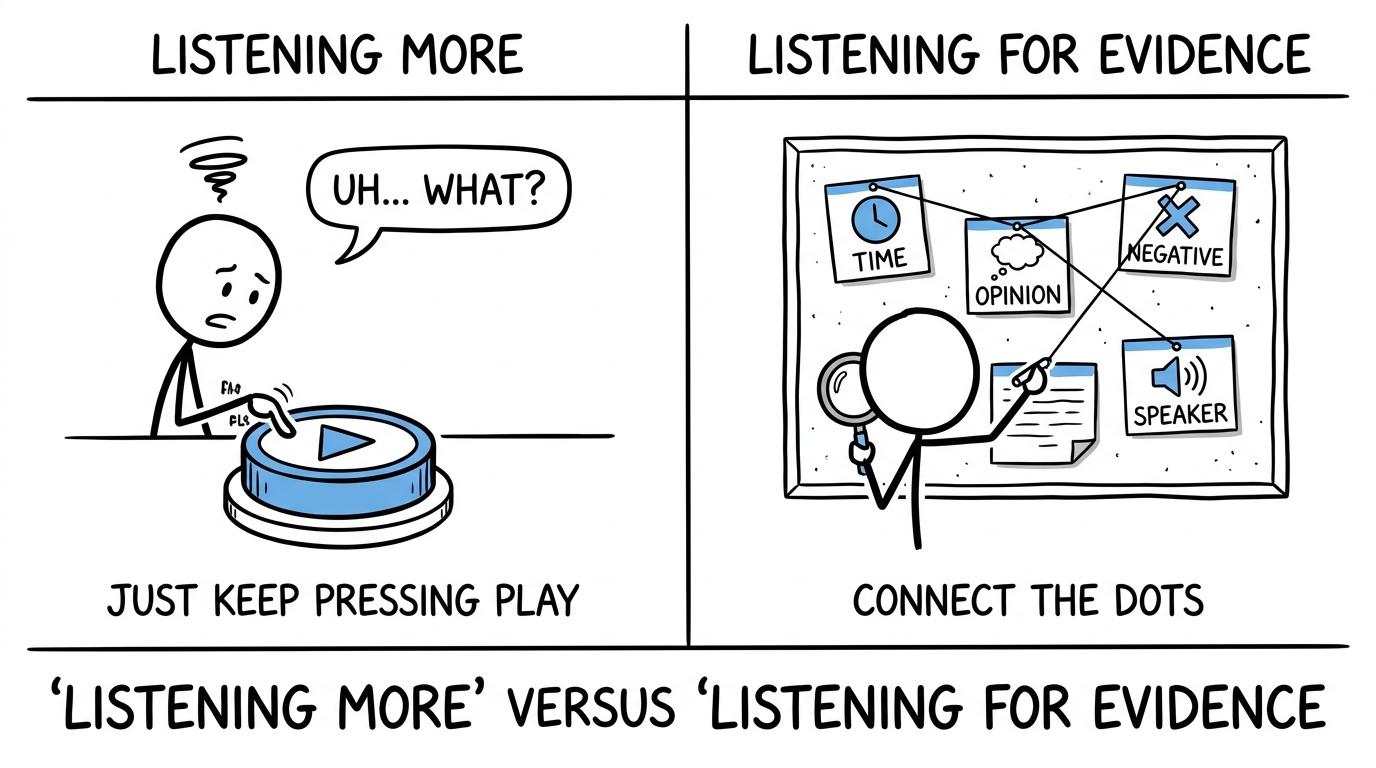 Two students discover the difference between more listening and listening for evidence
Turn every practice extract into a diagnosis
A score tells you how the attempt ended. It does not tell you what to practise tomorrow.
After completing an extract, check the official mark scheme and transcript where available. Classify each lost mark:
- Vocabulary gap: you did not know the key word.
- Sound-recognition gap: you knew it on paper but did not recognise it aloud.
- Processing gap: you recognised the words but could not combine them quickly enough.
- Question-reading error: you listened for the wrong information.
- Distractor error: you selected a word you heard without checking its role.
- Detail error: you missed a negative, number, tense or comparison.
- Answering error: your English response was ambiguous or included contradictory information.
Then apply one repair. Add an unknown item to audio-based vocabulary practice. Replay a sound-recognition error at normal speed. Rewrite an unclear answer more precisely. For a distractor error, identify the language showing why that option was wrong.
This diagnose-and-retest cycle is also central to MathsGenie’s guide to finding your weakest GCSE topics. The subject changes, but the principle does not: revise the cause of lost marks rather than repeatedly measuring the symptom.
Use transcripts without becoming dependent on them
A transcript is most valuable after an honest attempt.
Use this sequence:
- Listen under normal conditions and answer the questions.
- Listen once more only to the section that caused difficulty.
- Read the transcript and locate the evidence.
- Mark words you knew visually but missed aurally.
- Listen while following the transcript.
- Hide the transcript and listen again.
- Return on another day and test the extract without support.
Reading first can create an illusion of listening ability because your eyes supply information your ears did not find. Transcripts should expose the gap, not conceal it.
Occasionally use short dictation or shadowing. In dictation, record the sounds and words you can identify. In shadowing, repeat immediately after the speaker, copying pace and rhythm. These activities reveal weak sound boundaries and improve the link between pronunciation and recognition. Keep them short enough to remain precise.
Build a weekly GCSE Chinese listening routine
A sustainable plan is better than an ambitious plan abandoned after three days. A useful week might contain:
- two short sessions on vocabulary and sound recognition;
- one focused session on numbers, opinions, negatives or tense;
- one exam-style listening section;
- one correction session using the transcript and mark scheme;
- one delayed retest of previously difficult material.
Closer to the exam, add complete papers under the correct timing. Start full-paper practice only after you have a method for reviewing it. The article on when to start GCSE past papers explains why shorter diagnostic work should lead into timed papers rather than disappear beneath them.
If you are balancing Chinese with maths and other GCSEs, place this routine inside a realistic timetable. MathsGenie’s one-month GCSE revision plan and GCSE maths revision timetable both model the useful rhythm of focused practice, marking and retesting.
Common mistakes in GCSE Chinese listening preparation
Replaying audio until it feels familiar
Familiarity is not the same as independent comprehension. After reviewing an extract, leave it for several days and retest it without the transcript. That delayed attempt provides better evidence.
Translating every word
The recording will continue while you build a perfect English sentence in your head. Listen for the overall message and the detail demanded by the question. Translate only as much as the answer requires.
Treating the first familiar word as proof
A speaker may mention one activity and then reject it, compare it with another or explain that plans changed. Wait for the grammatical and contextual evidence.
Ignoring answers written in English
Although Chinese writing is not required in the current AQA and Edexcel listening papers, your English response must communicate the correct idea. Unclear or contradictory additions can lose a mark even when part of the answer is relevant.
Completing papers without analysing them
More papers do not automatically create better listening. Mark carefully, categorise errors and retest weak skills. Maths students can see the same process in how to use GCSE past papers properly.
Doing only comfortable topics
Food and school may feel reassuring, but the paper draws across the specification. Rotate themes and voices so that progress is not built on familiarity with one narrow set of recordings.
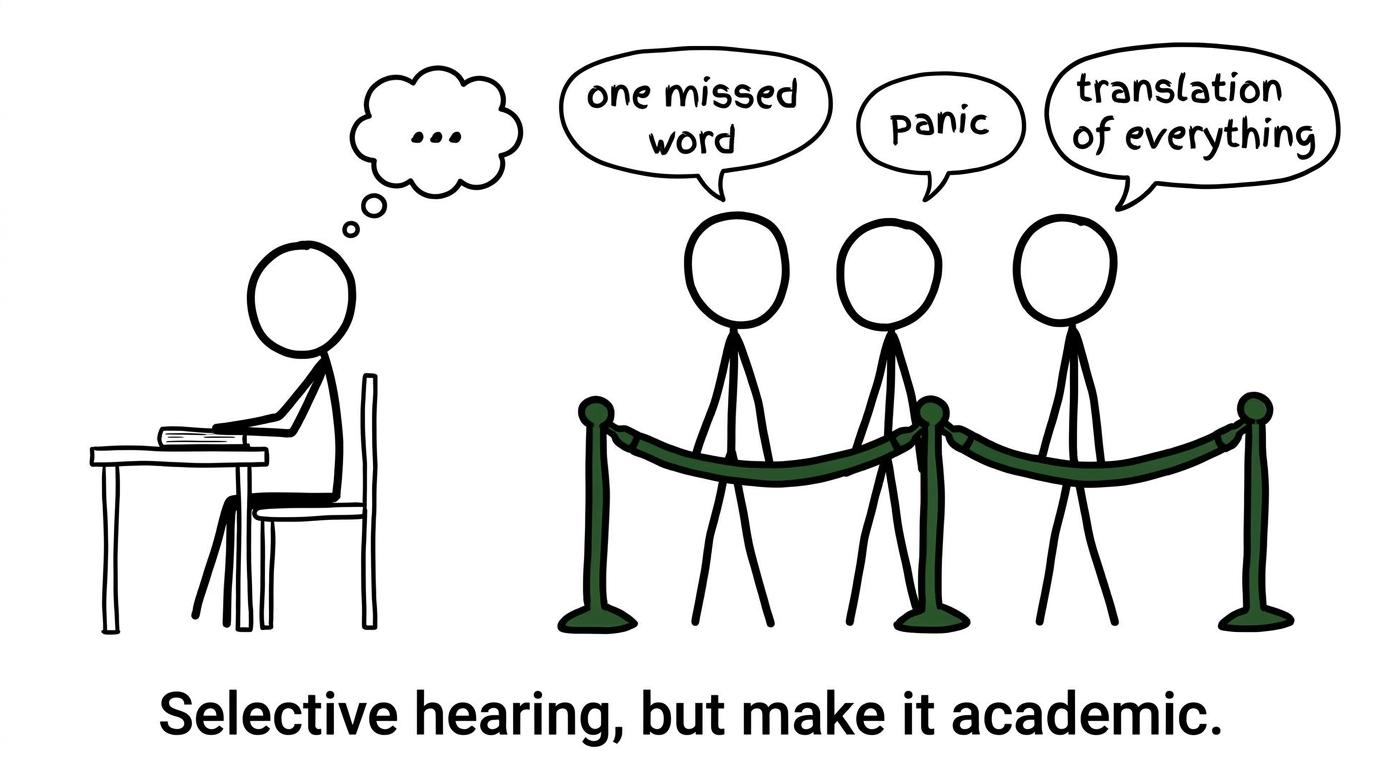 A calm student keeps panic and over-translation outside the listening exam
Prepare calmly for the final days
In the last few days, do not attempt to relearn the entire course. Review your error log, high-frequency sound confusions, numbers, time phrases, negatives and opinion language. Complete a small amount of normal-speed listening, but protect sleep and concentration.
Confirm your equipment and exam arrangements with school. During the paper, use the reading time, follow the question order and move on after a missed detail. One uncertain response does not decide the paper.
The same restraint is useful before maths exams. MathsGenie’s night-before GCSE plan focuses on correcting a few recurring errors rather than creating panic through unfocused revision.
Make practice produce a change
The best listening revision leaves evidence behind: a word you can now recognise at speed, a distractor you no longer follow, or an answer you can express more precisely. Improvement comes from making small failures visible and then repairing them.
Use official Chinese audio, papers, transcripts and mark schemes from your exam board for subject-specific practice. For the maths part of your GCSE timetable, make MathsGenie’s free GCSE maths revision hub your starting point. It brings together revision lessons, practice questions, mini tests, past papers, predicted papers, mark schemes and video solutions for boards including Edexcel, AQA, OCR and Eduqas. You can also use the Edexcel GCSE maths past papers when you are ready for timed practice.
Whatever the subject, the productive loop remains the same: attempt, check, diagnose, repair and retest. Begin with one short Chinese extract today and make sure the second attempt teaches you something the first one could not.