Do GCSE Chemistry Grade Boundaries Change Much?
GCSE chemistry grade boundaries year to year: see how far AQA and Edexcel marks moved, why boundaries change, and how to plan revision confidently.
The strange thing about finishing a GCSE Chemistry paper is that your mark still does not tell you your grade. You can estimate it from an older boundary, but the final threshold has not yet been set.
So, do GCSE chemistry grade boundaries year to year change much? The short answer is: sometimes only by a few marks, but larger shifts can happen. In recent AQA data, many selected boundaries moved by between 000 and 777 marks in one year. Some recent Edexcel higher-tier boundaries moved by considerably more, including shifts approaching 202020 marks out of 200200200.
That does not mean standards are being changed at random. Boundaries move because the demand of each examination series is slightly different. Their purpose is to keep the standard represented by a grade broadly consistent.
The quick answer at a glance
Before looking at the figures, remember these five points:
- A grade boundary is the minimum total raw mark required for a grade.
- Boundaries are set after the papers have been taken and marked.
- A more demanding examination will generally produce lower boundaries.
- A more accessible examination will generally produce higher boundaries.
- Previous boundaries are useful reference points, not predictions.
The latest confirmed summer boundaries at the time of writing are from June 202520252025. Boundaries for the summer 202620262026 examinations will not be official until GCSE results day.
For a longer historical view, see the GCSE Chemistry grade boundaries history.
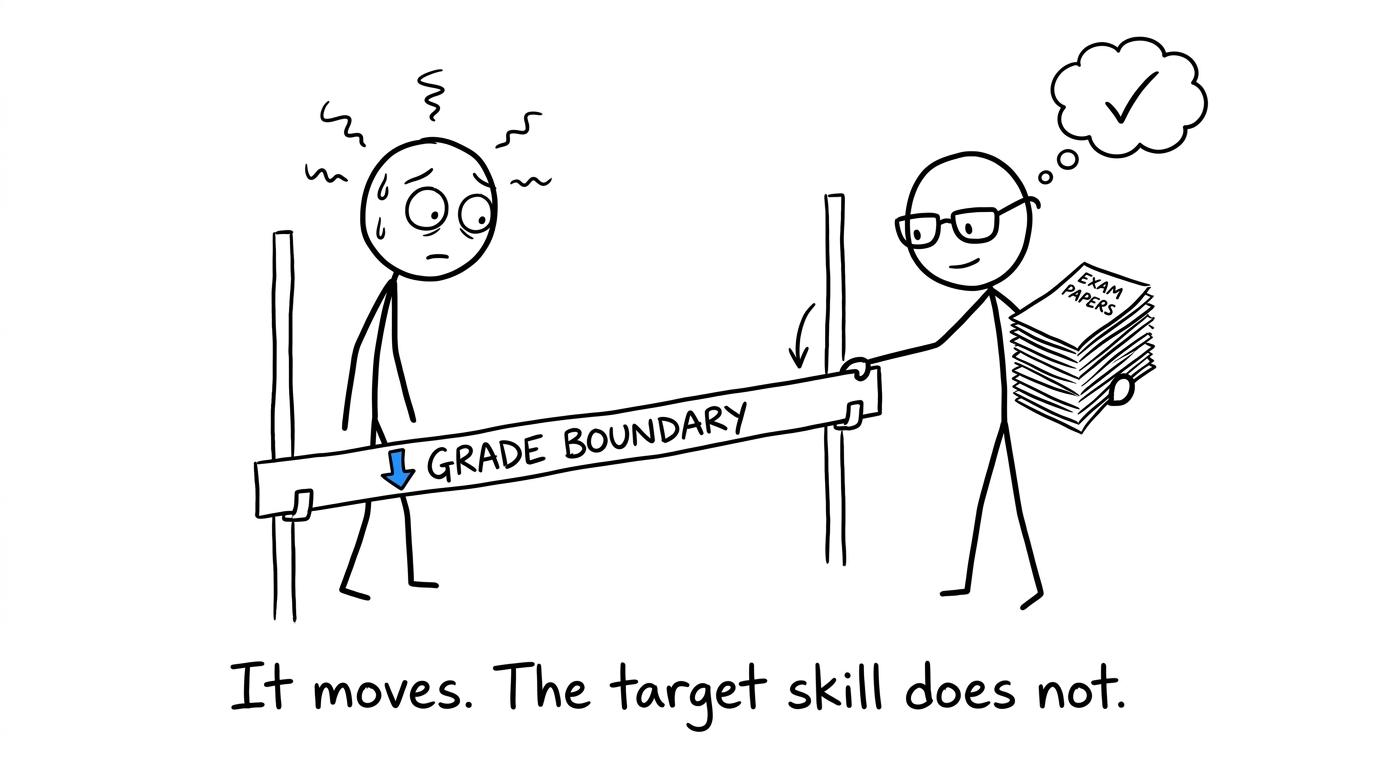 A student discovers that the grade boundary moves but the required skill remains
How much have Chemistry boundaries actually changed?
The most useful comparison keeps the exam board, specification, tier and total available marks the same. Comparing an AQA raw mark directly with an OCR or Edexcel mark can be misleading because each board uses its own assessment.
AQA GCSE Chemistry 846284628462 and Edexcel GCSE Chemistry 1CH01CH01CH0 are each assessed across two papers with a combined maximum of 200200200 marks. That makes their year-to-year movements easy to describe, although their boundaries should still not be treated as interchangeable.
Recent AQA changes
These are selected subject-level boundaries from the June series:
| AQA boundary | 202320232023 | 202420242024 | 202520252025 | Latest one-year change |
|---|---|---|---|---|
| Higher grade 999 | 149149149 | 149149149 | 150150150 | +1+1+1 mark |
| Higher grade 777 | 113113113 | 112112112 | 115115115 | +3+3+3 marks |
| Higher grade 444 | 484848 | 464646 | 424242 | −4-4−4 marks |
| Foundation grade 555 | 126126126 | 133133133 | 132132132 | −1-1−1 mark |
| Foundation grade 444 | 107107107 | 112112112 | 109109109 | −3-3−3 marks |
Across these selected AQA boundaries, the largest movement between adjacent years was 777 marks: the foundation grade 555 boundary rose from 126126126 in 202320232023 to 133133133 in 202420242024. Out of 200200200, that represents 3.5%3.5\%3.5% of the available marks.
The higher grade 999 boundary was far steadier, remaining at 149149149 before rising to 150150150. But this stability at one grade should not be assumed for every grade. Different parts of the mark distribution can move by different amounts.
You can examine the latest figures in more detail in the AQA GCSE Chemistry grade boundaries guide.
Recent Edexcel changes
Edexcel shows why students should not assume every annual movement will be small:
| Edexcel boundary | 202320232023 | 202420242024 | 202520252025 | Latest one-year change |
|---|---|---|---|---|
| Higher grade 999 | 159159159 | 148148148 | 161161161 | +13+13+13 marks |
| Higher grade 777 | 125125125 | 109109109 | 128128128 | +19+19+19 marks |
| Higher grade 444 | 545454 | 454545 | 626262 | +17+17+17 marks |
| Foundation grade 555 | 124124124 | 119119119 | 124124124 | +5+5+5 marks |
The higher grade 777 boundary fell by 161616 marks between 202320232023 and 202420242024, then rose by 191919 marks in 202520252025. The latter movement is equivalent to 9.5%9.5\%9.5% of the 200200200 available marks.
This is a meaningful shift. Yet it does not show that Edexcel suddenly decided to make a grade 777 harder to obtain. It indicates that the evidence from the papers, scripts and cohort supported a different raw-mark threshold for maintaining the grade standard.
The practical conclusion is balanced: Chemistry boundaries can remain close from one year to the next, but shifts of well over ten marks are possible.
Why GCSE Chemistry grade boundaries change year to year
Exam boards design papers to comparable levels of demand, but they cannot know precisely how students will respond until the examination has been taken.
A question may use familiar chemistry in an unfamiliar context. A calculation may create more difficulty than expected. Alternatively, students may find an extended-response question clearer than the assessment writers anticipated. Small differences accumulate across two papers.
After marking, awarding organisations use statistical evidence alongside expert judgement. Senior examiners review work around possible boundaries and consider whether it demonstrates the standard expected for each grade. The final boundaries are then set for that specific specification and series.
This leads to the central relationship:
- if the papers prove more demanding, boundaries will generally move down;
- if the papers prove more accessible, boundaries will generally move up.
The aim is not to guarantee identical grade proportions every year. It is to maintain standards so that the quality of work represented by a grade remains comparable over time.
Why different grades move by different amounts
It is tempting to imagine the entire boundary table sliding up or down by the same number. That is not necessarily what happens.
Students at different parts of the mark range may respond differently to a paper. A difficult set of later higher-tier questions might affect the grade 888 and grade 999 region differently from the grade 444 region. Likewise, foundation-tier performance has its own mark distribution.
Certain key grade boundaries are established through the awarding process. Intermediate boundaries can then be calculated according to the exam board's procedures. This is one reason movements may not look uniform across all grades.
It also explains why phrases such as “the boundary went up” are incomplete. The useful questions are:
- Which exam board and specification?
- Which tier?
- Which grade?
- Which examination series?
- Is the figure a subject boundary or only a notional paper boundary?
Subject boundaries and notional paper boundaries
Your final GCSE Chemistry grade is normally based on your combined subject mark across both papers. Individual papers may be accompanied by notional component boundaries, but these are illustrative rather than separate grades awarded for each paper.
If a qualification has two papers worth 100100100 marks each, the subject total is:
100+100=200 100+100=200 100+100=200A student should therefore compare the combined mark with the official subject-level table. Treating a notional Paper 111 boundary as a guaranteed grade for half the qualification can produce a false conclusion.
The same distinction matters in maths. The GCSE maths marks per grade guide explains how overall marks become grades, while the GCSE maths grade boundaries guide covers the results-day process.
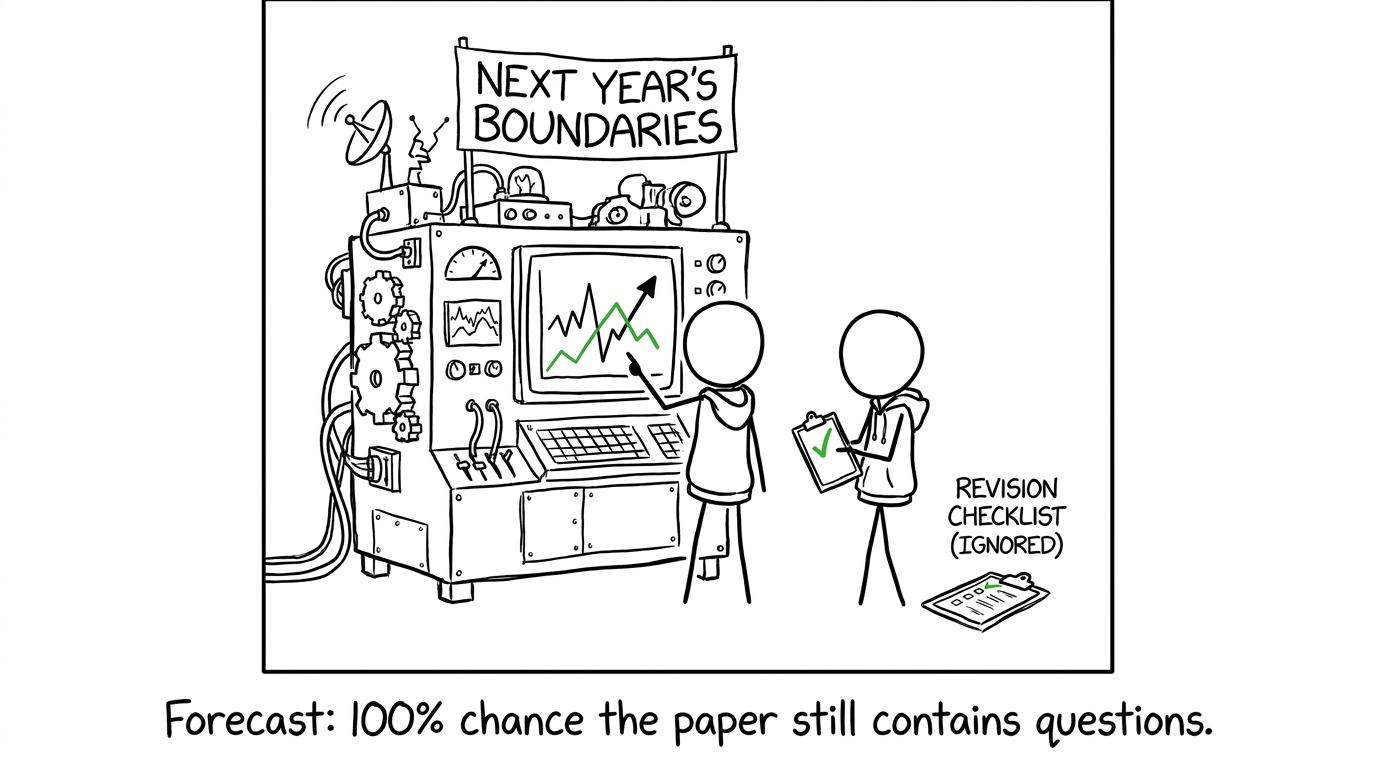 Students attempt to forecast boundaries while ignoring the certainty of exam questions
How to use previous boundaries sensibly
Past boundaries are useful when they are treated as a range rather than a promise. They can help you interpret practice-paper performance and decide whether you are operating near your target grade.
However, aiming for the exact previous threshold is fragile. If your target grade previously required 115115115 marks, building a revision plan around scoring exactly 115115115 leaves no protection against a higher boundary, an awkward question or an avoidable error.
A safer approach is to build a margin above recent boundaries. The appropriate margin depends on your current performance and target, but the principle is universal: revise to improve your mark rather than trying to predict the minimum acceptable mark.
For maths students, this means using GCSE past-paper revision guidance to develop a repeatable cycle:
- complete a paper under the correct conditions;
- mark it accurately;
- identify where marks were lost;
- return to the relevant revision lesson;
- complete focused practice questions;
- retest the topic later.
MathsGenie's Edexcel predicted papers can add fresh exam-style practice, but predicted papers should supplement official past papers rather than replace them.
What Chemistry boundaries teach maths students
Although the figures here concern Chemistry, the lesson is directly relevant when preparing for GCSE maths examinations with Edexcel, AQA, OCR or Eduqas.
Raw boundaries move. Your preparation should not.
You cannot control how demanding the national cohort finds a paper. You can control whether you show working, check calculations, practise weak topics and learn from mark schemes. MathsGenie's Edexcel maths grade boundary history shows the same broad principle: historical thresholds provide context, not certainty.
A boundary is an administrative line drawn after the examination. Revision is the process that moves your mark away from that line.
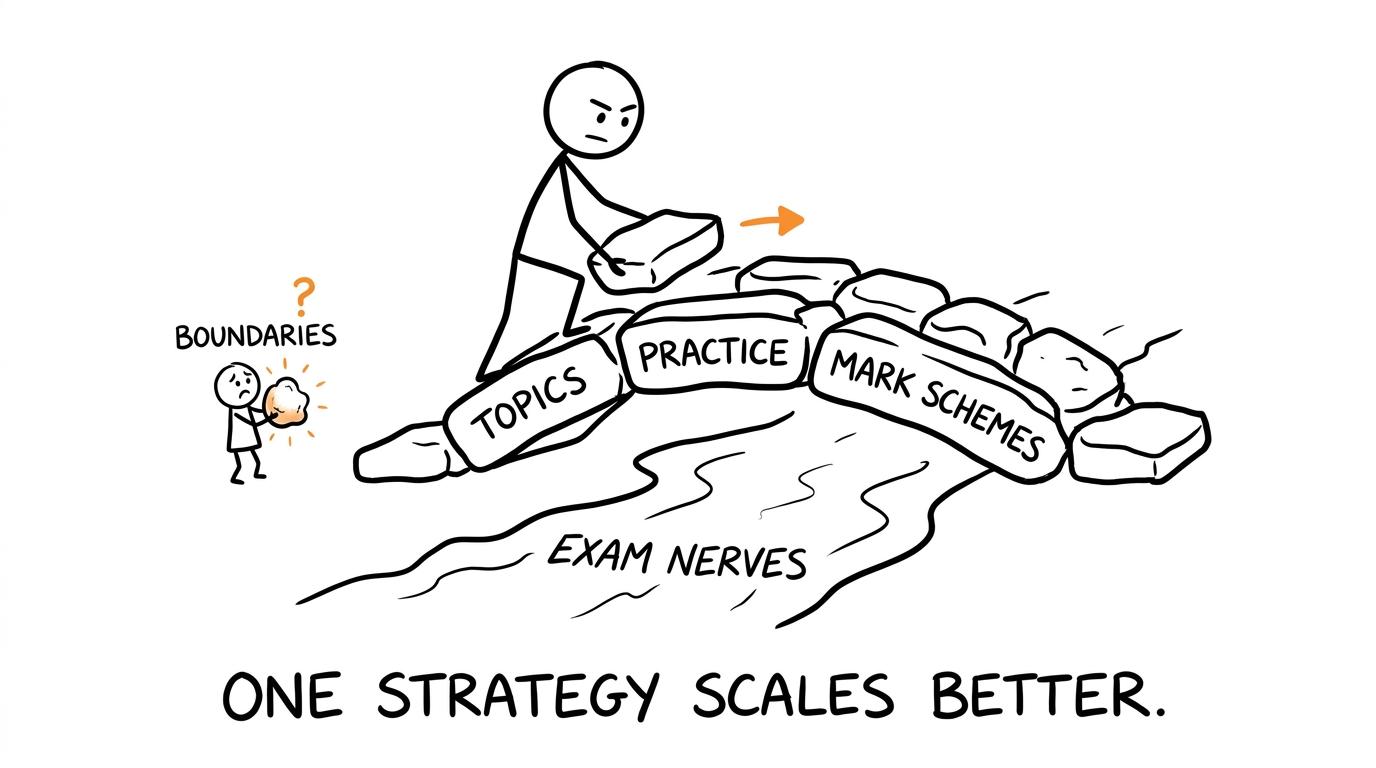 A revision bridge proves more useful than a grade-boundary crystal ball
Common mistakes when interpreting boundaries
Assuming lower boundaries mean easier grading
A lower raw boundary often indicates that the papers were more demanding. The standard associated with the grade is intended to remain comparable.
Comparing different exam boards by raw mark alone
Specifications, paper structures and maximum marks can differ. Even when totals match, the assessments are not identical. Compare changes within the same board and specification first.
Using the wrong qualification
Separate Chemistry and Combined Science are different qualifications with different papers and boundaries. Check the specification code as well as the subject name.
Treating one paper as a complete grade
Notional component boundaries do not replace the overall subject boundary. Add the marks from all required papers before interpreting the result.
Predicting next year's boundary from a trend
A rise in two consecutive series does not guarantee another rise. Boundaries respond to the evidence from each new assessment, not to a fixed upward or downward pattern.
Revising only to scrape an old threshold
An old boundary can move, and practice-paper marks naturally fluctuate. Build a cushion through knowledge, accuracy and exam technique.
Focus on marks you can control
GCSE Chemistry grade boundaries do change from one year to the next. Recent AQA figures include several small movements, while Edexcel provides clear examples of larger changes. Neither pattern allows next year's boundary to be predicted reliably.
The calm response is not to ignore boundaries, but to put them in their proper place. Use them to understand past results and estimate a sensible performance range. Do not let them become the centre of your revision plan.
For maths preparation, start at MathsGenie's free GCSE and A Level revision hub. Use revision lessons and practice questions to repair weak topics, mini tests to check progress, and past papers, predicted papers, mark schemes and video solutions to turn that knowledge into secure exam marks. The boundary will be decided later. The work that places you safely above it can begin now.