

GCSE Chemistry Grade Boundaries History: 2018-2025
GCSE Chemistry grade boundaries history from 2018 to 2025, with AQA and Edexcel trends, year-by-year tables and practical revision advice.
A past-paper score can feel wonderfully precise. Then you open another year's grade boundaries and discover that the same mark produces a different grade. It is unsettling, but it is not a mistake.
This GCSE Chemistry grade boundaries history shows that boundaries move because papers vary in difficulty and awarding maintains a consistent qualification standard. Recent AQA and Edexcel boundaries have shifted noticeably, particularly around the pandemic transition, but they do not reveal what your future boundary will be.
The useful answer is simple: use past boundaries as a range, not a promise.
What this comparison covers
This guide compares separate GCSE Chemistry qualifications with a maximum of 200200200 marks. It focuses on:
- AQA Chemistry 846284628462
- Edexcel Chemistry 1CH01CH01CH0
- summer exam series from 201820182018 to 202520252025
- key Higher tier boundaries for grades 999, 777 and 444
- the Foundation tier grade 555 boundary
You can explore the complete figures through MathsGenie's AQA GCSE Chemistry grade boundaries and Edexcel GCSE Chemistry grade boundaries.
Past GCSE Chemistry grade boundaries by year
A boundary is the minimum total raw mark needed for a grade across both papers. These figures were checked against published exam-board data.
| Year | AQA H grade 999 | AQA H grade 777 | AQA H grade 444 | AQA F grade 555 | Edexcel H grade 999 | Edexcel H grade 777 | Edexcel H grade 444 | Edexcel F grade 555 |
|---|---|---|---|---|---|---|---|---|
| 201820182018 | 150150150 | 112112112 | 525252 | 127127127 | 153153153 | 112112112 | 525252 | 108108108 |
| 201920192019 | 144144144 | 107107107 | 505050 | 133133133 | 160160160 | 124124124 | 555555 | 116116116 |
| 202020202020 | No summer exam | No summer exam | No summer exam | No summer exam | No summer exam | No summer exam | No summer exam | No summer exam |
| 202120212021 | No summer exam | No summer exam | No summer exam | No summer exam | No summer exam | No summer exam | No summer exam | No summer exam |
| 202220222022 | 144144144 | 103103103 | 363636 | 126126126 | 146146146 | 105105105 | 414141 | 110110110 |
| 202320232023 | 149149149 | 113113113 | 484848 | 126126126 | 159159159 | 125125125 | 545454 | 124124124 |
| 202420242024 | 149149149 | 112112112 | 464646 | 133133133 | 148148148 | 109109109 | 454545 | 119119119 |
| 202520252025 | 150150150 | 115115115 | 424242 | 132132132 | 161161161 | 128128128 | 626262 | 124124124 |
The table compares boundaries within each specification. An AQA mark should not be judged using an Edexcel boundary because the papers and awarding decisions are different.
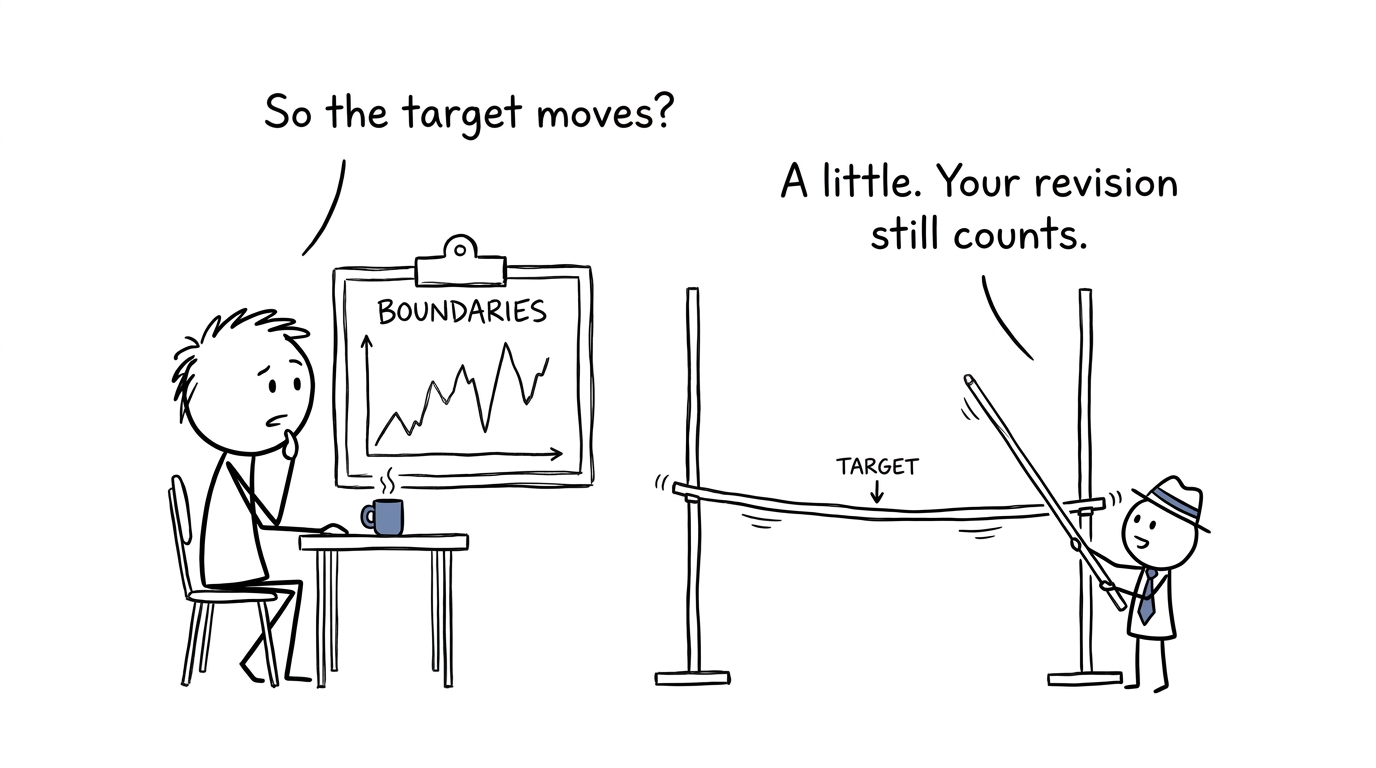 A student discovers that grade boundaries move while revision still counts
What the year-by-year changes mean
The pre-pandemic baseline: 201820182018 and 201920192019
The first two rows already show why one boundary cannot become a permanent target. AQA's Higher grade 999 boundary fell from 150150150 to 144144144, while Edexcel's rose from 153153153 to 160160160.
That does not prove that standards changed. Boundaries compensate for differences in paper demand. A more accessible paper will often require a higher raw mark for the same grade; a more demanding paper may require a lower mark.
Why 202020202020 and 202120212021 are missing
Summer GCSE exams did not take place as normal in 202020202020 or 202120212021. Grades were awarded through alternative arrangements, including teacher assessment. Some November examinations did take place, but their cohorts and circumstances were unusual.
For trend analysis, inserting November boundaries as though they were ordinary summer results would create a misleading comparison. This is why the table marks both years as having no summer exam.
The transition year: 202220222022
Summer exams returned in 202220222022, but Ofqual used transitional grading intended to sit between 201920192019 and 202120212021 outcomes. Students also received specific examination support.
This context helps explain unusually low boundaries in some places. AQA Higher grade 444, for example, was 363636 marks. Ofqual has advised schools not to rely on boundaries from pandemic-era and transitional series when estimating grades under normal arrangements.
The return towards normal grading: 202320232023 and 202420242024
In 202320232023, grading returned to pre-pandemic standards with protection for the cohort's disruption. Normal grading arrangements then continued in 202420242024.
Boundaries generally rose from their 202220222022 levels, but not in a neat straight line. Edexcel Higher grade 777 moved from 105105105 in 202220222022 to 125125125 in 202320232023, then fell to 109109109 in 202420242024. That movement reflects the particular papers and candidate evidence, not a dependable annual pattern.
The latest completed series: 202520252025
The 202520252025 figures reinforce the same lesson. AQA Higher grade 999 remained close to recent years at 150150150, while Edexcel rose to 161161161. Edexcel's Higher grade 444 also increased to 626262, compared with 454545 in 202420242024.
One sharp movement is not enough to predict the next series. It tells you what happened after that examination was marked, not what examiners have secretly planned for the future.
The clearest GCSE Chemistry grade boundary trends
Three conclusions survive careful analysis.
First, boundaries fluctuate. Across the years shown, there is no universal upward or downward path shared by both boards and every grade.
Second, lower boundaries do not automatically mean easier grading. They often indicate that students found the assessment more demanding.
Third, the safest revision target is above the historical boundary range. Aiming at the exact minimum leaves no protection against a harder boundary, a missed command word or a calculation error.
Use the GCSE grade boundaries hub to check your own board, tier and series. Edexcel students can also enter both paper marks into the GCSE Chemistry predicted grade calculator.
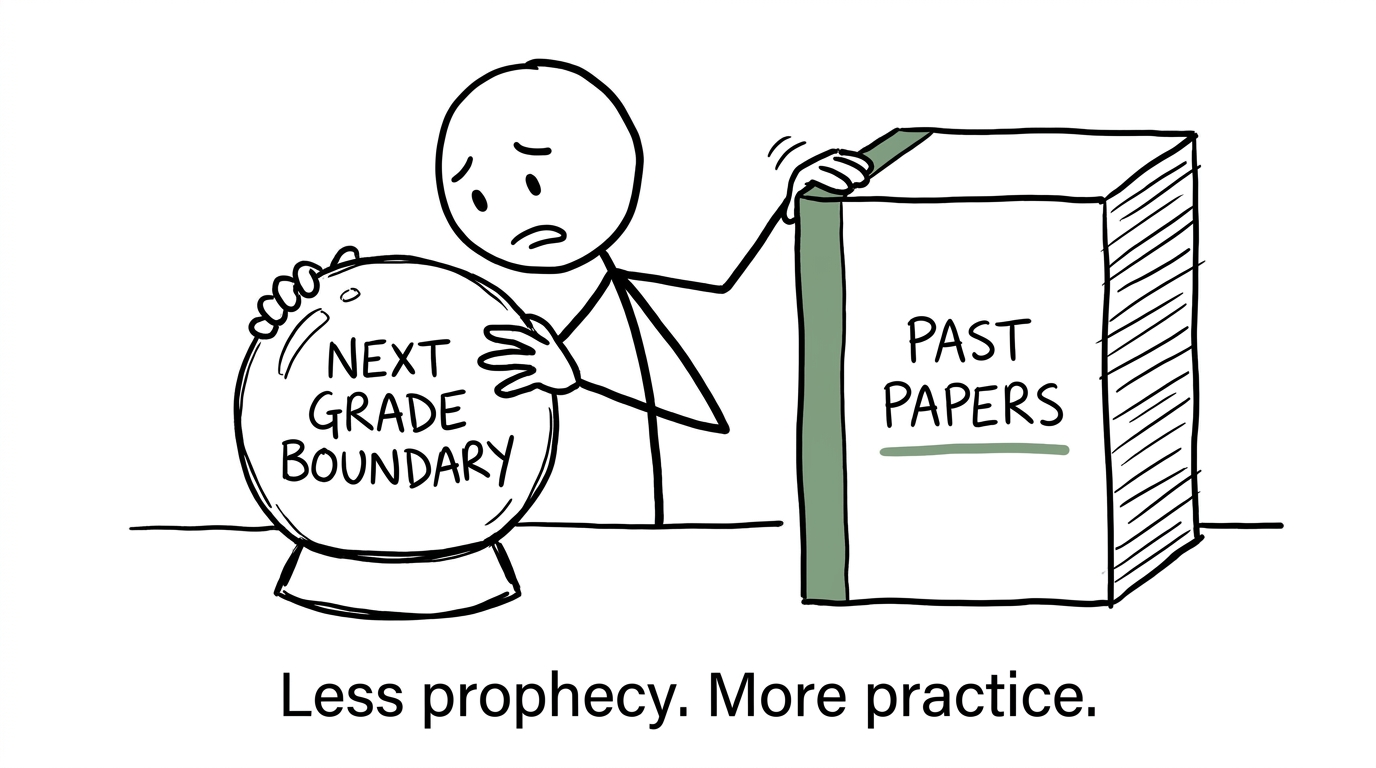 A crystal ball loses an argument with a useful stack of past papers
How to use boundaries without becoming distracted by them
Start with the correct specification and tier. Foundation and Higher boundaries are not interchangeable, even when they award an overlapping grade.
Next, complete a full paper under timed conditions and mark both knowledge and calculation questions strictly. The GCSE Chemistry revision hub brings together board-specific past papers, mark schemes, lessons, question banks and revision guides. Edexcel students can go directly to Edexcel GCSE Chemistry revision.
Record a range of possible grades using several normal exam years rather than treating one boundary as certain. Then focus on lost marks. Chemistry frequently tests ratios, graphs, percentages, standard form and rearranging formulae, so students preparing for maths exams can improve both subjects by fixing the underlying method.
For a repeatable routine, follow MathsGenie's guide to using GCSE past papers properly: sit the paper, mark it, classify errors, revise weak topics and retest.
Common mistakes when analysing grade boundaries
- Predicting the next boundary from the latest year: future boundaries are set after examiners review student performance.
- Mixing exam boards: AQA, Edexcel, OCR and Eduqas use different specifications and papers.
- Mixing tiers: always compare Foundation with Foundation and Higher with Higher.
- Treating 202020202020 and 202120212021 as normal summer series: summer examinations were cancelled.
- Using notional paper boundaries as final grades: GCSE Chemistry is linear, so the certificated grade comes from the combined qualification mark.
- Chasing a threshold instead of improving weaknesses: boundary analysis describes the past; targeted practice changes your result.
Turn the history into a better revision plan
Grade boundaries move because papers move. Your preparation should be steadier.
Choose the right board and tier from MathsGenie's free GCSE Chemistry past papers, complete a paper honestly, use its mark scheme and turn every lost mark into a revision task. Follow with topic practice, mini tests and predicted papers when you need fresh questions.
The goal is not to guess the boundary perfectly. It is to build enough knowledge, calculation accuracy and exam discipline that a few marks of movement no longer decide your grade.










