GCSE Maths Marks per Grade: 2025 Thresholds
GCSE maths marks per grade explained with 2025 raw mark thresholds for AQA, Edexcel, OCR and Eduqas, plus results-day guidance for 2026 students.
Results day can make one mark feel enormous. You see a grade, then immediately wonder what happened underneath it. The short answer is that GCSE maths marks per grade are not fixed. Exam boards set the final raw mark thresholds after the papers have been marked. For students awaiting 2026 results, the exact boundaries will therefore remain unknown until GCSE results day on Thursday 20 August 2026.
The latest summer figures currently available are from June 2025. They provide useful context, but they cannot predict the 2026 thresholds exactly.
GCSE maths grade thresholds at a glance
Before reading the table, check four things:
- your exam board: AQA, Edexcel, OCR or Eduqas
- whether you sat foundation or higher tier
- your total raw mark across every paper
- the correct exam series, such as June 2025
A grade boundary is the minimum raw mark required for that grade. Your overall total is usually found by adding your paper marks:
Total raw mark=Paper 1+Paper 2+Paper 3\text{Total raw mark}=\text{Paper 1}+\text{Paper 2}+\text{Paper 3}Total raw mark=Paper 1+Paper 2+Paper 3Eduqas uses two papers rather than three, while OCR has a maximum total of 300300300 marks. AQA, Edexcel and Eduqas have totals of 240240240 marks.
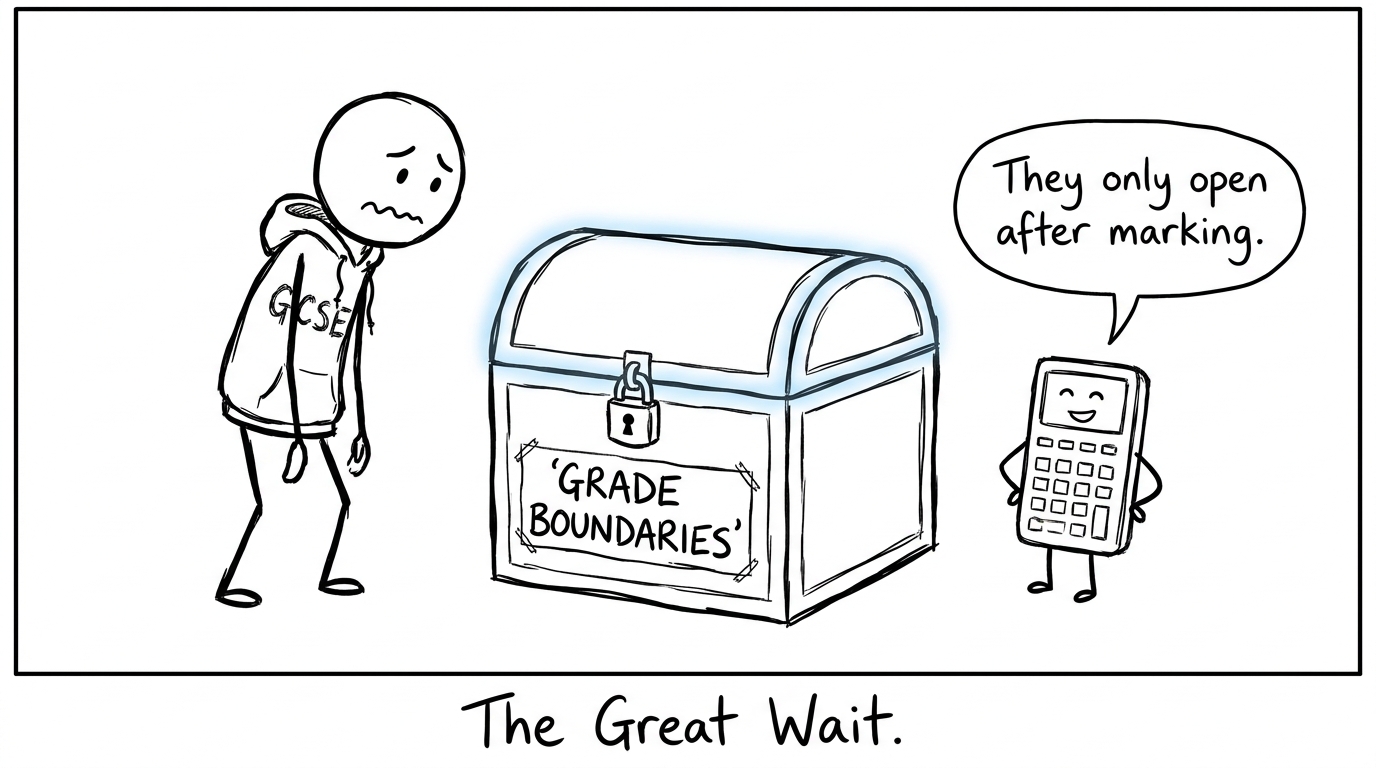 A student waiting for the mysterious grade-boundary chest to open
GCSE maths raw marks needed in 2025
These are the official June 2025 subject-level boundaries. A dash means that the grade was unavailable on that tier.
| Grade | AQA H | AQA F | Edexcel H | Edexcel F | OCR H | OCR F | Eduqas H | Eduqas F |
|---|---|---|---|---|---|---|---|---|
| 999 | 219219219 | N/A | 217217217 | N/A | 258258258 | N/A | 196196196 | N/A |
| 888 | 191191191 | N/A | 186186186 | N/A | 212212212 | N/A | 155155155 | N/A |
| 777 | 164164164 | N/A | 156156156 | N/A | 166166166 | N/A | 115115115 | N/A |
| 666 | 130130130 | N/A | 121121121 | N/A | 126126126 | N/A | 858585 | N/A |
| 555 | 969696 | 188188188 | 878787 | 175175175 | 868686 | 182182182 | 565656 | 141141141 |
| 444 | 636363 | 160160160 | 535353 | 144144144 | 474747 | 134134134 | 272727 | 111111111 |
| 333 | 464646 | 119119119 | 363636 | 105105105 | 272727 | 959595 | 121212 | 818181 |
| 222 | N/A | 797979 | N/A | 676767 | N/A | 565656 | N/A | 515151 |
| 111 | N/A | 393939 | N/A | 292929 | N/A | 171717 | N/A | 212121 |
You can explore previous exam series through the Maths Genie GCSE grade boundaries hub. There are also dedicated pages for AQA GCSE grade boundaries, OCR GCSE Maths boundaries and Eduqas GCSE Maths grade boundaries.
Why the marks differ between boards and years
Raw marks cannot be compared directly across exam boards. OCR Maths is marked out of 300300300, while the other qualifications in this table are marked out of 240240240. The papers also contain different questions and may vary slightly in difficulty.
Boundaries are set after marking is nearly complete. Exam boards examine statistical evidence and review work around proposed thresholds so that the standard represented by a grade remains comparable. A harder paper may lead to lower boundaries; an easier paper may produce higher ones.
This is why last year's GCSE maths grade thresholds are evidence, not promises. There is no reliable fixed percentage that always earns a particular grade.
Foundation and higher tier limits
Foundation tier offers grades 111 to 555. Higher tier principally covers grades 444 to 999, with a grade 333 safety net available when a student falls narrowly below grade 444. A result below the grade 333 higher boundary is ungraded.
Grade 444 is commonly described as a standard pass, while grade 555 is called a strong pass in school performance measures. Your sixth form, college or employer may set its own entry requirement.
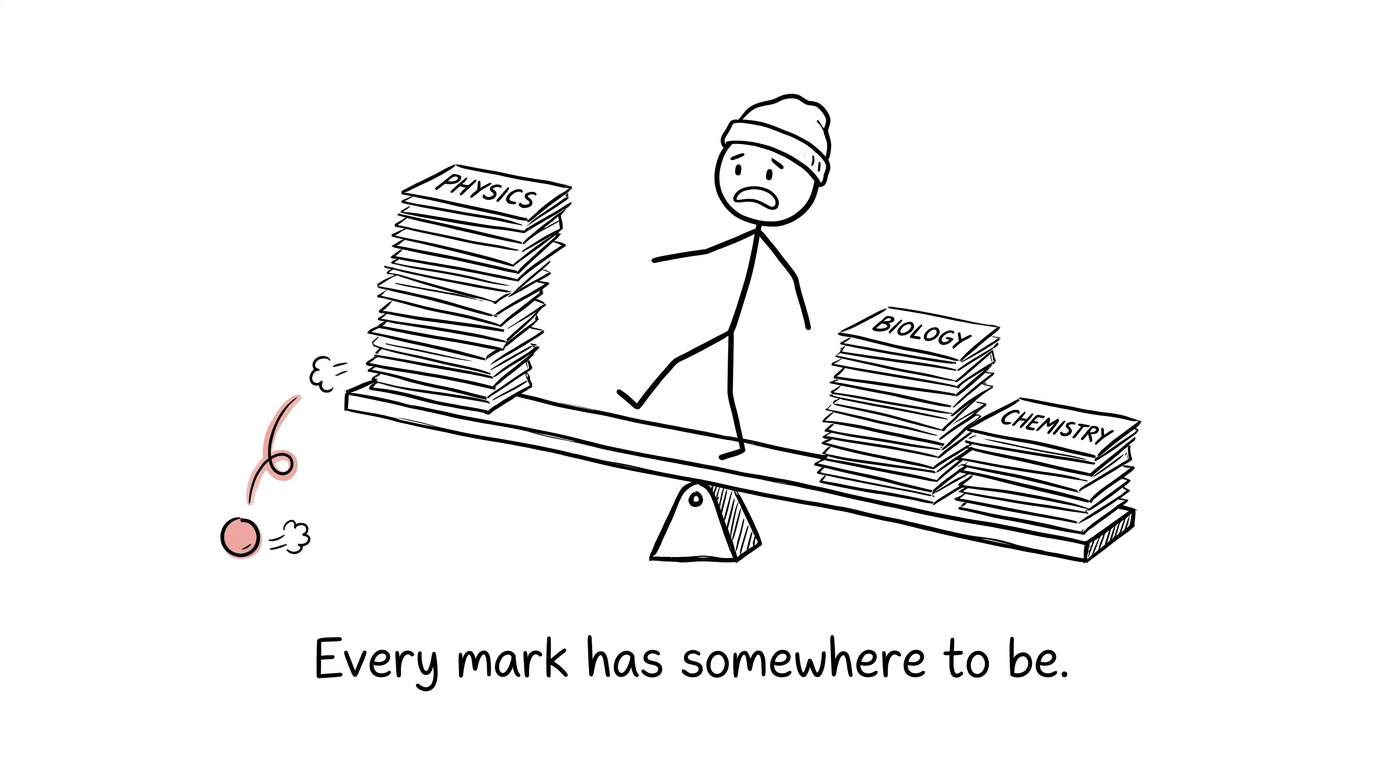 Three exam papers balancing while one mark escapes
How to use boundaries during revision
Do not revise only to the previous boundary. Give yourself room for normal variation between papers and exam series.
Complete papers under timed conditions, add the marks across the full qualification and compare like with like. The GCSE Maths revision hub lets you choose the correct board, while Edexcel GCSE Maths past papers and AQA GCSE Maths past papers include mark schemes and solutions.
Once you identify where marks disappear, return to MathsGenie's revision lessons, practice questions and mini tests. Predicted papers can add fresh exam-style practice, but they cannot reveal future grade boundaries.
Common mistakes when checking your grade
- Using one paper's mark: the official qualification boundary normally applies to the combined total.
- Checking the wrong tier: foundation and higher thresholds are separate.
- Comparing percentages across boards: different maximum marks and papers make this misleading.
- Treating 2025 figures as 2026 boundaries: final thresholds are not known before marking.
- Using notional paper boundaries as final grades: component boundaries are guidance; the overall qualification total determines the result.
Turn the number into a revision plan
A boundary tells you where a grade began in one exam series. It does not tell you which topic should receive your next half-hour. That comes from marking your work honestly.
Start with the Maths Genie guide to Edexcel grade boundaries, then complete a paper, check the mark scheme and list the topics costing you marks. Use MathsGenie's free revision lessons, practice questions, video solutions, mini tests, past papers and predicted papers to repair those gaps. Results day gives you the final number. Good revision gives you the best chance of moving it.