GCSE Chemistry AQA Grade Boundaries: Results Day
GCSE chemistry AQA grade boundaries explained with confirmed marks, tier differences, percentages and a calm checklist for GCSE results day.
Results day can make one number feel larger than it is. You open the envelope, find your Chemistry grade and immediately wonder how close you were to the next one. The short answer is that GCSE Chemistry AQA grade boundaries are the minimum total marks required for each grade. They change between exam series and are confirmed only after the papers have been marked.
For summer 2026, GCSE results day is Thursday 20 August. AQA says its grade boundaries are published at eight in the morning on results day. Until then, the June 2025 boundaries are the latest confirmed guide, not a prediction of what the 2026 boundaries will be.
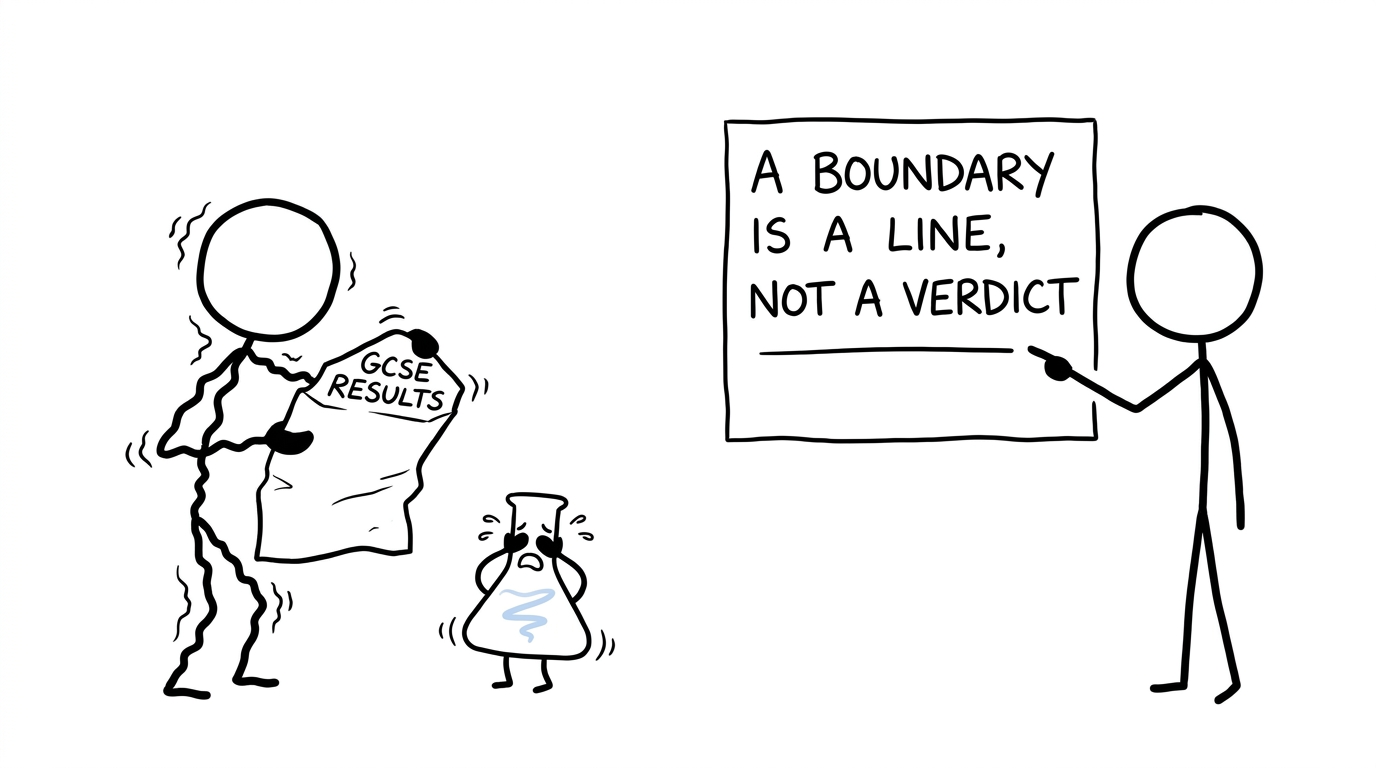 A nervous student and laboratory flask discover that a grade boundary is a line, not a verdict
GCSE Chemistry results day checklist
Before comparing marks, check these details:
- Confirm that your qualification is AQA GCSE Chemistry 8462, rather than AQA Combined Science.
- Check whether you sat foundation or higher tier.
- Use your total raw mark across both Chemistry papers.
- Compare it with the boundary table for the correct exam series.
- Ask your school or exams officer for your raw mark if it is not shown.
- Speak to your school before making decisions about a review of marking.
This distinction matters. Separate Chemistry gives one grade, while Combined Science produces a pair of grades using boundaries across the full Combined Science qualification. Students taking Combined Science should use the AQA GCSE Combined Science revision and results resources, not the separate Chemistry table below.
Latest confirmed AQA Chemistry grade boundaries
AQA GCSE Chemistry 8462 has two papers. Each is worth 100100100 marks, so the qualification total is:
100+100=200 100+100=200 100+100=200The table shows the official subject boundaries for the June 2025 series. A boundary is inclusive: the figure shown is the minimum total raw mark needed for that grade.
| Tier | Grade | Minimum mark | Percentage of 200200200 |
|---|---|---|---|
| Higher | 999 | 150150150 | 75%75\%75% |
| Higher | 888 | 132132132 | 66%66\%66% |
| Higher | 777 | 115115115 | 57.5%57.5\%57.5% |
| Higher | 666 | 909090 | 45%45\%45% |
| Higher | 555 | 666666 | 33%33\%33% |
| Higher | 444 | 424242 | 21%21\%21% |
| Higher | 333 | 303030 | 15%15\%15% |
| Foundation | 555 | 132132132 | 66%66\%66% |
| Foundation | 444 | 109109109 | 54.5%54.5\%54.5% |
| Foundation | 333 | 808080 | 40%40\%40% |
| Foundation | 222 | 525252 | 26%26\%26% |
| Foundation | 111 | 242424 | 12%12\%12% |
Foundation tier awards grades 111 to 555. Higher tier provides access to grades 444 to 999, with grade 333 available in the published boundary table. A dash in AQA's official table means that grade is not available through that tier.
The percentage is useful for interpreting the table, but AQA awards the grade from the raw-mark boundary, not from a separately rounded percentage. You can explore the examinable content through the free AQA GCSE Chemistry revision guides.
Why AQA chemistry grade boundaries change
Grade boundaries are not fixed before the exam. Once marking is complete, senior examiners and assessment experts consider statistical evidence, the difficulty of the papers and samples of students' work. The aim is to maintain a comparable standard when one year's paper proves more or less demanding than another.
That is why last year's table is useful for reviewing a past paper but unreliable as a promise about a future grade. A score near a previous boundary should be treated as a revision signal, not a guaranteed result.
This also explains why boundaries that look surprisingly low do not mean the qualification was easy. GCSE Chemistry tests recall, application, practical understanding and mathematical skills across two substantial papers. The mark is evidence collected across the whole assessment.
How to read your Chemistry result
Your results slip may show the final grade without showing your raw marks. If you want to understand how the result relates to the boundary, ask your teacher or exams officer for your total mark.
Use the overall subject boundary, not an individual paper boundary. AQA may publish notional component boundaries for Paper 111 and Paper 222, but these are illustrative. Your qualification grade is based on the combined total across both papers.
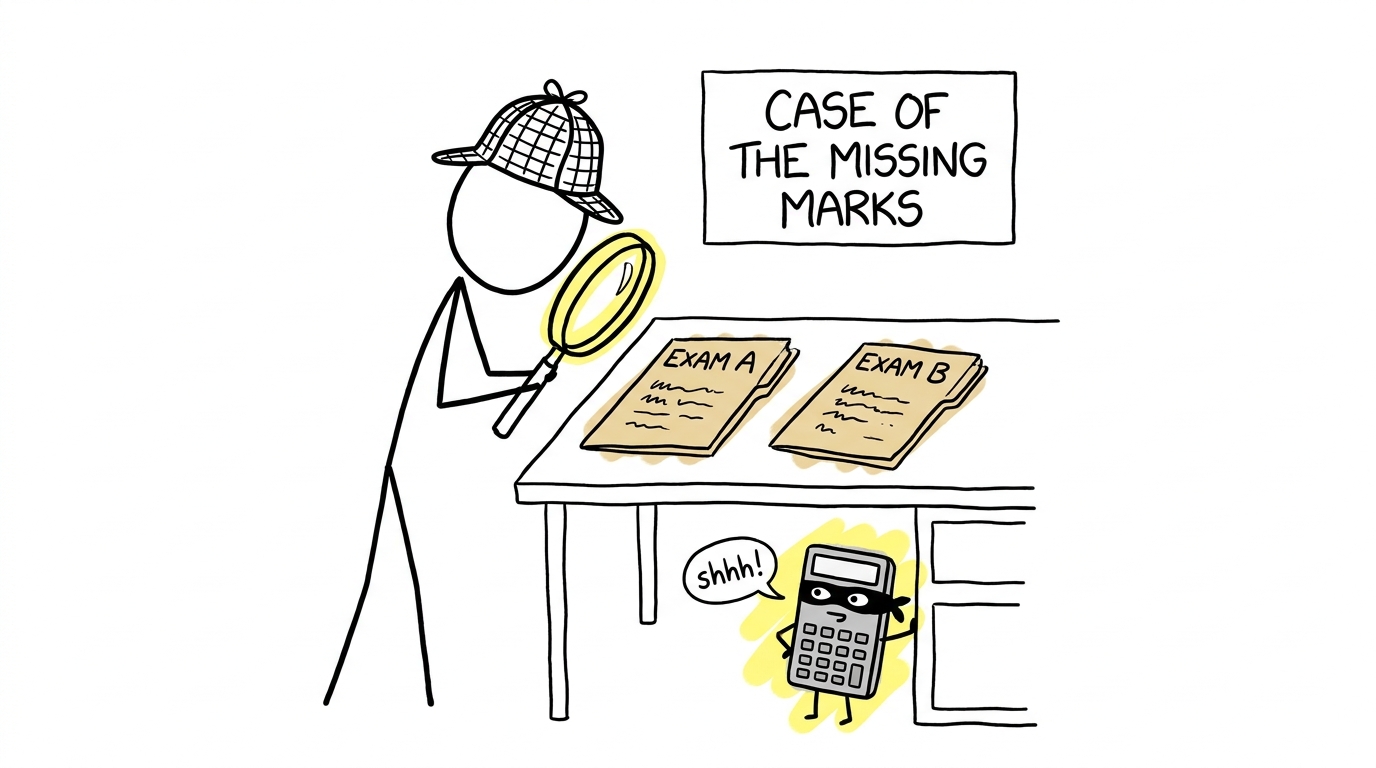 A student detective investigates two exam papers in the case of the missing marks
If your total is close to the next boundary, talk to your school. Staff can explain the available post-results services and whether reviewing the marking is sensible. A review is not an automatic extra mark, and an outcome can remain unchanged or move in either direction.
Turning the boundary into a revision target
Before results day, boundaries are most valuable when used carefully. Complete an entire paper set, mark it honestly and compare the total only with the boundary from that same year. The AQA GCSE Combined Science past papers are available for Combined Science students, while separate Chemistry students can use the topic-specific guides to identify gaps.
Do not revise only until you touch a historic boundary. Build a margin for unfamiliar questions, strict mark-scheme wording and ordinary exam pressure. Then classify lost marks as knowledge, application, practical method or calculation errors. The guide to improving GCSE Chemistry when you are stuck at a pass explains how to turn those errors into focused practice.
Chemistry calculations often depend on proportion, graphs, standard form, rearranging formulae and unit conversion. If those marks are slipping away, use the AQA GCSE Maths revision guides alongside Chemistry practice.
Common mistakes with GCSE Chemistry boundaries
Using Combined Science boundaries
Separate Chemistry 8462 and Combined Science are different qualifications. Their totals, grading systems and boundaries cannot be exchanged.
Looking at one paper in isolation
The final grade uses the combined mark from Paper 111 and Paper 222. Notional paper boundaries do not determine the qualification grade.
Treating 2025 boundaries as 2026 predictions
The latest table offers context, but the next boundaries cannot be confirmed until marking and awarding are complete.
Comparing percentages without checking the tier
The same percentage can lead to different outcomes on foundation and higher tier. Always identify the tier first.
Your next step with MathsGenie
A boundary tells you where one grade ended in one exam series. It cannot describe every strong answer you wrote, nor can it decide what you do next.
Start with the MathsGenie AQA Chemistry revision guides, then combine revision lessons with practice questions, past papers, mark schemes and mini tests. Use predicted papers for rehearsal rather than certainty, and strengthen calculation skills through MathsGenie's free GCSE and A Level revision resources. Results day gives you a number. Thoughtful practice gives you a direction.