GCSE Maths Grade Boundaries: Results Day 2026
GCSE maths grade boundaries explained for results day 2026. Learn how marks become grades, how tiers work and what to do if your result is close.
Opening a results envelope can make two years of work feel strangely small. One line says Mathematics. Beside it sits a grade. What you cannot immediately see is the process that turned your marks into that number.
The essential answer is simple: GCSE maths grade boundaries are the minimum total marks needed for each grade in a particular exam series. They are set after papers have been marked, so the official maths grade boundaries 2026 cannot be confirmed in advance. GCSE results day 2026 is Thursday 20 August, with results available to candidates from 8.00am, although your school or college decides its collection arrangements.
 A calculator guarding GCSE grade-boundary rumours
Your GCSE maths results day checklist
Before examining individual marks, establish four facts:
- your exam board: Edexcel, AQA, OCR or Eduqas
- whether you entered foundation or higher tier
- your overall maths mark, if it appears on your results information
- the official boundary document for the correct series and specification
You can compare previous and current figures through the Maths Genie grade boundaries centre. Do not use another board's table or assume a boundary quoted on social media applies to your paper.
How GCSE maths grade boundaries work
A grade boundary is not a target chosen before the examination. Exam boards set boundaries after marking, using statistical evidence and expert judgement to maintain comparable standards between years.
If a paper proves harder than expected, boundaries may be lower. If it proves easier, they may be higher. This does not mean exam boards decide that a fixed number of students must fail. Ofqual confirms that there are no quotas or caps for individual grades.
The principle is fairness. A slightly more difficult paper should not make the same standard of mathematical performance worth less.
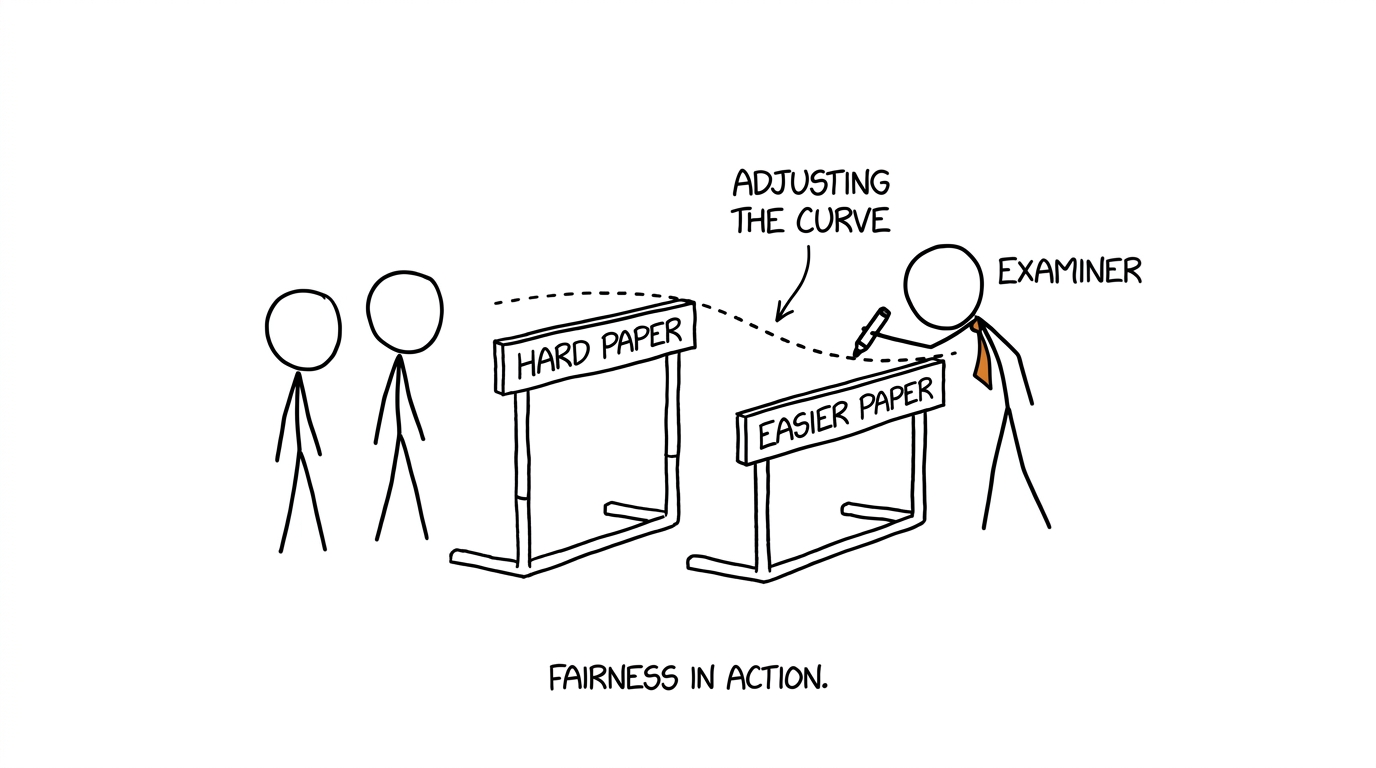 An examiner adjusting hurdles for papers of different difficulty
Your marks are normally combined
GCSE Maths is a linear qualification. Your paper marks are added to produce one overall subject mark, and that total is compared with the qualification-level boundaries.
For example, Edexcel and AQA GCSE Maths each have three papers worth 808080 marks, producing a total of:
80+80+80=24080+80+80=24080+80+80=240OCR uses a different maximum total, so raw marks cannot be compared directly between boards. Use the correct table for your specification. Pearson and other boards may publish notional boundaries for individual papers, but these are illustrative. Your final grade comes from the combined qualification total.
Students following Edexcel can explore the dedicated Edexcel GCSE Maths revision hub, while the AQA GCSE Maths revision hub keeps board-specific resources together.
Foundation and higher tier boundaries
Foundation tier offers grades 111 to 555. Higher tier offers grades 444 to 999, with a narrow grade 333 safety net for candidates who fall just below grade 444. A higher-tier mark below that safety-net boundary receives an unclassified result.
A grade 444 or 555 has the same value whether it was earned on foundation or higher tier. The tier changes the available questions and grade range, not the value of the final grade.
Grade 444 is commonly described as a standard pass and grade 555 as a strong pass. However, sixth forms, colleges, apprenticeships and individual courses may set their own entry requirements.
Worked grade-boundary example
Suppose a higher-tier student receives these hypothetical paper marks:
50+52+55=15750+52+55=15750+52+55=157Imagine that the official subject boundaries for that series were:
- grade 777: 158158158 marks
- grade 666: 124124124 marks
With 157157157 marks, the student would receive grade 666. They are one mark below grade 777, but marks are not rounded up simply because the result is close. A boundary is the minimum mark required.
This is only an illustration, not a prediction of the 2026 boundaries. The real figures must come from the student's exam board on results day.
Why previous boundaries cannot predict 2026 exactly
Past boundaries provide context, not certainty. They can show the range seen in earlier series, but each year's papers and student evidence are considered separately.
That is why a claim such as “grade 777 will definitely be this mark” should be treated cautiously before 20 August. Even a well-informed estimate remains unofficial.
Maths Genie provides board-specific historical information, including OCR GCSE Maths grade boundaries and Eduqas GCSE Maths grade boundaries. Make sure you select the correct year, series and tier.
What to do when you receive your result
First, check the grade against any course or sixth-form condition. If you have met it, follow the enrolment instructions rather than worrying about how far you were from the next boundary.
If the result is unexpected, ask your teacher or exams officer for your component marks and discuss whether accessing the script would be useful. A review of marking checks for marking errors; it does not award extra marks merely because you were close to a boundary. If an error is found, a mark and grade can rise or fall, so understand the possible outcome before giving consent.
Act promptly because schools and exam boards have post-results deadlines.
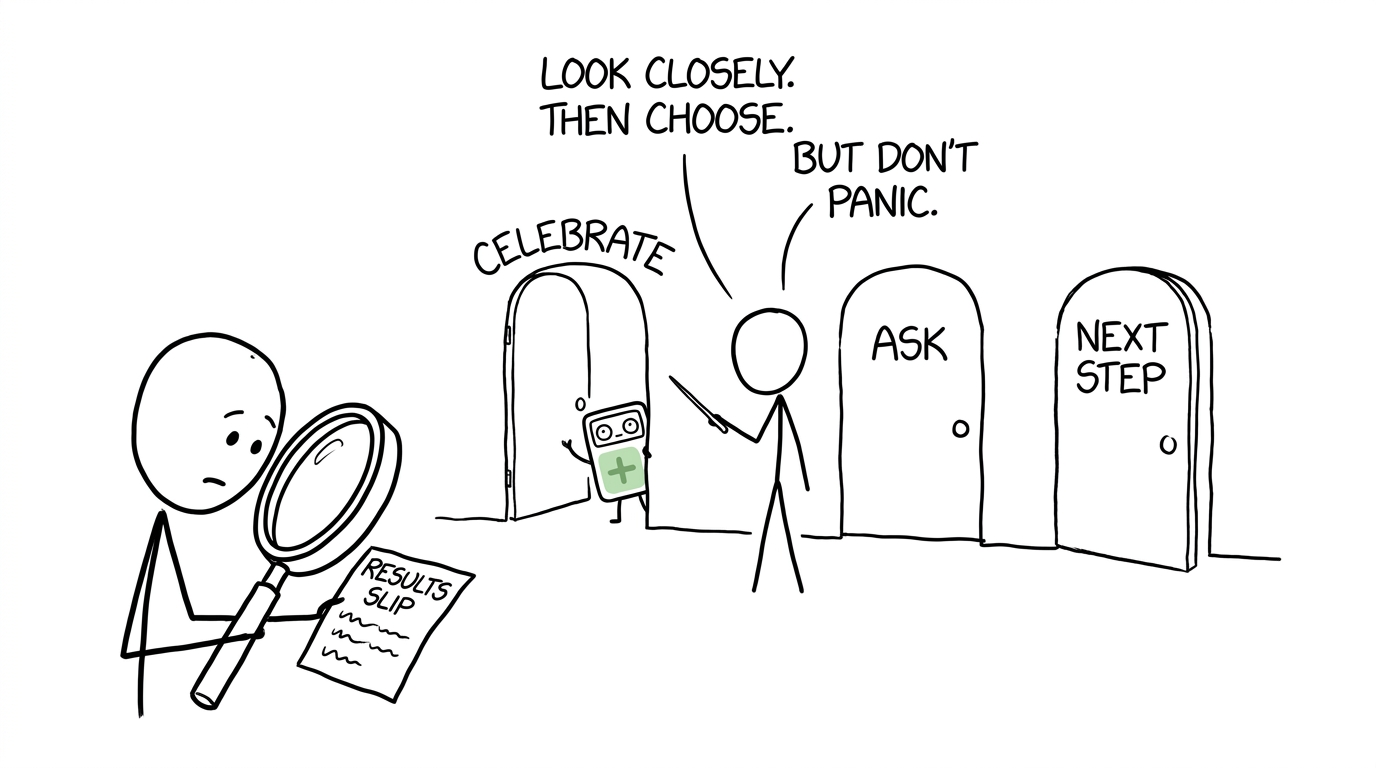 A student choosing a calm next step after reading a results slip
Common mistakes with maths grade boundaries
Looking at a boundary for one paper
Your final grade normally depends on the combined subject mark, not a separate grade on each paper.
Using the wrong tier or exam board
An OCR higher-tier boundary cannot interpret an Edexcel foundation result. Check the specification code and tier carefully.
Treating a predicted boundary as official
The official 2026 figures are confirmed only after marking and awarding. Before results day, predictions are estimates.
Assuming one missing mark guarantees a review
Closeness alone is not evidence of a marking error. Ask your school to examine the available information before requesting a review.
Your result is information, not an identity
A boundary can change the label attached to a mark, but it does not erase the knowledge built while preparing. Once you understand your result, take the next useful step.
If you are continuing with maths, resitting or strengthening your foundations for A Level, begin with the free GCSE Maths revision guides. Then use Edexcel GCSE Maths past papers, OCR GCSE Maths past papers or your board's equivalent resources. Maths Genie brings revision lessons, practice questions, mini tests, predicted papers, mark schemes and video solutions together so that your next result is built one mark at a time.