

GCSE Business Busy Schedule: A Survival Guide
GCSE business busy schedule? Build a realistic plan for Business and maths with short revision blocks, active recall and exam practice that fits real life.

Some evenings seem to disappear before they begin. Training finishes late. A job shift runs over. Maths homework is waiting, another subject has a test tomorrow, and GCSE Business is quietly sliding towards the bottom of the list.
If you are trying to manage a GCSE business busy schedule, the answer is not to force another two-hour session into an evening that is already full. Build a smaller system: identify what matters, revise actively for short periods and return to weak areas regularly. Even 151515 focused minutes can be useful when they contain retrieval, an exam question and immediate feedback.
This guide will help you keep Business moving while protecting time for GCSE maths, sport, work and sleep.
Your survival checklist
When time is limited, use these rules:
- Check your Business exam board and specification before choosing topics.
- Protect three or four short revision slots each week.
- Recall information before opening your notes.
- Practise application, analysis and evaluation as well as definitions.
- Keep Business calculations and GCSE maths skills connected.
- Mark questions immediately and record the reason for lost marks.
- Use longer sessions for timed questions, not rewriting notes.
- Preserve sleep and recovery rather than relying on late-night cramming.
The aim is not to create the perfect timetable. It is to create one you can still follow on a difficult Wednesday.
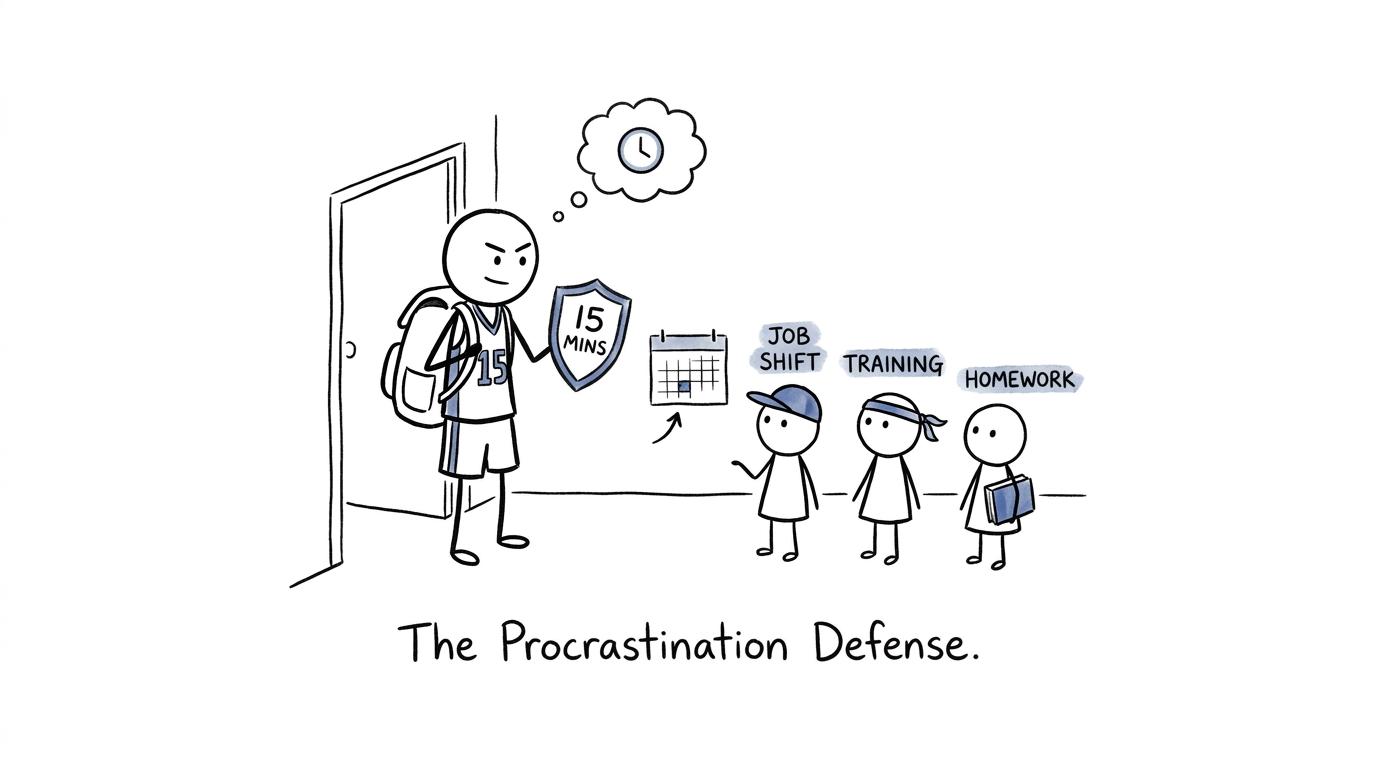 A busy student defending a small revision slot from a queue of commitments
Stop planning around imaginary free time
A common revision plan begins with hope: perhaps tomorrow will be quieter. Usually, tomorrow arrives carrying its own problems.
Instead, map the week you actually have. Add lessons, travel, training, fixtures, shifts, homework and regular commitments first. Revision belongs in the remaining spaces, not on top of everything else.
A realistic week might use this pattern:
| Available time | Best use |
|---|---|
| 101010 minutes before school | Retrieve definitions or business formulae from memory |
| 151515 minutes after dinner | Answer one short contextual question and check it |
| 202020 minutes while travelling | Review flashcards or plan an extended response |
| 303030 minutes on a free evening | Revise one weak topic and complete exam questions |
| 454545 minutes at the weekend | Complete and mark a timed section |
Treat these as appointments. Decide the topic in advance so that the first five minutes are not lost choosing what to do.
For maths, the same principle is explained in MathsGenie's 20-minute GCSE maths revision routine. A short session works because its purpose is narrow, not because the clock possesses special powers.
Prioritise marks, not chapters
When students feel behind, they often begin at the first page of the textbook. That feels orderly, but it assumes every topic deserves equal time and every weakness sits in chapter order.
Your Business revision should begin with evidence. Check a recent assessment, homework task or exam-style question set. Sort lost marks into four broad categories:
- Knowledge: you did not know a term, formula or concept.
- Application: you knew the idea but did not connect it to the business context.
- Analysis: you stated an effect without developing the chain of reasoning.
- Evaluation: you gave a judgement without weighing evidence or conditions.
Knowledge, application, analysis and evaluation are central demands across GCSE Business, although exam boards organise papers and label assessment objectives differently. Paper structures also vary between Edexcel, AQA, OCR and Eduqas, so use the specification and guidance supplied for your exact course.
Create a list of no more than five priorities. “Marketing” is too wide. “Applying market segmentation to the case study” is useful. “Finance” is vague. “Interpreting cash-flow information” gives you a task you can practise.
Use the same diagnostic thinking in maths. The MathsGenie guide to finding weak GCSE topics shows how lost marks can become a focused revision list rather than a reason to panic.
Use a repeatable short-session method
A busy timetable creates decision fatigue. A fixed routine removes it.
Recall
Close your notes and spend a few minutes writing what you remember about one narrow topic. You might retrieve a definition, list advantages and disadvantages, sketch an argument structure or state relevant formulae.
Retrieval practice requires an active attempt to remember. Educational research supports repeated retrieval, especially when it is followed by feedback. It also reveals gaps that rereading can hide.
Apply
Complete one or two exam-style questions. Business is not only a memory test. You need to use knowledge in the setting described, whether the case concerns a small start-up, a growing employer or a larger organisation.
Use details from the context deliberately. A generic advantage may show knowledge; explaining why it matters to the particular business demonstrates application.
Check and fix
Use the mark scheme, teacher feedback or a model response. Record one specific correction:
- define the term more precisely;
- use evidence from the case;
- extend the consequence;
- consider a competing factor;
- support the final judgement.
Then revisit the same skill on another day. Spacing revision across several occasions is more useful for retention than meeting a topic once and assuming it is finished.
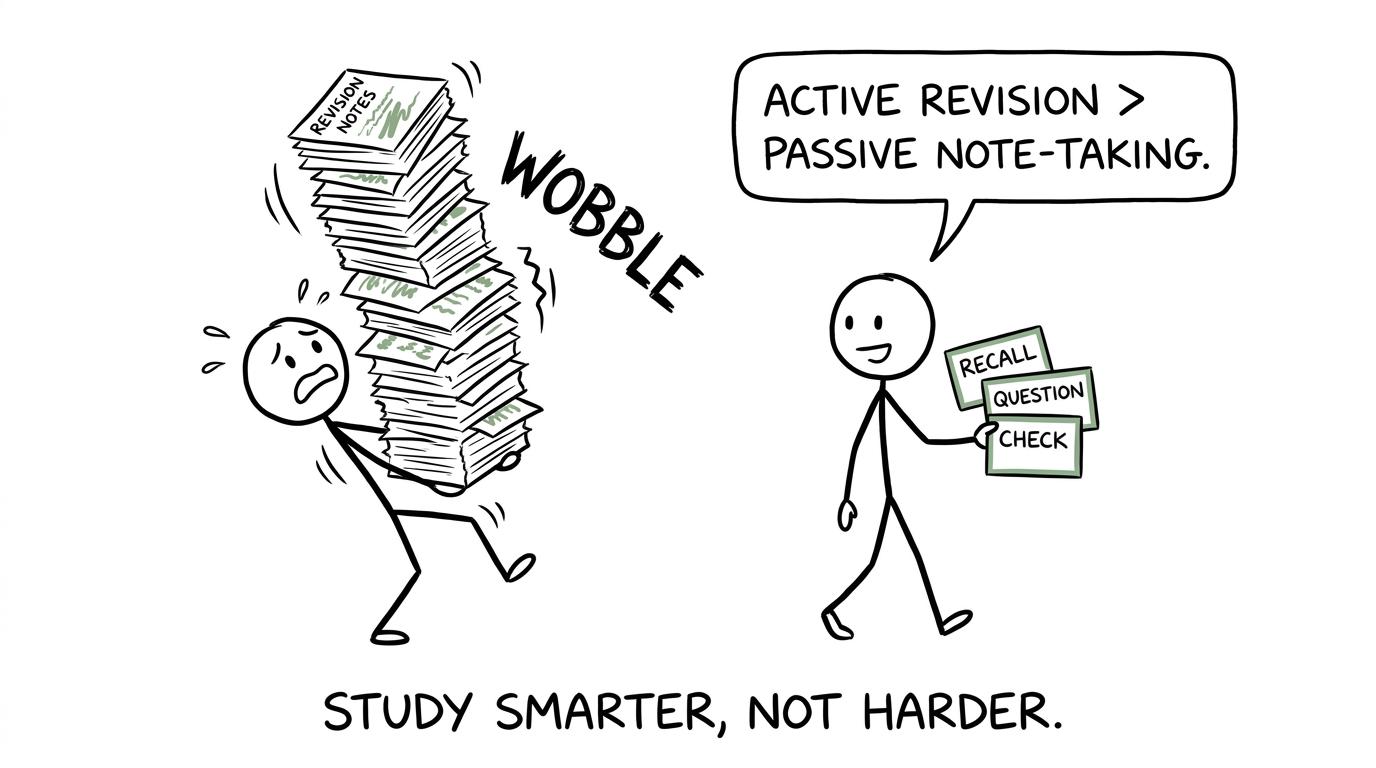 One student struggles with a tower of notes while another carries three active revision cards
Keep Business and maths connected
Business and maths do not need to compete for every minute. Some revision can strengthen both.
Depending on your specification, GCSE Business may ask you to calculate or interpret revenue, costs, profit, percentage change, averages, cash flow and break-even information. Core relationships include:
revenue=selling price×quantity sold\text{revenue} = \text{selling price} \times \text{quantity sold}revenue=selling price×quantity sold profit=revenue−total costs\text{profit} = \text{revenue} - \text{total costs}profit=revenue−total costs total costs=fixed costs+variable costs\text{total costs} = \text{fixed costs} + \text{variable costs}total costs=fixed costs+variable costs percentage change=changeoriginal amount×100\text{percentage change} = \frac{\text{change}}{\text{original amount}} \times 100percentage change=original amountchange×100Do not simply memorise a formula. Practise choosing the correct values, showing working, checking units and interpreting what the result means for the business.
If percentages or rearranging formulae slow you down, use the free GCSE maths revision hub to find a lesson and targeted practice questions. MathsGenie does not replace your Business specification, but it can remove the mathematical friction that costs time and marks in Business calculations.
When your maths exam also needs attention, use a shared error log. Label each problem as business knowledge, application, calculation, calculator use or interpretation. This prevents a percentage error from being mistaken for a misunderstanding of the business concept.
Build a timetable that survives disruption
A timetable should have three levels rather than one rigid plan.
The minimum session
On training or work nights, complete a 101010 to 151515 minute session. Retrieve one topic, answer one short question and check it. This keeps the subject active.
The standard session
When you have around 303030 minutes, use the full recall, apply and fix cycle. Stay with one priority rather than opening several topics.
The weekly anchor
Reserve one longer period for a timed Business question set or paper section. Mark it while your reasoning is still fresh. Use the results to choose the following week's short sessions.
For coordinating several subjects, adapt the structure in the GCSE maths revision timetable guide. Give each subject a minimum weekly commitment, then add extra time according to upcoming exams and current weaknesses.
If your week is disrupted, do not attempt to repay every missed minute. Move the most important unfinished task into the next available slot and continue. A revision plan should recover from disruption without becoming a source of more stress.
Protect sport, work and sleep sensibly
Sport is not automatically the enemy of revision. Physical activity can provide routine, recovery and relief from exam pressure. A part-time job may also be a genuine responsibility rather than an optional diary entry.
The useful question is not “What must I quit?” but “What can be adjusted temporarily?” Speak early to a coach, employer, teacher or family member if exam pressure is becoming unmanageable. You may be able to change a shift, reduce an optional commitment or protect a regular revision window.
Do not routinely fund revision by borrowing from sleep. NHS guidance says most teenagers need around 888 to 101010 hours of sleep, and it warns that all-night cramming is usually a poor strategy. Decide when revision stops, pack what you need for the next day and let the plan end.
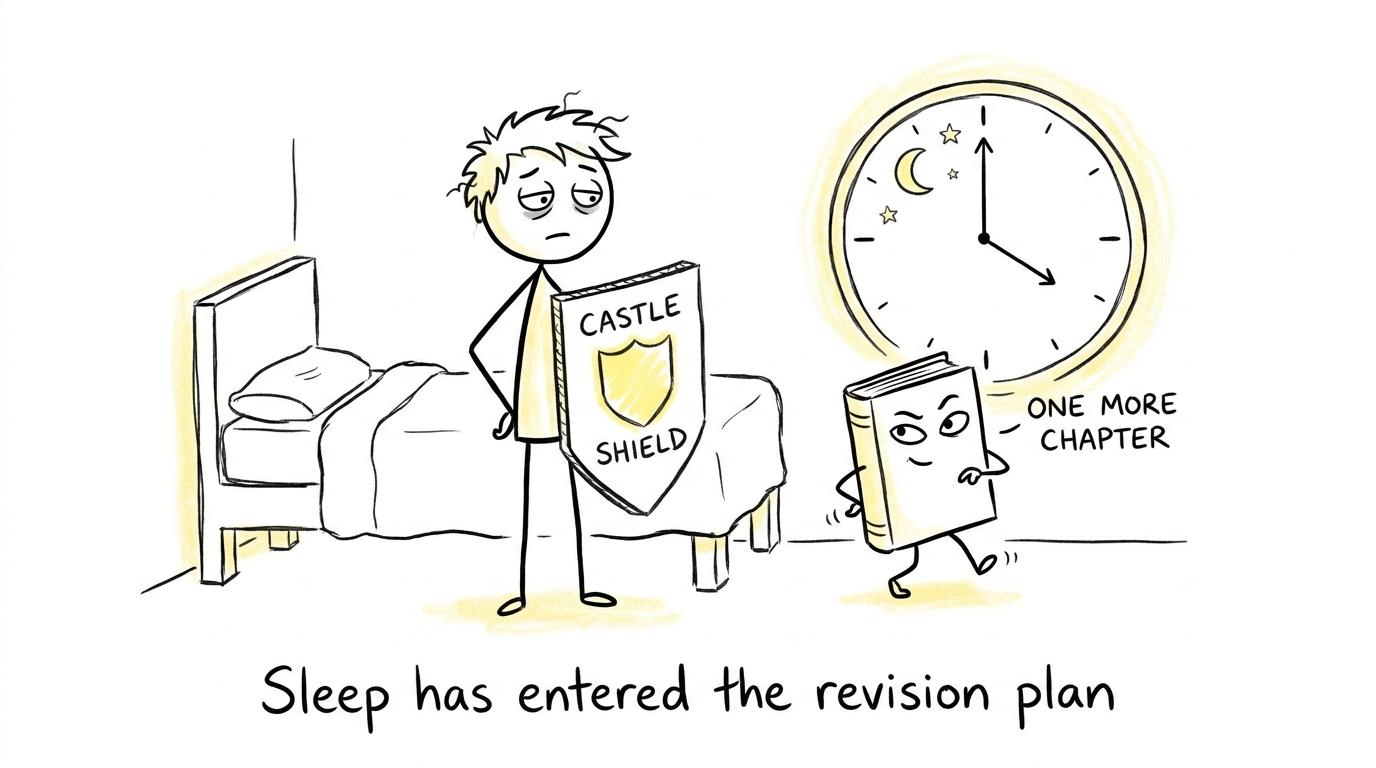 A student protects bedtime from a book demanding one more chapter
Close to the exam, use the calm priorities in MathsGenie's GCSE maths exam-week checklist: targeted practice, immediate marking, a short fix list and protected sleep.
Make longer sessions earn their place
A free weekend afternoon can disappear into note-making because notes feel productive and have no obvious finish line. Give longer sessions a measurable output instead.
Choose one of these:
- complete a timed section and mark it;
- plan several extended responses;
- compare your answers with a mark scheme;
- retest the five priorities on your weakness list;
- correct calculation errors and practise the underlying maths skill.
Past papers are most valuable when they produce feedback. Do not collect scores without investigating them. Ask which command words caused difficulty, where context was missed and whether your judgement followed from the evidence.
The same rule applies to maths papers. The one-month GCSE maths revision plan shows how to combine diagnosis, topic repair and timed papers rather than completing papers without a follow-up process. If only a week remains, adapt the more concentrated one-week GCSE revision plan.
Common mistakes when revision time is limited
Rewriting everything
Neat notes can support learning, but copying a chapter is not the same as retrieving or applying knowledge. Produce a question, decision or correction from every session.
Ignoring the business context
A memorised advantage is rarely enough. Refer to the organisation, objective, market, cost or evidence in the question and explain why the point matters there.
Leaving calculations until the end
Calculation skills fade when they are avoided. Include short quantitative practice throughout revision and strengthen the supporting maths skill when necessary.
Using every spare minute
A timetable with no rest or buffer collapses as soon as life changes. Leave some capacity for travel delays, homework and recovery.
Marking without correcting
A total mark describes the past. A correction changes the future. Write the reason for each important error and schedule a retest.
Revising the comfortable topics
Familiar material feels faster, which is attractive during a busy week. However, your highest-value task is usually the weakness repeatedly costing marks.
A small plan can still be a serious plan
Limited time does not require careless revision. It requires sharper choices.
Confirm your Business specification, identify five precise weaknesses and protect a few short sessions. Retrieve first, answer questions, check the mark scheme and return to mistakes later. Use one weekly anchor session to practise under time. Most importantly, build the plan around your real responsibilities rather than an imaginary empty calendar.
For the maths side of your GCSE timetable, start with MathsGenie's free GCSE maths resources. Choose your exam board and tier, then use revision lessons, practice questions and mini tests to repair weak skills. Progress to past papers and predicted papers, checking mark schemes and video solutions after each attempt. Combined with a realistic revision planner, that gives every available minute a clear job, without asking your life to stop first.










