

GCSE Biology 4 to 6: How to Raise Your Grade
GCSE biology 4 to 6: discover how precise recall, stronger application, practical knowledge and better data skills can lift your exam performance.

A grade 444 often means you know more biology than your exam answers reveal. You recognise the topic, remember part of the process and understand the question but a missing scientific term, an undeveloped explanation or a misread graph quietly costs the mark.
Moving from GCSE biology 4 to 6 is therefore not simply about learning twice as many facts. It means turning basic recall into precise explanations, applying familiar ideas in unfamiliar situations and handling practical or numerical evidence with greater confidence. You also need to be entered for Higher tier where the qualification is tiered, because grade 666 is not available on Foundation tier.
The encouraging part is that these are trainable skills. A grade is not a personality trait. It is the accumulated result of many small decisions made on an exam paper.
Your grade 444 to grade 666 checklist
Focus your revision on these changes:
- confirm your exam board, specification and tier;
- replace vague recall with precise biological vocabulary;
- build explanations as connected cause-and-effect chains;
- practise applying knowledge to unfamiliar organisms and contexts;
- learn practical methods, variables, risks and improvements;
- improve percentages, ratios, standard form, graphs and averages;
- answer the command word and match your detail to the available marks;
- use past-paper questions, mark schemes and an error log;
- retest weaknesses rather than repeatedly reading comfortable topics.
The gap is rarely one enormous weakness. More often, it is a collection of small marks leaking from several places.
 A friendly cell interrupts a student's Biology revision while a calculator waits with tea
What separates a grade 444 from a grade 666 in GCSE Biology?
There is no permanent national mark separating the two grades. Grade boundaries change between exam series, boards and tiers to reflect the demand of each paper. You should therefore avoid revising towards an assumed percentage.
The more useful distinction is the quality of performance.
A student working around grade 444 may recall straightforward facts and complete familiar calculations, but can lose marks when a question changes the context or asks for a developed explanation. A grade 666 response tends to be more selective, connected and evidence-led. It uses the information provided rather than merely repeating remembered notes.
Across current GCSE Biology specifications, the shared assessment objectives broadly reward three things:
- AO1: knowledge and understanding of biological ideas, techniques and procedures;
- AO2: application of that knowledge and understanding;
- AO3: analysis, evaluation, judgement and conclusions.
Typical weightings are approximately 40%40\%40% for AO1, 40%40\%40% for AO2 and 20%20\%20% for AO3, although students should check their own specification. That balance explains why memorising a revision guide is not enough. A substantial proportion of the examination tests what you can do with knowledge.
AQA, Edexcel, OCR and Eduqas organise their content and papers differently. They may also use different names for required or core practical activities. Check your board's current specification rather than borrowing another student's topic list.
Turn remembered facts into precise explanations
At grade 444, an answer may contain the right general idea but not the biological mechanism. Words such as “helps”, “affects” and “makes it better” often conceal the missing mark.
At grade 666, explanations usually connect stages:
- identify the relevant structure, process or condition;
- state what changes;
- explain the biological consequence;
- connect that consequence to the outcome in the question.
For example, revision should not stop at knowing that villi are adapted for absorption. You should be ready to connect surface area, diffusion distance, blood supply and the maintenance of a concentration gradient. This is not about writing everything you know. It is about choosing the chain that answers the question.
Definitions need the same precision. Create short recall prompts for terms such as osmosis, active transport, homeostasis, mutation and biodiversity. Say the definition aloud, check it, then repair the exact missing phrase.
Learn to apply biology in unfamiliar contexts
Application is often where an apparently confident student becomes stuck. The question mentions an unfamiliar plant, disease or experimental treatment, and the topic suddenly feels new.
Usually, the underlying biology is not new. The context is camouflage.
When this happens:
- identify the topic beneath the story;
- underline the data or conditions that matter;
- recall the relevant biological principle;
- adapt that principle to the named organism or situation;
- avoid adding facts that do not answer the question.
Practise with questions rather than notes because application cannot be built through recognition alone. After marking, ask whether the problem was missing knowledge, failure to identify the topic or failure to use the information supplied. Those are different weaknesses and need different repairs.
This diagnostic approach also works in maths. MathsGenie's guide to the best order for learning GCSE Maths topics shows how secure foundations make later application more manageable.
Treat practical knowledge as exam content
Practical work is not separate from the written examination. Current specifications assess practical understanding through questions about methods, apparatus, variables, measurements, graphs, uncertainty and evaluation.
For every required or core practical on your specification, be able to identify:
- the independent, dependent and control variables;
- the equipment and sequence of the method;
- how measurements are taken accurately;
- relevant safety precautions;
- the expected pattern in the results;
- possible sources of random or systematic error;
- realistic improvements;
- whether the evidence supports the conclusion.
“Repeat the experiment” is not automatically a complete improvement. Explain why repetition helps: for example, it may reveal anomalous results and allow a mean to be calculated. Likewise, “use better equipment” is too vague. Name the equipment and state what becomes more precise or controlled.
Secure the maths inside GCSE Biology
Mathematical skills account for at least 10%10\%10% of the marks in GCSE Biology assessments. These marks can become reliable if the underlying methods are familiar before they appear inside a scientific paragraph.
Common skills include:
- ratios, fractions and percentages;
- percentage change;
- standard form and orders of magnitude;
- arithmetic means and ranges;
- probability;
- areas and volumes;
- rearranging simple equations;
- plotting and interpreting graphs;
- gradients and rates;
- significant figures and unit conversions.
Formulae that may appear in biological contexts include:
magnification=image sizeactual size\text{magnification}=\frac{\text{image size}}{\text{actual size}}magnification=actual sizeimage sizeand
percentage change=new value−original valueoriginal value×100\text{percentage change}=\frac{\text{new value}-\text{original value}}{\text{original value}}\times 100percentage change=original valuenew value−original value×100The biology and the calculation should be revised together, but you can repair the mathematical method separately. Use the MathsGenie GCSE Maths revision hub to choose your board and revisit number, ratio, graphs, probability and statistics. The full GCSE Maths topics guide can help you identify the exact prerequisite skill behind a lost Biology calculation mark.
Always show substitution, keep units visible and avoid rounding during intermediate steps unless instructed. A correct method can sometimes earn marks even when the final value is wrong.
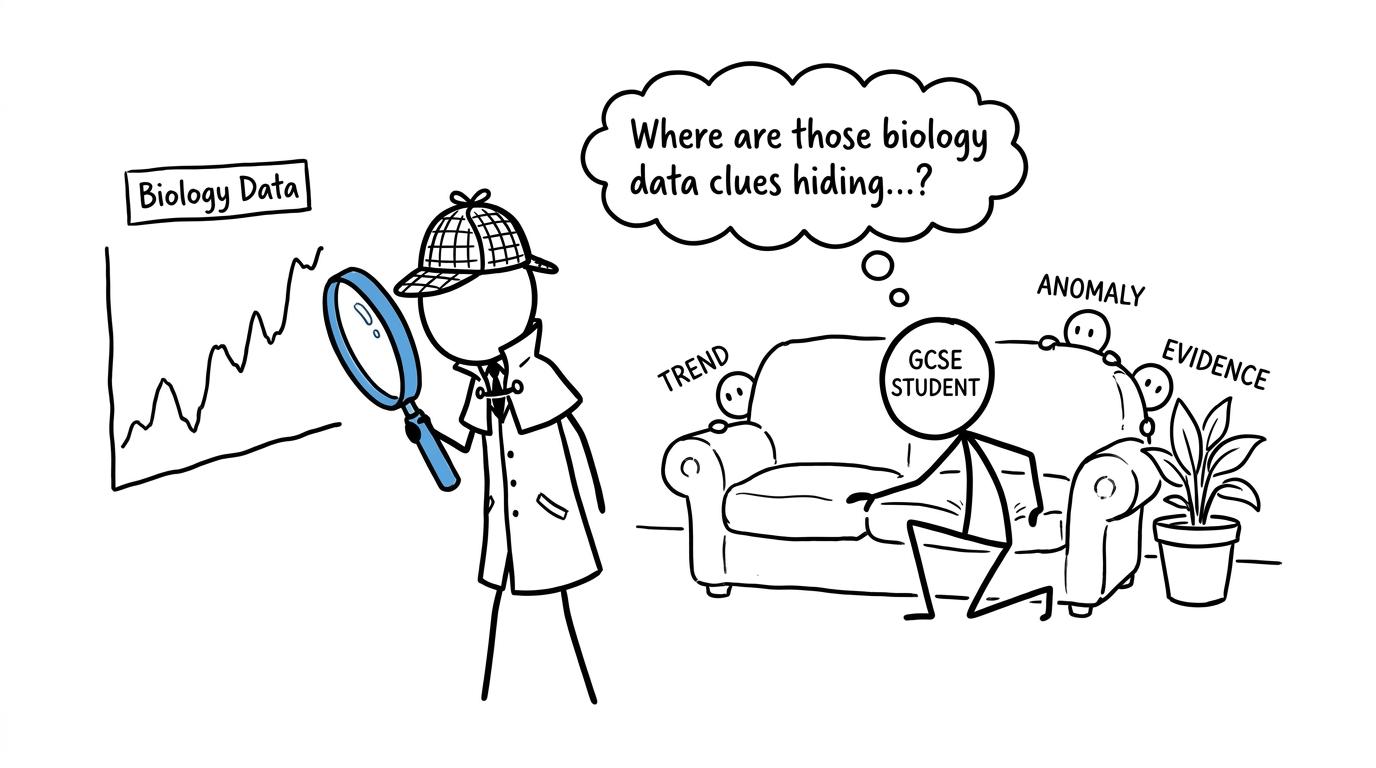 A student detective searches a graph for trends, anomalies and evidence
Read graphs like evidence, not decoration
A graph question is rarely asking whether a line goes up or down. Stronger answers describe the relationship accurately and support it with relevant data.
Look for:
- the variables and units on both axes;
- positive, negative or absent correlation;
- sections where the rate changes;
- plateaus, peaks and anomalies;
- whether the evidence supports causation or only association;
- whether the conclusion goes beyond the range tested.
If a question asks you to calculate a rate from a straight-line section, the gradient is:
gradient=change in vertical valuechange in horizontal value\text{gradient}=\frac{\text{change in vertical value}}{\text{change in horizontal value}}gradient=change in horizontal valuechange in vertical valueChoose two well-separated points on the line, not necessarily two plotted data points. Then interpret the result in its biological context and include the correct compound unit.
Use command words and mark allocations deliberately
Command words are instructions, not decoration.
- State usually needs a short fact.
- Describe asks what happens or what the data show.
- Explain requires reasons or mechanisms.
- Compare needs both similarities or differences linked directly.
- Calculate requires working and a numerical answer.
- Evaluate asks you to weigh evidence, limitations and possible improvements.
The mark allocation is also a clue. A response worth several marks usually needs several connected ideas. However, writing a long paragraph is not the same as developing an answer. Plan extended responses around distinct scientific points, then connect them logically.
Build a revision loop that changes performance
Passive rereading feels fluent because the page is familiar. The exam does not ask whether the page looks familiar. It asks whether you can retrieve, apply and communicate the idea without support.
Use this loop instead:
- retrieve one small topic from memory;
- check it against your specification or class resource;
- complete exam-style questions;
- mark them carefully;
- classify each lost mark;
- write one precise correction;
- retest the weakness after a short gap.
Your error categories might include knowledge, application, practical method, command word, calculation, units or careless reading. A weekly timed section then shows whether the repair survives under pressure.
For help organising the numerical side of science, adapt the structure in the MathsGenie GCSE revision timetable. As exams approach, the advice on when to begin past papers can help you move sensibly from topic practice to timed work.
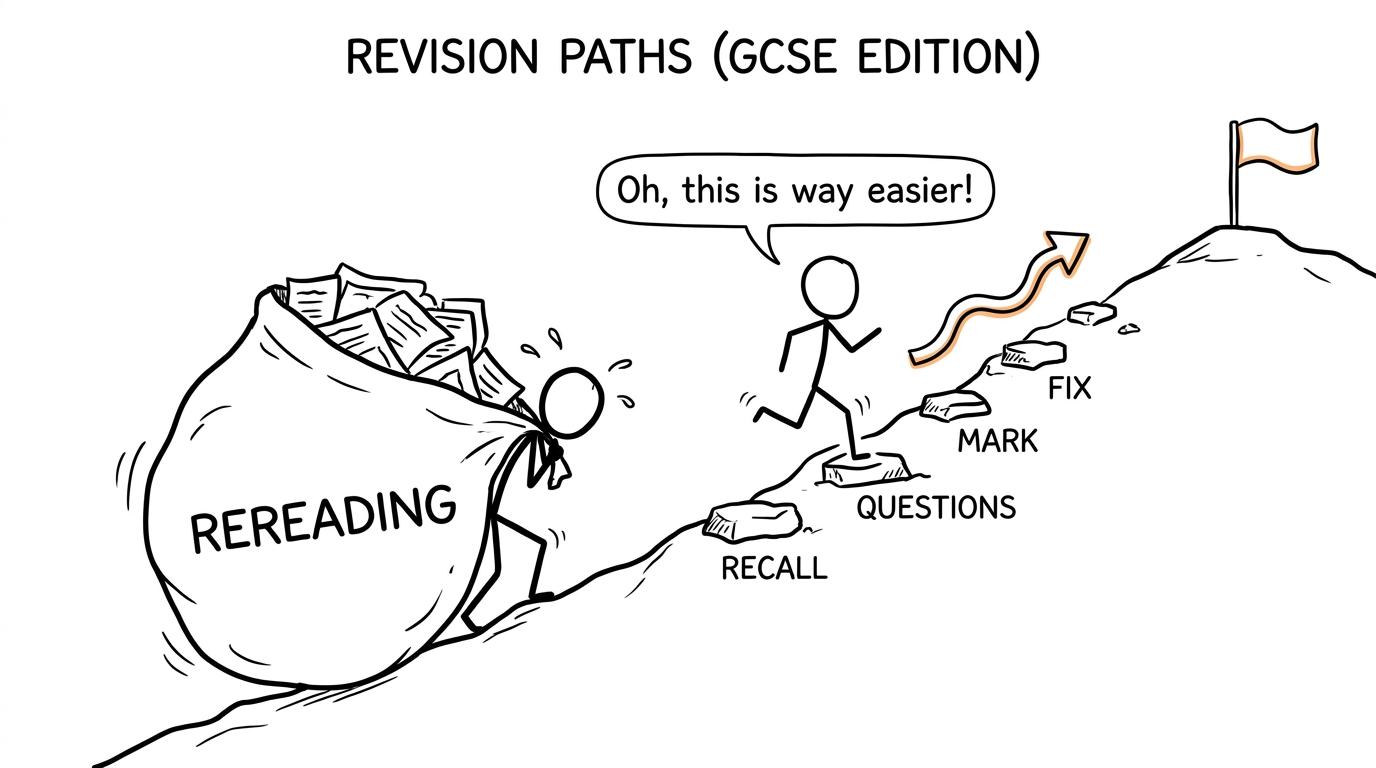 Two students climb a revision hill using very different strategies
Common mistakes that keep students near grade 444
Revising only favourite topics
Comfortable revision protects confidence but leaves the same gaps untouched. Use a diagnostic paper to select weaknesses rather than choosing by mood.
Memorising mark schemes without understanding
Mark schemes show the precision required, but copied phrases are fragile when the context changes. Explain why each phrase earns credit.
Ignoring practical methods
Students often revise conclusions but forget variables, measurement techniques and evaluation. Learn each practical as a complete investigation.
Describing when the question says explain
A description reports the pattern. An explanation supplies the biological reason. Check the command word before writing.
Dropping units or rounding too early
Keep full calculator values during the method, round at the end and include the requested unit. Strengthen these habits with MathsGenie's free lessons and practice questions; its article on whether GCSE Maths is harder than science explains why shared skills matter across both subjects.
Using predicted content as a substitute for the specification
No prediction can guarantee what appears. Cover the specification first, then use predictions only as extra practice. The MathsGenie guide to predicted GCSE topics sets out this distinction clearly.
Your next step towards grade 666
Moving from grade 444 to grade 666 is less about dramatic revision days than about improving the quality of ordinary ones. Recall precisely. Apply ideas to unfamiliar settings. Learn practicals as examinable content. Treat graphs and calculations as opportunities rather than interruptions. Then let mark schemes reveal what your answers still fail to communicate.
Start by completing one short Biology assessment and classify every lost mark. For any numerical weakness it exposes, open the MathsGenie GCSE Maths revision area, revisit the relevant revision lesson and complete the practice questions. Then build towards mini tests, past papers, predicted papers, mark schemes and video solutions.
The grade changes when your repeated actions change. One repaired weakness may feel small. Several repaired weaknesses, revisited often enough, become a different exam performance.










