Extra Practice Material for GCSE Further Maths
Extra practice material GCSE Further Maths students need: when to ask, what to request, and how to show your teacher that you have made a real effort first.
There is an awkward moment in revision when you know you need more questions, but asking for them feels risky. Will your teacher think you ignored the original work? Will it sound as though you expect them to organise everything for you?
The short answer is yes: asking for extra practice material GCSE Further Maths students can use is worthwhile, provided your request is specific and supported by evidence of what you have already tried. Bring completed work, identify the topic causing difficulty and explain what kind of practice would help. That sounds responsible, not lazy.
The aim is not to collect the largest possible stack of worksheets. It is to find the next useful set of questions.
The quick checklist
Before asking your teacher, make sure you can answer these questions:
- Which Further Maths qualification and specification are you following?
- Which precise topic do you need to practise?
- What questions or resources have you already attempted?
- What kind of error keeps recurring?
- Do you need routine questions, harder problem solving or timed practice?
- Will you mark the work and ask about any remaining mistakes?
If you can explain those six things, your request will usually come across as evidence of effort.
Why extra practice can be worth asking for
GCSE Further Maths sits in an unusual position. It is often taught in less curriculum time than GCSE Mathematics, yet it introduces demanding ideas and expects strong algebraic fluency.
The exact qualification matters. For example, AQA's Level 222 Certificate in Further Mathematics, specification 836583658365, is an untiered qualification intended as an addition to GCSE Mathematics rather than a replacement. AQA describes it as suitable for learners expected to achieve grades 777-999 in GCSE Maths and likely to continue to Level 333 mathematics. Its content extends algebra and geometry while introducing areas such as calculus and matrices.
Other schools may offer a different extension qualification, such as OCR's Level 333 FSMQ in Additional Mathematics. Do not assume that a worksheet labelled “Further Maths” automatically matches your course. Ask your teacher which specification you are following before investing time in unfamiliar material.
This is one reason a teacher's recommendation is valuable. Your teacher knows:
- what has already been taught;
- what remains outside your specification;
- how your examination questions are structured;
- whether your difficulty is conceptual, algebraic or caused by exam technique;
- which questions provide an appropriate next step.
More practice is useful when it is correctly pitched. Questions that are far too easy create confidence without much improvement. Questions that are far beyond the course consume time and can make a manageable topic feel impossible.
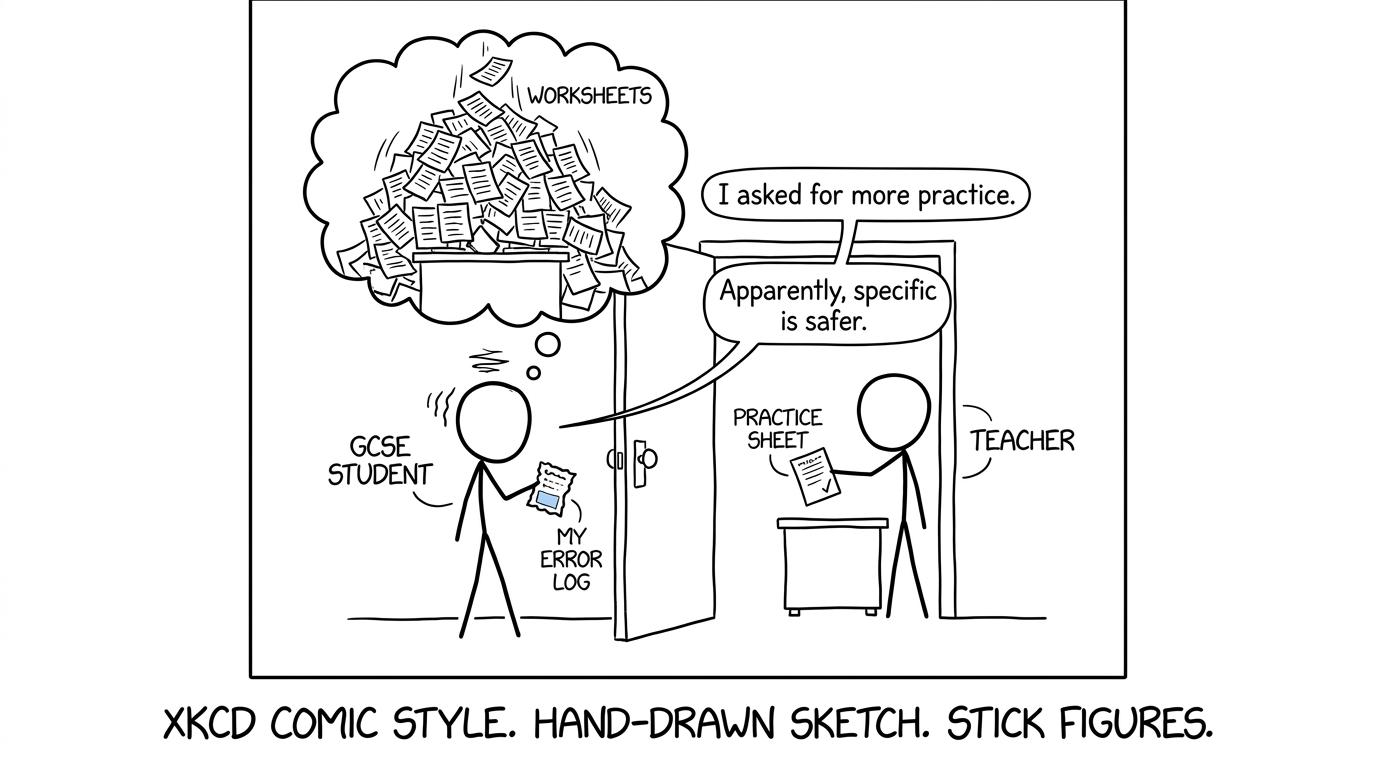 A student cautiously asks a teacher for one useful practice sheet while imagining an avalanche of worksheets
How to ask without sounding as though you are not trying
The difference between an unconvincing request and a strong one is usually evidence.
“Can I have more work?” gives your teacher very little information. A better request shows that you have attempted something, reflected on it and identified a next step.
You could say:
“I completed the questions we were given on differentiation and marked them. I can use the basic rule, but I am still losing marks on tangents and stationary points. Do you have another set at that level that I could try?”
Or:
“I attempted these matrix questions and corrected the calculation errors. I am not yet confident about choosing the correct transformation. Is there a worksheet or past-paper set focused on that skill?”
These requests work because they contain four useful details:
- what you completed;
- how you checked it;
- what is still going wrong;
- what you want to do next.
You are not asking the teacher to manufacture motivation for you. You are asking for expert direction after making a genuine start.
Bring evidence of your first attempt
Take the completed worksheet, marked questions or a short error log. It does not need to be perfect. In fact, crossed-out attempts can be useful because they show where your reasoning changed.
An effective error log records:
- the topic;
- the question source;
- whether the problem was method, accuracy, interpretation or timing;
- the correction you made;
- whether you could answer a similar question later.
MathsGenie's guide to finding your weakest GCSE topics explains how to use lost marks as evidence rather than relying on a vague feeling that you are “bad at algebra”.
Ask for a type of practice, not simply more
Your teacher can help more effectively if you describe the gap. You might request:
- routine questions to make a new procedure reliable;
- mixed questions requiring you to choose a method;
- non-calculator practice;
- proof or reasoning questions;
- exam-style questions with increasing difficulty;
- a timed topic test;
- questions from a particular specification section.
That distinction matters. If you understand a method but cannot recognise when to use it, another page of identical exercises may not solve the problem. You need mixed or unfamiliar questions instead.
Try the available resources before you ask
A good request begins with some independent effort. Start at the MathsGenie GCSE Maths revision hub, where you can choose board-specific revision resources, lessons, practice questions and examination papers.
Although ordinary Higher GCSE Maths does not cover every Further Maths topic, its upper-level content supplies much of the fluency that extension work depends on. Quadratics, surds, functions, circle equations, trigonometry, algebraic proof and vectors are all valuable foundations. The GCSE topics by exam board and tier guide can help you check whether a weakness belongs to your core Higher GCSE knowledge or the additional qualification.
Use this short sequence before approaching your teacher:
- Revisit the relevant lesson or class notes.
- Attempt a focused set without copying a solution.
- Mark it carefully.
- Correct every error you understand.
- Write down the first point at which you remain stuck.
For a broader structure, follow the best order for learning GCSE Maths topics. It can reveal whether an advanced topic is being blocked by an earlier gap. Difficult differentiation, for example, may partly reflect insecure algebra rather than the calculus rule itself.
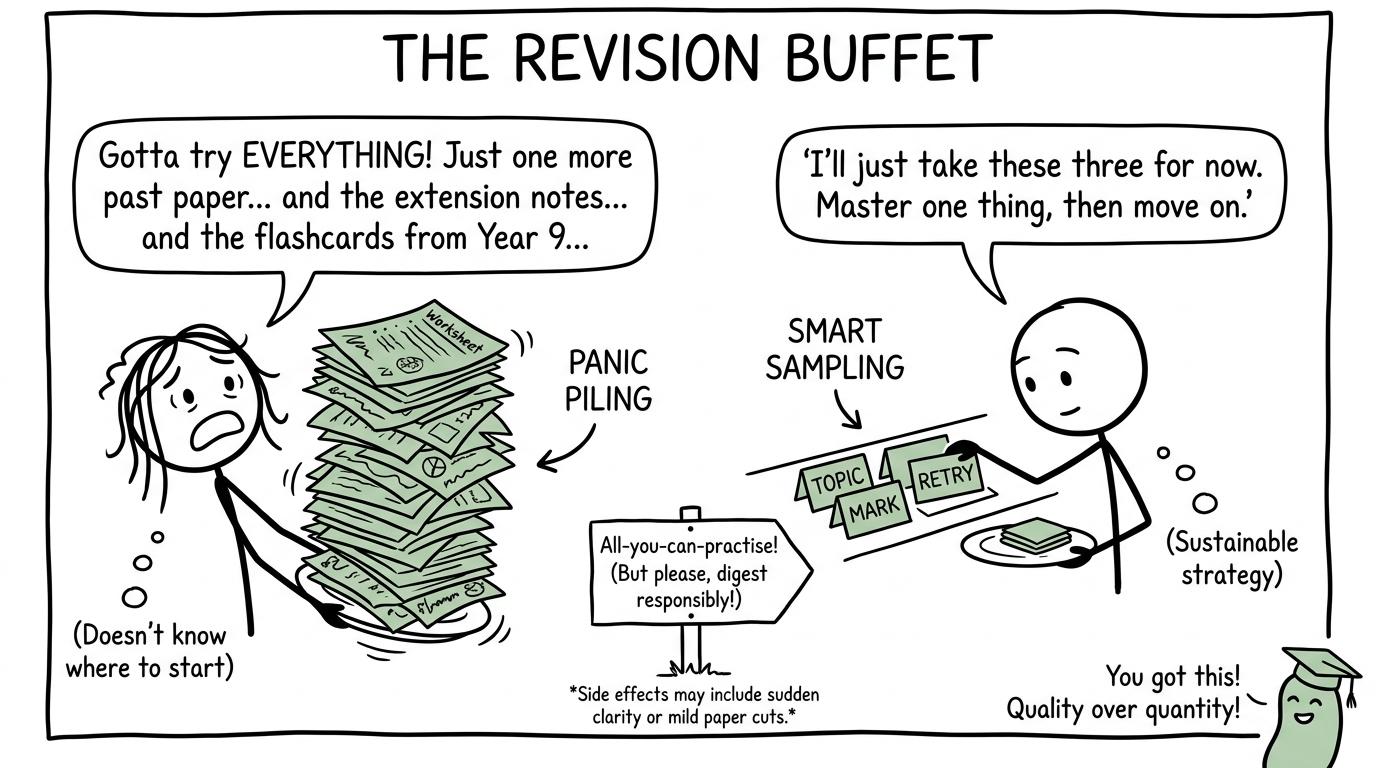 A revision buffet where one student collects random worksheets and another chooses a focused practice plan
Turn new material into better marks
Receiving a worksheet is not the finish line. It is the beginning of a feedback loop.
A useful cycle is:
- attempt the questions under appropriate conditions;
- mark them with answers or a mark scheme;
- classify each lost mark;
- repair the weakest skill;
- retry a different question after a gap;
- test the skill later within mixed practice.
The final two stages are easy to miss. Looking at a correction can create the feeling of understanding, but independent retrieval is the real test. MathsGenie's guide to revising GCSE Maths efficiently develops this learn, practise, mark and fix routine.
Short tests can be particularly helpful when a full paper would include too much material that you have not covered. For students following Edexcel GCSE Mathematics alongside an extension course, the Edexcel GCSE Maths mini tests can strengthen prerequisite Higher skills and provide quick feedback.
As the examination approaches, move towards mixed and timed questions. The guide to when to start GCSE past papers explains why papers should diagnose your revision rather than merely measure it. Predicted papers can add useful exam-style practice, but the GCSE predicted topics guide also explains why predictions should not replace broad specification coverage.
What if your teacher cannot provide more?
A teacher may decline for practical reasons. They may not have another suitable set, may want you to finish existing work first or may believe that reviewing mistakes is more valuable than starting new questions.
Treat that response as guidance, not rejection. Ask one smaller question:
“What should I do next with the material I already have?”
Your teacher might recommend reattempting selected questions without notes, completing corrections in full or combining questions from several topics. They may also point you towards a textbook exercise, specification resource or past-paper section.
You can then use MathsGenie's free revision lessons, practice questions, mark schemes and video solutions to strengthen the underlying GCSE skills. The important principle is that “no new worksheet” does not mean “no possible practice”.
Common mistakes when requesting extra material
Asking before attempting the original work
This is the fastest way to make a reasonable request appear premature. Complete a meaningful first attempt unless your teacher has told you not to continue when stuck.
Being too vague
“More algebra” could mean equations, functions, proof, inequalities or manipulation. Name the smallest skill you can identify.
Collecting resources without completing them
A folder full of untouched papers can feel like preparation while producing no feedback. Ask for an amount you can realistically attempt and review.
Requesting material from the wrong qualification
AQA Further Mathematics, OCR Additional Mathematics and other extension qualifications are not interchangeable. Check the title, level and specification with your school.
Ignoring marking and corrections
Practice without review can reinforce the same mistake. A shorter set marked carefully is often more valuable than several rushed worksheets.
Neglecting ordinary Higher GCSE Maths
Further Maths revision should not undermine the main GCSE qualification. If core algebra is insecure, repairing it may improve both courses. Balance extension work with the areas identified by your normal GCSE papers and teacher assessments.
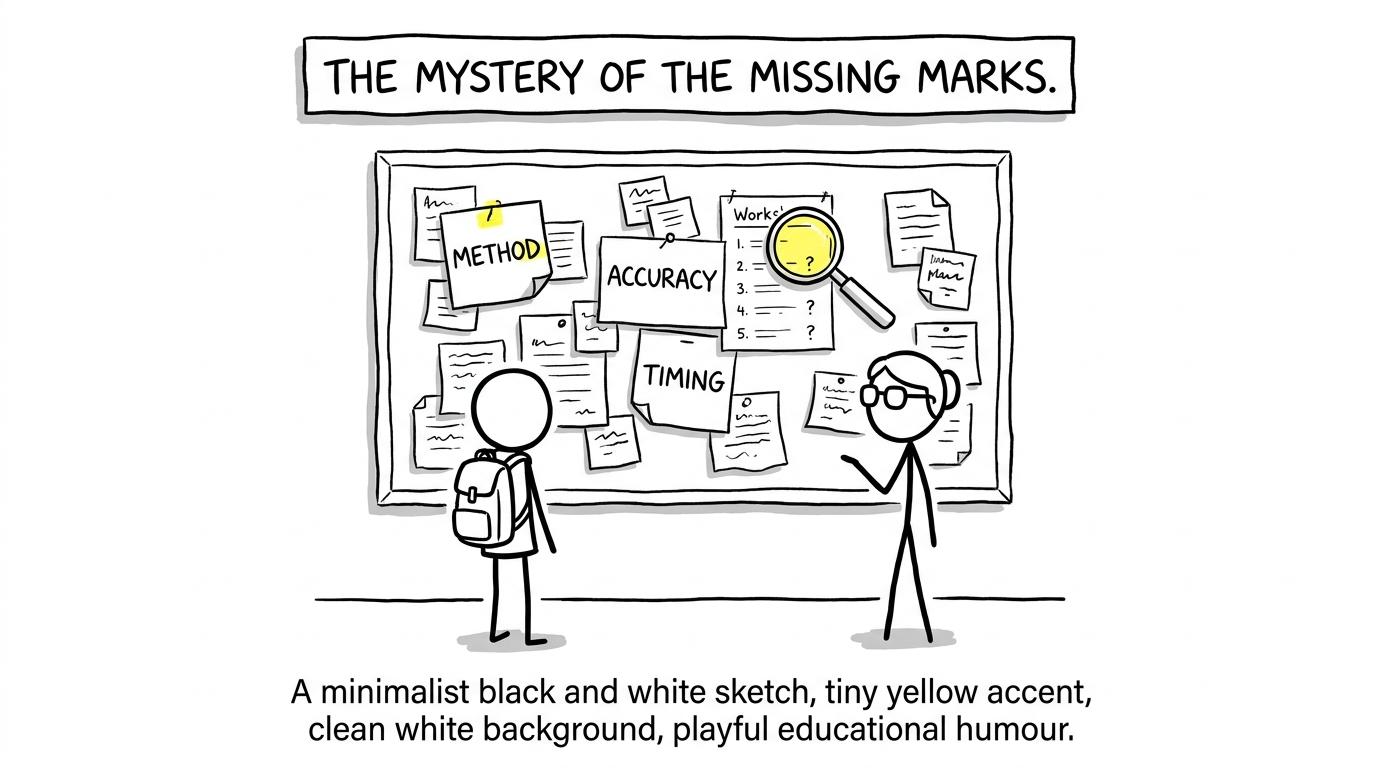 A student and teacher investigate missing marks using an error log as a detective evidence board
Make the conversation easy for your teacher
The best request is brief, specific and easy to answer. Choose an appropriate moment rather than asking while your teacher is beginning a lesson or dealing with another student. Show the work, explain the pattern and request one clear next step.
Then follow through. Complete the material, mark what you can and return with focused questions. That creates a productive conversation: not “give me more”, but “here is what the last set taught me”.
Ask for direction, then do the work
It is absolutely worth asking your teacher for additional GCSE Further Maths practice. Teachers can help you avoid irrelevant questions, choose an appropriate level and distinguish a new-content gap from a weakness in core GCSE algebra or geometry.
The request will not look like a lack of effort if your effort is visible. Attempt, mark, diagnose, then ask.
Start today with the MathsGenie GCSE revision hub. Use revision lessons to rebuild methods, practice questions and mini tests to develop accuracy, and past papers or predicted papers to test timing and selection. Check your work with mark schemes and video solutions, then take the remaining evidence to your teacher.
You do not need every worksheet. You need the right next question and the discipline to learn from its answer.