Extra Practice Material GCSE Chemistry: Is It Worth It?
Extra practice material GCSE chemistry can expose weak topics and maths gaps. Learn what to ask your teacher, how to ask, and how to use it well for exams.
There is an awkward moment many students recognise. You know you need more questions, but asking your teacher can feel as though you are admitting that you have ignored the work already provided. In reality, asking for extra practice material GCSE chemistry students can use is usually worthwhile, particularly when you make a specific request and show what you have already attempted.
The short answer is simple: yes, ask. A teacher can often direct you towards the right topic, difficulty and exam-board style more efficiently than you can find it alone. The important part is not whether you request another worksheet. It is whether you can explain the gap you are trying to close and what you will do with the material.
For students preparing for maths exams too, this matters because GCSE Chemistry contains ratios, percentages, standard form, equations, unit conversions, graphs and proportional reasoning. Better chemistry practice can reveal maths weaknesses that might otherwise remain hidden until an exam.
A quick checklist before you ask
Before approaching your teacher, check that you can answer these questions:
- Which chemistry topic do you need to practise?
- Is the difficulty caused by chemistry knowledge, mathematical method or both?
- Have you attempted the material already available?
- Can you show one or two questions that caused difficulty?
- Do you know your exam board and course, such as combined science or separate chemistry?
- Will you mark the extra work and act on your mistakes?
You do not need a perfect revision plan. You simply need a clear reason for asking. Compare “Can I have more chemistry sheets?” with “I have completed the rates questions, but I am still struggling to calculate gradients and explain what they mean. Is there another exam-style set I could try?”
The second request shows effort, diagnosis and a willingness to improve.
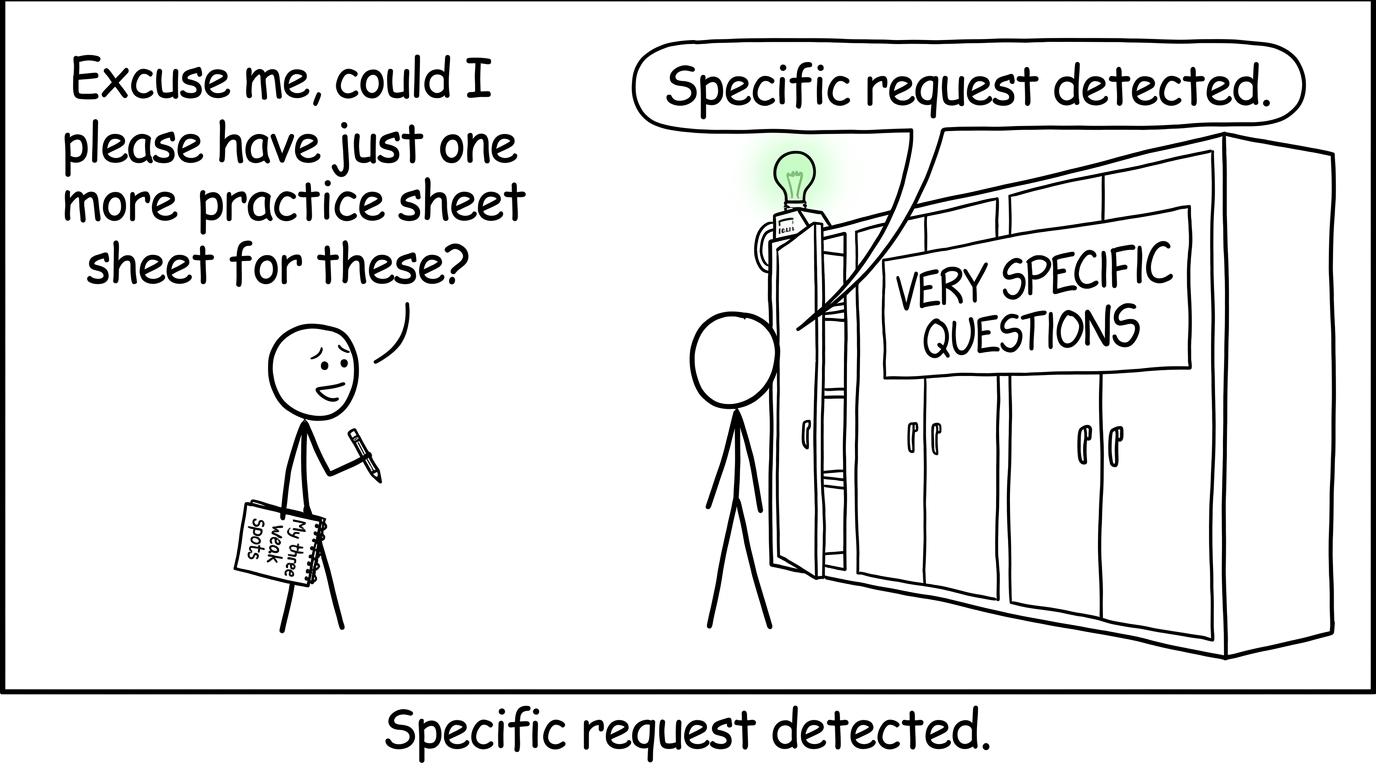 A student makes a specific request for chemistry questions
Why extra GCSE Chemistry practice can help
Official GCSE Chemistry specifications assess more than recalled facts. Across boards including AQA, Edexcel, OCR and Eduqas, students must demonstrate knowledge, apply it in unfamiliar situations, analyse information and evaluate experimental methods. Written papers can include multiple-choice questions, short responses, calculations and extended answers.
That variety explains why reading notes can feel productive while leaving exam performance unchanged. Recognition is not the same as retrieval. You may recognise the definition of a mole when it appears in a revision guide but still struggle to select the correct equation in a multi-step question.
Well-chosen extra material can help you:
- retrieve facts without looking at notes;
- apply familiar ideas in unfamiliar contexts;
- interpret tables, diagrams and practical results;
- practise calculations with units and significant figures;
- learn the wording expected in longer responses;
- distinguish a knowledge gap from an exam-technique problem.
Retrieval practice is most useful when it includes appropriate challenge, repeated recall and feedback. That last part matters. Completing forty questions and never checking them may strengthen the wrong method. Completing ten, marking them carefully and correcting each error is usually a better use of time.
Asking without sounding as though you are not trying
The fear is understandable: “What if my teacher thinks I have not used the resources already given?” The easiest solution is to make your effort visible without giving a long defence.
Show what you have completed
Take the worksheet, homework or past-paper section you have attempted. Highlight the questions you could not complete and mark any corrections you understand. This turns the conversation from “I want more work” into “I have reached a specific obstacle”.
You might say:
“I completed the questions from the lesson and marked them. I lost marks on concentration and volume conversions. Could you recommend another short set at the same level?”
That wording is calm and practical. It neither exaggerates your effort nor apologises for needing help.
Ask for a topic, not an entire library
Teachers are more likely to help quickly when your request is narrow. Useful requests might focus on:
- quantitative chemistry;
- balancing equations;
- electrolysis;
- rates of reaction graphs;
- required or core practical questions;
- bonding explanations;
- chemical analysis;
- higher-tier calculations.
Include your exam board where necessary because specifications and question styles are not identical. Also state whether you take combined science or separate chemistry. Asking for the correct course prevents you from spending time on content you may not be required to learn.
Ask for guidance as well as paper
Sometimes the best extra material is not another worksheet. Your teacher may recommend that you redo selected questions, use a past paper, revisit a practical or correct an earlier assessment.
A useful question is:
“Would another question set help here, or should I revise the method first?”
That gives your teacher room to diagnose the problem. It also shows that you are interested in improvement, not merely collecting pages.
Choose a sensible moment
Avoid asking while your teacher is beginning a lesson, managing a busy corridor or dealing with another student. Ask at the end of a lesson, during an agreed support session or through the school’s normal messaging system. Keep the first request brief.
If the answer is “not today”, that is not a judgement on your effort. Teachers have limited time and may need to locate resources. Ask when you should follow up, then continue with the material you already have.
Connect chemistry practice to GCSE Maths revision
Chemistry calculations often expose small mathematical habits. A student may understand the science but lose marks by using inconsistent units, rounding too early or failing to rearrange a formula.
The mathematical requirements found in GCSE Chemistry specifications include skills such as decimals, standard form, ratios, fractions, percentages, estimates, means, graphs, significant figures, substitution and changing the subject of an equation. Chemistry assessments are therefore another place where your maths needs to work under pressure.
Common formula structures include:
concentration=massvolume\text{concentration}=\frac{\text{mass}}{\text{volume}}concentration=volumemassand
mean rate=quantity changedtime\text{mean rate}=\frac{\text{quantity changed}}{\text{time}}mean rate=timequantity changedThe chemistry determines what the quantities mean. The maths determines whether you can manipulate and use the relationship accurately.
If extra chemistry questions reveal weak arithmetic or algebra, use the free GCSE Maths revision hub to find revision lessons, practice questions and video solutions. The MathsGenie guide to revising GCSE Chemistry with the maths that scores can help you identify the numerical skills underneath topics such as moles, concentration, percentage yield and reaction rates.
Do not try to repair every maths topic at once. Use the best order for learning GCSE Maths topics to rebuild foundations logically, or check the GCSE Maths topics by exam board and tier when you need board-specific direction.
How to use the material once you receive it
Asking is only the beginning. Extra practice becomes valuable through the cycle that follows.
Attempt it without immediate support
Choose a short, manageable set. Put away your notes for the first attempt so that you discover what you can genuinely retrieve. If you get stuck, leave evidence of your thinking rather than erasing everything.
Mark it promptly
Use the available answers or mark scheme. Record why each mark was lost:
- missing scientific knowledge;
- incorrect mathematical method;
- unit conversion;
- premature rounding;
- misreading the command word;
- incomplete practical explanation;
- careless transcription.
A total mark tells you how the attempt went. An error category tells you what to do next.
Correct, then revisit
Write a complete correction and return to a similar question after a delay. MathsGenie’s guide to stopping yourself forgetting GCSE content explains how retrieval, spacing and marking can form a repeatable revision loop.
If school days are crowded, adapt the twenty-minute GCSE Maths revision routine: recall the idea, attempt a small set, mark it and record one action for the next session.
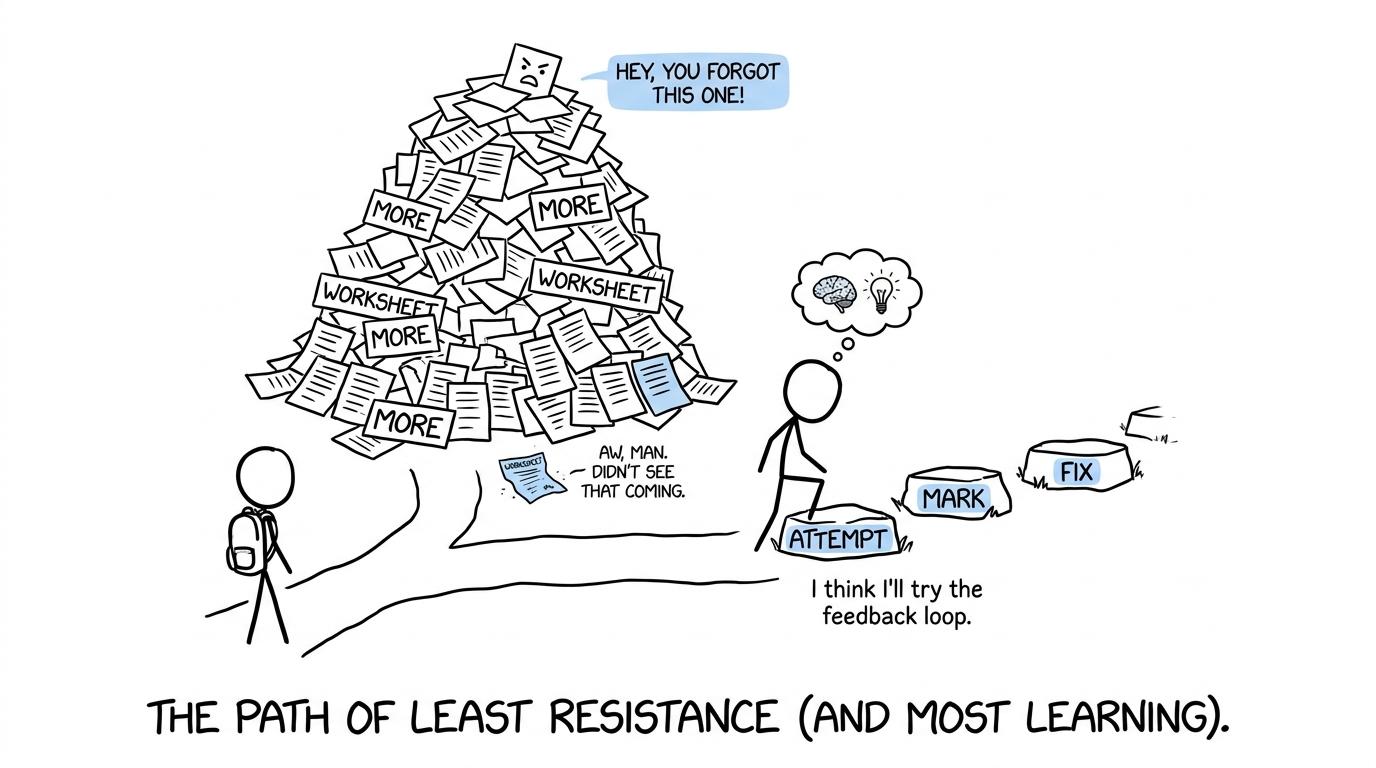 A student chooses an attempt, mark and fix revision path
When more material is not the answer
More questions are not automatically better. If you cannot begin any question on a topic, you may need an explanation before more assessment. If you repeatedly make the same error, you may need feedback rather than volume. If you already have several untouched booklets, adding another can create guilt without creating learning.
Use this decision rule:
- You do not remember the content: return to notes, a lesson or a concise revision guide.
- You understand the content but cannot apply it: request targeted exam questions.
- You complete questions but lose marks unexpectedly: compare your answer with the mark scheme and ask for feedback.
- You are accurate but too slow: use a timed section.
- Your mistakes are mainly numerical: repair the underlying GCSE Maths skill.
Past papers are most useful once you can attempt a reasonable range of topics. The MathsGenie guide on when to start GCSE past papers explains how to move from diagnostic questions to timed paper practice without using up every paper too soon.
Common mistakes when requesting extra practice
Asking vaguely
“Have you got anything else?” makes it difficult for a teacher to choose suitable material. Name the topic, course, tier where applicable and type of difficulty.
Requesting work you will not mark
A worksheet is not progress until you attempt it, check it and respond to errors. Ask how it should be marked if no answers are provided.
Hiding previous attempts
Your incorrect work is useful evidence. It helps your teacher see whether the difficulty lies in recall, application, scientific language or maths.
Jumping straight to the hardest questions
Challenge matters, but impossible questions do not produce useful practice. Begin at a level where you can make a serious attempt, then increase the demand.
Treating every chemistry error as a chemistry problem
Losing a mark on a rate calculation might come from a weak understanding of rates, but it could also come from gradients, rearranging or units. Diagnose before revising.
Collecting resources instead of using them
A large folder can create the appearance of preparation. A small set of completed, marked and corrected questions creates evidence of learning. The second is what matters.
Make the request, then make it count
Asking your teacher for extra GCSE Chemistry practice material does not suggest that you are failing to try. A focused request supported by attempted work usually communicates the opposite: you have identified a weakness and want to do something useful about it.
Keep the request specific. State what you have done, name the difficulty and ask what resource or next step would help. Then attempt the material, mark it, correct it and revisit the skill.
When chemistry exposes a mathematical gap, make MathsGenie your free revision base. Start with revision lessons and practice questions, check methods through video solutions, use mini tests to measure progress, and build towards GCSE Maths past-paper preparation. Closer to the exams, add predicted papers and focused paper practice.
More material is useful. Better-directed material, followed by honest correction, is where the marks begin to change.