

Revise GCSE Chemistry Fast (With Maths That Scores)
GCSE revision for Chemistry without wasting time: use maths-first practice, mark schemes, and past papers to boost marks quickly with YesGenie.
When people say they’re revising GCSE Chemistry, they often mean they’re reading. Highlighting. Rewriting. Watching. It feels busy, so it feels productive.
Then the exam arrives and the marks don’t.
That gap is usually not about effort. It’s about how the effort was spent. Chemistry rewards clear recall, but it also rewards something quieter: the ability to do the maths quickly, accurately, and under pressure. The good news is that you can stop wasting time by revising like the mark scheme thinks.
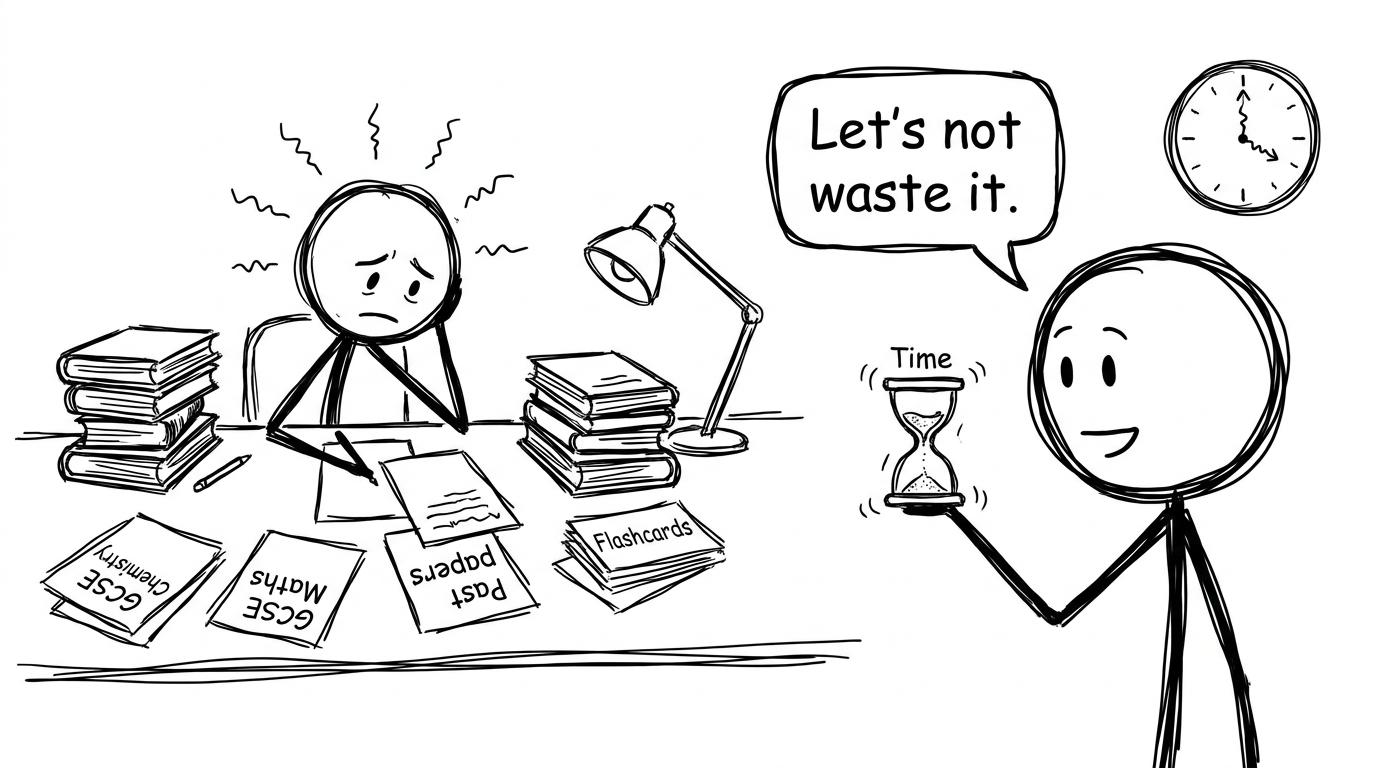 A student tries to revise everything at once
A no-waste GCSE Chemistry revision checklist
Use this as your filter. If a revision task does not pass the filter, bin it.
- Know your exam board (AQA, Edexcel, OCR, Eduqas) and your tier where relevant.
- Use active recall: blurting, flashcards, self-testing.
- Do exam-style questions early (not “when you’re ready”).
- Mark with the mark scheme and correct in a different colour.
- Target the maths-heavy Chemistry marks: moles, concentration, gas volume, percentage yield, rate graphs, energy changes.
- Fix the maths foundations on YesGenie so you don’t lose marks to arithmetic.
YesGenie is a maths site, but that’s exactly why it helps: most “wasted time” in GCSE Chemistry is actually wasted marks in maths.
Why GCSE Chemistry revision wastes time (and how to stop it)
The biggest trap is confusing familiarity with skill. Reading your notes makes the page look familiar, but it doesn’t train your brain to retrieve the idea when the question is phrased in a new way.
A better model is:
- Retrieve what you know (without help).
- Check against the correct answer or mark scheme.
- Repair the gap with one small piece of teaching.
- Repeat until the method is automatic.
The twist for Chemistry is that step 4 often fails because of the maths. You might know what to do (for example, use c=nVc=\frac{n}{V}c=Vn), but still drop marks because you can’t rearrange or convert units quickly.
So you revise Chemistry content, yes. But you also practise the maths that makes the content score.
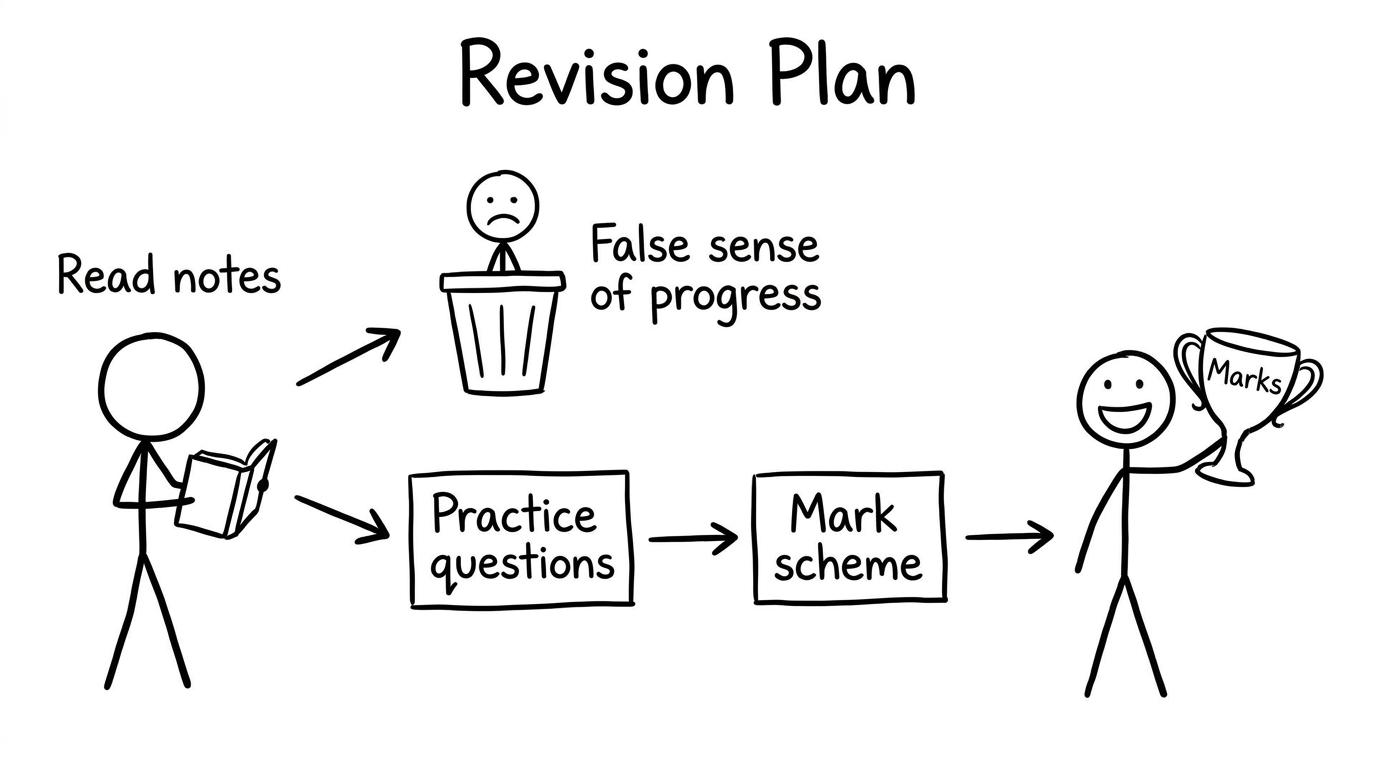 Flowchart of revision that avoids fake progress
GCSE Chemistry maths: the quiet mark magnet
A lot of GCSE Chemistry questions are “one idea plus three bits of maths”. If you get fluent at the maths, your Chemistry revision suddenly feels lighter because you stop fighting the numbers.
Here are the maths skills that show up constantly:
- Fractions, decimals and percentages (yields, purity, percentage change)
- Ratio and proportion (equations, reacting masses)
- Rearranging formulae (concentration, energy)
- Units and conversions (cm3^33 to dm3^33, g to kg)
- Graphs and gradients (rates, cooling curves)
Build those foundations using YesGenie lessons and practice:
- GCSE Past papers
- Edexcel GCSE Maths Predicted Papers
- Edexcel GCSE Maths Mini Tests
- Eduqas GCSE Maths Question Bank
- Fractions, Decimals and Percentages Revision Guide
- Fractions of an Amount Revision Guide
- Changing the Subject of a Formula (topic list page)
- Using a Calculator (GCSE Maths topic page)
Worked example: concentration without losing silly marks
A classic GCSE Chemistry move is converting volume units and rearranging.
Question: A solution contains 0.250.250.25 moles of solute in 500 cm3500\text{ cm}^3500 cm3 of solution. Find the concentration in mol/dm3^33.
Step 1: Write the formula
c=nV c=\frac{n}{V} c=VnStep 2: Convert cm3\text{cm}^3cm3 to dm3\text{dm}^3dm3
Remember 1 dm3=1000 cm31\text{ dm}^3 = 1000\text{ cm}^31 dm3=1000 cm3, so:
500 cm3=5001000 dm3=0.5 dm3 500\text{ cm}^3 = \frac{500}{1000}\text{ dm}^3 = 0.5\text{ dm}^3 500 cm3=1000500 dm3=0.5 dm3Step 3: Substitute
c=0.250.5=0.5 mol/dm3 c=\frac{0.25}{0.5}=0.5\text{ mol/dm}^3 c=0.50.25=0.5 mol/dm3Notice what actually earned the marks: units, conversion, and one division. If this takes you two minutes, your Chemistry knowledge doesn’t get to show.
To speed up the arithmetic and unit confidence, build fluency with the number topics above, especially Fractions, Decimals and Percentages and Using a Calculator.
Worked example: percentage yield (and why it’s mostly GCSE maths)
Question: The theoretical yield is 12 g12\text{ g}12 g. The actual yield is 9.6 g9.6\text{ g}9.6 g. Calculate the percentage yield.
Use:
percentage yield=actual yieldtheoretical yield×100 \text{percentage yield}=\frac{\text{actual yield}}{\text{theoretical yield}}\times 100 percentage yield=theoretical yieldactual yield×100Substitute:
percentage yield=9.612×100 \text{percentage yield}=\frac{9.6}{12}\times 100 percentage yield=129.6×100Compute:
9.612=0.8 \frac{9.6}{12}=0.8 129.6=0.8So:
0.8×100=80 0.8\times 100=80 0.8×100=80Answer: 80%80\%80%.
This is why GCSE Chemistry revision can be optimised: you can learn the definition in 10 seconds, but you can lose the marks for months if your percentage work is shaky. Use the Fractions, Decimals and Percentages Revision Guide and then hammer exam-style practice from the Eduqas GCSE Maths Question Bank.
The 30-minute routine that stops wasted GCSE revision
A tight routine beats a vague plan. Try this structure when you revise GCSE Chemistry on a school night:
Active recall first (10 minutes)
Pick one micro-topic (for example, electrolysis, rates, energy changes). Write everything you remember on a blank page. No notes. No phone.
Then check your notes and correct with ruthless honesty: what did you miss, and what did you write incorrectly?
Exam questions next (15 minutes)
Do exam-style questions on that same micro-topic. Mark them straight away.
If the questions include calculations, treat that as a signal: your revision should include maths practice, not just Chemistry content. Pull a short maths set from Edexcel GCSE Maths Mini Tests or targeted topics from the Eduqas GCSE Maths Question Bank.
Fix one weakness (5 minutes)
Choose one weakness and repair it properly. That might be re-learning one Chemistry definition, or it might be a maths gap like rearranging.
If it’s maths, use a YesGenie lesson pathway (topic lesson, then practice, then check solutions). The aim is small improvement with high certainty.
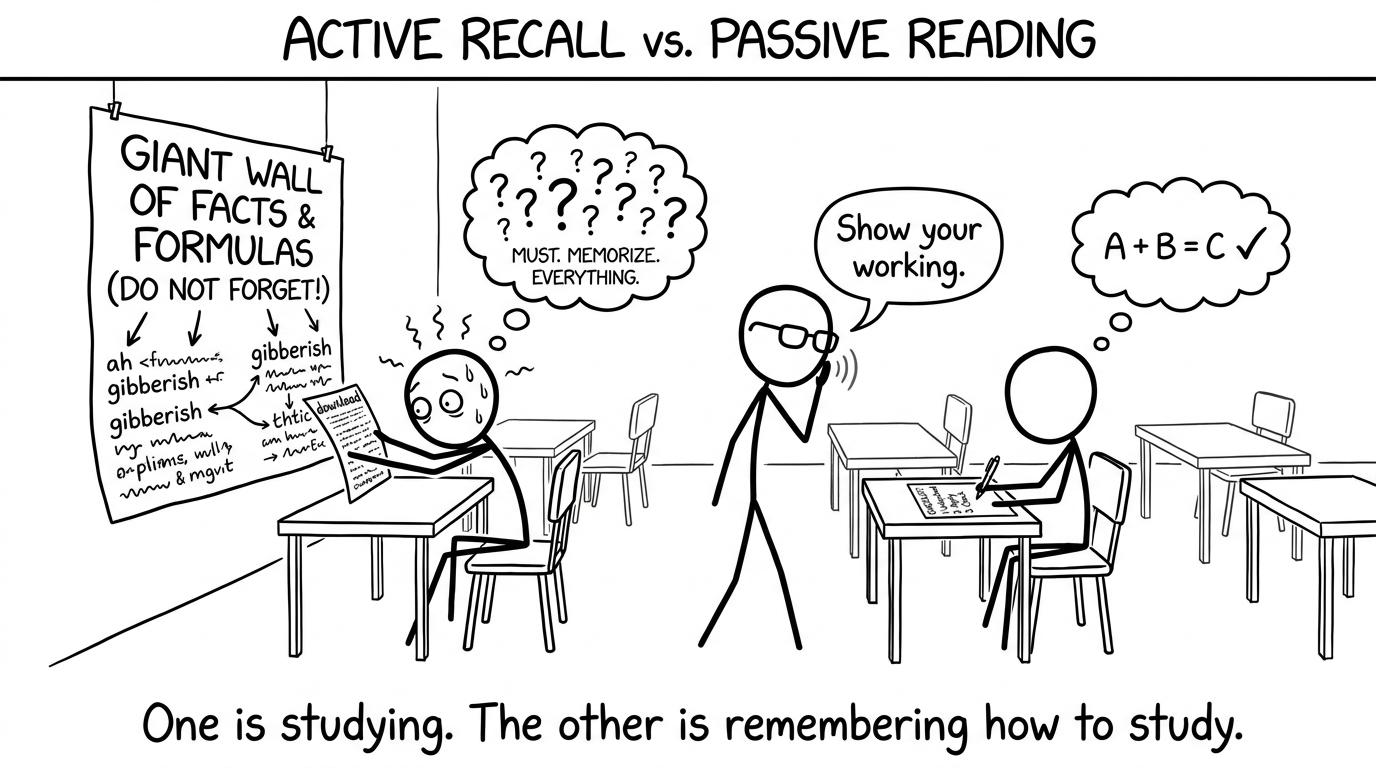 Exam hall: memorising vs method
Common mistakes that waste GCSE Chemistry revision time
- Doing passive revision for too long. If you can’t answer questions without notes, you haven’t revised yet.
- Avoiding mark schemes. Mark schemes feel harsh, but they teach the language the examiner rewards.
- Not converting units early. For concentration and gas volume questions, unit errors are the silent mark killers.
- Rounding too early. Keep exact values until the end unless the question tells you otherwise.
- Rearranging incorrectly. For example, from c=nVc=\frac{n}{V}c=Vn, students sometimes write n=cVn=\frac{c}{V}n=Vc instead of n=cVn=cVn=cV.
- Calculator misuse. Brackets and order of operations matter: practise this explicitly with Using a Calculator.
Bringing it together: revise GCSE Chemistry like the examiner
If you want to revise GCSE Chemistry without wasting time, the strategy is simple but not easy: do the kind of work that can be marked. Retrieval. Questions. Mark schemes. Targeted fixes.
And because Chemistry is quietly mathematical, you get a huge return by making your GCSE maths automatic: percentages, units, rearranging, calculator fluency. That’s where YesGenie becomes your unfair advantage.
Use YesGenie to build the engine underneath your Chemistry marks:
- Learn methods with revision lessons and revision guides
- Practise with topic questions and the question bank
- Build confidence with mini tests
- Prepare under pressure with GCSE Past papers and Edexcel GCSE Maths Predicted Papers
- Check your working with mark schemes and video solutions where available
Stop revising to feel better. Start revising to score. Then let YesGenie handle the maths so your Chemistry knowledge can finally show up on the page.










