

Exam Countdown GCSE English Language: Help or Pressure?
Exam countdown GCSE English Language advice: see when a timer motivates revision, when it adds pressure, and how to protect your wider GCSE maths plan.
A countdown can look harmless: a small number on a phone, calendar or classroom wall. Yet that number can feel very different depending on the day. Searching for an exam countdown GCSE English Language timer may give you the push to begin revision. It may also turn every free evening into a reminder of what you have not done.
The short answer is that a countdown helps when it leads to a clear, manageable action. It adds pressure when you check it repeatedly, compare yourself with other students or treat the remaining days as proof that you are behind. The best countdown does not simply measure time. It helps you decide what to do next, while leaving enough attention for maths and your other GCSE subjects.
The quick countdown checklist
A healthy countdown should help you:
- confirm the correct exam date with your school;
- choose one realistic task for today;
- divide revision between English, maths and other subjects;
- track completed practice rather than hours of worry;
- protect sleep, meals, movement and breaks;
- become less prominent as the examination approaches.
If the countdown makes it harder to start, disrupts sleep or encourages frantic changes to your plan, hide it. You do not need a constantly visible timer to revise effectively.
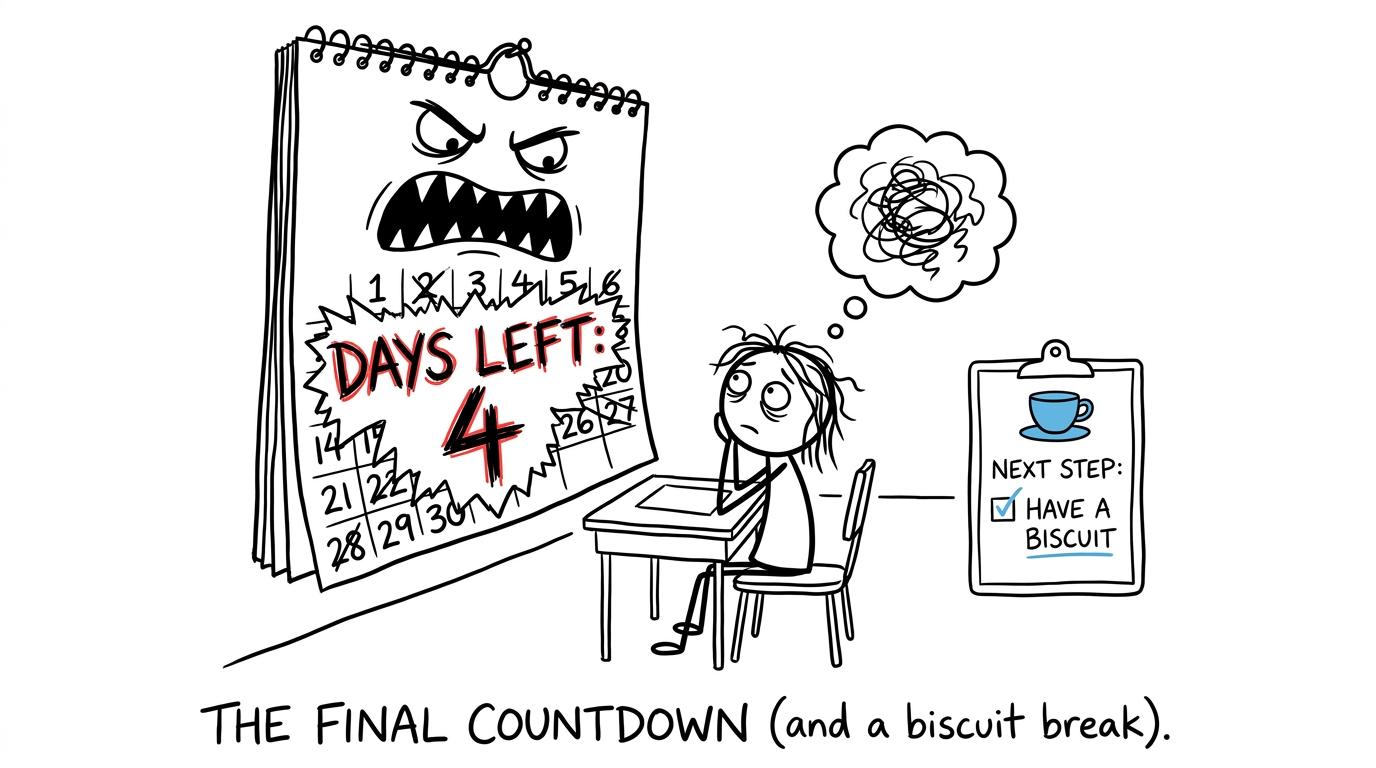 A GCSE countdown calendar becomes a monster while a sensible checklist offers a calmer next step
Why an exam countdown can motivate revision
A distant exam is easy to treat as an abstract problem. There is always another weekend, another lesson or another opportunity to begin. A countdown makes the deadline concrete.
That can be useful because it encourages planning. Current Education Endowment Foundation guidance on metacognition and self-regulated learning highlights the value of planning, monitoring and evaluating learning. A good countdown can support that cycle:
- Plan: choose the skill or topic that needs attention.
- Monitor: complete questions or a timed response and check the result.
- Evaluate: decide what should change in the next session.
Notice what the countdown is not doing. It is not teaching English Language or repairing a weakness in algebra. It is only prompting the next useful behaviour.
For a maths student, that prompt might lead to the GCSE Maths revision hub, where resources are organised by exam board and tier. It could also remind you to complete a short English writing task before returning to maths. The value lies in the action, not the number on the screen.
A countdown can reduce uncertainty
Uncertainty often creates more pressure than the deadline itself. Knowing which paper comes next, what equipment you need and when you will practise removes avoidable decisions.
Use the date supplied on your personalised school timetable. AQA, Edexcel, OCR and Eduqas publish official timetables, but your school or college should remain your final source for the paper, date, session and any individual examination arrangements. Do not rely on a social-media graphic or an old countdown page.
Once the date is confirmed, connect it to a plan such as the GCSE English Language exam-week checklist. A date without a plan creates urgency. A date attached to specific tasks creates direction.
When the countdown starts adding pressure
The same tool can become unhelpful when it stops guiding behaviour and starts judging it.
Imagine opening a countdown several times during one revision session. The number has barely changed, but your attention has. Instead of considering the next paragraph or maths question, you begin calculating how much remains unfinished. The clock has become another task competing for concentration.
A countdown is probably adding pressure if you:
- check it more often than your revision plan;
- feel guilty whenever you rest;
- increase revision hours without choosing better tasks;
- abandon one subject whenever another exam feels closer;
- compare your preparation with friends;
- stay awake trying to make the day feel productive.
NHS exam guidance recommends realistic schedules, manageable chunks, regular short breaks, physical activity and asking for help when stress feels difficult to manage. It also recommends using past papers to become familiar with question styles and timing. These habits create preparation. Watching a number shrink does not.
Pressure is not the same as productive urgency
Some urgency can help you begin. Too much can narrow your thinking until every task appears equally important.
Productive urgency sounds like: “English Language is approaching, so I will practise one reading skill tonight.”
Unproductive pressure sounds like: “There is hardly any time, so I must revise everything.”
The first statement gives you a starting point. The second creates an impossible standard. GCSE preparation becomes calmer when large subjects are broken into observable actions: complete, mark, correct and revisit.
Turn the countdown into a next-action system
The simplest improvement is to check the countdown once, then translate it into a short plan. After that, close it.
Choose outputs rather than vague hours
“Revise English” is too broad. So is “do maths”. A useful plan names something you can finish, such as:
- complete one timed English Language response;
- review teacher feedback and rewrite one paragraph;
- finish one maths mini test;
- mark a paper section and record lost marks;
- revisit one weak Foundation or Higher tier topic.
This approach works because progress becomes visible. You are no longer asking whether you have revised enough. You are checking whether the planned task was completed and reviewed.
MathsGenie’s guide to finding your weakest GCSE topics can help you replace vague worry with evidence. A short test and an honest mark scheme review usually tell you more than an evening spent thinking about everything that might appear.
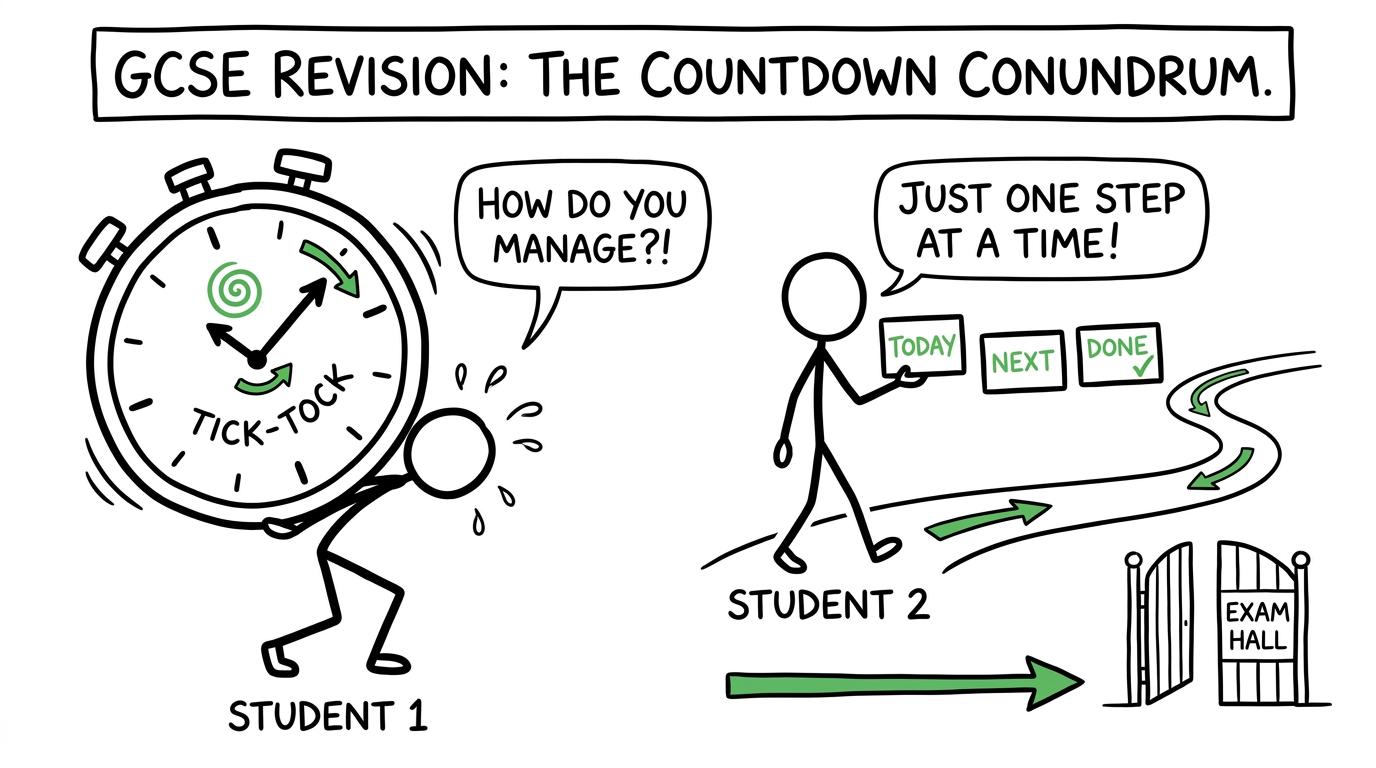 Two students take different revision paths: one carries a giant clock while the other carries small action cards
Use checkpoints, not constant surveillance
A countdown does not need to remain on your home screen. Try checking it at a fixed weekly planning point instead.
At each checkpoint, ask:
- What did I complete?
- What did marking reveal?
- Which paper is approaching next?
- What is the smallest useful task I can schedule?
- Is the plan leaving enough room for rest?
This mirrors the plan, monitor and evaluate cycle. If you want a wider structure, use the GCSE maths revision timetable guide or adapt the one-month GCSE maths plan around your complete examination timetable.
Protect maths while English Language gets closer
The nearest exam deserves attention, but it should not automatically receive every available revision session. Maths performance depends on keeping methods familiar and continuing to practise retrieval, accuracy and exam technique.
During an English-focused week, maintain maths with one small closed task. That might be a mini test, a group of topic questions or a short section from a paper. On another day, use a revision lesson and then answer questions without notes. The aim is maintenance, not a full maths mock every evening.
If you study Edexcel, the Edexcel GCSE Maths revision area brings Foundation and Higher tier lessons, questions and revision tools together. When you need exam practice, use the Edexcel GCSE Maths past papers with the relevant mark schemes and worked solutions.
Students following AQA, OCR or Eduqas should use resources matching their own specification, tier and paper rules. The principle remains the same: keep maths active while temporarily giving English Language a larger share of your attention.
Let evidence change the balance
Your timetable should respond to performance rather than panic. If an English response reveals a significant weakness, schedule another focused attempt. If a maths mini test exposes repeated errors, allocate time to that topic before the next maths paper.
Past papers are most useful when they produce a revision decision. The guide to using GCSE past papers properly explains the paper, mark, fix and retest cycle. That cycle is more informative than any countdown because it shows what has actually improved.
Make the final days quieter, not louder
As an exam approaches, many students make the countdown larger and their plan more complicated. The calmer choice is usually the reverse.
In the final days:
- confirm the correct paper and start time;
- complete a limited amount of familiar, focused practice;
- review feedback and recurring mistakes;
- prepare equipment and travel arrangements;
- choose a clear stopping time;
- protect sleep rather than beginning an exhausting late-night session.
The goal is not to experience zero nerves. Some nervousness before an important examination is normal. The goal is to prevent the countdown from controlling your decisions.
Maths students can use the GCSE maths night-before plan when the next paper is maths. Its wider lesson also applies to English: fewer decisions, carefully chosen practice and a definite stopping point are usually better than last-minute volume.
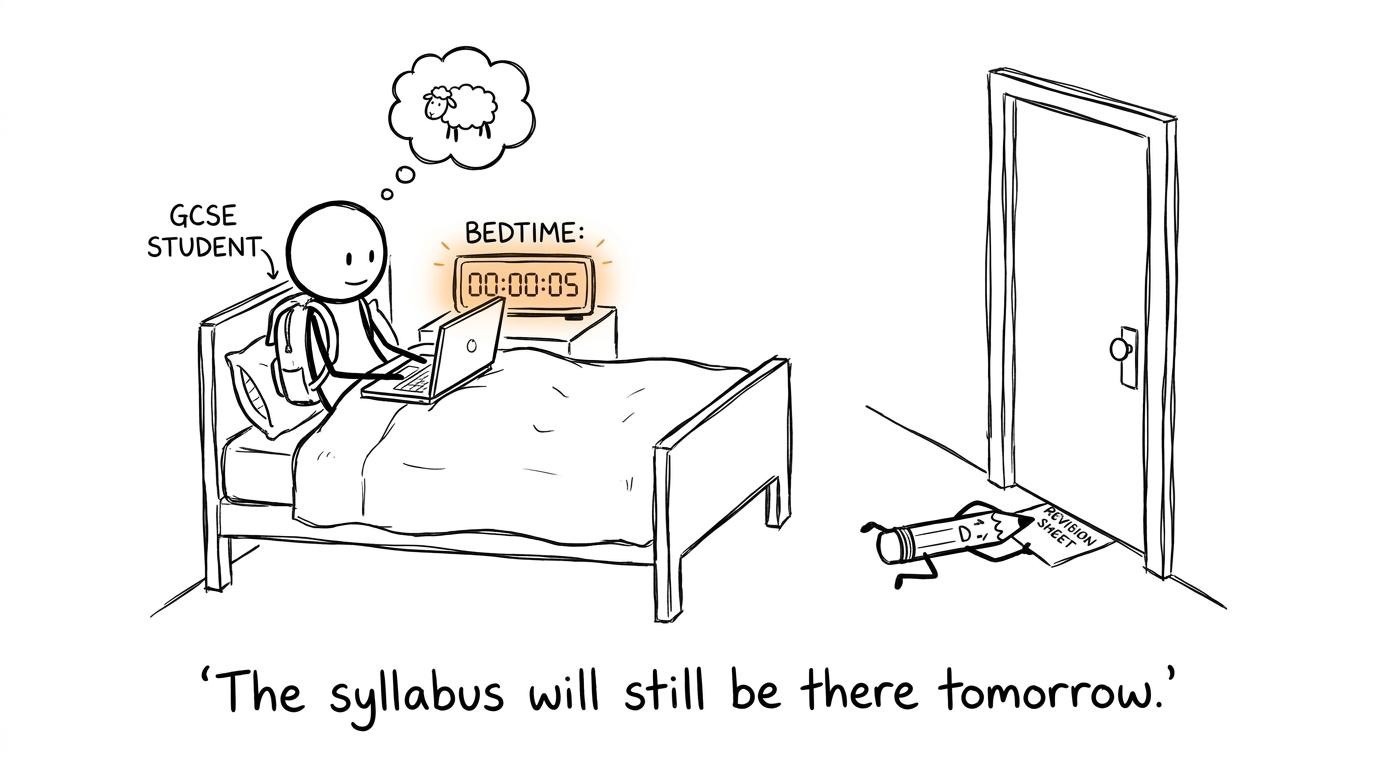 A student closes the countdown at bedtime while a pencil tries to sneak in one more revision sheet
Common countdown mistakes
Using an unverified examination date
Dates copied from search results, social posts or last year’s timetable may be wrong. Confirm your paper using the personalised timetable issued by your school or college.
Counting days without assigning tasks
A countdown measures time but does not decide how to use it. Attach each planning checkpoint to specific English and maths actions.
Treating every remaining day as fully available
School, homework, meals, sleep, travel and recovery all require time. Build a realistic plan around your actual week rather than an imaginary empty calendar.
Sacrificing sleep to satisfy the countdown
Staying up late may make a revision total look impressive while leaving you tired and less focused. Set a stopping time and treat recovery as part of preparation.
Dropping maths until English is finished
GCSE exams arrive close together. Keep maths moving through short topic practice, mini tests and mark scheme review, even when English Language is the immediate priority.
Mistaking predicted papers for predictions of certainty
Predicted papers can provide valuable unseen practice, but they cannot guarantee which questions will appear. Use them after topic revision and alongside genuine past papers, not as a substitute for broad specification coverage.
A countdown should point forward
An exam countdown is useful only when it makes the next step clearer. If it helps you confirm the date, organise a realistic task and begin, keep it. If it creates guilt, repeated checking or lost sleep, remove it and work from a weekly plan instead.
Your grade will not be determined by how often you watched the days disappear. It will be shaped by what you practised, how carefully you used feedback and whether you returned to your weaknesses.
Start with MathsGenie’s free GCSE revision resources. Choose your exam board and tier, use revision lessons to rebuild understanding, practise with topic questions and mini tests, then check progress through past papers, predicted papers, mark schemes and video solutions. Let the countdown tell you when the exam is. Let your revision plan tell you what to do today.










