GCSE English Language Exam Week: A Simple Checklist
GCSE English Language exam week checklist: what to pack, how to plan, and how to keep maths ticking over with YesGenie past papers and mini tests.
If you are in GCSE exam week, English Language can feel oddly heavy. Not because you do not know how to read or write, but because every question seems to demand something invisible: calm. Meanwhile, maths sits in the background like a subject that never stops needing attention. The trick is not to “do everything”. It is to make the week boringly predictable with a simple GCSE checklist that protects your energy, your timing, and your marks.
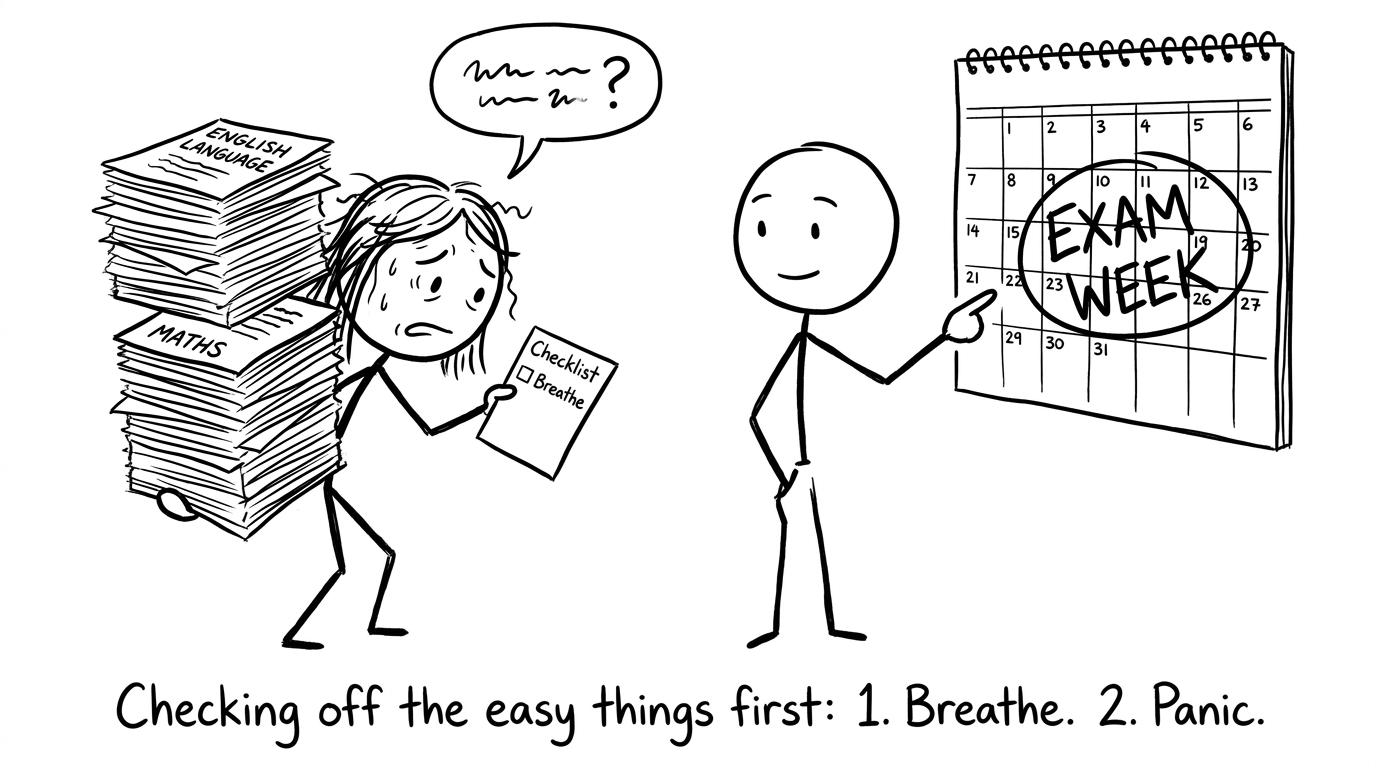 A stressed student with a tiny checklist labelled “Breathe”
The GCSE English Language exam week checklist (fast version)
Keep this somewhere you will actually look at it (notes app, bedroom wall, the front of your revision planner).
The night before
- Check your exam board and paper (AQA, Edexcel, OCR, Eduqas) and the start time.
- Pack: pens, highlighters, spare pen, water, tissues, clear pencil case, school ID if needed.
- Decide your “first five minutes” plan: read, underline command words, box the marks.
- Do one short maths warm-up (15 to 25 minutes) so you do not lose rhythm.
The morning of
- Eat something you can tolerate.
- Arrive early enough to avoid adrenaline.
- In the exam: pace yourself by marks and minutes.
Between exams
- Do not do a full post-mortem with friends.
- Use short, targeted maths practice: one topic, one mini test, stop.
Why an English checklist helps your maths grades (and vice versa)
Most students treat GCSE exam week as separate battles. English today, maths tomorrow, science sometime later. But your brain does not reset between papers. If English drains you, maths suffers. If maths panic builds, English becomes harder to think through.
A checklist creates a small sense of control. It reduces decision fatigue. That matters when Paper 1 asks you to analyse language choices and your mind tries to sprint ahead to the next question.
For your maths alongside English week, YesGenie makes the “keep it ticking over” plan realistic: short revision lessons, mini tests, and past papers with mark schemes.
Useful starting points:
Your timing rule: marks are minutes
English Language feels open-ended, but the mark scheme is not. The simplest pacing method is:
minutes for the question≈marks for the question \text{minutes for the question} \approx \text{marks for the question} minutes for the question≈marks for the questionIf Question 2 is worth 888 marks, you are aiming for roughly 888 minutes. If a writing task is 404040 marks, you are aiming for roughly 404040 minutes.
Worked example: building a timing plan
Imagine a paper section has three questions worth 888, 121212, and 202020 marks. Total marks:
8+12+20=40 8 + 12 + 20 = 40 8+12+20=40So for a 40-minute section, a sensible plan is:
- 888 marks →\rightarrow→ 888 minutes
- 121212 marks →\rightarrow→ 121212 minutes
- 202020 marks →\rightarrow→ 202020 minutes
That uses all 404040 minutes. If you want a built-in buffer, shave a minute off each early question and bank it for the longer one:
(8−1)+(12−1)+(20+2)=40 (8-1) + (12-1) + (20+2) = 40 (8−1)+(12−1)+(20+2)=40You are not “rushing” the smaller questions. You are buying thinking time where it pays.
The first five minutes: a GCSE exam ritual that works
In GCSE English Language, your first five minutes are where you quietly win time later. Do the same ritual every time:
Read the question like a mark scheme would
- Underline the command word: analyse, compare, evaluate.
- Box the focus: character, setting, writer’s methods, viewpoint.
- Circle the marks and set a time target.
Write one sentence before you write the paragraph
A single controlling idea stops you listing techniques. For example: “The writer makes the place feel threatening by using sound imagery and short sentences.”
You have just created a paragraph plan in one line.
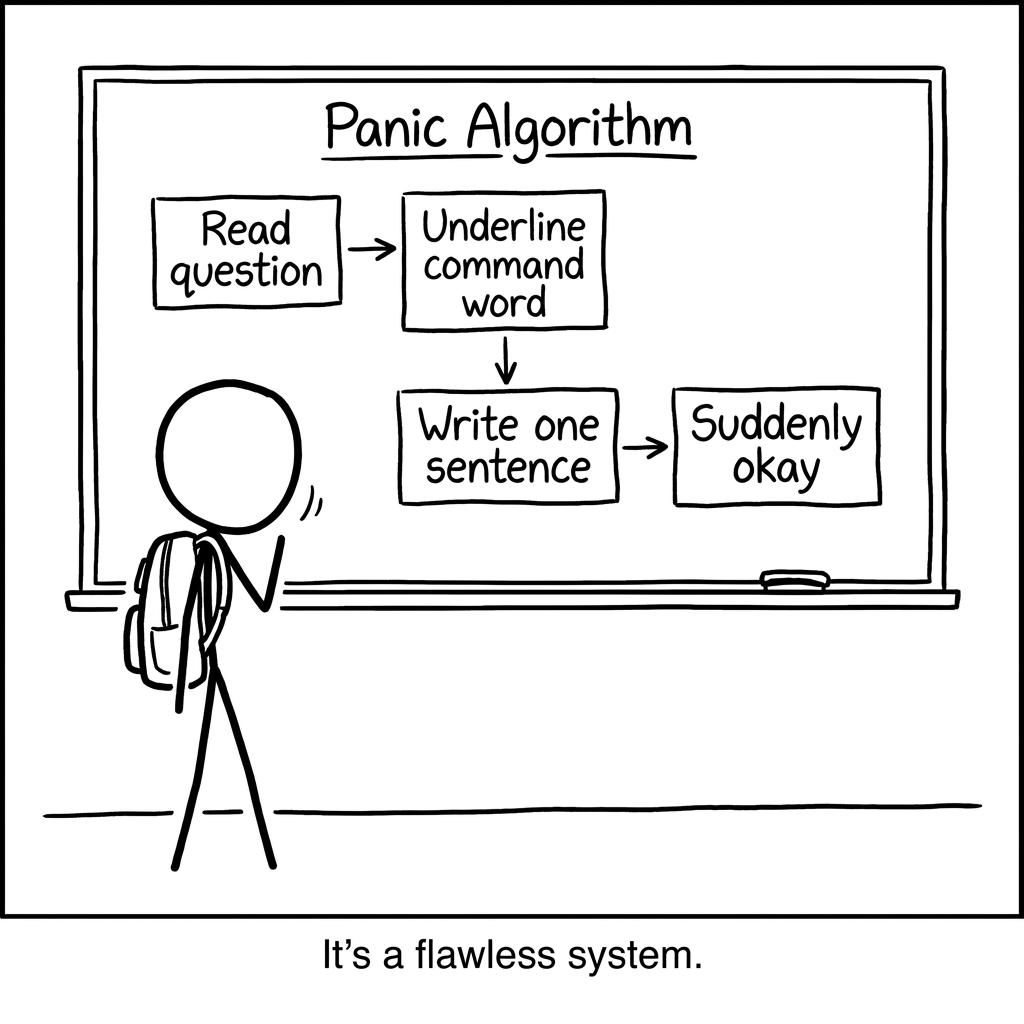 A flowchart labelled “Panic Algorithm” that ends with “Suddenly okay”
The calm revision split: English focus, maths maintenance
During GCSE exam week, you do not need a heroic schedule. You need a sustainable one.
The 60-30-15 approach (daily)
- 60 minutes English Language: one skill (Paper 1 reading, Paper 2 comparison, creative writing, transactional writing).
- 30 minutes recovery: walk, shower, food, anything that lowers stress.
- 15 minutes maths maintenance: one tiny, closed task.
The maths block works because it is small enough to do even when you are tired. Pick something self-contained:
- a short mini test
- a single topic lesson
- ten exam-style questions with a mark scheme check
Try these YesGenie routes:
- Edexcel GCSE Maths Mini Tests
- Edexcel GCSE Maths Revision Guides
- OCR GCSE Maths (topics and practice)
- Eduqas GCSE Maths Question Bank
A small maths worked example for exam week (because it builds confidence)
When English drains you, maths revision should be comforting: clear method, quick win.
Worked example: percentage change (common GCSE crossover skill)
A book costs £121212. It is reduced by 15%15\%15%. What is the new price?
Reduce by 15%15\%15% means keep 85%85\%85% of the original:
12×0.85=10.2 12 \times 0.85 = 10.2 12×0.85=10.2So the new price is £10.2010.2010.20.
If you are doing this without a calculator, use fractions:
15%=15100=320 15\% = \frac{15}{100} = \frac{3}{20} 15%=10015=203Reduction amount:
12×320=3620=1.8 12 \times \frac{3}{20} = \frac{36}{20} = 1.8 12×203=2036=1.8New price:
12−1.8=10.2 12 - 1.8 = 10.2 12−1.8=10.2Same answer, two routes. That is the feeling you want during GCSE week: steady, checkable, done.
The night-before checklist (English Language specific)
What to pack
- Black pens (at least two)
- Highlighter (optional, but useful for quick scanning)
- Water bottle
- Tissues
- Clear pencil case
What to decide
- Your pacing rule: “marks are minutes”.
- Your paragraph shape: one idea, evidence, method, effect, link to question.
- Your writing plan: 555 minutes plan, then write.
What not to do
- Do not rewrite full essays the night before.
- Do not learn new terminology lists at midnight.
- Do not “just check TikTok” for paper predictions and end up awake at 01:3001{:}3001:30.
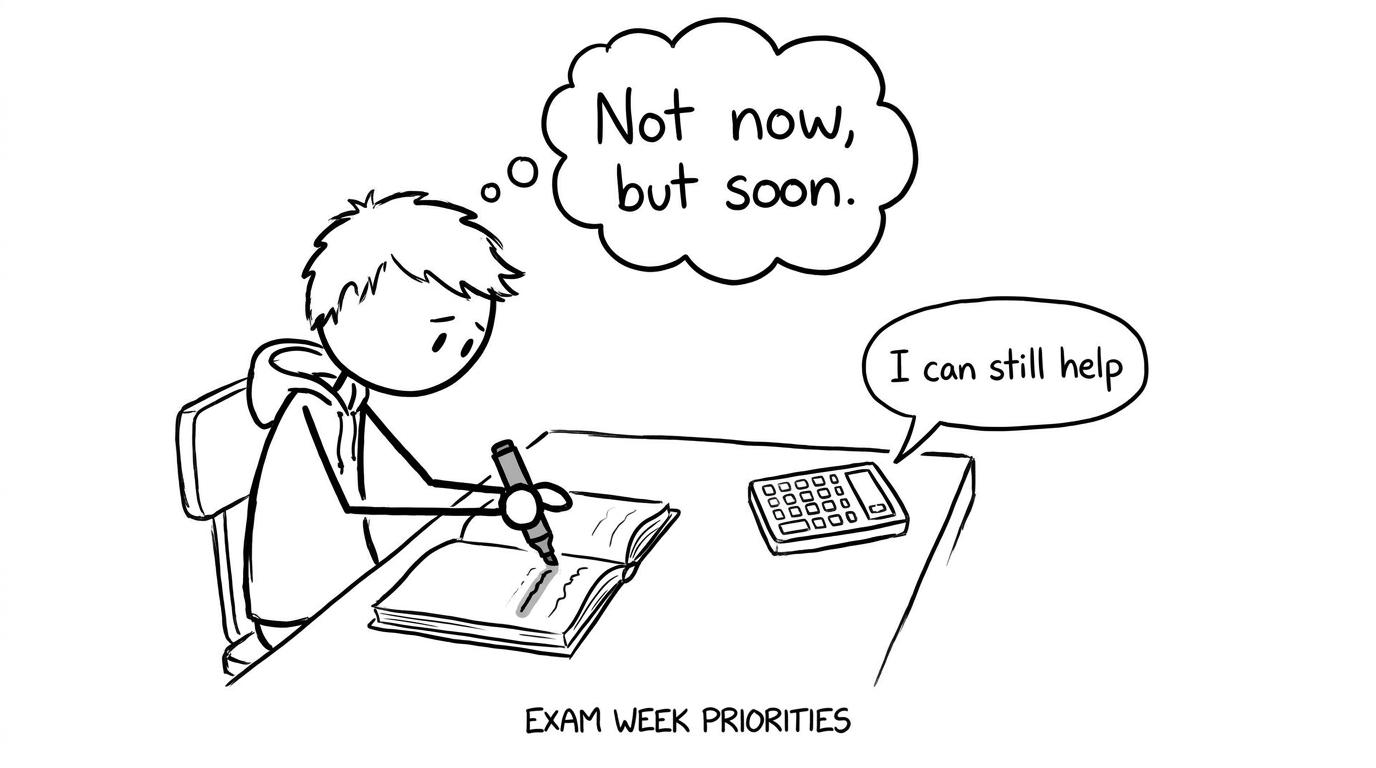 A student highlights a sentence while a calculator whispers “I can still help”
Common mistakes students make in GCSE English Language exam week
Over-revising the wrong thing
Students often practise the hardest question repeatedly and ignore the easy marks. In GCSE English Language, straightforward retrieval and inference can add up fast. If you drop 444 marks on small questions and chase them with a perfect creative writing piece, you still lose. Your checklist should protect the basics first. You want “reliable marks” before “impressive paragraphs”.
Timing by panic, not by marks
If you spend 181818 minutes on an 888-mark analysis question, it is rarely because your answer is improving. It is usually because you are trying to make it feel finished. GCSE papers reward coverage and clarity more than perfection. Put a hard stop on questions. Move on.
Memorising phrases instead of practising decisions
Stock phrases like “this makes the reader want to read on” rarely earn marks by themselves. What earns marks is selecting a quotation, naming a method, and explaining its effect in context. That is a decision-making skill, not a memory skill. Your checklist should include one short daily practice of choosing evidence quickly.
Letting English consume the whole week
This is the hidden one for maths students. After English, you feel “done”, so you avoid maths because it feels like another mountain. The fix is tiny: 151515 minutes, one topic, stop. Use GCSE Past papers or mini tests so the task is already defined.
A simple closing promise: make GCSE exam week boring
The best GCSE exam week does not feel dramatic. It feels repetitive: pack the same things, use the same five-minute ritual, pace by marks, and move on. English Language rewards students who can stay calm long enough to be clear.
And if you are a maths student juggling papers, keep the maths flame small but steady. Use YesGenie to make that easy: revision lessons when you need a method, mini tests when you need momentum, and GCSE Past papers when you need realism. Start with the Resources hub, choose one task for today, and let the checklist do the heavy lifting. Your GCSE results are built in ordinary minutes, not heroic nights.
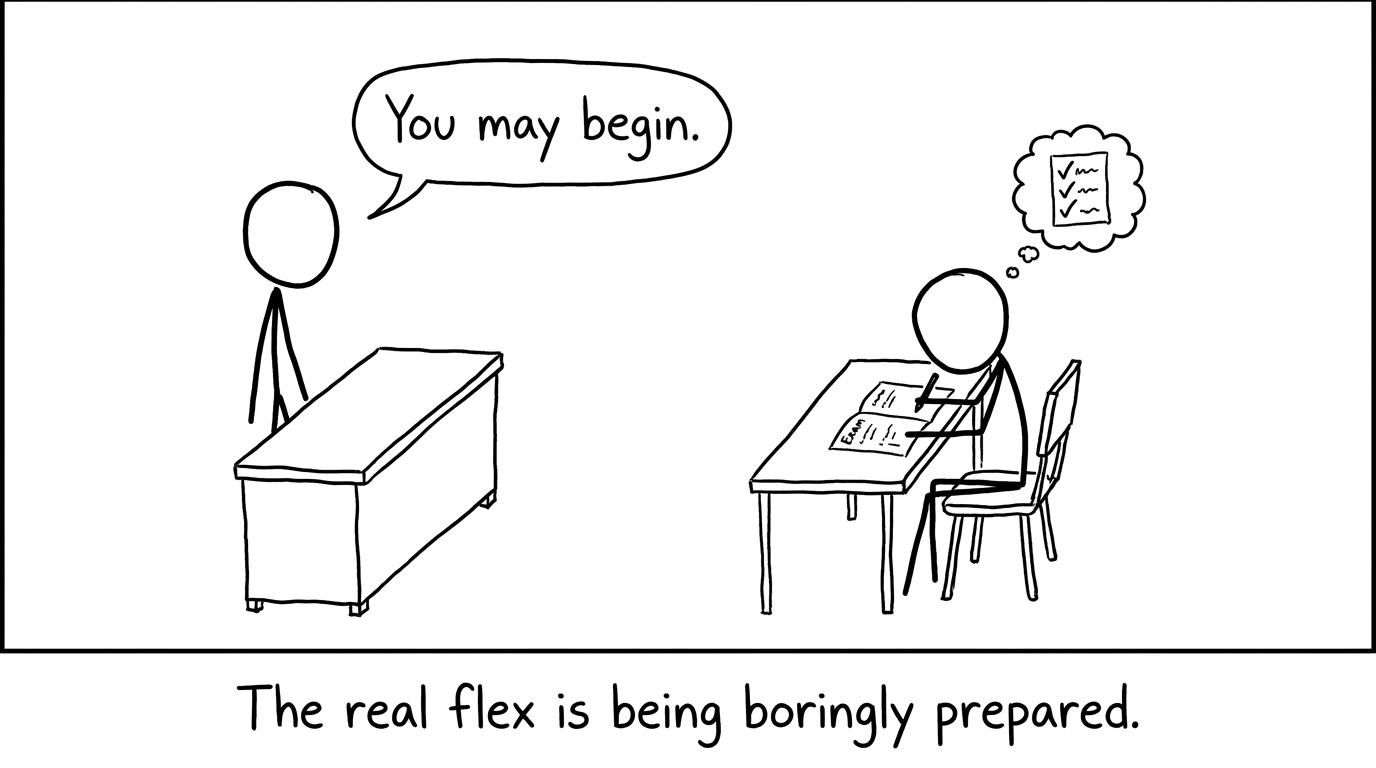 Exam hall: “The real flex is being boringly prepared.”