AI Tools to Revise GCSE English Literature
AI tools to revise GCSE English Literature can quiz, plan and challenge you. Learn where ChatGPT helps, where it misleads, and how to verify claims.
The blank page is often the hardest part of English Literature revision. You know the play. You recognise the characters. Yet when asked how the writer presents conflict, responsibility or power, every useful thought seems to disappear.
That explains the growing interest in using AI tools to revise GCSE English Literature. ChatGPT and similar tools can generate questions, test quotations, challenge interpretations and help organise a revision plan. But they can also invent quotations, flatten complex ideas and produce polished essays that teach you very little.
The short answer is yes: AI can help you revise. It should act as a questioning partner, not an author you copy or an authority you automatically trust.
Your quick AI revision checklist
Before using an AI tool, follow these rules:
- Decide on one precise task, such as testing quotation recall.
- Tell it your exam board, text and current topic.
- Keep your novel, play, anthology or trusted class notes beside you.
- Verify every quotation, plot detail and contextual claim.
- Write your own analysis before asking for feedback.
- Never submit AI-generated work as your own.
- Check your school’s AI policy and follow your teacher’s guidance.
- Finish with independent, timed writing away from the tool.
The principle is simple. Let AI create useful friction, questions, objections and retrieval prompts, but do not let it remove the thinking that the examination is designed to assess.
Where AI tools genuinely help with English Literature
Generating retrieval questions
AI is useful for turning material you already know to be accurate into short quizzes. You might provide a verified quotation list and ask for one-at-a-time questions about speaker, scene, theme or significance.
This is stronger than asking, “Tell me everything about the text.” Broad requests usually produce broad summaries. A focused quiz makes you retrieve knowledge, notice gaps and correct mistakes.
Ask the tool not to reveal the answer until you have responded. You can also request that it revisit missed questions later. That makes AI behave more like a stack of adaptable flashcards and less like an answer machine.
Challenging your interpretation
Literature rewards supported interpretation rather than a single secret reading. An AI tool can therefore play devil’s advocate. Give it an argument you have written yourself and ask:
- What assumption have I made?
- Which alternative interpretation could challenge this?
- What evidence would strengthen my claim?
- Have I analysed the writer’s choices or merely retold the plot?
The value lies in defending and refining your reasoning. If the tool supplies the interpretation first, it can feel impressive without becoming knowledge you can reproduce independently.
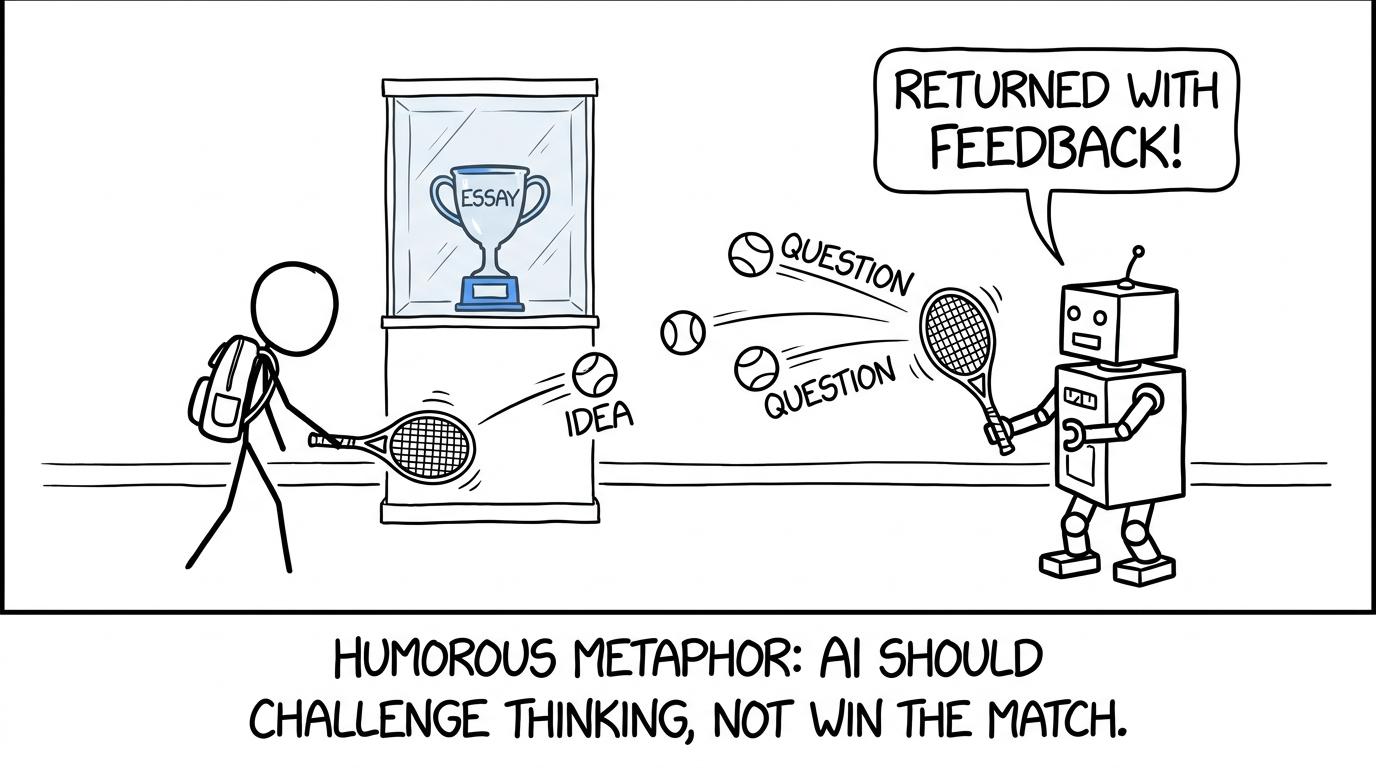 A student uses an AI robot as a practice partner rather than an essay-writing machine
Improving essay planning
AI can inspect a plan and identify imbalance. For example, it may notice that every paragraph discusses character while ignoring structure, or that contextual material has become detached from the text.
A useful process is:
- Read the question yourself.
- Create your thesis and paragraph sequence without assistance.
- Add the evidence you could recall in an examination.
- Ask AI to identify omissions or weak links.
- Revise the plan in your own words.
- Close the tool and write one paragraph independently.
This protects the part that matters most: deciding what you think.
Creating a manageable revision schedule
When English Literature sits beside GCSE maths, science and other subjects, the problem is often organisation rather than willingness. AI can divide a list of texts and themes across the available days, provided you give it realistic information about your timetable.
However, a schedule only matters if it leads to active work. Include quotation retrieval, essay plans, timed paragraphs and self-marking rather than vague instructions to “revise Macbeth”.
The same principle works in maths. MathsGenie’s guide to finding your weakest GCSE topics explains why evidence from mistakes is more useful than revising whatever feels comfortable. If you are balancing several subjects, the one-month GCSE maths revision plan can give the mathematical side of your timetable a dependable structure.
Where ChatGPT and other AI tools lead students astray
Invented or altered quotations
A language model predicts plausible language. It is not a searchable, perfect copy of your set text. That means it may change a word, combine two lines or confidently produce a quotation that does not exist.
In Literature, one altered word can damage the analysis built around it. Check quotations against the original text, your anthology or material supplied by your teacher. Never memorise a quotation simply because an AI tool presented it confidently.
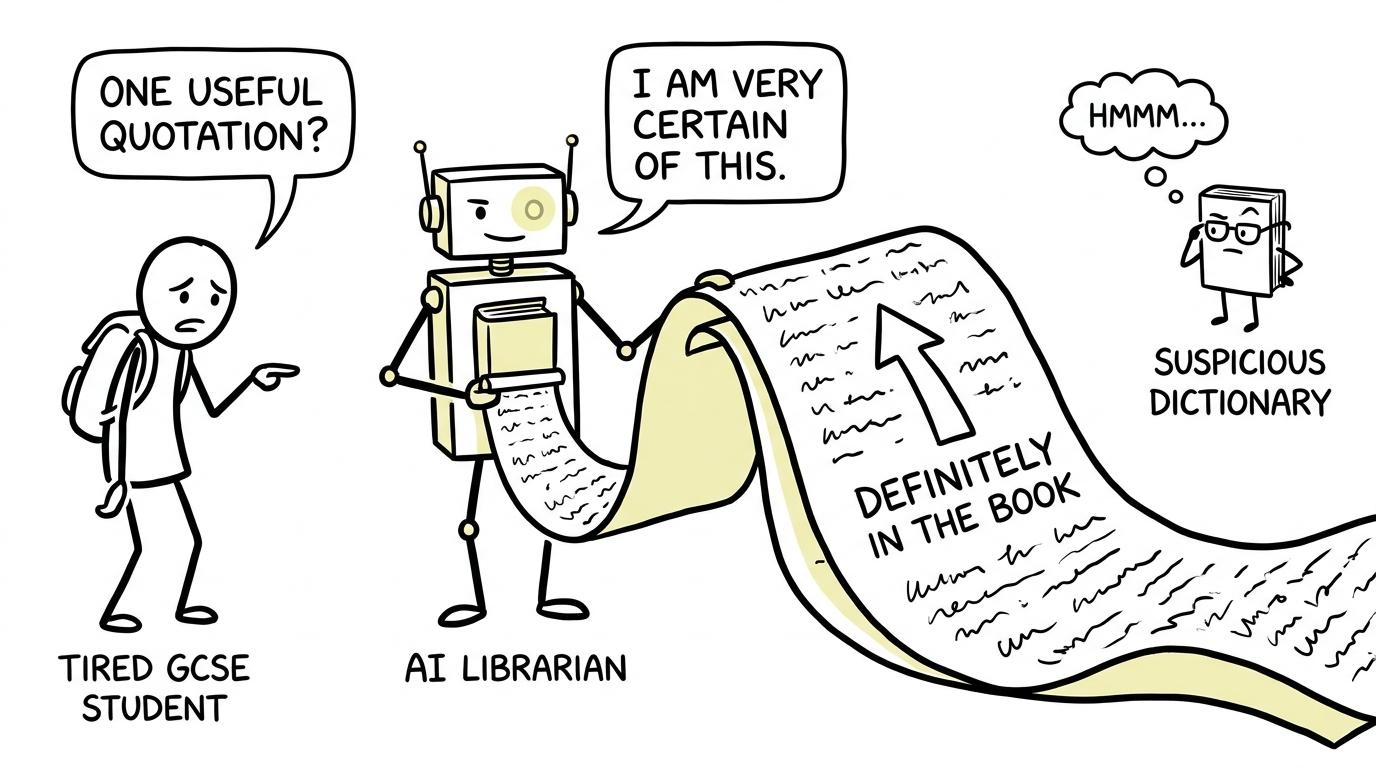 A robot librarian produces a suspiciously confident quotation while a dictionary looks unconvinced
Generic analysis
AI-generated analysis often sounds fluent while saying little. Phrases such as “this creates an effect on the reader” or “the writer uses powerful language” do not explain what the language suggests, how the method works or why it matters within the text.
GCSE English Literature assessment is shaped by your board’s specification. Across boards including AQA, Edexcel, OCR and Eduqas, relevant demands include responding to the text, supporting ideas with references, analysing language, form and structure, and understanding context where required. Exact paper structures and mark allocations differ, so use your own specification and teacher guidance.
An elegant AI paragraph is not automatically a high-mark response. It may neglect the question, misuse terminology or bolt historical context onto an argument without explaining its relevance.
False confidence about exam requirements
AI may confuse exam boards, texts or paper formats. It might tell an AQA student about an Edexcel requirement, assume the wrong anthology or describe arrangements from another qualification.
Always verify:
- your exam board;
- your set texts and poetry cluster;
- which assessment objectives apply;
- the paper structure and timings;
- what material is provided in the examination;
- where spelling, punctuation and grammar are assessed.
These details can change how you prepare. Your current specification, teacher and official exam-board material take priority over any chatbot response.
Replacing productive struggle
Reading a polished answer can create the feeling of progress. But recognition is easier than recall. In the examination, the chatbot will not be beside you to choose evidence, construct a thesis or recover an argument when the question is unfamiliar.
The strongest revision includes moments that feel difficult: recalling a quotation without looking, planning against a timer and writing an explanation that does not work on the first attempt. Difficulty is not always evidence of failure. Often, it is evidence that your memory is doing the work.
A safe method for using AI tools to revise GCSE English Literature
Start from verified material
Use your set text, teacher-approved notes, specification and mark schemes as the foundation. AI should work with that material rather than replace it. When accuracy matters, ask the tool to use only the information you provide and still check its response.
Use prompts that preserve your thinking
Strong prompts request a process rather than a finished product. Try instructions such as:
- “Ask me one question at a time about this verified quotation list.”
- “Do not rewrite my paragraph. Identify where my reasoning becomes unclear.”
- “Challenge my interpretation with two questions, but do not give me a model answer.”
- “Test whether my plan addresses the wording of the question.”
- “Create a mixed retrieval quiz using only the notes pasted below.”
Avoid asking for a complete essay to memorise. Even if it is accurate, it trains imitation rather than adaptable examination thinking.
Verify, correct and record
When AI makes an error, do not merely move on. Record the correction in a small error log. This turns an unreliable output into a useful lesson and makes you more alert to similar mistakes later.
Maths revision benefits from the same habit. The guide to using GCSE past papers properly shows how marking, logging errors and retesting create genuine improvement. You can apply that feedback loop to essay plans and quotation tests too.
End without AI
Every AI-assisted session should finish with an independent task. Close the tool and complete a timed plan, retrieval grid or paragraph from memory. Then compare your work with reliable notes or a mark scheme.
This final step tells you what you can actually do. It is the difference between borrowing an explanation and owning it.
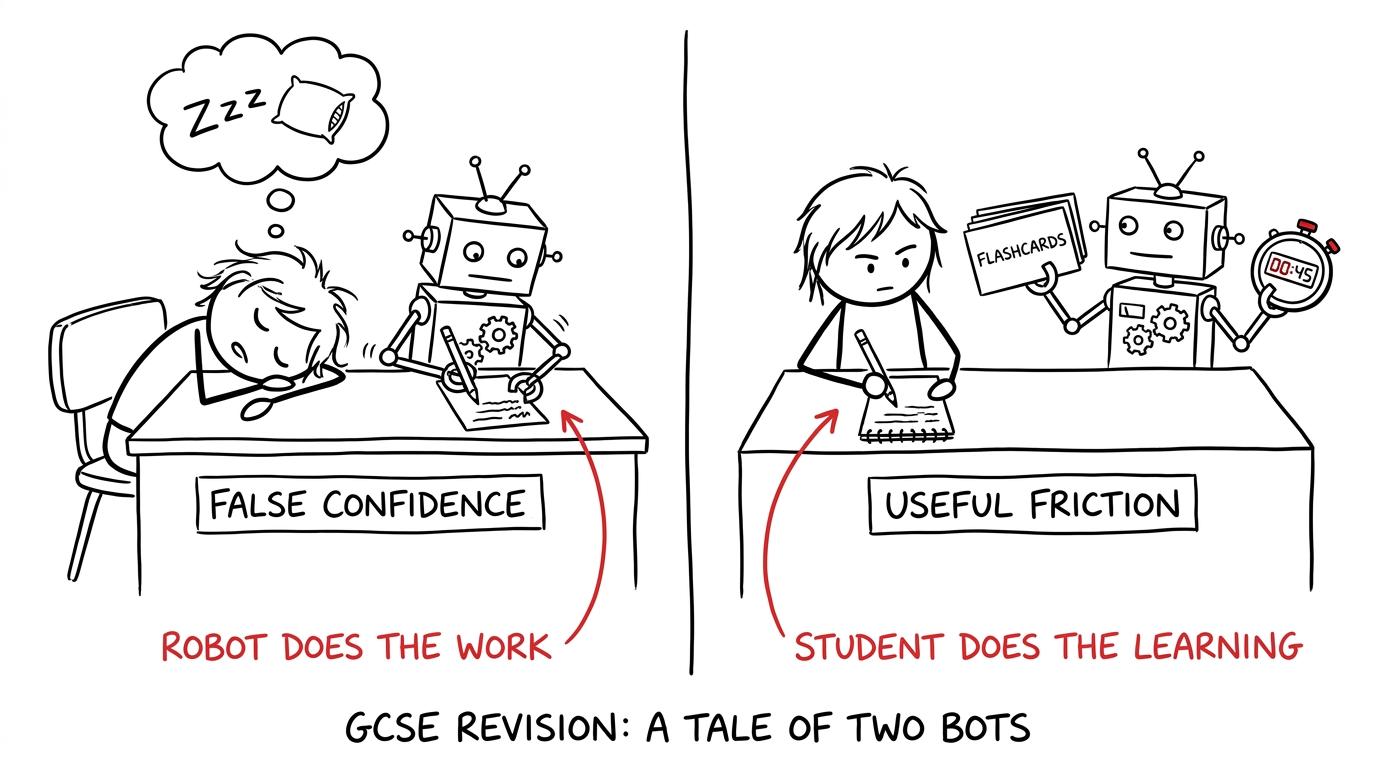 One student lets a robot do the work while another uses it to create useful revision friction
AI rules, plagiarism and assessed work
Current Joint Council for Qualifications guidance requires work submitted for assessment to be the student’s own. Copying or paraphrasing AI-generated material so that submitted work no longer reflects your independent work can constitute malpractice. AI use may also need to be acknowledged where assessment conditions permit it.
Most GCSE English Literature assessment for the major exam boards takes place through written examinations, where unauthorised internet access and AI tools are not available. The wider rule still matters for any assessed work: never present generated content as your own, and follow your school’s policy.
Ordinary revision is different from submitting assessed work, but good habits remain important. Keep control of your ideas, verify claims and ask your teacher if you are uncertain about acceptable use.
Common mistakes when revising with AI
Asking questions that are too broad
“Teach me the whole novel” encourages shallow coverage. Choose one character, relationship, theme, scene or assessment skill.
Trusting confident wording
Fluency is not proof. Check quotations, terminology, plot events, context and exam information independently.
Copying model paragraphs
Copying hides what you cannot yet do. Write first, then request questions or limited feedback rather than a replacement response.
Revising only through conversation
Chatting can feel active while avoiding sustained writing. Build regular timed plans and paragraphs into your routine.
Ignoring your actual exam board
Always name your board and text, then verify the response against your current specification. A useful answer for one course may be misleading for another.
Letting English revision displace maths practice
Students preparing for several GCSE examinations need subject-specific practice. AI can organise a timetable, but it cannot replace solving questions. Use the GCSE Maths revision hub for board-relevant lessons and questions, and the MathsGenie past-paper library for timed examination practice.
Build a revision system that works without the chatbot
AI is most useful when it gradually makes itself less necessary. It can prompt retrieval, expose a weak argument and help organise your next step. Your final preparation must still include reading, remembering, planning and writing independently.
Apply the same standard across your subjects. For maths, follow MathsGenie’s guide to efficient GCSE maths revision, use the GCSE maths topics by board and tier to check your coverage, and turn to the one-week maths revision plan when the examination is close.
Start your next session with one precise English Literature task. Use AI to test your thinking, verify every factual claim, and finish by writing alone. Then make MathsGenie your home for free maths revision lessons, practice questions, mini tests, past papers, predicted papers, mark schemes and video solutions. Tools are valuable. The marks, however, still come from what you can do without them.