Reflection, refraction and lenses

EasyMediumHard
123456789101112131415161718192021222324252627282930313233343536373839404142434445464748495051525354555657585960616263646566676869
Question 31
Easy

Figure 1 shows a ray diagram of an upright object placed in front of a thin converging lens, acting as a magnifying glass. The diagram is drawn on a grid where each grid square has a height and width of 1 cm.
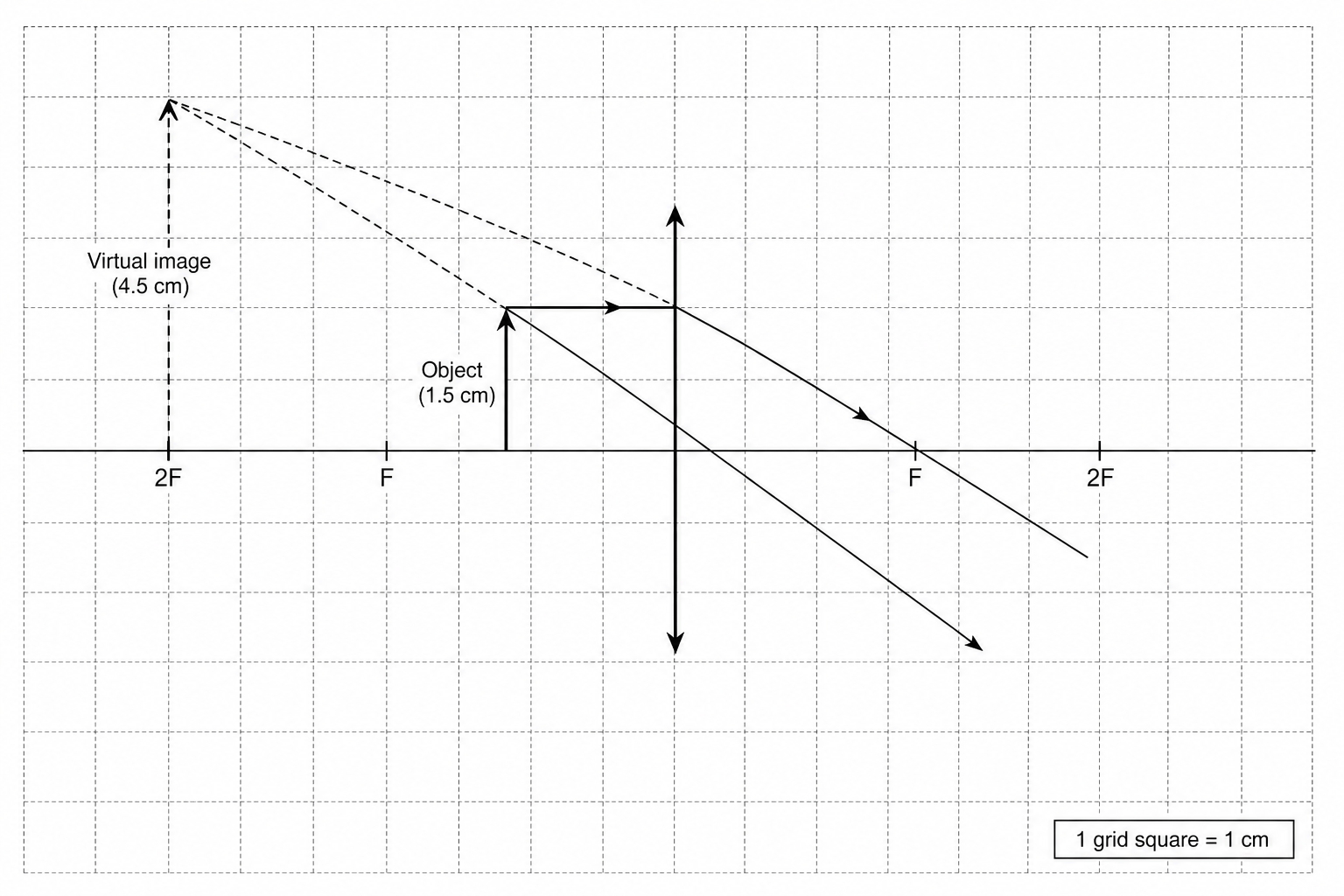
A ray diagram on a grid with 1 cm squares. A thin converging lens is represented vertically at the center. An upright solid arrow representing the object of height 1.5 cm is placed on the principal axis to the left of the lens. Two light rays trace from the top of the object through the lens: one enters parallel to the principal axis and refracts through the focal point on the right, and the other passes straight through the center of the lens. These rays are projected backwards as dashed lines to the left of the lens, where they intersect. At this intersection, a dashed arrow representing the virtual image is drawn with a height of 4.5 cm.

Using the information in Figure 1, determine the magnification of the virtual image.

Use the equation:

magnification=height of imageheight of object \text{magnification} = \frac{\text{height of image}}{\text{height of object}} magnification=height of objectheight of image​
[2]

Reflection, refraction and lenses Questions

  1. GCSE
  2. /Physics
  3. /Reflection, refraction and lenses