Question 2
FA student investigates what happens to light inside a semicircular glass block.
The Figure shows the apparatus.
Figure
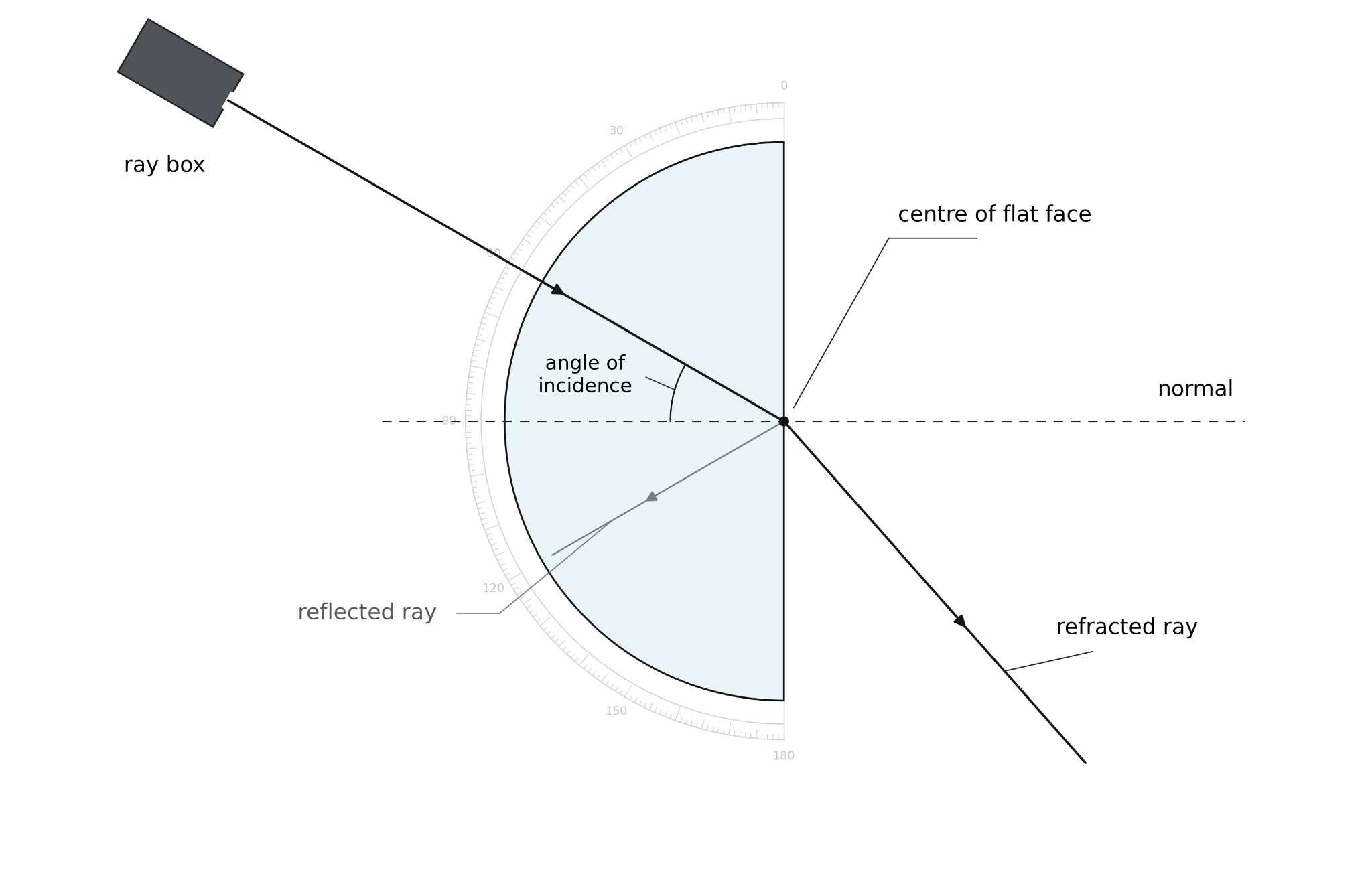
The student changes the angle of incidence at the flat face. The Table shows the results.
Table
| Angle of incidence in glass | Observation |
|---|---|
| 20∘20^{\circ}20∘ | bright refracted ray and faint reflected ray |
| 35∘35^{\circ}35∘ | refracted ray much further from the normal and reflected ray brighter |
| 42∘42^{\circ}42∘ | refracted ray travels along the flat face of the block |
| 55∘55^{\circ}55∘ | no refracted ray and very bright reflected ray |
a.[1]
Give the critical angle for this glass.
b.[1]
State what is meant by the critical angle.
c.[2]
Describe what happens to the ray when the angle of incidence is 55∘55^{\circ}55∘. Give the name of this effect.
d.[2]
Explain why the ray does not change direction as it enters the curved side of the block.
e.[2]
Another student says:
'Total internal reflection would also happen if a ray travelled from the air into the glass at an angle of incidence of 55∘55^{\circ}55∘.'
Explain why the student is wrong.
5.1 Reflection, refraction and lenses Questions
93 exam-style questions on Edexcel GCSE Physics 5.1 Reflection, refraction and lenses, covering 5.1.1 Reflection, refraction and total internal reflection, 5.1.2 Specular and diffuse reflection, 5.1.3 Colour of light: absorption and filters, 5.1.4 Lenses: power, focal length and shape, 5.1.5 Ray diagrams for converging and diverging lenses, and 5.1.6 Real and virtual images. Each one has a worked solution and a mark scheme showing where the marks go.