Moments, levers and gears

EasyMedium
12345678910111213141516171819202122232425262728293031323334353637383940
Question 11
Medium

A person holds a professional camera weighing 35 N in their hand, keeping their forearm horizontal.

Figure 1 shows the forces acting on the forearm and their horizontal distances from the elbow joint, which acts as the pivot.
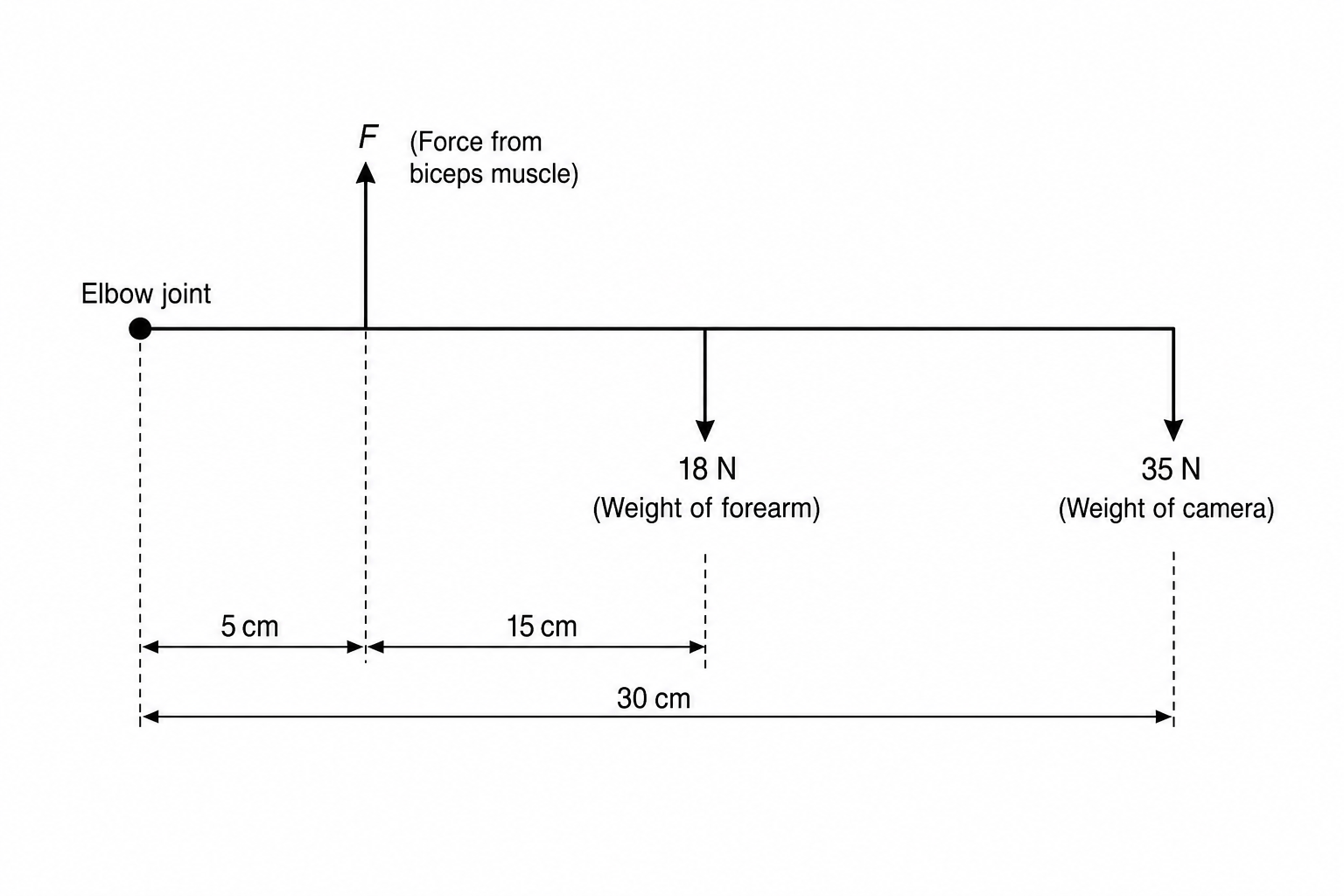
Figure 1: A simplified mechanical diagram of a forearm holding a camera. The pivot point, representing the elbow joint, is on the far left. A vertical upward arrow representing the 'Force from biceps muscle, F' is positioned 5 cm to the right of the pivot. A vertical downward arrow representing the 'Weight of forearm = 18 N' is positioned 15 cm to the right of the pivot. At the right-hand end of the forearm, a vertical downward arrow representing the 'Weight of camera = 35 N' is positioned 30 cm to the right of the pivot. All distances are measured horizontally from the pivot.

Calculate the upward force, FFF, exerted by the biceps muscle required to keep the forearm system in equilibrium.

[3]

Moments, levers and gears Questions

  1. GCSE
  2. /Physics
  3. /Moments, levers and gears