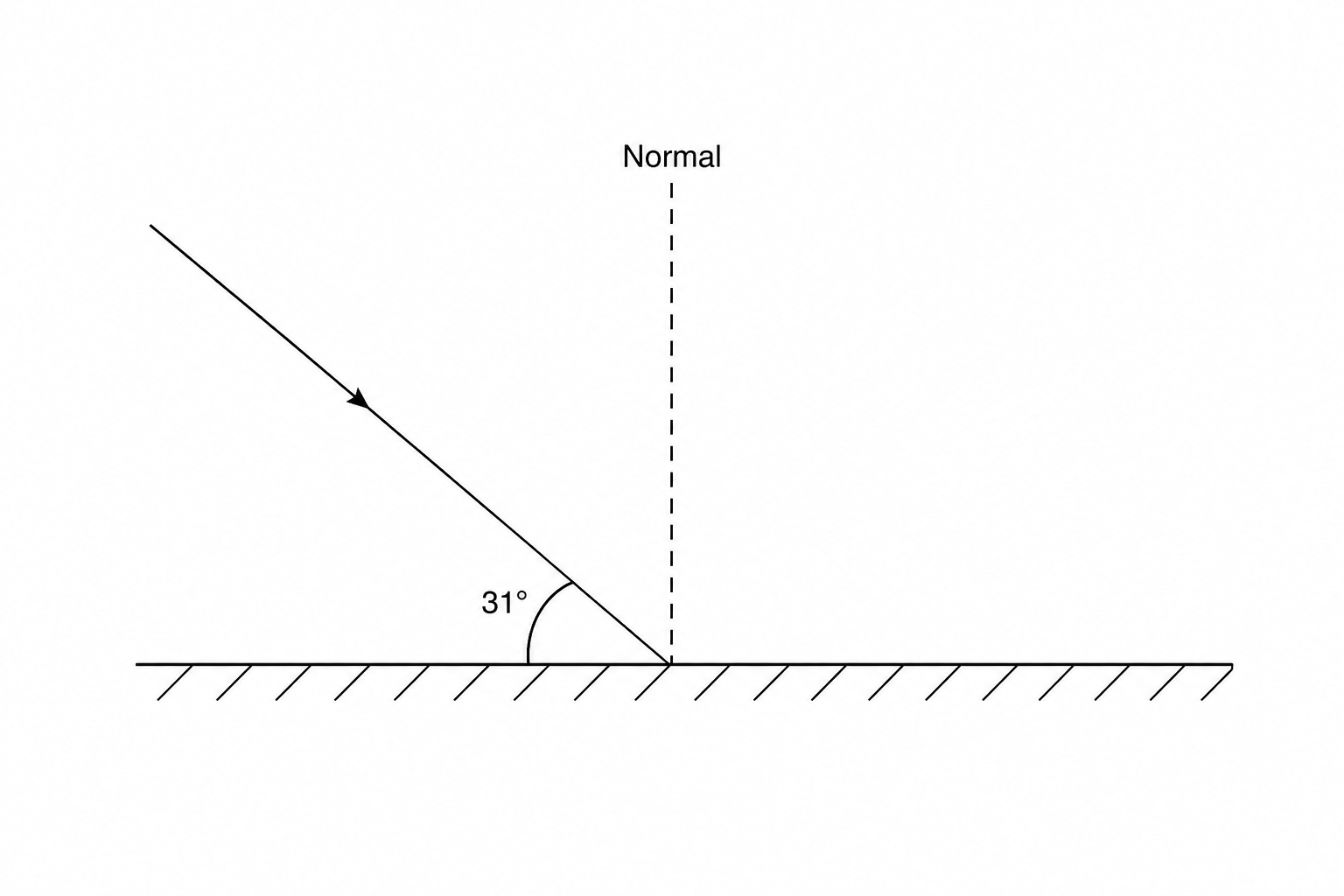
An optical technician is aligning a high-precision laser guidance system. To test the reflections off a front-surface plane mirror, they project an incident light ray as shown in the diagram below:
a.[2]
Calculate the angle of incidence of the light ray, showing your working.
b.[1]
Under the law of reflection, state the angle of reflection.
c.[2]
The technician compares two methods of producing the test light ray:
- Method P uses a white-light bulb with a collimating lens and a single slit, which produces a beam that spreads out (diverges) slightly over distance.
- Method Q uses a helium-neon laser diode, which produces an extremely narrow, collimated beam of light.
Explain two reasons why Method Q provides more accurate measurements of the reflection angles than Method P.