Waves in air, fluids and solids

EasyMedium
123456789101112131415161718192021222324252627282930313233343536373839
Question 29
Medium

An ultrasound transmitter and receiver probe is used to detect a hidden crack in a solid steel block as shown in the diagram.
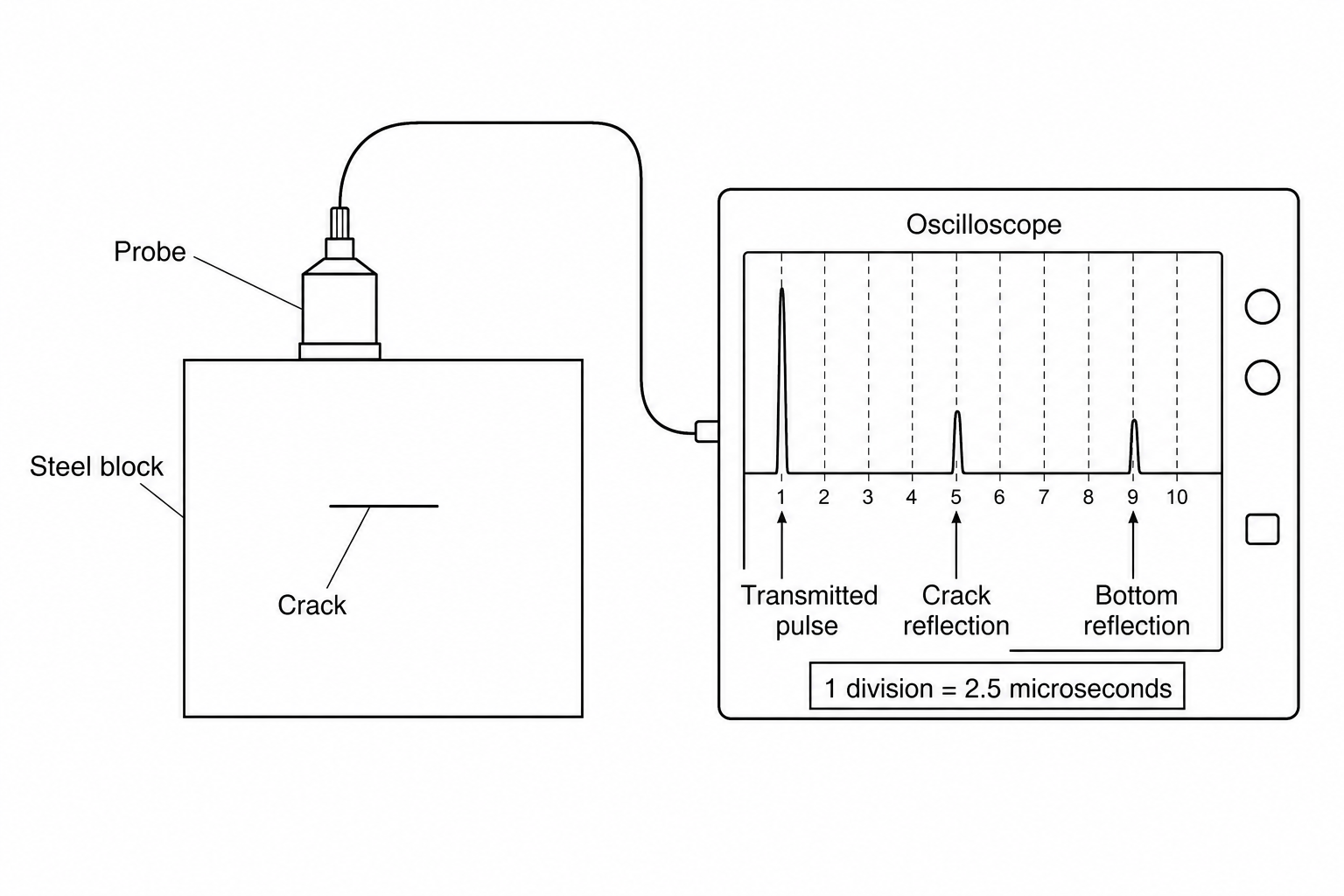
An ultrasound transmitter and receiver probe is placed on the top surface of a solid steel block containing a crack. A cable connects the probe to an oscilloscope. The oscilloscope screen displays a grid where 1 horizontal division represents 2.5 microseconds. On the screen, the transmitted pulse is shown as a sharp upward spike peak exactly on the 1st vertical grid line. Another smaller upward spike representing the reflection from the crack is shown exactly on the 5th vertical grid line, meaning they are separated by 4 grid divisions. There is also a third, smaller spike on the 9th grid line representing the bottom surface echo, but the focus is on the crack echo.

a.

Which of the following is the same as 2.5 microseconds (μs)2.5\text{ microseconds } (\mu\text{s})2.5 microseconds (μs)?

  • 2.5×10⁻³ s2.5 \times 10^{-3}\text{ s}2.5×10⁻³ s
  • 2.5×10⁻⁶ s2.5 \times 10^{-6}\text{ s}2.5×10⁻⁶ s
  • 2.5×10⁻⁹ s2.5 \times 10^{-9}\text{ s}2.5×10⁻⁹ s
  • 2.5×10⁻¹² s2.5 \times 10^{-12}\text{ s}2.5×10⁻¹² s
[1]
b.

Ultrasound travels at 5800 m/s5800\text{ m/s}5800 m/s in steel.

Determine the depth of the crack below the top surface of the steel.

Give your answer to two significant figures.

[4]

Waves in air, fluids and solids Questions

  1. GCSE
  2. /Physics
  3. /Waves in air, fluids and solids