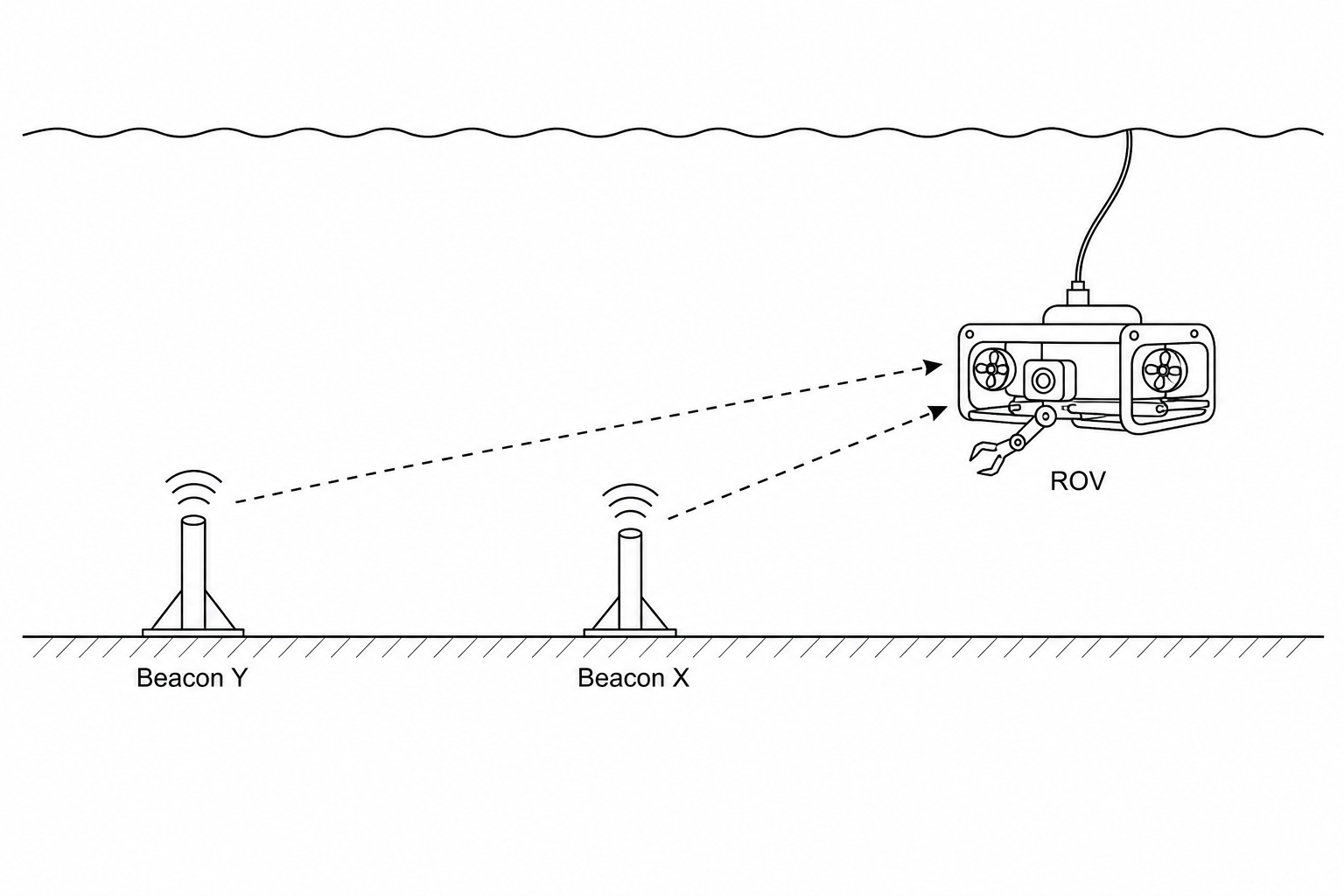
An underwater research station uses two acoustic positioning beacons, Beacon X and Beacon Y, to transmit ultrasonic positioning pulses to a submerged robotic drone (ROV). Beacon X is situated closer to the ROV than Beacon Y, as illustrated in the schematic below.
An ultrasonic calibration pulse transmitted by the beacons has a frequency of 25.0 kHz25.0\text{ kHz}25.0 kHz.
Convert this frequency into hertz (Hz\text{Hz}Hz).
Calculate the period of this acoustic wave.
Calculate the wavelength of an acoustic wave with a frequency of 37 500 Hz37\,500\text{ Hz}37500 Hz when the speed of sound in seawater is 1500 m/s1500\text{ m/s}1500 m/s. State the correct unit for wavelength.
Write down the equation that links distance (sss), speed (vvv), and time (ttt).
Calculate the time taken for the pulse to travel from Beacon X to the ROV over a distance of 75.0 m75.0\text{ m}75.0 m where the speed of sound in seawater is 1500 m/s1500\text{ m/s}1500 m/s.
The acoustic pulses from both Beacon X and Beacon Y travel at the same speed of 1500 m/s1500\text{ m/s}1500 m/s. Explain why the pulse from Beacon Y must be transmitted slightly before the pulse from Beacon X for the ROV to receive them at the exact same instant.