An oceanographer is monitoring swell waves passing two research buoys anchored at a fixed distance d d\,d apart in the open sea.
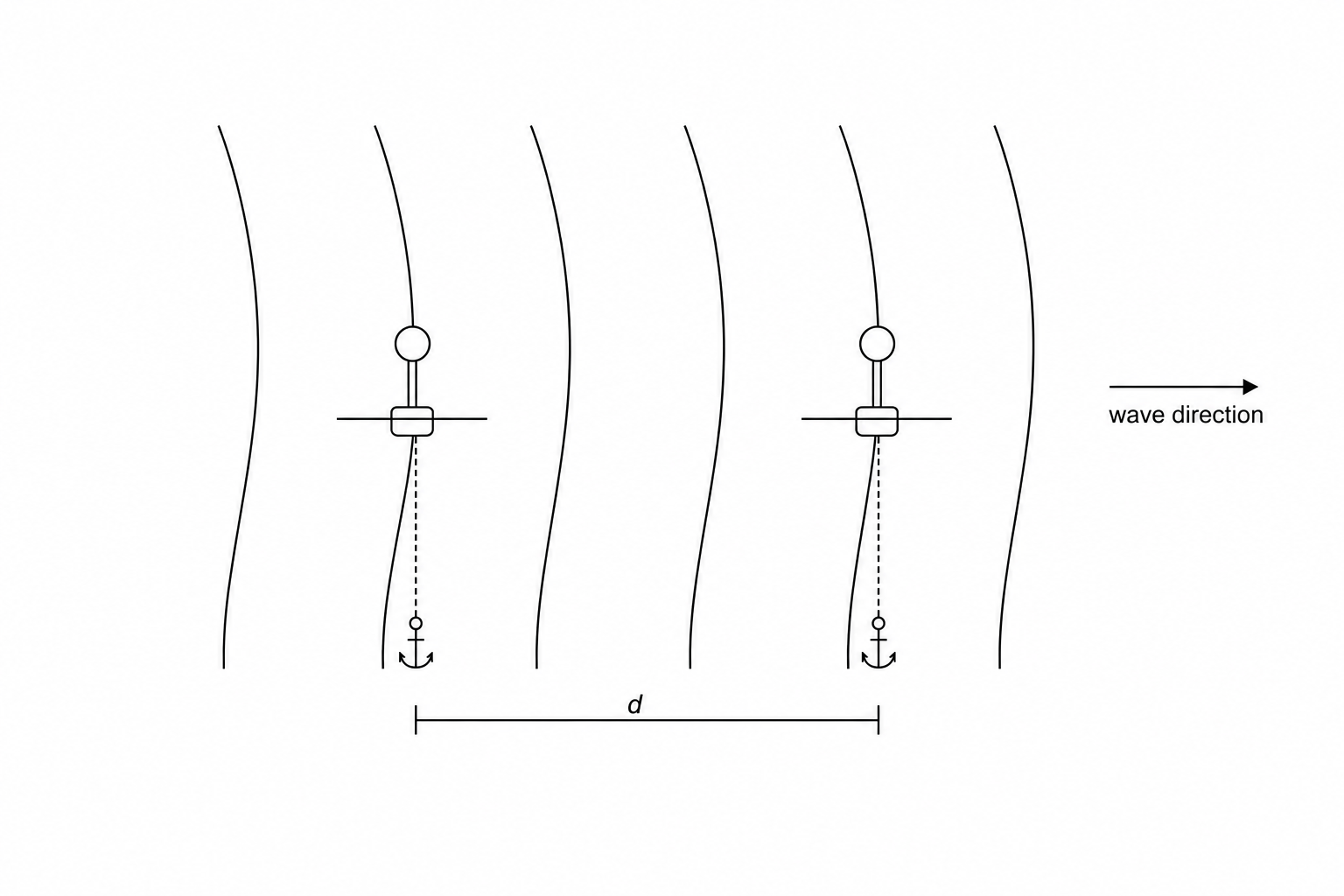
The researcher first measures the time taken for 18 wave crests to pass the first buoy. They repeat this measurement three times and calculate a mean. State the scientific advantage of repeating these measurements and calculating a mean.
The researcher's three measurements for the time taken for 18 wave crests to pass the first buoy are: 32.4 s,34.1 s,31.9 s32.4\text{ s}, \quad 34.1\text{ s}, \quad 31.9\text{ s}32.4 s,34.1 s,31.9 s Calculate the mean frequency of the waves. Give your final answer to 2 significant figures.
In the next part of the investigation, the researcher wants to determine the speed of the waves. The researcher does not measure the wavelength of the waves. Using the setup shown in the diagram, explain how the researcher could determine the speed of the waves.