Waves in air, fluids and solids

EasyMedium
123456789101112131415161718192021222324252627282930313233343536373839
Question 13
Medium

An experiment was carried out to investigate how the speed of water waves in a channel is affected by the depth of the water. The results are shown in the graph below.
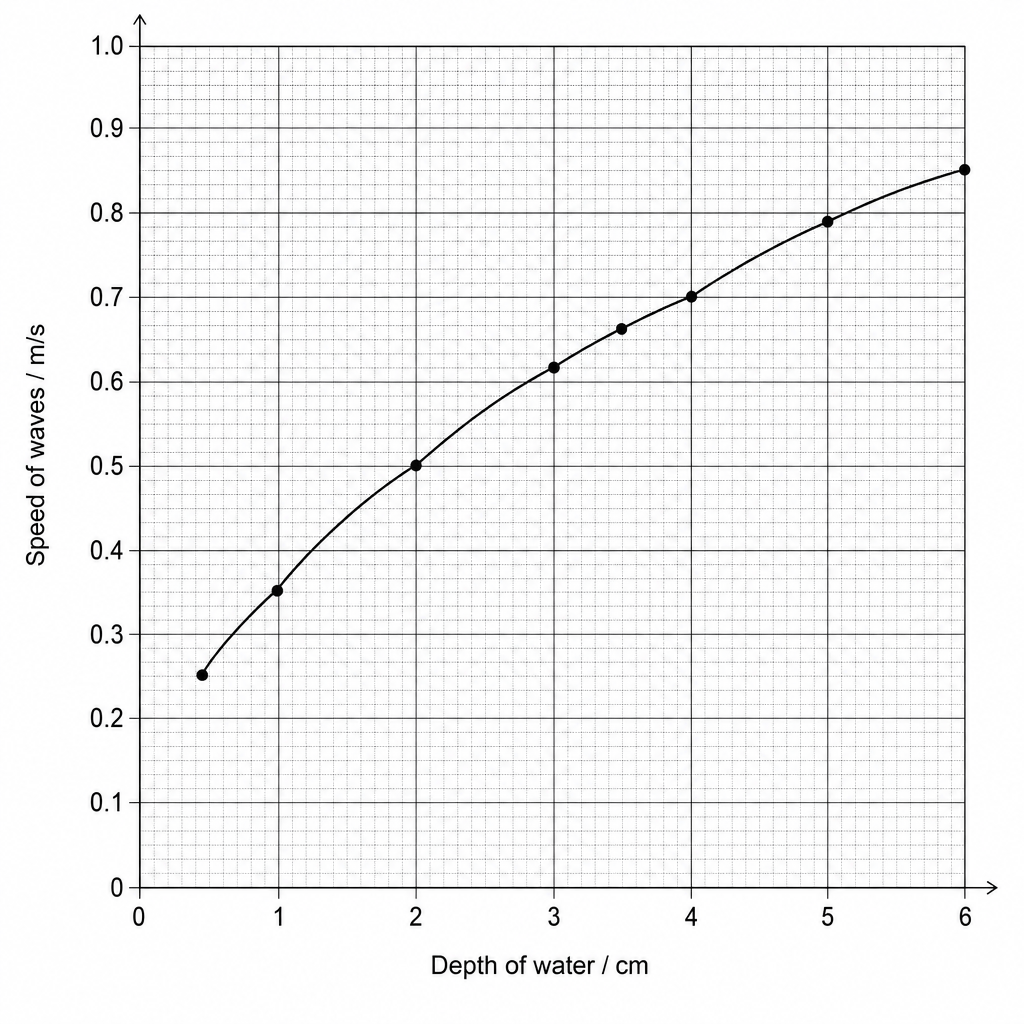
A line graph showing wave speed on the vertical y-axis against water depth on the horizontal x-axis. The y-axis is labeled 'Speed of waves in metres per second' and ranges from 0 to 1.0 m/s with major grid lines every 0.1 m/s and minor grid lines every 0.02 m/s. The x-axis is labeled 'Depth of water in centimetres' and ranges from 0 to 6 cm with major grid lines every 1 cm and minor grid lines every 0.1 cm. A smooth, upward curving line starts at (0.5, 0.25) and passes through the points: (1.0, 0.35), (2.0, 0.50), (3.0, 0.61), (3.5, 0.66), (4.0, 0.70), (5.0, 0.78), and (6.0, 0.85).

a.

State the relationship shown by the graph between the depth of water and the speed of the wave.

[1]
b.

Determine the speed of the wave when the depth of the water is 3.5 cm3.5\text{ cm}3.5 cm.

[1]
c.

The frequency of the wave generator is 5.0 Hz5.0\text{ Hz}5.0 Hz. Calculate the wavelength of the wave when the water depth is 3.5 cm3.5\text{ cm}3.5 cm. Use the equation: wave speed=frequency×wavelength\text{wave speed} = \text{frequency} \times \text{wavelength}wave speed=frequency×wavelength

[2]

Waves in air, fluids and solids Questions

  1. GCSE
  2. /Physics
  3. /Waves in air, fluids and solids