Waves in air, fluids and solids

EasyMedium
123456789101112131415161718192021222324252627282930313233343536373839
Question 32
Medium

An acoustic experiment is set up to study how sound waves behave when they cross thermal boundaries in a gas.

A transmitter produces plane sound waves in a chamber. The wavefronts are shown in the figures below.
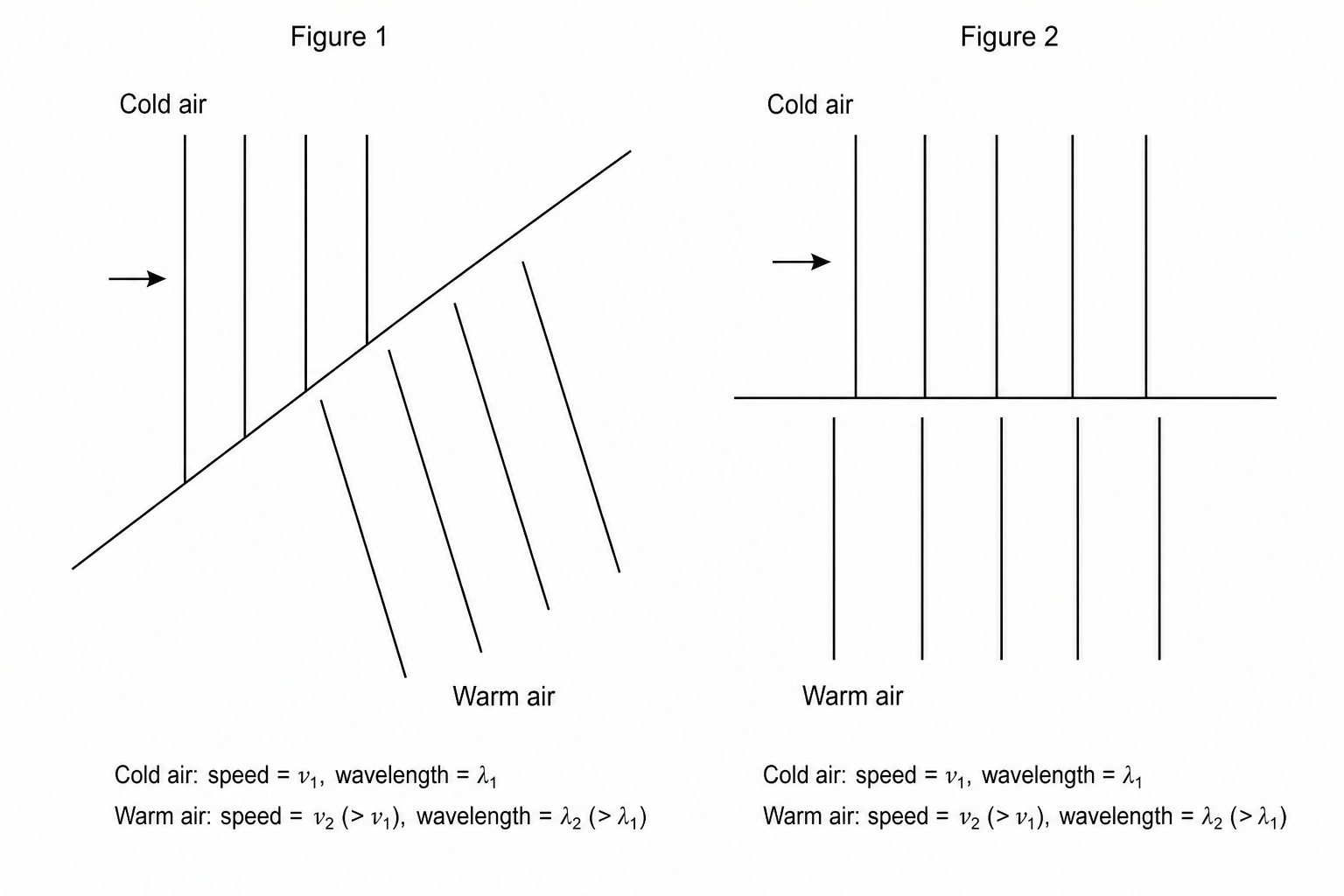
A side-by-side diagram showing sound wave refraction across a thermal boundary. In Figure 1, parallel wavefronts in cold air approach a diagonal boundary with warm air and refract (bend) as they enter the warm air. In Figure 2, the parallel wavefronts approach the boundary at normal incidence and do not bend, though their speed still increases.

a.

Explain why refraction (a change in direction of the wavefronts) occurs at the boundary in Figure 1 as the sound waves travel from the cold air into the warm air.

[3]
b.

Explain why the wavefronts in Figure 2 do not refract (change direction) when they cross the boundary, even though their speed changes.

[2]

Waves in air, fluids and solids Questions

  1. GCSE
  2. /Physics
  3. /Waves in air, fluids and solids