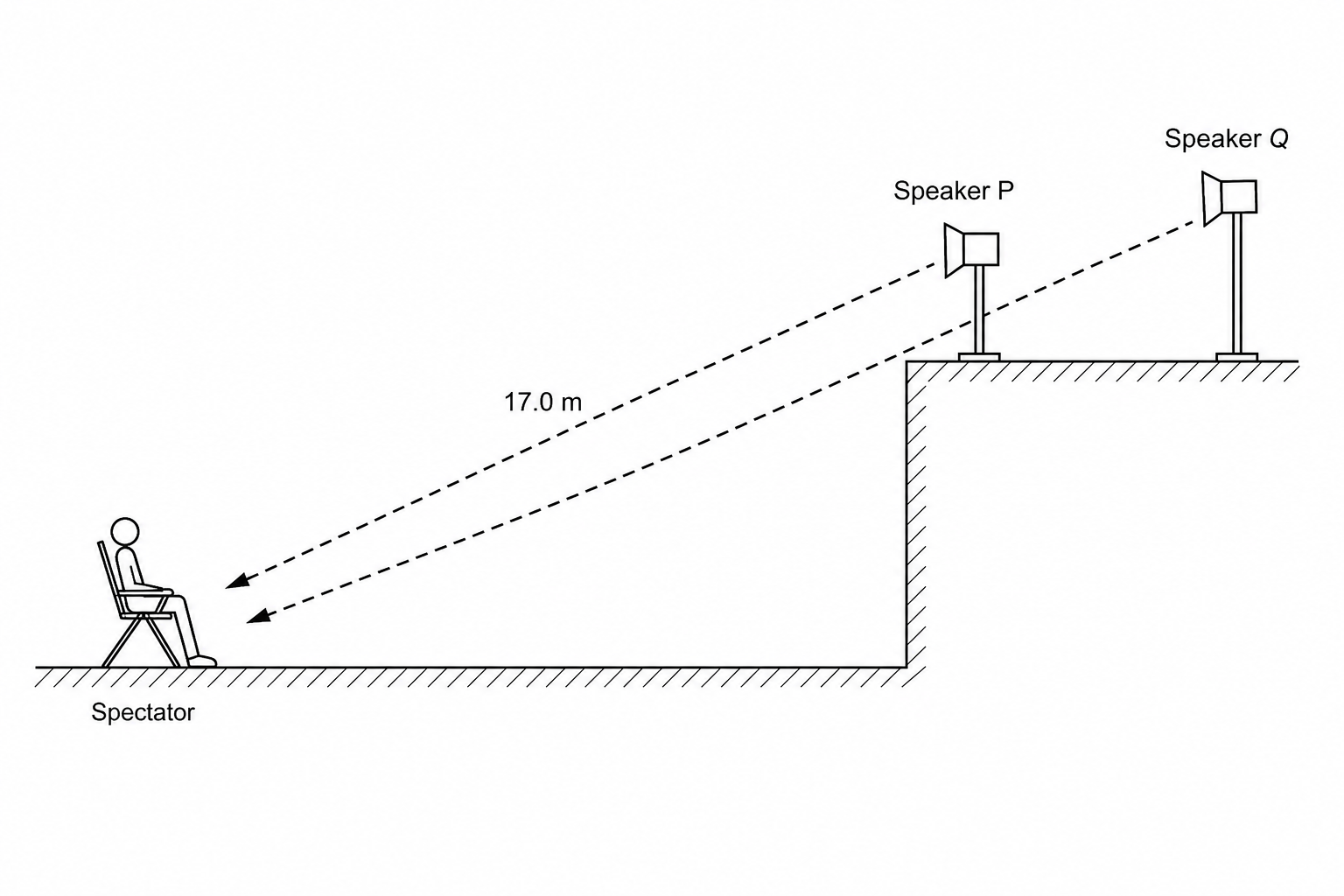
An outdoor cinema setup has two main loudspeakers, Speaker P and Speaker Q, broadcasting sound to a spectator. Speaker P is closer to the spectator than Speaker Q, as shown in the diagram.
A particular sound tone played by the speakers has a frequency of 5.0 kHz5.0\text{ kHz}5.0 kHz.
Convert this frequency into hertz (Hz\text{Hz}Hz).
Calculate the period of this sound wave.
Calculate the wavelength of a sound wave with a frequency of 4250 Hz4250\text{ Hz}4250 Hz when the speed of sound is 340 m/s340\text{ m/s}340 m/s. State the correct unit for wavelength.
Write down the equation that links distance (sss), speed (vvv), and time (ttt).
Calculate the time taken for the sound to travel from Speaker P to the spectator over a distance of 17.0 m17.0\text{ m}17.0 m where the speed of sound is 340 m/s340\text{ m/s}340 m/s.
The sound from both Speaker P and Speaker Q travels at the same speed of 340 m/s340\text{ m/s}340 m/s. Explain why the sound from Speaker Q must be emitted slightly before the sound from Speaker P for the spectator to hear a single, synchronized sound.