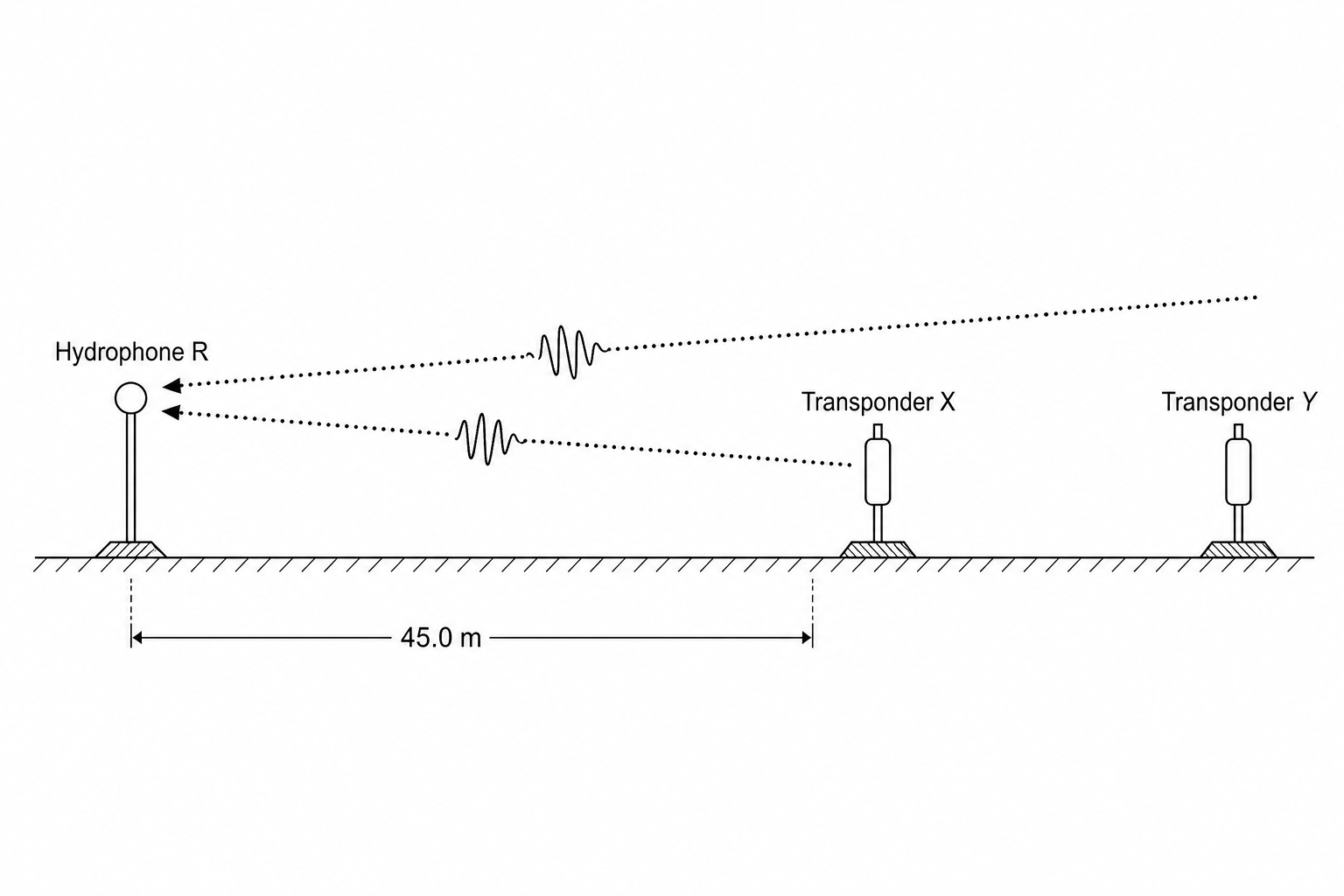
An underwater marine survey setup uses a hydrophone receiver R R\,R to monitor signals from two acoustic transmitters, Transponder X X\,X and Transponder YYY, anchored on the seabed. Transponder X X\,X is closer to the hydrophone than Transponder YYY, as shown in the diagram.
A particular sonar beacon tone transmitted by the transponders has a frequency of 8.0 kHz8.0\text{ kHz}8.0 kHz.
Convert this frequency into hertz (Hz\text{Hz}Hz).
Calculate the period of this sound wave.
Calculate the wavelength of an acoustic wave with a frequency of 6000 Hz6000\text{ Hz}6000 Hz when the speed of sound in seawater is 1500 m/s1500\text{ m/s}1500 m/s. State the correct unit for wavelength.
Write down the equation that links distance (sss), speed (vvv), and time (ttt).
Calculate the time taken for the acoustic signal to travel from Transponder X to Hydrophone R over a distance of 45.0 m45.0\text{ m}45.0 m where the speed of sound in seawater is 1500 m/s1500\text{ m/s}1500 m/s.
The acoustic signals from both Transponder X and Transponder Y travel at the same speed of 1500 m/s1500\text{ m/s}1500 m/s. Explain why the signal from Transponder Y must be emitted slightly before the signal from Transponder X for the hydrophone to detect both signals simultaneously.