Waves in air, fluids and solids

EasyMedium
123456789101112131415161718192021222324252627282930313233343536373839
Question 27
Medium

An apparatus shown below is used to investigate waves in a stretched string.
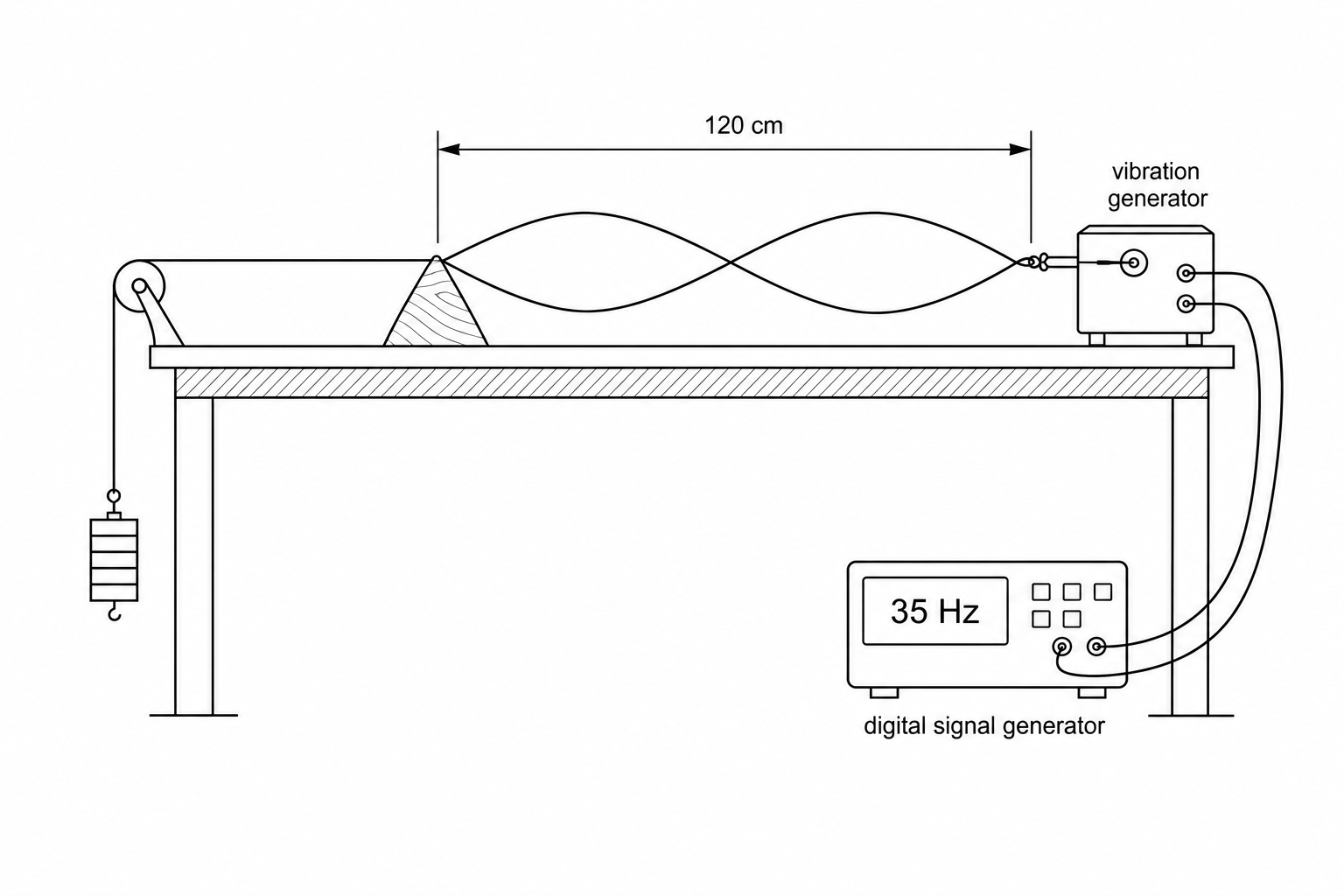
A diagram of the apparatus used to investigate the waves in a stretched string. On a horizontal table, a string is stretched. One end of the string is attached to a vibration generator which is connected to a signal generator showing 35 Hz. The string passes over a movable wooden bridge, then over a pulley at the left edge of the table, and has masses suspended from its end. Between the wooden bridge and the vibration generator, the string forms a stationary wave showing one complete wavelength (one crest and one trough). A double-headed horizontal arrow above this section indicates a distance of 120 cm.

a.

The wavelength of the wave shown in the diagram is measured as 120 cm120\text{ cm}120 cm. State what piece of apparatus is suitable for measuring this wavelength.

[1]
b.

Write down the equation that links frequency, wavelength, and wave speed.

[1]
c.

The string in the diagram vibrates at 35 Hz35\text{ Hz}35 Hz. Calculate the wave speed of this wave. Show your working.

[3]
d.

The frequency of the signal generator is now decreased. This changes the wavelength of the wave, while the wave speed remains constant. Describe how the wooden bridge could be adjusted to show exactly one complete wave without changing the frequency back.

[2]
e.

A student wants to investigate how the wavelength of a stationary wave on a stretched string depends on the frequency of the wave. Describe a method the student could use for this investigation.

[4]

Waves in air, fluids and solids Questions

  1. GCSE
  2. /Physics
  3. /Waves in air, fluids and solids